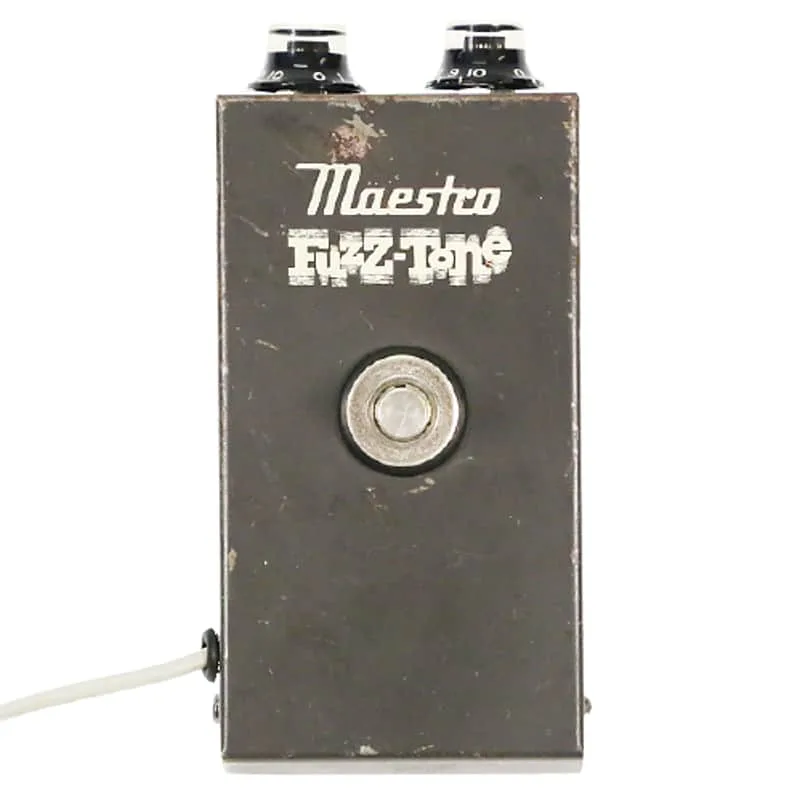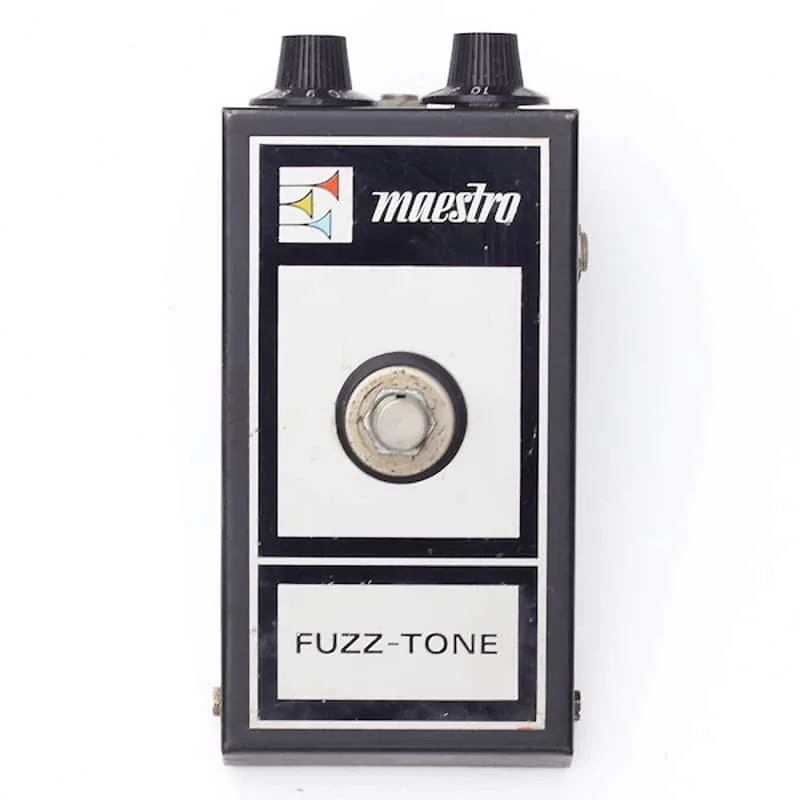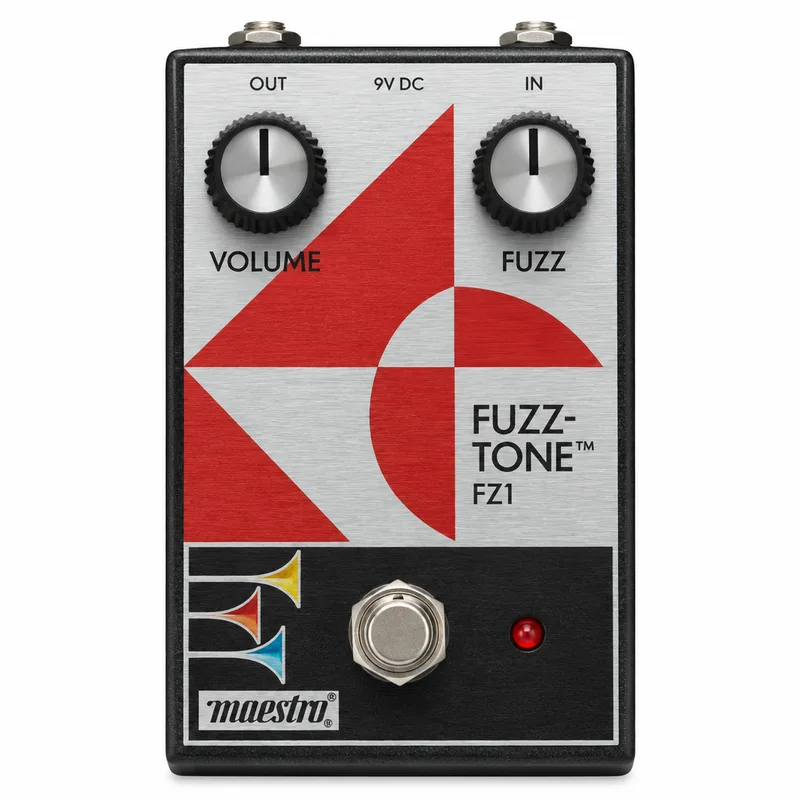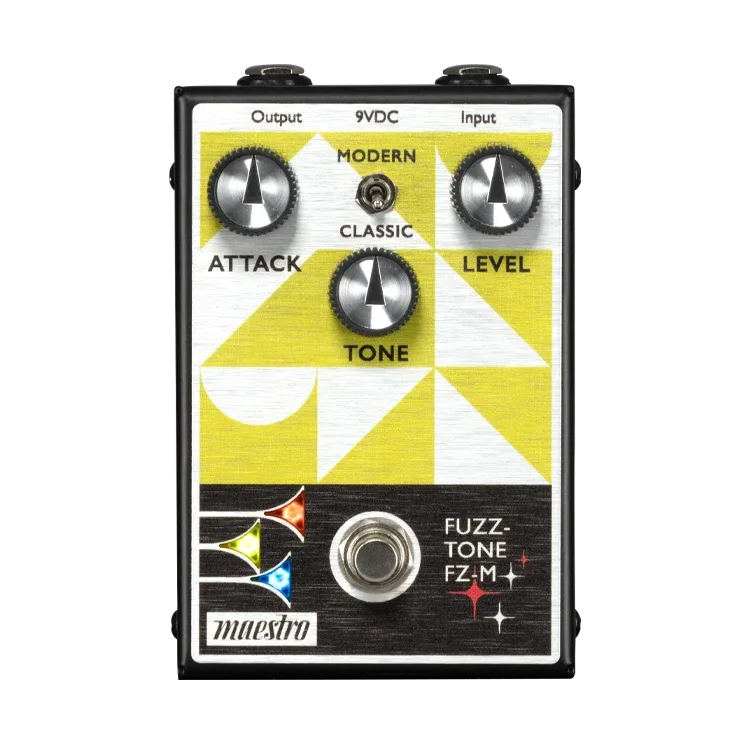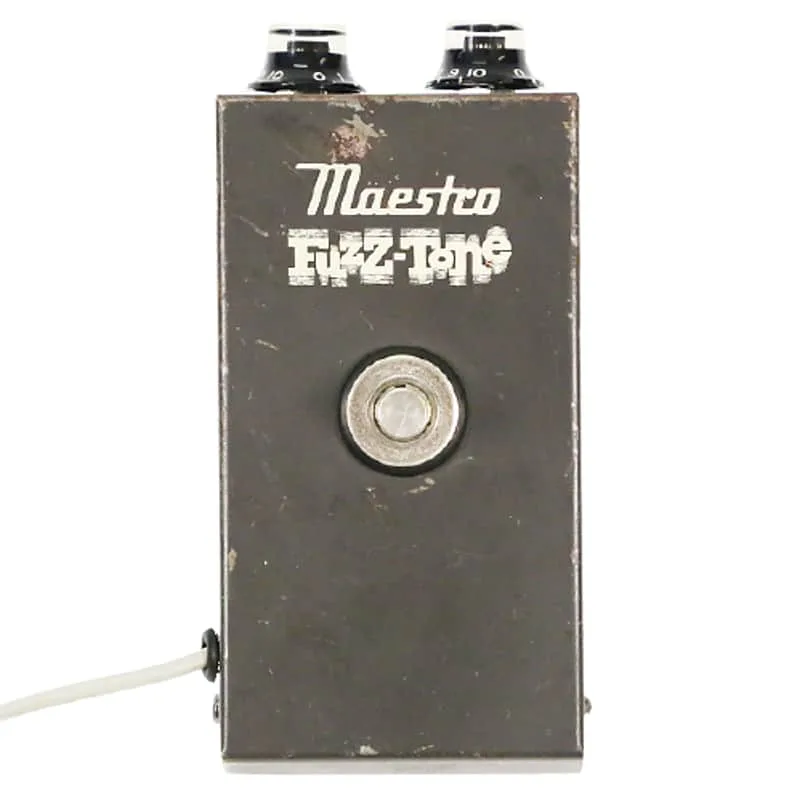


The Maestro Fuzz Tone FZ-1A is a vintage germanium fuzz pedal from Maestro, the pedal brand owned by Gibson. Gibson released the FZ-1A in late 1965 as a follow-up to the original FZ-1, and the two used largely the same circuitry with three germanium transistors1. It belongs to the same family as the Maestro FZ-1 Fuzz-Tone and the later Maestro Fuzz-Tone FZ-1B, and sits at the root of the fuzz pedal family tree.
Power: 1.5 volts from an AA cell
The FZ-1A is unusual among pedals in that it runs from a single AA battery, so 1.5 volts only, not the 9 volts modern players are used to23. Because the circuit uses PNP transistors, the supply is negative polarity: the battery's negative terminal goes to ground and the positive terminal to the negative 1.5 volt rail3.
The 1.5V negative-polarity supply means the FZ-1A cannot be dropped onto a standard pedalboard daisy chain without some kind of step-down or regulation. Builders should also note that the attack control is a bias control which may alter the current draw, so a fixed-current assumption may not hold3.
Transistors and build notes
The original circuit uses three germanium transistors1. For anyone building a replica, the builder behind the Guitar FX Layouts layout notes that PNP transistors with a little leakage work best, and a build verified with SFT323 transistors, devices with about 200 hfe and a lot of leakage3. One working build close to an original FZ-1A measured:
| Transistor | hfe | Leakage |
|---|---|---|
| Q1 | 56 | 100 uA |
| Q2 | 100 | 320 uA |
| Q3 | 85 | 150 uA |
The signal path uses two 1uF capacitors, and any type of 1uF capacitor will work there, electrolytics not required3. The attack control is worth understanding before you turn it: it is a bias control, which may alter the circuit's current draw, rather than a straightforward fuzz amount knob3.
How it sounds and what reviewers found
The most detailed published impressions come from the Guitar FX Layouts builder, who owned an original FZ-1A3:
"My crusty old FZ-1A isn't really gated at all. In fact it, can be a little noisy when it's hot."
He described it as dynamic and responsive to pick attack and fingerpicking, and said he prefers to use his FZ-1A with humbuckers, since low output single coils do not get a very saturated fuzz3.
One quirk to know about: in one build, with the fuzz pot set below 12 o'clock the volume cuts in and out like a Leslie speaker. The same behavior was reported on an FZ-1 build, so it appears tied to the circuit's bias-set attack control rather than any single component3.
The FZ-1A and the Maestro family
The FZ-1A sits alongside the original Maestro Fuzz-Tone in the Maestro fuzz family, and hobbyist circuit layouts document both: the blog author notes that "Mark has already drawn the Maestro FZ-1, so here's my layout for the FZ-1A," a vero (stripboard) and tagboard layout for the FZ-1A13. One practical quirk to know: the attack control on this pedal is a bias control, which the layout's author thinks may alter the current draw3. As for how it behaves, the same author reports that "My crusty old FZ-1A isn't really gated at all. In fact it, can be a little noisy when it's hot," while describing it as dynamic and responsive to pick attack and fingerpicking13.
Videos
Brian Hansen
VINTAGEGEARHOLLYWOOD
Mr. C
Questions
What power does the Maestro Fuzz-Tone FZ-1A use?
The FZ-1A runs from a single AA battery, giving it only 1.5 volts. Because the circuit uses PNP transistors, the supply is negative polarity: the battery's negative terminal connects to ground and the positive terminal to the negative 1.5 volt rail. That unusual arrangement means it cannot simply share a standard 9V daisy chain, and builders have suggested a charge pump with series diodes or a 1.5V regulator as ways to power it from a shared supply.
Does the Maestro Fuzz-Tone FZ-1A use germanium or silicon transistors?
It uses three germanium transistors. Vintage Guitar magazine notes the FZ-1 and FZ-1A shared largely the same circuitry with three germanium transistors. Builders reproducing the circuit report that PNP germanium devices with some leakage work best, and one verified build used SFT323 transistors with about 200 hfe and a lot of leakage.
Does the Maestro Fuzz-Tone FZ-1A work well with single coils?
It depends on the pickup's output. The builder behind the Guitar FX Layouts write-up said he prefers to use his FZ-1A with humbuckers, and that low output single coils do not get a very saturated fuzz. Players with lower output single coil guitars should expect a less compressed, less saturated fuzz character than humbucker players get.
When did the Maestro Fuzz-Tone FZ-1A come out?
Gibson released the FZ-1A in late 1965, according to Vintage Guitar magazine. It followed the original FZ-1 and used largely the same circuitry with three germanium transistors.
Why does the volume cut in and out at low fuzz settings?
In one reported build, with the fuzz pot set below 12 o'clock the volume cuts in and out like a Leslie speaker. This was reported on both an FZ-1A build and an FZ-1, and is tied to the attack control, which is a bias control that may alter the current draw of the circuit rather than a simple gain knob.
Sources (3)
- Maestro Fuzz-Tone, Vintage Guitar magazine, 2015-12-08
- Coda Effects, Coda Effects (coda-effects.com), 2016-12
- Guitar FX Layouts: Maestro Fuzz Tone FZ-1A, Guitar FX Layouts (tagboardeffects.blogspot.com), 2015-08-29
 Keith Richards