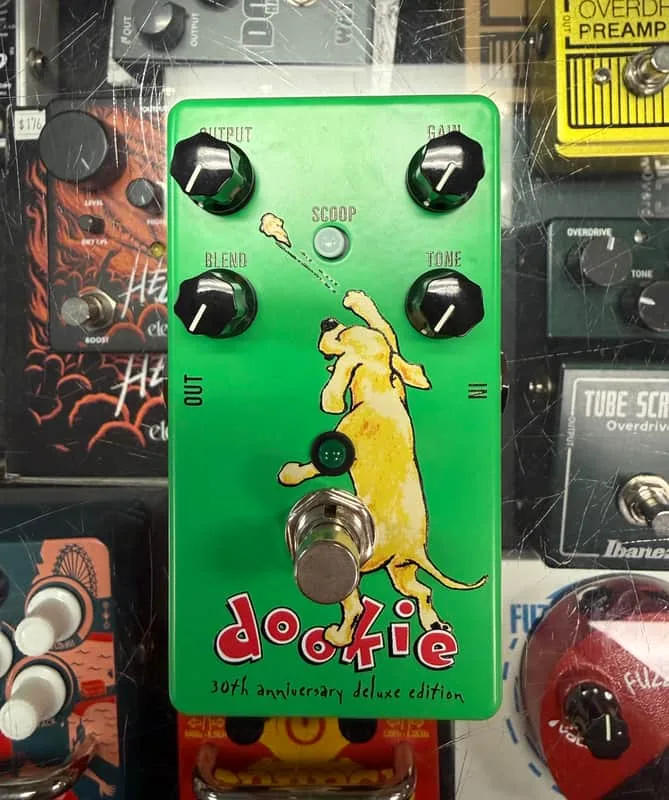

The controls
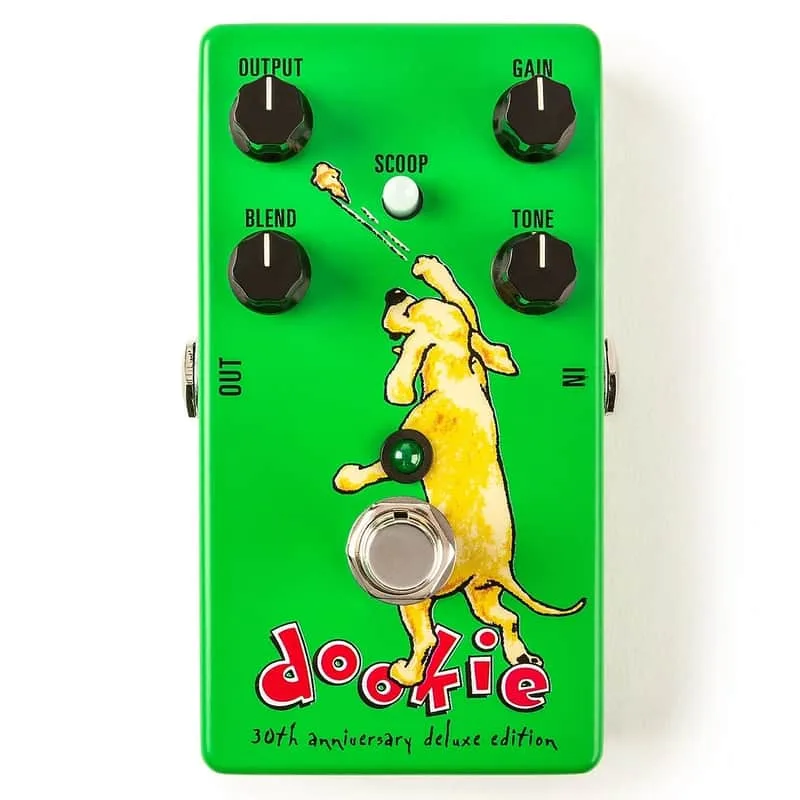
The DD30's front panel carries four knobs and a switch, and one of the most useful controls is inside the pedal. Here is what each does, per Dunlop's manual1:
| Control | What it does |
|---|---|
| GAIN | Sets intensity of the High Gain circuit's overdrive |
| TONE | Controls overall EQ; clockwise for a brighter sound, counterclockwise for a warmer sound |
| BLEND | Sets mix of High Gain and Crunch Gain circuits; clockwise for more High Gain, counterclockwise for more Crunch Gain |
| OUTPUT | Sets overall volume |
| SCOOP switch | Cuts overall midrange frequencies |
| CRUNCH VOLUME (internal) | Sets output level of the Crunch Gain circuit |
| FOOTSWITCH | Toggles effect on/bypass; green LED indicates on |
The BLEND knob is the heart of the design: because the two circuits are separate, you can run anything from the Crunch Gain sound alone to the High Gain sound alone, or any mix between them1. The internal CRUNCH VOLUME knob sets how loud the Crunch circuit sits in that mix before blending1.
The SCOOP switch is a fixed mid cut rather than a sweep. Pushed to the IN position, it cuts midrange frequencies for a modern scooped sound; Dunlop specs the cut at -8 dB at 1 kHz, which is a deep dip centered on the mids most overdrive pedals leave alone1. The TONE control is gentler by comparison, at ±5 dB at 10 kHz1.
Gain range and specs
The two circuits have very different gain ranges, which is what makes the blend useful. Dunlop specs the High Gain circuit from +9 dB to +70 dB at 1 kHz, and the Crunch Gain circuit from +2 dB to +45 dB at 1 kHz1. At the top of its range the High Gain side is a heavy distortion; at the bottom of its range the Crunch side is closer to a mild boost into an already driven amp.
| Specification | Value |
|---|---|
| High Gain | +9 dB to +70 dB, 1 kHz |
| Crunch Gain | +2 dB to +45 dB, 1 kHz |
| Scoop | -8 dB, 1 kHz |
| Tone control | ±5 dB, 10 kHz |
| Nominal output level | -8 dBV A-Weighted, all controls at mid position |
| Noise floor | -89 dBV A-Weighted, all controls at mid position |
| Input impedance | 770 kΩ |
| Output impedance | 900 Ω |
All values from Dunlop's manual1.
Power and bypass
The DD30 runs on DC 9 volts and draws 11 mA1. Dunlop names the Dunlop ECB003 9-volt adapter or an MXR Brick Series power supply as the supply options1. It also runs on one 9-volt battery, installed by removing the bottom plate1. At 11 mA the draw is light enough for a standard output on most pedalboard power supplies.
The bypass type is listed as True Hardwire, not "true bypass" by that name1. The footswitch toggles the effect on and off, with a green LED showing when it is on1.
Videos
Tech Sphere Pro
Questions
Does the Dookie Drive 30th Anniversary Edition run on a battery?
Yes. According to Jim Dunlop's manual, the DD30 is powered by one 9-volt battery, and you remove the bottom plate to install it. It can also run from a DC 9 volt adapter such as the Dunlop ECB003 or an MXR Brick Series power supply, drawing 11 mA.
Is the DD30 Dookie Drive true bypass?
The manual lists the bypass type as True Hardwire. The footswitch toggles the effect on and off, and a green LED indicates when the effect is on.
What does the Scoop switch do on the DD30?
The SCOOP switch cuts overall midrange frequencies. Pushed to the IN position, it cuts mids for a modern scooped sound. Dunlop specs the scoop cut at -8 dB at 1 kHz, so it is a substantial mid dip rather than a subtle one.
Where is the Crunch Volume knob on the DD30?
The CRUNCH VOLUME knob is an internal control: it sets the output level of the Crunch Gain circuit. Because it is internal rather than on the top panel, you set the balance between the Crunch and High Gain circuits there, then use the BLEND knob to set the mix of the two.
What power supply does the DD30 Dookie Drive need?
Dunlop's manual specifies a DC 9 volt supply, naming the Dunlop ECB003 9-volt adapter or an MXR Brick Series power supply. A 9-volt battery also works.
How much current does the DD30 draw?
The manual lists the current draw at 11 mA, a light load that most pedalboard power supplies can handle on a standard 9 volt output.
Sources (2)
- DD30.pdf, Jim Dunlop, 2024
- DD30 Dookie Overdrive 30th Anniversary by MXR, RockBoard PedalPedia, 2026