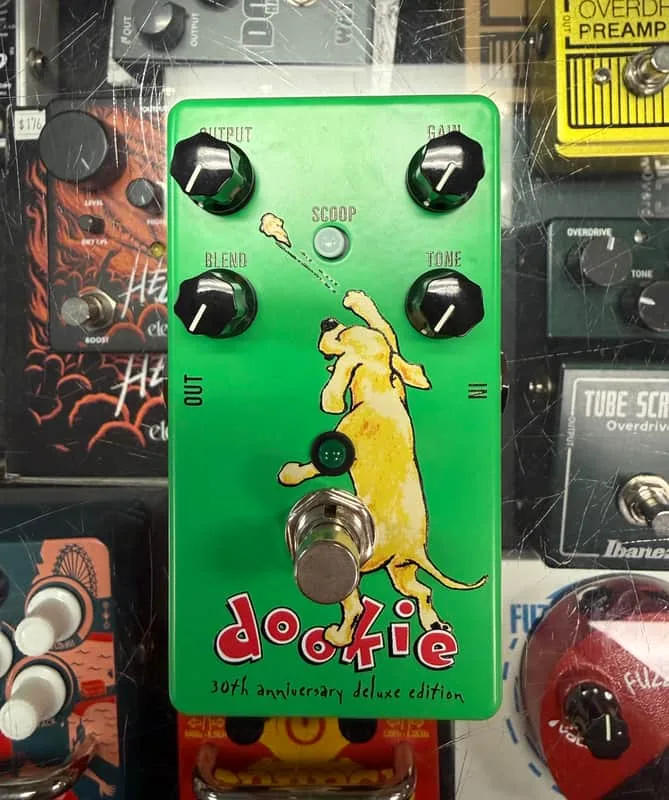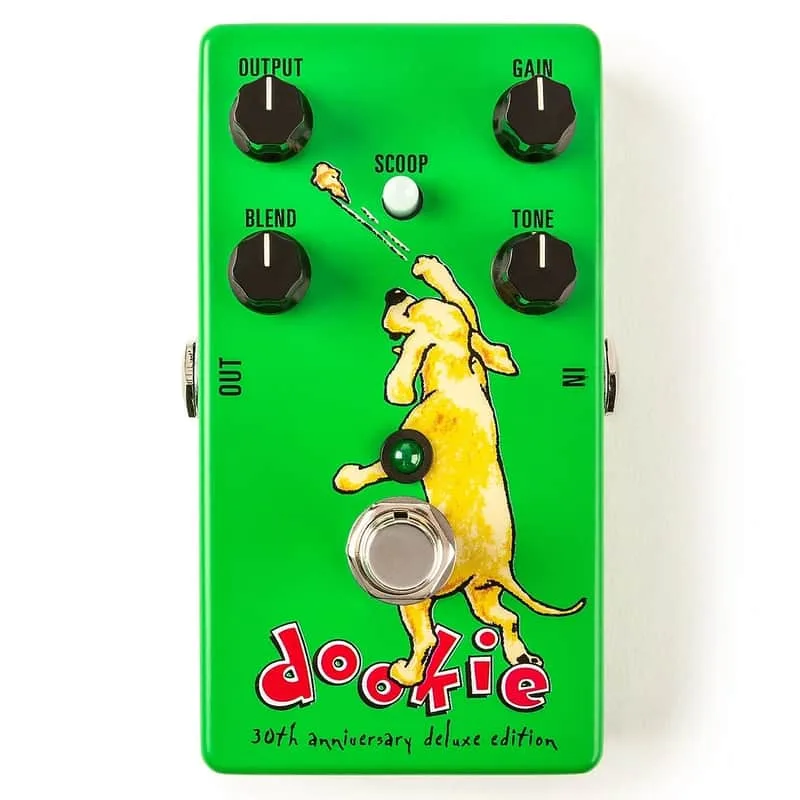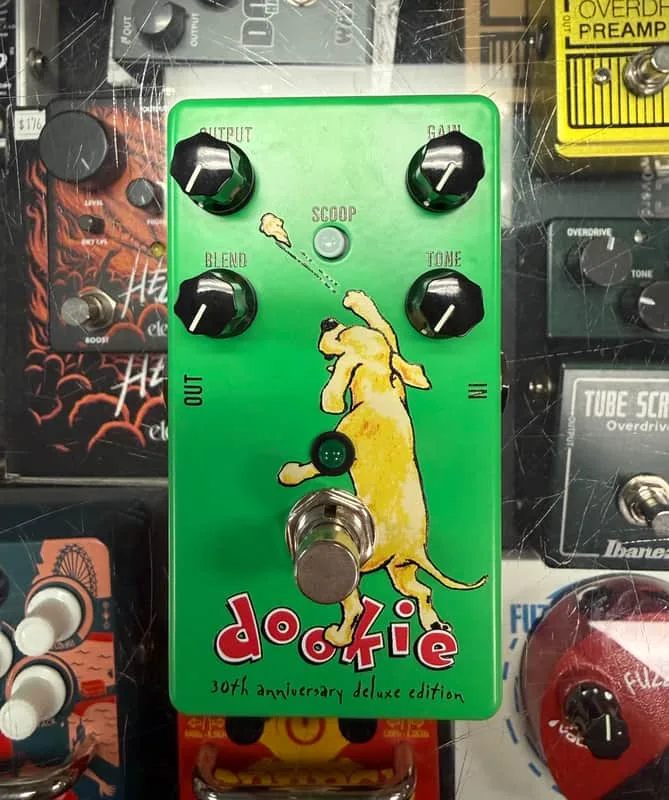
The Dunlop DD25V4 Dookie Drive is an overdrive/distortion effects pedal built around a specific piece of history: the two heavily modified amplifiers that Billie Joe Armstrong used to get his dirty yet articulate sound when recording Green Day's Dookie. Rather than model one amp, the pedal recreates both as separate, blendable circuits, a High Gain circuit and a Crunch Gain circuit, so you can run either one alone or mix them together1.
The two circuits and how they mix
The idea behind the pedal is that Dookie-era Armstrong tone came from two amps doing different jobs. Dunlop specs the High Gain circuit from +9 dB to +70 dB at 1 kHz, and the Crunch Gain circuit from +2 dB to +45 dB at 1 kHz1. The front-panel BLEND knob sets the mix of the two, so the pedal can go from a crisper crunch to the fuller sound of both circuits stacked1.
Each circuit has its own internal trimmers. The internal CRUNCH GAIN knob sets the intensity of the Crunch Gain circuit's overdrive, and the internal CRUNCH VOLUME knob sets that circuit's output level, letting you balance the Crunch side against the High Gain side before the Blend knob combines them1.
Controls
| Control | What it does |
|---|---|
| BLEND knob | Sets mix of High Gain and Crunch Gain circuits1 |
| OUTPUT knob | Sets overall volume1 |
| TONE knob | Controls overall EQ1 |
| SCOOP switch | Cuts overall midrange frequencies1 |
| Internal CRUNCH GAIN knob | Sets intensity of Crunch Gain circuit's overdrive1 |
| Internal CRUNCH VOLUME knob | Sets output level of Crunch Gain circuit1 |
| FOOTSWITCH | Toggles effect on/bypass, green LED indicates on1 |
The SCOOP switch has two positions. Pushed to the IN position, it cuts midrange frequencies for what Dunlop calls a modern scooped sound; the manual specs the cut at -8 dB centered at 1 kHz1. The TONE knob covers overall EQ with a range of plus or minus 5 dB at 10 kHz1.
Power and specifications
The DD25V4 runs on DC 9 volts and draws 11 mA. Dunlop specifies the ECB003 9-volt adapter, or the company's DC Brick, Iso-Brick and Mini Iso-Brick power supplies. It can also run on one 9-volt battery, installed by removing the bottom plate1.
The battery sits under the bottom plate, so changing it means unscrewing the plate. At 11 mA the pedal is light on a power supply's budget, but a battery is a practical option for occasional use.
| Specification | Value |
|---|---|
| Input impedance | 770 kΩ1 |
| Output impedance | 900 Ω1 |
| Nominal output level | -8 dBV A-Weighted, all controls at mid position1 |
| Signal-to-noise ratio | 89 dBV A-Weighted, all controls at mid position1 |
| High Gain range | +9 dB to +70 dB, 1 kHz1 |
| Crunch Gain range | +2 dB to +45 dB, 1 kHz1 |
| Tone control | ±5 dB, 10 kHz1 |
| Scoop | -8 dB, 1 kHz1 |
Hooking it up is the usual two-cable arrangement: run a cable from your guitar to the DD25's INPUT jack, and another from the OUTPUT jack to your amplifier1.
Related versions
Dunlop has built the Dookie Drive concept into other pedals: there is an earlier DD25V3 Dookie Drive and a DD30 Dookie Drive 30th Anniversary Edition marking three decades of the album. For a wider look at the category, see Overdrive Pedals and Distortion Pedals.
Questions
Does the Dookie Drive take a battery?
Yes. According to Dunlop's manual, the DD25V4 is powered by one 9-volt battery, and you remove the bottom plate to install it. It can also run on a 9-volt DC adapter such as the Dunlop ECB003, or from a Dunlop DC Brick, Iso-Brick or Mini Iso-Brick power supply.
Is the Dookie Drive true bypass?
Dunlop's manual lists the bypass type as True Hardwire, and the footswitch toggles the effect on and off with a green LED showing when it is engaged.
What does the Scoop switch do on the Dookie Drive?
The Scoop switch cuts overall midrange frequencies. Pushed to the IN position, Dunlop says it produces a modern scooped sound. The manual specs the scoop cut at -8 dB centered at 1 kHz.
What is the internal Crunch Volume knob for?
The internal Crunch Volume knob sets the output level of the Crunch Gain circuit. It works alongside the internal Crunch Gain knob, which sets the intensity of that circuit's overdrive, and lets you balance the Crunch side against the High Gain side before the Blend knob mixes the two.
What does the Blend knob on the Dookie Drive do?
The Blend knob sets the mix of the two circuits inside the pedal, the High Gain circuit and the Crunch Gain circuit. Because the pedal recreates two separate amplifiers, the Blend knob lets you run one, the other, or any combination of the two.
What power supply does the Dookie Drive use?
The DD25V4 runs on DC 9 volts. Dunlop specifies the ECB003 9-volt adapter, or the company's DC Brick, Iso-Brick and Mini Iso-Brick power supplies. It also runs on a single 9-volt battery.
Sources (1)
- DD25V4.pdf, Jim Dunlop, 2023