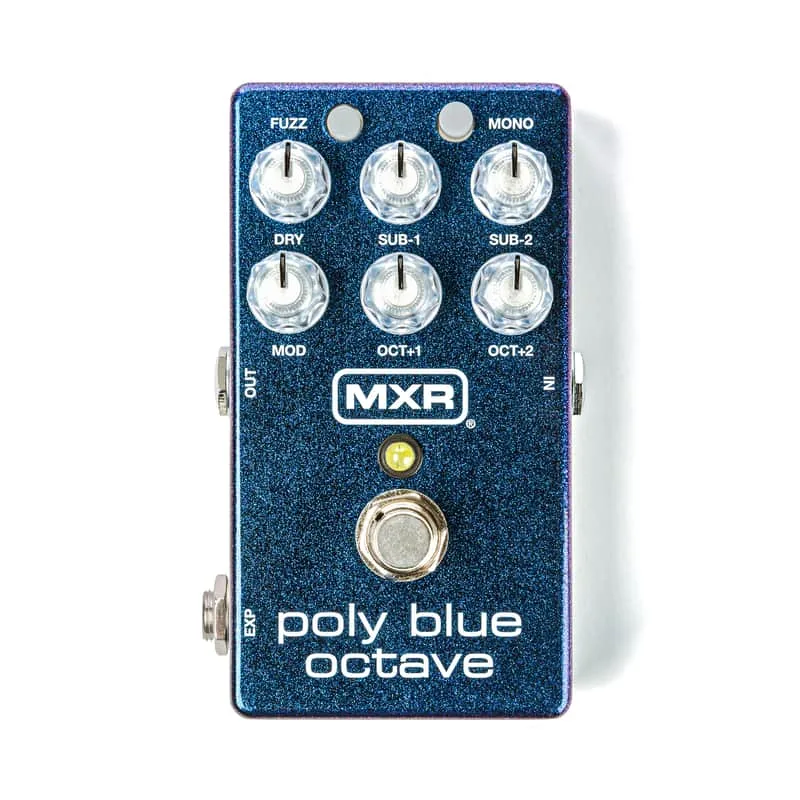


The MXR M306 Poly Blue Octave is a fuzz, pitch-shifting and modulation pedal in one box. It gives you four separate octave voices with their own level controls, a switchable fuzz circuit, and a dual-mode modulation section that taps into Leslie/Phase 90-style effects depending on which pitch-shifting mode you select12.
It is a reworking of the MXR Blue Box, the octave/fuzz pedal MXR has built for decades. Where the Blue Box drops your signal two octaves down and fuzzes it, the Poly Blue opens the circuit out into a four-octave, polyphonic pitch shifter with modulation on top12.
What it does: octave, fuzz and modulation
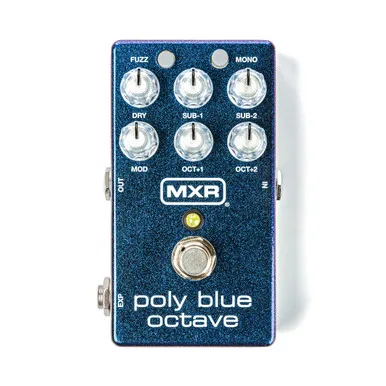
The core of the pedal is pitch shifting. You get four separate octave divisions, each with its own level control: Sub-1 and Sub-2 for one and two octaves down, and Oct+1 and Oct+2 for one and two octaves up12. That is a four-octave total range, so you can blend anything from a deep sub-octave rumble to a shrieking two-octaves-up squeal against your dry signal.
On top of the pitch shifting sits a fuzz circuit you can switch in and out, plus a modulation effect. The modulation is dual-mode: it taps into Leslie-style and Phase 90-style effects depending on whether the pitch shifting is running polyphonic or monophonic2. In monophonic mode it provides swirls and swooshes that MXR says were inspired by the Phase 901.
The pedal is polyphonic by default, meaning it tracks chords rather than just single notes, and it can be switched to work in monophonic mode3.
The controls
| Control | What it does |
|---|---|
| Sub-1 | Level for one octave down12 |
| Sub-2 | Level for two octaves down1 |
| Oct+1 | Level for one octave up12 |
| Oct+2 | Level for two octaves up12 |
| Dry | Blends the un-effected signal in; with a held press of the fuzz toggle switch it doubles as a volume control for the fuzz circuit3 |
| Modulation | Sets the modulation effect1 |
| Fuzz switch | Mini push switch that switches the fuzz circuit1 |
| Mono switch | Mini push switch that selects monophonic mode1 |
The Dry control is worth a closer look: it blends your clean signal in with the shifted octaves, and when combined with a held press of the fuzz toggle switch it also acts as the volume level control for the fuzz circuit3.
Expression and tap switch options
The Poly Blue has an expression jack that opens up two ways to control it hands-free312.
- Expression pedal: connecting a TRS cable from an expression pedal into the Expression jack lets you crossfade between two different pedal configurations in the heel and toe positions3. Gearnews describes it as an expression output allowing expression pedal-operated control of various parameters12.
- Tap switch: you can connect a regular tap switch into the expression socket and use it to switch the fuzz circuit on and off, or to change between polyphonic and monophonic mode3.
That crossfade trick effectively gives you two sounds in one pedal, swept with your foot, which partly makes up for the lack of presets31.
Based on the MXR Blue Box
The Poly Blue is an expanded version of the Blue Box, the octave/fuzz pedal MusicRadar called iconic3. Gearnews framed it the same way: MXR "takes their Blue Box pedal, and makes the circuit way more versatile"1.
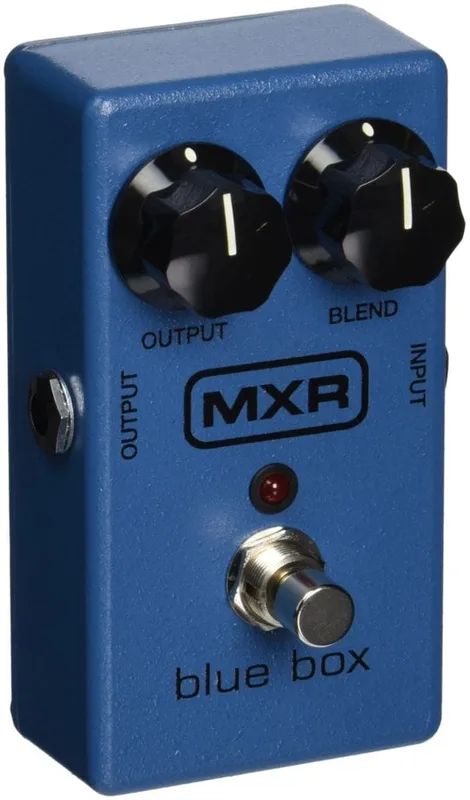
The original Blue Box is a much simpler animal. Its single OUTPUT control sets the overall volume of the effect, and it is powered by one 9-volt battery installed under the bottom plate4. It currently lists at $99.995, roughly half the Poly Blue's launch price. The Poly Blue keeps the octave-and-fuzz concept but adds the four-octave pitch shifting, the modulation, the polyphonic tracking and the expression control, and it drops the battery: it runs from an external power supply only1.
What reviewers said
Gearnews covered the pedal from announcement to a later verdict, and the two reports land very differently1.
In an early note, the reviewer was blunt about the fuzz side of the pedal1:
"Just digital noise and hash. No usable tones."
Gearnews, on the Poly Blue's overall tone1
By the end of February 2022 the verdict had turned around completely:
"A completely brilliant pedal and execution. Comparing to the Boss OC5 it only loses range control. Otherwise it destroys"1
Gearnews, comparing the Poly Blue Octave to the Boss OC51
The same reviewer's one regret was storage: "Shame you can't set up more presets because there's plenty of great sounds in there"1.
Videos
PJ and the Beard
Pedal Experiments
News
Questions
Does the MXR Poly Blue take a battery?
No. The Poly Blue Octave runs from an external power supply only, with no option to use a battery. That differs from the original Blue Box, which is powered by a single 9-volt battery installed under the bottom plate.
Is the Poly Blue Octave polyphonic?
Yes. The pedal tracks chords polyphonically by default, so you can play more than one note at a time and each note gets pitch-shifted. It can also be switched into monophonic mode, which tracks a single note and changes the character of the modulation.
How much does the MXR Poly Blue Octave cost?
At launch in January 2022 the Poly Blue Octave was priced at $199 in the US, with retailers accepting pre-orders at that price. MusicRadar also reported an expected UK price of £199.
Can the Poly Blue save presets?
No. Gearnews noted it as a shortcoming that you cannot set up more presets, while adding that there are plenty of great sounds in the pedal. You can, however, crossfade between two configurations with an expression pedal.
What does the mono switch do on the Poly Blue?
The mono mini push switch puts the pitch-shifting into monophonic mode, so the pedal tracks one note at a time instead of chords. In that mode the modulation produces swirls and swooshes that MXR says were inspired by the Phase 90.
Sources (5)
- MXR Poly Blue Octave: An updated Blue Box for the modern guitarist, gearnews.com, 2022-01-05
- MXR reboots its cult classic Blue Box for the refined Poly Blue Octave pedal, Guitar World, 2022-01-05
- MXR Poly Blue expands the classic Blue Box octave-fuzz with additional controls, features and modulation, MusicRadar, 2022-01-13
- M103.pdf, Dunlop Manufacturing, Inc., 2019
- MXR® SUB MACHINE® FUZZ, Dunlop (jimdunlop.com)