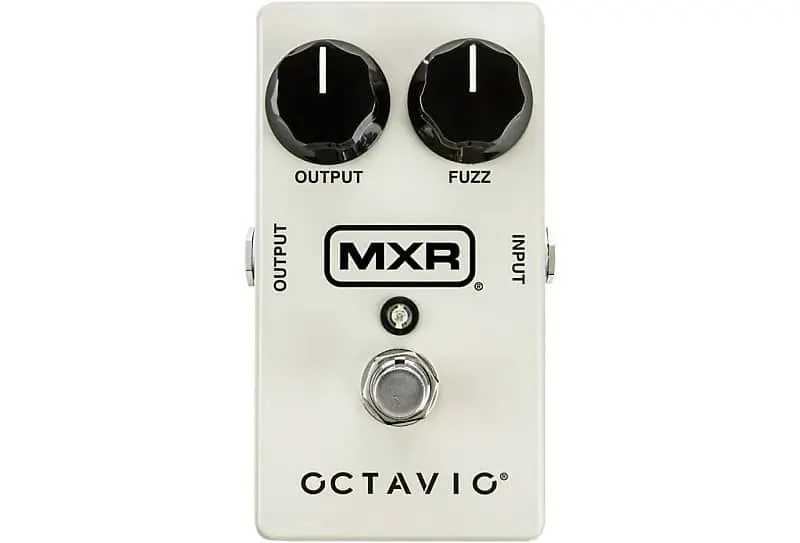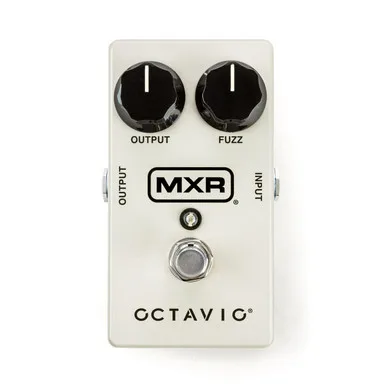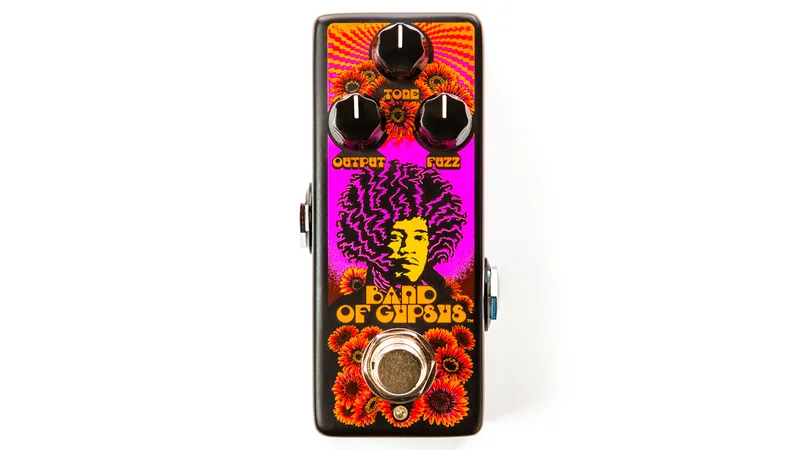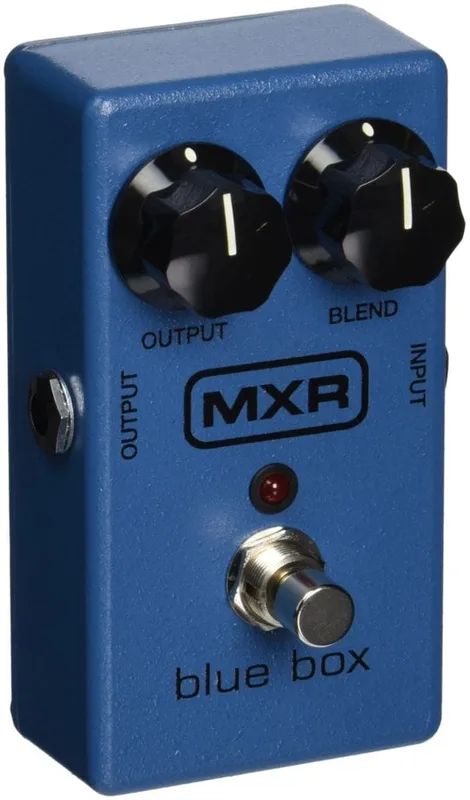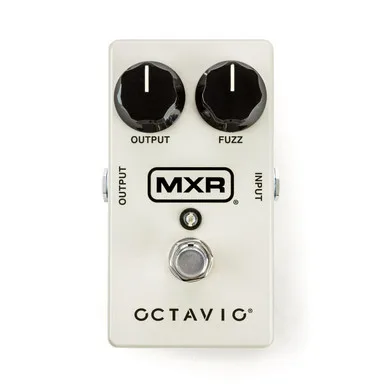


The MXR Octavio Fuzz (model M267) is a compact fuzz pedal from MXR that adds an octave above your note to a saturated fuzz tone. MXR describes it as delivering "touch-responsive octave-up saturation," where your picking and plucking dynamics coax out the pedal's "searing, synth-like tones"1. It is a modern, pedalboard-friendly version of the Octavio effect made famous in the 1960s, and it was the first time that effect appeared as a standard MXR pedal1.
Jim Dunlop lists the MXR Octavio Fuzz as a legacy product that is no longer in production1. It is now found on the secondhand market.
What it does to your sound
The Octavio Fuzz is an octave fuzz: the fuzz and the octave-up are part of one sound rather than two stacked effects. MXR says the pedal produces "touch-responsive octave-up saturation," meaning the octave component comes and goes with how hard you play1. Played gently, the fuzz dominates; dug into, the octave above the note pushes forward, which is what gives the effect its synth-like character1.
Delicious Audio described the result as "a Silicon based Octave-up Fuzz" that is "as simple and responsive as the original units of the '60s, but a lot smaller and quiet"3. The silicon circuit is part of that character: MXR pitches the pedal as a way to "explore the furthest reaches of silicon saturation in a trusted vessel"1. Silicon fuzzes are generally brighter and more aggressive than germanium designs, and less sensitive to temperature.
The controls: Output and Fuzz
The control set is deliberately minimal. Guitar World's spec list reads simply: "Output, Fuzz, Bypass footswitch"4, and at the pedal's launch Guitar World noted that "with just two knobs for Output and Fuzz, it prides itself on a sound that won't need much tweaking at all"5.
| Control | What it does |
|---|---|
| Output | Sets the overall volume of the effect2 |
| Fuzz | Sets the intensity of the fuzz effect2 |
| Bypass footswitch | Engages and bypasses the pedal4 |
MXR's own guidance is to "just set the Level and Fuzz controls to your desired volume and intensity" and let your playing dynamics shape the rest1. There is no separate octave blend, tone knob, or mode switch on the standard M267: the octave is baked into the circuit, and the Fuzz knob is the main way to push it forward or pull it back.
Powering it
The pedal runs on one 9-volt battery, installed by removing the bottom plate, or on 9 volts DC through the Dunlop ECB003 adapter2. MXR also lists the DC Brick, Iso-Brick, and Mini Iso-Brick power supplies as compatible, none of which are included with the pedal1. Guitar World's review lists the current draw at 5mA4, low enough that it places almost no demand on a shared pedalboard supply.
Where the circuit came from
The Octavio effect dates to the 1960s. Guitar World's review traces the M267's lineage: "the lineage can be traced back to the vintage pedal used by Jimi to full effect on Purple Haze"4. Guitar.com identifies that vintage circuit as "the Roger Mayer Octavia (aka Octavio)" in its review of a later Dunlop version6. The original pedal came in a wedge-shaped housing often called the cheese wedge, and the MXR M267 marked the first time the effect joined the standard MXR line1.
Delicious Audio framed the M267 as keeping the original's character in a modern package: "as simple and responsive as the original units of the '60s, but a lot smaller and quiet"31.
Part of MXR's Hendrix-inspired line
The M267 sits within a wider family of Octavio and Hendrix-related pedals from Dunlop. Delicious Audio noted the context at launch: "With its popular line of Jimi Hendrix-inspired Uni-Vibes, MXR is further tying its brand to the tone of the legendary guitarist with the release of the Octavio"31. Guitar World's review adds a distinction: among the various Octavio versions, "it is the only one available as a standard two-knob MXR pedal without any artist connection"4.
The related versions include:
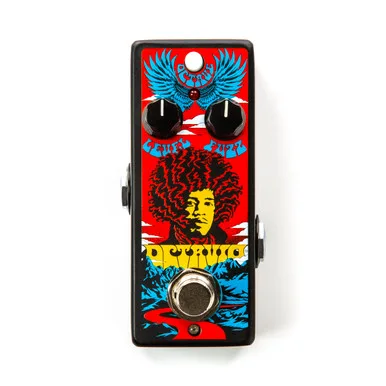
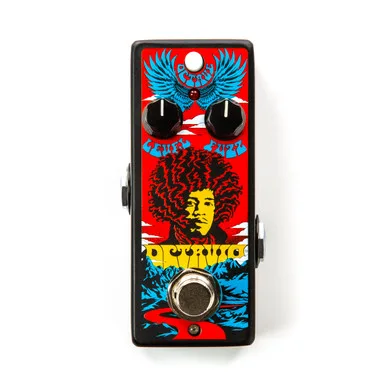
- The Dunlop Authentic Hendrix '68 Shrine Series Octavio, which "crams the MXR Octavio, with its Output and Fuzz knobs, into a smaller housing"7. Dunlop says it "updates the circuitry of the original cheese wedge Octavio Fuzz for modern players and pedalboards," and that "both modes deliver a range touch-sensitive fuzz tones"8. It is also listed as a legacy product8.
- The Dunlop Authentic Hendrix '69 Octavio Fuzz, an octave fuzz pedal reviewed by Guitar.com6.
- The Dunlop Siete Santos Octavio Fuzz, whose "searing circuit is based on the Jimi Hendrix Octavio Fuzz" according to Jim Dunlop9.
Guitar World has also reported that the Hendrix Series Fuzz Face, Octavio and Univibe "were designed by the MXR team"10.
Videos
jimdunlopusa
Guitar Bonedo
Gear4music Guitars
Questions
Is the MXR Octavio Fuzz still in production?
No. Jim Dunlop lists the MXR Octavio Fuzz as a legacy product that is no longer in production. It was the first time the Octavio effect appeared in the standard MXR line, and it remains available only through the secondhand market. Related versions, such as the Authentic Hendrix '68 Shrine Series mini pedal, are also listed as legacy products.
Does the MXR Octavio Fuzz use silicon or germanium transistors?
It is a silicon based octave-up fuzz. MXR describes it as touch-responsive silicon saturation, and Delicious Audio's coverage called it a silicon based octave-up fuzz. That puts it in the same family as other silicon fuzzes rather than the warmer, more temperature-sensitive germanium designs.
What power supplies work with the MXR Octavio Fuzz?
It runs on one 9-volt battery, installed by removing the bottom plate, or on 9 volts DC through the Dunlop ECB003 adapter. MXR also lists the DC Brick, Iso-Brick, and Mini Iso-Brick power supplies as compatible. Guitar World's review lists the current draw at 5mA, so it is easy on a pedalboard power supply.
What original Octavio is the MXR pedal based on?
It traces back to the original cheese wedge Octavio Fuzz of the 1960s, the pedal Jimi Hendrix used to full effect on Purple Haze. Guitar.com identifies that vintage circuit as the Roger Mayer Octavia, also known as the Octavio. The MXR version keeps the effect but packages it in a smaller, quieter modern housing.
Sources (10)
- MXR® OCTAVIO® FUZZ, Jim Dunlop (jimdunlop.com)
- M267.pdf, Jim Dunlop, 2020
- MXR Octavio Fuzz, Delicious Audio, 2020-05-06
- MXR M267 Octavio Fuzz review, Guitar World, 2020-06-18
- NAMM 2020: Jim Dunlop announces 4 new pedals, including the Green Day Dookie Drive V3, Guitar World, 2020-01-17
- Review: Dunlop Authentic Hendrix ’69 Psych Series Pedals, Guitar.com, 2019-11-12
- Dunlop honors Jimi Hendrix's iconic effects with Authentic Hendrix '68 Shrine mini pedals, Guitar World, 2023-02-02
- AUTHENTIC HENDRIX™ '68 SHRINE SERIES OCTAVIO® FUZZ, Jim Dunlop (www.jimdunlop.com)
- SIETE SANTOS™ OCTAVIO® FUZZ, Jim Dunlop (jimdunlop.com)
- Dunlop Introduces Limited-Edition Jimi Hendrix 70th Anniversary Tribute Series Pedals, Guitar World, 2012-11-21