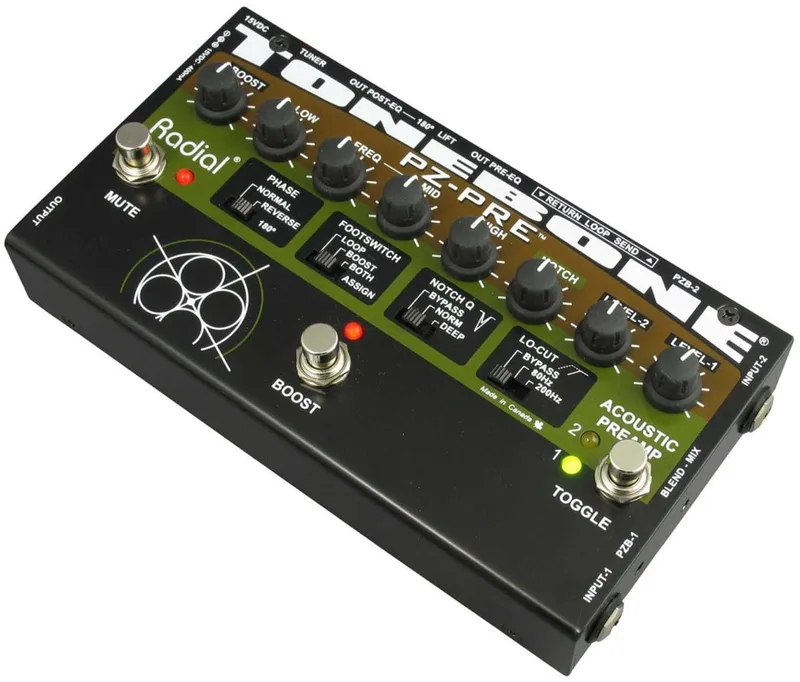


The Radial PZ-Pre is an analog acoustic instrument preamplifier in pedal form, built around a powerful EQ and feedback control section. Radial describes it as a preamp that will adapt to any pickup system, using 100% discrete class-A PZB piezo boosters and an ultra-quiet preamp circuit, with a 10 meg-ohm input impedance that suits piezo pickups12. MusicRadar's Dave Burrluck called it "pretty much the most feature-laden dual-input acoustic guitar/instrument preamp we've encountered"3.
The two inputs let you switch quickly between instruments on stage or blend two pickups together, such as a magnetic pickup with a piezo1. Radial positions it primarily for live use, with pre-EQ and post-EQ direct box outputs so the house gets a dry signal while monitors carry your tailored sound24.
What the PZ-Pre does
The PZ-Pre is a preamp and direct box for acoustic players. Radial says the combination of class-A PZB piezo boosters and the quiet preamp circuit is what lets it adapt to any pickup system1. Radial's own support material describes it plainly: "It is a very good sounding, clean & natural instrument preamp"2.
The two channels serve two purposes. For a player carrying two guitars, the toggle footswitch selects channel 1 or channel 2, with LEDs showing the active input5. For a player with one instrument and two pickups, the BLEND setting engages both channels at once: Radial's guidance is to activate the PZB booster for the piezo and then adjust the relative channel levels2. The PZ-Pre also works with Sunrise pickups with or without the Sunrise buffer box2.
The DI side gives you two balanced XLR outputs. The pre-EQ output sends a dry signal, without EQ, to the PA; the post-EQ output sends your EQ-shaped signal to the PA or monitors5. Radial says these output circuits are similar to the output stage of the Radial J48 direct box2.
Controls and footswitches
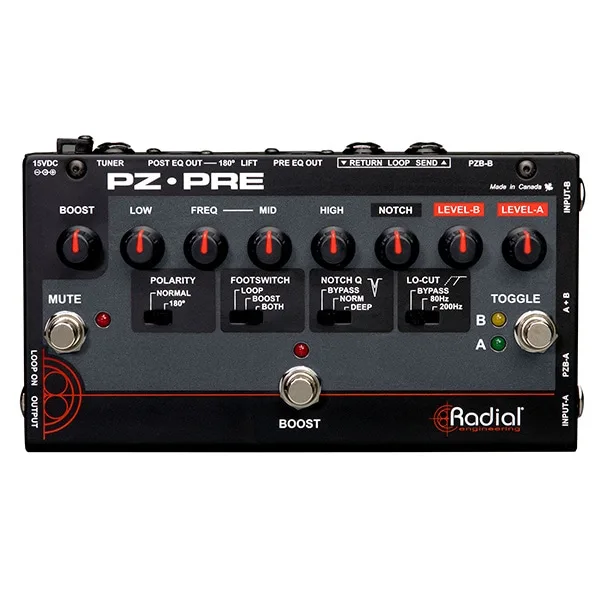
The front panel centers on a 3-band EQ with bass, semi-parametric midrange and high frequency controls5. Premier Guitar's reviewer noted the Boost switch, 12 dB variable, sits "front and center"6, while Radial's feature page gives the boost control as up to 8dB of added gain for solos5.
| Control or switch | What it does |
|---|---|
| Toggle footswitch | Selects channel 1 or channel 2; LEDs indicate active input5 |
| Boost footswitch | Activates booster or effects loop; works with the Boost Assign setting5 |
| Boost control | Up to 8dB of added gain for solos5 |
| Footswitch Assign | Sets the Boost footswitch for boost, effects loop, or both5 |
| Mute footswitch | Turns off all outputs except the tuner out, for quiet on-stage tuning5 |
| Loop Send / Return | Inserts effects into the signal path, activated with the boost footswitch5 |
| Lo-Cut | 3-position filter that reduces low frequency rumble and resonance5 |
| Lift switch | Disconnects pin-1 ground at the XLR output to help eliminate hum and buzz from ground loops5 |
| 180° switch | Recessed switch reversing pins 2 and 3 at the XLR output, to help eliminate feedback5 |
The effects loop is in series, so all of the instrument signal passes through the PZ-Pre2. One detail worth knowing: the boost knob is disabled, not in the circuit, when the footswitch is assigned to LOOP2. Premier Guitar's review also noted two signal polarity reverse switches, one in the main 1/4" output and one assigned to the post-EQ, post-effects mic-level XLR direct out, plus a mute toggle6.
Feedback control: notch, Notch-Q and phase
Feedback control is a core part of the design. Radial says the notch and resonance filters eliminate feedback, and the semi-parametric EQ and feedback controls let you fine-tune your sound while eliminating troublesome frequencies15.
- Notch: sets the center frequency for the notch filter, used to eliminate feedback5
- Notch-Q: selects a normal or extra deep notch, working with the notch frequency control5. Premier Guitar described it as a Notch Q switch with a dedicated pot, with normal and deep V settings for cutting midrange feedback6
- Phase (reverse): corrects the phase relationship of the instrument output to reduce on-stage feedback5
- Lo-Cut: a 3-position filter that reduces low frequency rumble and resonance that can cause feedback or muddy the sound5
Power and connections
The PZ-Pre runs on a 15V DC power supply, which Radial says delivers more headroom than a typical 9V supply for added clarity and dynamics5. RockBoard's PedalPedia listing gives the current draw as 400mA4. Because it has an onboard regulator, it may be used with an unregulated supply2.
Power polarity matters here. The PZ-Pre uses a center pin positive supply, so with a center pin negative supply you need a 2.1mm barrel-connector polarity reverse cable2. Radial also notes that running it at 18V instead of 15V shortens the lifespan of the internal voltage regulators from approximately 20 years to 18 years2. The Cioks DC10 and AC10 both have 15V outlets that suit it2.
The inputs have built-in safety capacitors that protect the unit from external DC voltages, such as phantom power arriving from a mixer2. The always-on buffered tuner output keeps working when the mute footswitch silences everything else5.
Versions of the PZ-Pre
The PZ-Pre has been through cosmetic changes: Radial says the artwork and paint color scheme changed from the original model with no functional design change2. The latest version adds a recessed effects loop switch on the left side that lets the loop be footswitch controlled or always on, which required a redesign2. Earlier units were sold under the Tonebone name, which is how Premier Guitar's review identifies it6.
Videos
Radial Engineering
어갤 기타라면
Dean Wolfe [Prog dog]
Questions
Can I blend a magnetic pickup and a piezo with the PZ-Pre?
Yes. The PZ-Pre has two inputs and a BLEND setting that engages both channels at once. Radial's guidance is to engage BLEND so both channels are on, activate the PZB booster for the piezo, and then adjust the relative levels of the two channels to balance the pickups.
Does the PZ-Pre provide phantom power for a microphone?
No. The PZ-Pre cannot power a phantom powered microphone. Radial says you need to add an external 48V phantom power supply to your system for that. The unit does have built-in safety capacitors on the input that protect it from external DC voltages, so phantom power from a mixer will not damage it.
What happens if I leave the PZB piezo booster on by mistake?
Nothing is damaged. Radial says leaving the piezo boosters on by mistake will not hurt the PZ-Pre and will likely only result in distortion. The practical rule is to turn the PZB boosters off when using an external piezo preamp, since driving one buffer into the other can cause unnecessary noise and distortion.
Can the PZ-Pre be used for recording direct?
Yes, though it is primarily designed for live use, and many of its features are aimed at solving problems on live stages. It offers both pre-EQ and post-EQ balanced XLR direct box outputs, so you can record a dry signal or your EQ-shaped sound, and its output circuits are similar to those of the Radial J48 direct box.
Sources (6)
- PZ-Pre - Radial Engineering, Radial Engineering, 2026-09-24
- PZ-Pre FAQ, Radial Engineering, 2019-05-13
- Radial Tonebone PZ-Deluxe review, MusicRadar, 2016-03-11
- PZ-Pre by Radial Engineering, RockBoard PedalPedia, 2026
- PZ-Pre Features, Radial Engineering, 2020-09-29
- Review: Tonebone PZ-Pre DI Preamp, Premier Guitar, 2008-03-28