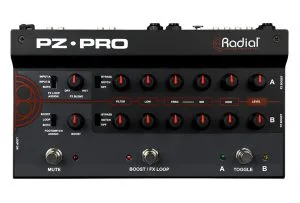



The Radial PZ-Pro is an acoustic preamp and direct box in pedal form, built by Radial. It carries two inputs, a 1/4 inch instrument input on channel A and a second channel that accepts either another instrument or a microphone via XLR, and it routes them to balanced pre-EQ and post-EQ XLR outputs plus a 1/4 inch amp out1. Each channel gets its own variable three-band EQ, and the pedal adds a clean boost, an effects loop with a wet/dry blend, a polarity reverse, a ground lift, and a tuner output that keeps working when everything else is muted21.
Premier Guitar reviewed it in December 2022 and described it as "a pro-level tool that puts more weight and thought behind the essential elements of acoustic amplification," noting it "could easily function as a grab-and-go setup or the centerpiece of an expansive pedalboard"3.
The controls and footswitches
The PZ-Pro's front panel is organized around three footswitches and a set of controls that shape each channel independently.
| Control or switch | What it does |
|---|---|
| Toggle footswitch | Selects between input A and input B, with LEDs showing the active input. Bypassed when a rear panel switch is engaged2 |
| Mute footswitch | Turns off all outputs except the Tuner Out, for silent on-stage tuning or instrument changeovers2 |
| Boost / FX Loop footswitch | Activates the built-in clean boost or the FX loop, set by the Footswitch Assign switch2 |
| Footswitch Assign | Three-position switch that sets the Boost/FX Loop footswitch to activate the Boost, the FX Loop, or both simultaneously2 |
| Boost knob | Sets the amount of clean boost applied when the Boost circuit is active2 |
| 3 Band EQ | Variable EQ for each input, with bass, semi-parametric midrange, and high frequency boost/cut controls2 |
| FX Blend | Wet/dry control that mixes the original dry input signal with the wet FX loop return2 |
| FX Loop Assign | Selects whether pedals in the FX loop affect input A, input B, or both2 |
The EQ deserves a closer look for acoustic players: because it is variable per input, a guitar on channel A and a microphone on channel B can each get their own bass, mid, and treble settings, so switching between them with the Toggle footswitch carries the right EQ along with the right source2.
The boost is a clean design, with the Boost knob setting how much level is applied when the circuit is engaged2. Radial lists the instrument input gain as +20dB1.
The effects loop is a pair of 1/4 inch TS send and receive jacks for external pedals, activated by the Boost/FX Loop footswitch2. The FX Blend knob is the loop's most useful trick for acoustic work: Premier Guitar's reviewer found that "the added blend knob ensures that your external effects won't overpower your fundamental tone"3. The FX Loop Assign switch then decides whether those pedals process channel A, channel B, or both, so a delay, for instance, can be reserved for the vocal mic or shared with the guitar2.
Power and connections
The PZ-Pro runs on a 15V DC power supply at 400mA, center-pin positive, and Radial includes the supply with the pedal21.
The PZ-Pro runs on its included Radial power supply rather than a typical pedalboard daisy chain, and a cable clamp on the pedal locks down the PSU cable to prevent accidental power disconnection2.
The rear panel carries the full set of connections:
- Input A: 1/4 inch TS instrument input for channel A2
- Input B: 1/4 inch TS instrument input for channel B, deactivated when the MIC ON switch is engaged2
- Mic Input B: XLR input for a microphone feeding channel B, compatible with both condenser and dynamic mics2
- Tuner Out: 1/4 inch TS buffered output for a tuner pedal, always active even when Mute is engaged2
- FX Send and Receive: 1/4 inch TS jacks for external effects pedals, activated by the Boost/FX Loop footswitch2
- Post EQ output: Balanced XLR direct box output feeding a mic-level signal to the PA or a recording interface, affected by the EQ and FX/Boost functions2
- Pre EQ output: Balanced XLR output ahead of the EQ1
The two XLR outputs are the key to how the pedal fits a stage rig: the post-EQ output carries your shaped tone to the front of house, while the pre-EQ output can feed a second destination with the unprocessed signal21. The 1/4 inch amp out covers a stage amp or monitor1.
Specifications
| Specification | Value |
|---|---|
| Frequency response | 20Hz to 20kHz, +/-0.5dB1 |
| Input impedance | 220k Ohm at input jack, 10 megohm when PZ Boost active1 |
| Output impedance | 1k Ohm1 |
| Clip level | +10dBu at XLR output1 |
| Noise | -91dB1 |
| Gain | +20dB at instrument input1 |
| Weight | 5.0 lbs (2.27 kg)1 |
| Size | 9.10" x 5.32" x 1.82" (231 x 135 x 46mm)1 |
| Operating conditions | Dry locations only, between 5°C and 40°C1 |
The input impedance figure is the one piezo-equipped players will care about. Radial specifies 220k Ohm at the input jack normally, rising to 10 megohm when PZ Boost is active1. Piezo pickups generally need a very high input impedance to deliver their full low end, and the 10 megohm setting is what the PZ Boost name refers to.
What reviewers said
Premier Guitar's December 2022 review was positive about the pedal's core job. The reviewer wrote:
"The PZ-Pro's preamps are top notch and gave me plenty of clarity and headroom for nearly any amplified situation"3
The same review called the pedal "a pro-level tool that puts more weight and thought behind the essential elements of acoustic amplification," and noted its flexibility as either a compact standalone rig or the hub of a larger board3. The review carried a $499 price at the time3.
Related Radial pedals
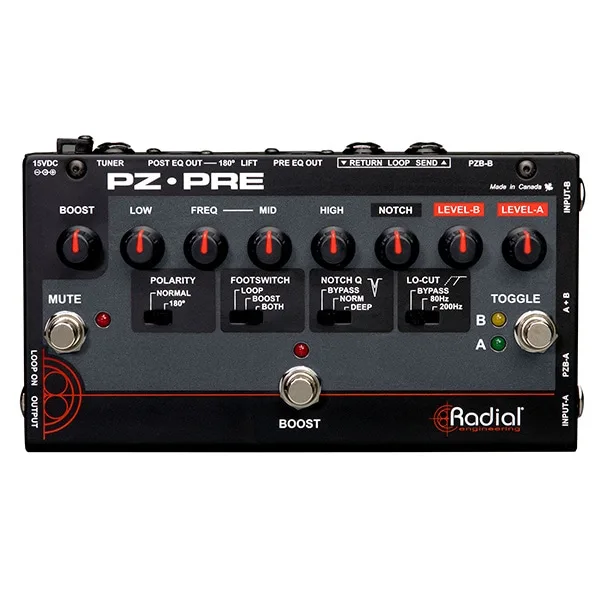
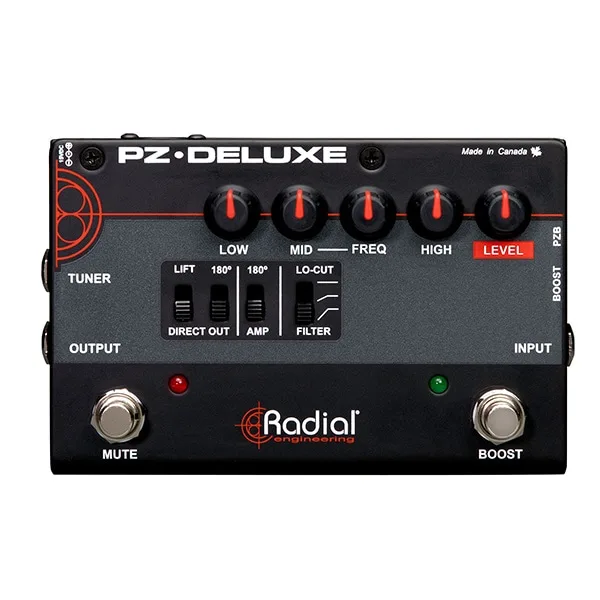
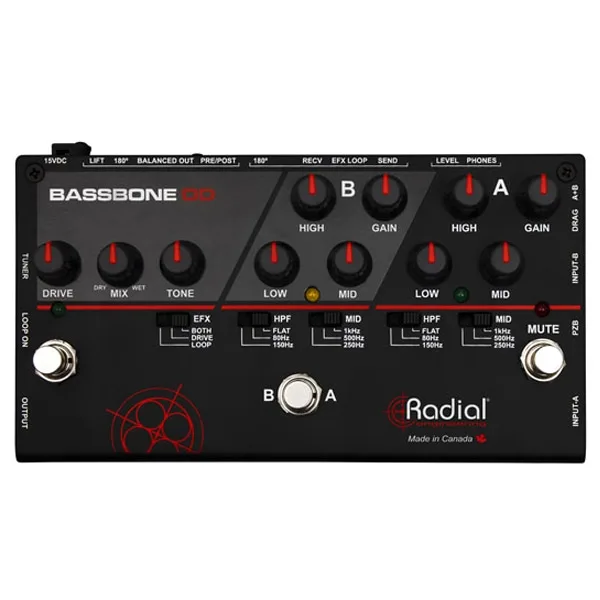
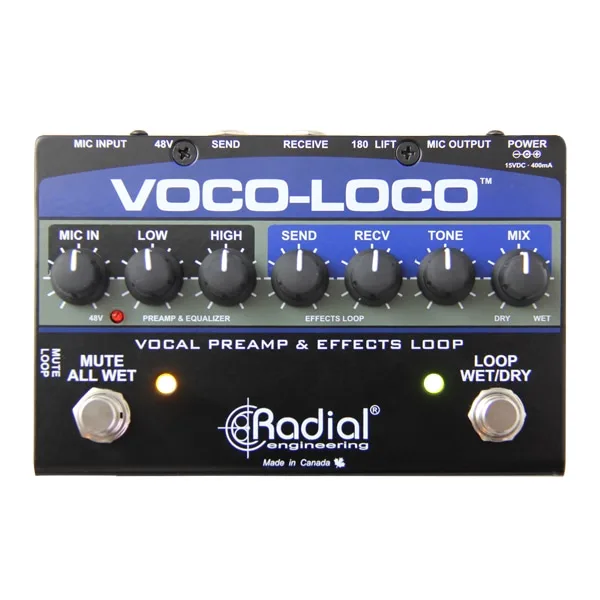
The PZ-Pro sits in Radial's family of acoustic and multi-input preamps. The PZ-Pre and PZ-Deluxe are Radial's other piezo-oriented preamp DI pedals, the Bassbone V2 applies the two-channel preamp idea to bass, and the Voco-Loco handles the instrument-plus-microphone switching job for vocalists. More generally, it belongs to the wider category of preamp pedals and acoustic pedals1.
Videos
Radial Engineering
Radial Engineering
Adrian Bellue
Questions
Can you plug a microphone into the Radial PZ-Pro?
Yes. The PZ-Pro has an XLR microphone input that feeds channel B, and it works with both condenser and dynamic microphones. When the MIC ON switch is engaged, the 1/4 inch instrument input for channel B is deactivated, so the mic takes over that channel.
What is the PZ Boost on the Radial PZ-Pro?
PZ Boost is a setting that raises the input impedance at the input jack from 220k Ohm to 10 megohm. Radial lists the two figures side by side in its specifications, with the higher impedance applying when PZ Boost is active, a condition typically used with piezo pickups that need a very high input impedance to sound natural.
Does the PZ-Pro have a tuner output?
Yes. The Tuner Out is a 1/4 inch TS buffered output for a tuner pedal, and it stays active even when the Mute footswitch is engaged, so you can tune silently at any time without interrupting the signal path.
Can the PZ-Pro run two guitars at once?
Yes. The PZ-Pro has two 1/4 inch instrument inputs, channel A and channel B, and a Toggle footswitch selects between them, with LEDs showing which input is active. Channel B can also be used for a microphone instead of a second instrument.
Sources (3)
- PZ-Pro Specifications, Radial Engineering, 2020-09-29
- PZ-Pro Features, Radial Engineering, 2020-08-28
- Radial’s Powerful Updated Acoustic Preamp-Plus, Premier Guitar, 2021-06-07