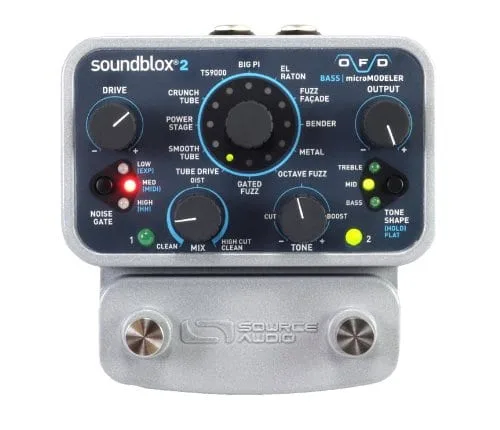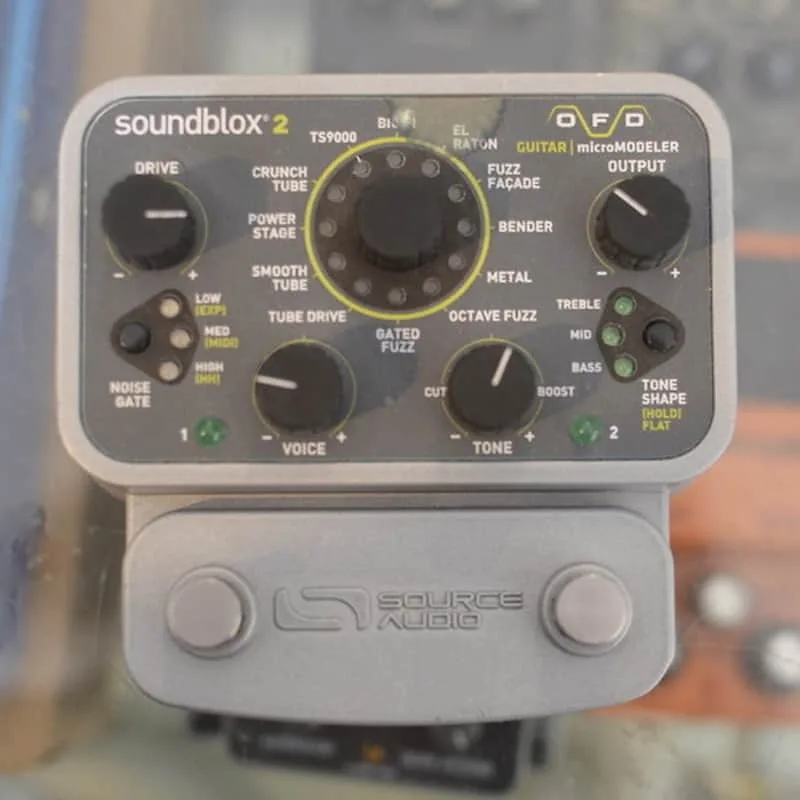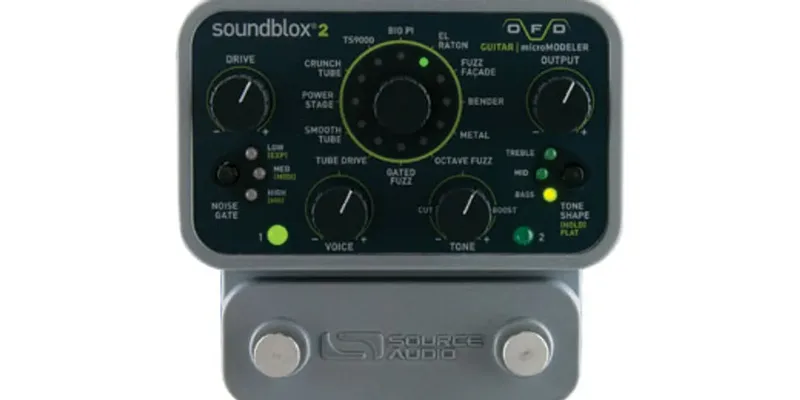


The Source Audio OFD is a compact pedal that models overdrive, fuzz and distortion circuits rather than offering a single fixed sound. It was released in the Soundblox 2 series as the Soundblox 2 OFD, short for Overdrive, Fuzz and Distortion, in guitar and bass versions, each with twelve effect types voiced for its instrument123. Premier Guitar reviewed it as a "microModeler" that assembles a variety of vintage- and boutique-flavored gain sounds in one small enclosure1.
What it does and how it is controlled
The heart of the pedal is the center knob, used to access the distortion/amp/fuzz bank and pick one of the twelve effect types1. Among them are models of well-known pedals: Vintage Guitar's announcement names the Big Muff, Fuzz Face and Tube Screamer as circuits modeled2, and Premier Guitar notes the Fuzz Face model carries the name "Fuzz Façade"1.
Beyond the model selection, the OFD adds tools that a single-purpose dirt pedal usually lacks1:
- A threshold-variable noise gate that can be applied to any of the basic sounds, with low, medium and high settings1
- A multi-function in/out jack for connecting MIDI, an expression pedal, or Source Audio's own Hot Hand controller1
- Two presets stored to the dual footswitches, saved by holding down the selected switch for a few seconds1
The bass version of the OFD adds a clean/dirty Mix knob and Source Audio's signature low-end preserving algorithm, called Lo-Retain, which is designed to keep the bottom end intact under distortion3.
Bypass and presets
The OFD arrives set to its true-bypass mode. If a player prefers a buffer, for example on a large board with long cable runs, the pedal can be switched to a relay-based buffer by powering it up with the right footswitch depressed1. The dual-footswitch design also means the pedal is not just an on/off box: each switch holds its own saved setting, so a player can keep two different models or two settings of the same model ready at a stomp1.
Where it came from
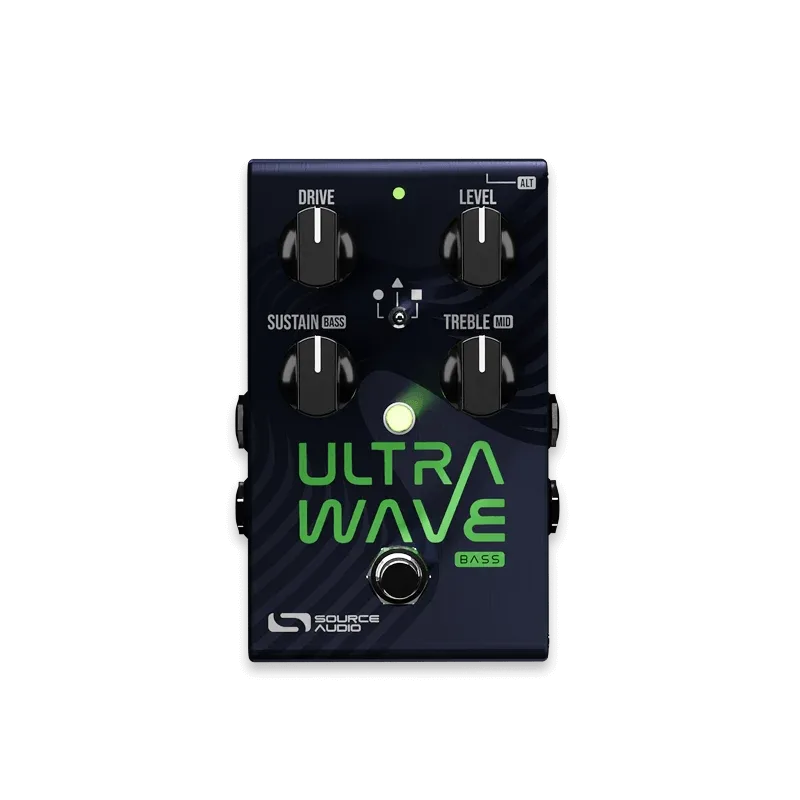
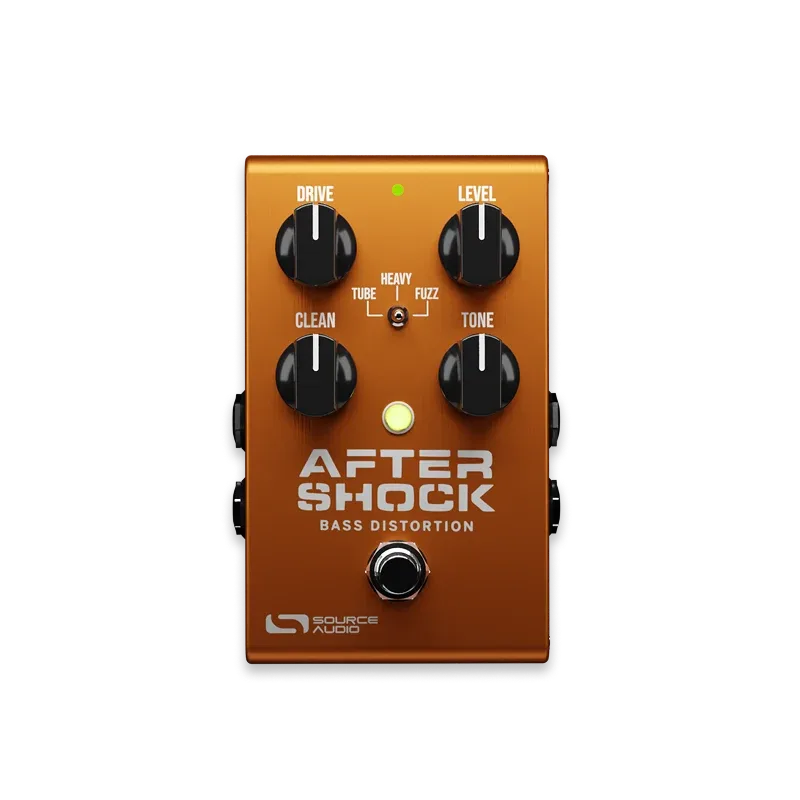
Source Audio announced the Soundblox 2 OFD Guitar and Bass microModelers as available in October 2013, with a street price of $16931. The pedals joined a Soundblox 2 line that Premier Guitar's reviewer said "must be contenders for the function-to-size ratio championship," referring to how much control Source Audio packs into the series' small enclosures1. Source Audio has since built on the same territory with later pedals such as the Source Audio Ultrawave and the Source Audio AfterShock Bass Distortion.
What reviewers said
Premier Guitar's reviewer came away positive on the modeling itself: "Most settings capture the essence of the effects they emulate. Clearly, Source Audio put a lot of time into crafting the" models, the review states, praising the quality and quantity of the amp and fuzz sounds1. On the Fuzz Façade specifically, the reviewer found that "Like a Fuzz Face, 'Fuzz Façade' is extremely responsive to changes in guitar volume, making it great for veering from rhythm to lead" with the guitar's volume knob alone1.
Related pedals
- Source Audio Soundblox 2 OFD: the same pedal under its full Soundblox 2 name23
- Source Audio Soundblox Multiwave Distortion and Source Audio Soundblox2 Multiwave Distortion: earlier Soundblox-series distortion from the same maker
- Source Audio Ultrawave Distortion Lab: a later Source Audio take on drive and distortion
- For the wider field, see Distortion Pedals, Overdrive Pedals and Fuzz Pedals
Videos
ProGuitarShopDemos
sourceaudioeffects
Zachary Rizer
Questions
How many effect types does the Source Audio OFD have?
The OFD offers twelve overdrive, fuzz and distortion types, selected with the center knob. Premier Guitar's review counts models of classic and boutique pedals, including a Fuzz Face model called the Fuzz Façade, and Vintage Guitar notes models based on the Big Muff, Fuzz Face and Tube Screamer. The pedal was made in guitar and bass versions, each voiced for its instrument's frequency range.
Is the Source Audio OFD true bypass?
Yes, the OFD ships set to true bypass. Premier Guitar reports that you can switch it to a relay-based buffered mode by powering the pedal up with the right footswitch depressed, so players with long cable runs or complex boards have the option of a buffer instead.
Can you use an expression pedal with the OFD?
Yes. The OFD has a multi-function in/out jack that accepts an expression pedal, a MIDI connection, or Source Audio's own Hot Hand controller, according to Premier Guitar's review. That single jack covers several jobs that would otherwise need separate sockets.
What is the Fuzz Façade model on the OFD?
The Fuzz Façade is the OFD's model of a Fuzz Face. Premier Guitar's reviewer found that, like a real Fuzz Face, it is extremely responsive to changes in guitar volume, which makes it useful for moving from rhythm to lead tones using only the guitar's volume knob.
How do you save presets on the Source Audio OFD?
The OFD has two footswitches and stores two presets. To save a setting, you hold down the selected footswitch for a few seconds, as described in Premier Guitar's review. Each switch then recalls its stored sound.
Sources (3)
- Source Audio OFD Guitar microModeler Review, Premier Guitar, 2014-01-30
- Source Audio Launches Soundblox Effects, Vintage Guitar magazine, 2013-09-26
- The Soundblox 2OFD Micromodelers from Source Audio Now Available, Guitar Interactive Magazine, 2013-10-03