

The Source Audio Soundblox Multiwave Distortion is a digital distortion pedal that takes a different approach to gain. Instead of clipping the whole guitar signal at once, it divides the input into multiple frequency bands, distorts each band separately, and then recombines the signal1. The point of doing it that way is clarity: where a conventional distortion pedal can turn a complex chord into mush, the Multiwave keeps the notes separated. Premier Guitar's reviewer put it to the test and reported "a distorted guitar tone with an incredible amount of clarity between the notes," managing a complex G7b13+9 chord "with unbelievable clarity"1.
The pedal was part of Source Audio's first line of Soundblox pedals, announced in January 2008, and was described at the time as a completely new design rather than an evolution of the company's earlier Hot Hand products23. It carried a US RRP of $149.99 when the Soundblox line launched3, and Premier Guitar's review lists it at an MSRP of $159.991.
Multiband distortion that keeps chords clear
Multiband processing is the idea the whole pedal is built on. The signal is split into multiple frequency bands, each band is distorted on its own, and the bands are recombined at the output1. Because the intermodulation products that normally smear a chord never get a chance to interact across the full frequency range, each note keeps its own space. Source Audio's press material for the Pro version described the result as "a clear distortion with unprecedented" note articulation5.
This is a technique that only really exists in the digital domain, as Delicious Audio noted when covering the bass version: multiband distortion "would only be available in the digital domain"6. In the Soundblox Multiwave Distortion it runs on the SA601 56-bit digital signal processor with 24-bit A/D and D/A converters1.
Premier Guitar's reviewer found the approach did exactly what it promises for chord work1:
"The Multiwave Distortion definitely solves that problem. I pulled off a complex G7b13+9 chord through distortion with unbelievable clarity"
The same review noted the enclosure: a 4" x 7" footprint, a little larger than the average stompbox, in a turquoise finish with a modern design1.
The controls and distortion banks
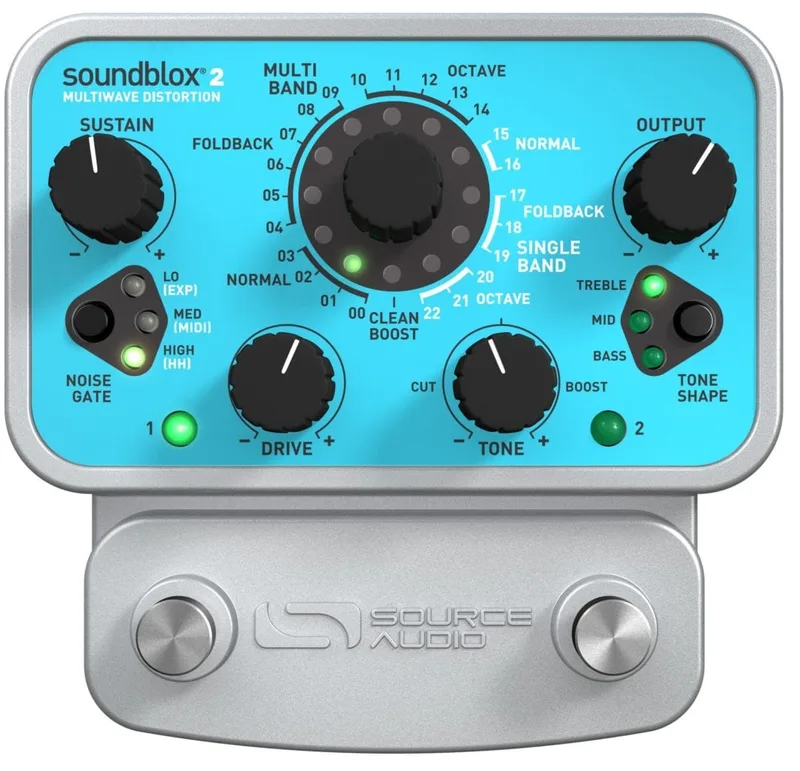
The front panel keeps things simple, with four controls: Sustain, Drive, Output and Effect Selection1.
| Control | What it does |
|---|---|
| Effect | Chooses effects within the Multi Band and Single Band distortion setting banks1 |
| Drive | Sets the amount of distortion47 |
| Sustain | Sets sustain1 |
| Output | Sets the output level1 |
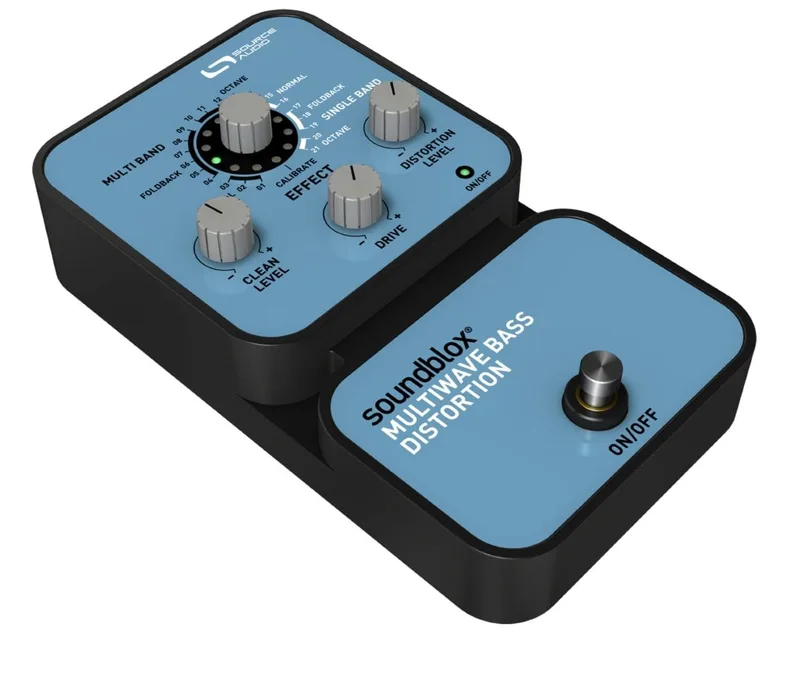
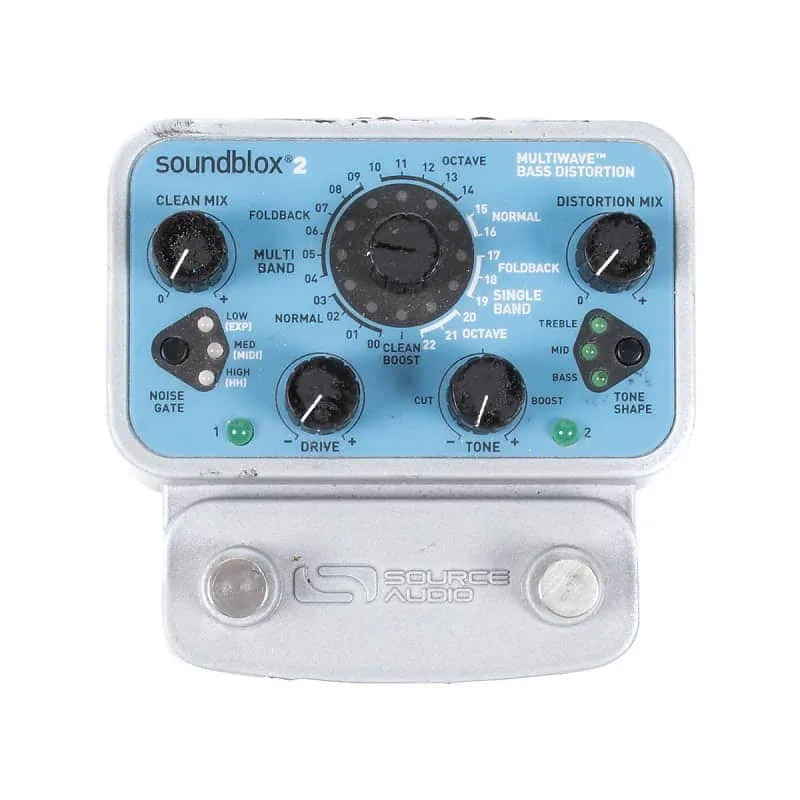
The Effect knob is where the pedal's range lives. The 21 effects are organized into two banks, Multi Band and Single Band, and each bank is divided into three groups: Normal, Foldback and Octave14. Premier Guitar described the spread at NAMM as ranging "from normal, for a somewhat traditional distortion curve, to extreme foldback and octave settings for more aggressive and synth-like tones"4. In other words, the Normal group covers conventional distortion territory, while Foldback and Octave push toward aggressive, synth-like sounds.
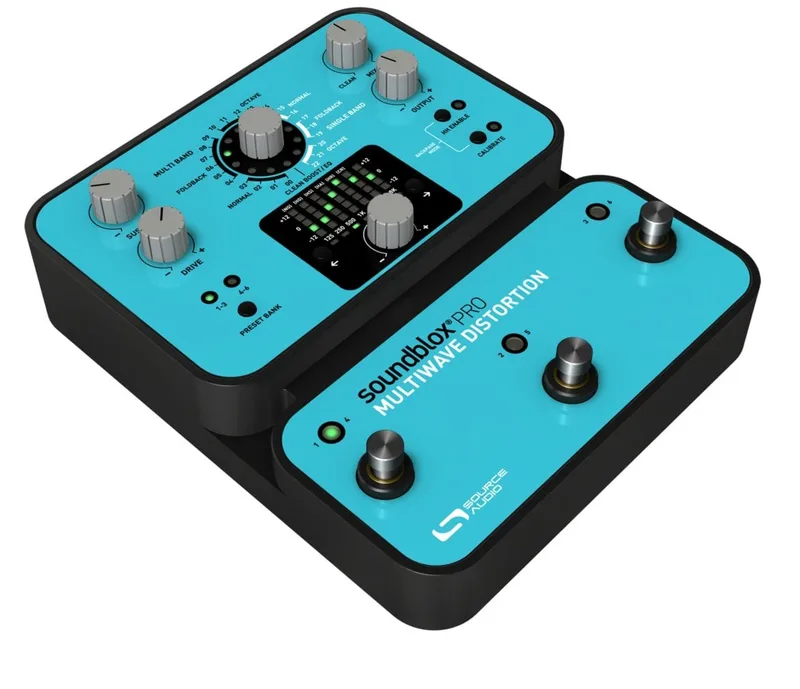
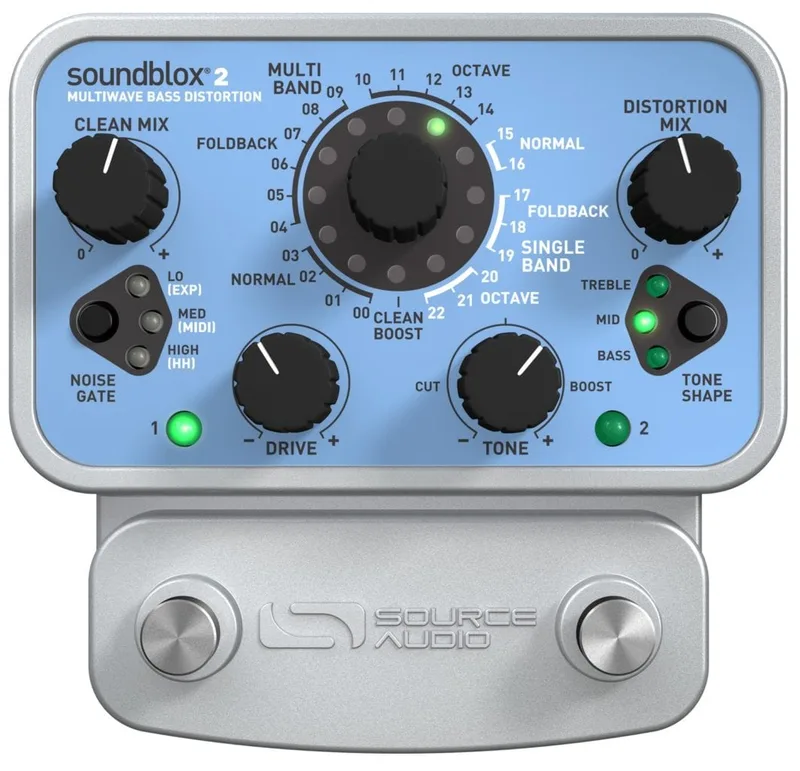
The 21 effects were positioned at launch as "truly unique and modern distortion effects" not found on typical distortion pedals2, and the pedal was later joined by a Pro version, the Soundblox Pro Multiwave Distortion, which expanded the count to 23 effect types5. The line continued in the Soundblox 2 era with the Soundblox2 Multiwave Distortion, which Performer Mag described as offering "23 varieties of unique distortion algorithms" with "tons of distortion modes from tube drive, to an octave fuzz, and pretty much everything in between"8.
Power and connections
The Soundblox Multiwave Distortion runs its effect in the digital domain but its bypass in analog. Premier Guitar's review describes "an active analog bypass, which is fully routed around the DSP and guarantees no signal loss"1. That is not the same as true bypass: the signal still passes through active circuitry when the pedal is off, though it never touches the converters. Later Soundblox 2 versions of the Multiwave design moved to what Source Audio calls Universal Bypass, a selectable buffered or true bypass system9.
The original Soundblox Multiwave Distortion runs on a 4"x7" footprint, a little larger than the average stompbox, in a cast-aluminum housing with a turquoise finish1. Its rear panel is straightforward: a Guitar In 1/4" jack, a Guitar Out 1/4" jack, and a connection for the Hot Hands sensor7.
The bass versions
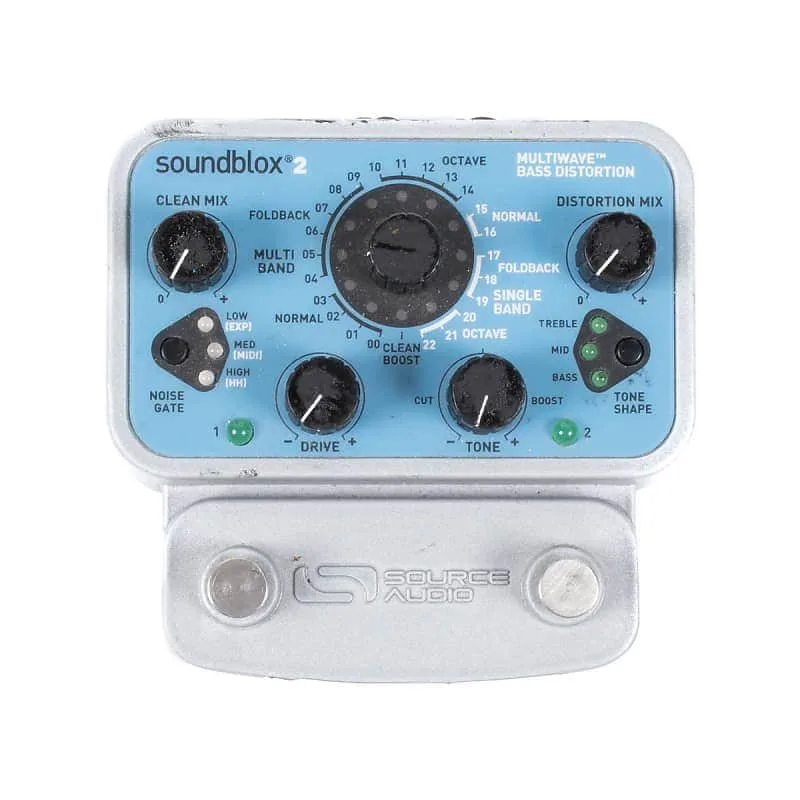
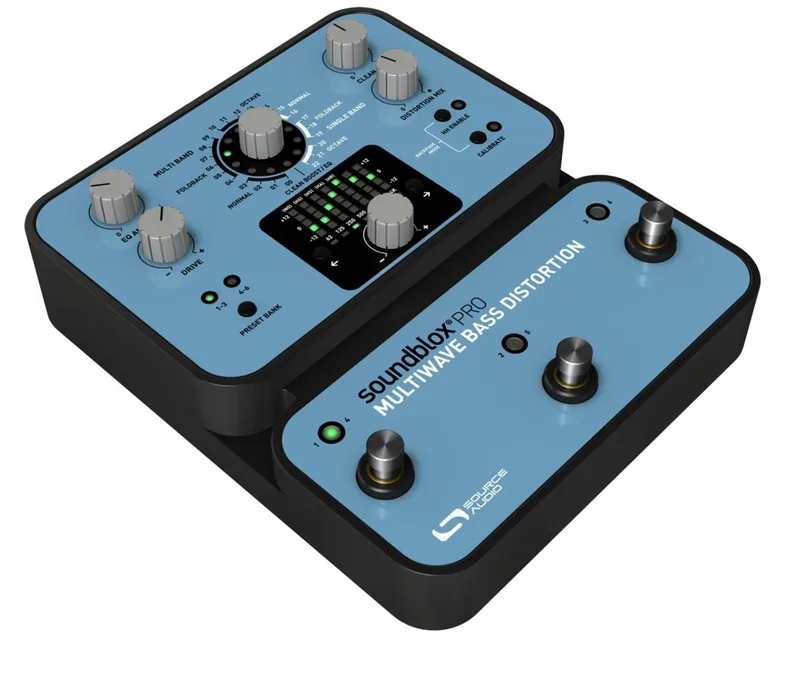
The multiband approach was adapted for bass almost immediately. The Soundblox Multiwave Bass Distortion uses the same multi-band process as the original guitar pedal, retuned to the bass frequency range, and Source Audio's material said it "alleviates the tendency for low-end reduction associated with most bass distortion units"4. It was offered alongside the programmable Soundblox Pro Multiwave Bass Distortion, which added six memory presets, a seven-band graphic EQ, MIDI control over parameters, and a connection for the Hot Hands motion sensor7.
MusicPlayers.com's John Montalbano reviewed the bass version and found its multiband algorithm divided the input into ten frequency bands, distorted each separately, then recombined them, awarding it an overall rating of 3.6 and a WIHO Award7. The design carried into the Soundblox 2 Multiwave Bass Distortion, which Premier Guitar later described as "an excellent tool for adding grind and grit to your bass tone," noting that its multi-band modes are "just the ticket for keeping even the wildest distortions tight and crisp"9. Bass players today can also look at the later AfterShock Bass Distortion and Ultrawave lines from the same maker.
Videos
sourceaudioeffects
Leon Todd
Gearfacts
Questions
Is the Source Audio Multiwave Distortion analog or digital?
It is a digital pedal. The Soundblox Multiwave Distortion uses Source Audio's SA601 56-bit digital signal processor with 24-bit analog-to-digital and digital-to-analog converters. The bypass path, however, is analog: an active analog bypass routes the signal fully around the DSP so there is no signal loss when the effect is off.
Is the Soundblox Multiwave Distortion true bypass?
No. The original Soundblox Multiwave Distortion uses an active analog bypass, which Premier Guitar described as fully routed around the DSP and guaranteeing no signal loss. Later Soundblox 2 versions moved to a selectable buffered or true bypass system Source Audio calls Universal Bypass.
How many distortion types does the Multiwave Distortion have?
The original Soundblox Multiwave Distortion gives guitarists 21 distortion effects, organized into Multi Band and Single Band banks that are each divided into Normal, Foldback and Octave groups. The Pro version expanded this to 23 effect types, and the Soundblox 2 Multiwave Distortion carried those 23 algorithms forward.
Does the Multiwave Distortion work on bass?
Source Audio built a dedicated bass version using the same multiband process adapted to the bass frequency range. The Soundblox Multiwave Bass Distortion was designed to counter the low-end loss typical of bass distortion units, and the line continued through the Soundblox 2 Multiwave Bass Distortion.
Sources (9)
- Review: Source Audio Soundblox Multiwave Distortion, Premier Guitar, 2008-08-06
- Source Audio's New Soundblox Pedals, Premier Guitar, 2008-01-14
- New Soundblox pedals offer unique sounds, MusicRadar, 2008-01-10
- NAMM-Source Audio Multiwave Distortion Demo & More, Premier Guitar, 2010-02-18
- Source Audio Unveils Soundblox Pro Pedals at NAMM 2010, Premier Guitar, 2010-01-06
- Review: Audio Source Multiwave Bass Distortion, Delicious Audio, 2012-07-22
- Source Audio Soundblox Multiwave Bass Distortion Pedal, MusicPlayers.com, 2011-08-11
- Source Audio SoundBlox 2 Multiwave Distortion Pedal Review, Performer Mag, 2014-11-20
- Soundblox 2 Multiwave Bass Distortion Pedal Review, Premier Guitar, 2012-09-05