

The Strymon La Brea Tape Saturation Drive is an all-analog overdrive pedal from Strymon, announced on 29 September 2026 as the third pedal in the company's Series A line of analog effects1. Where most Strymon drives and saturators have been digital designs, the La Brea is, in Strymon's own words, "completely analog and discrete"2.
What it does for your sound is tape-style saturation: Strymon says it uses multi-stage tape saturation techniques to cover everything from mild breakup to borderline fuzz, with natural compression3. Guitar Pedal X described the result as "a full-range analog overdrive - with that elegant warm saturated edge"1. The pedal grew out of the tape saturation side of Strymon's Deco pedal, but with significantly more gain on tap2.
What the La Brea does
The La Brea is a tape-style drive pedal, fully analog, built around independent tape saturation and clean circuits. Pedal of the Day reports that this split gives the pedal "versatile dynamics interaction with added high-frequency shaping," meaning the saturated and clean paths can be balanced against each other rather than the whole signal being clipped at once5.
The range is wide. Strymon's announcement says the multi-stage saturation covers "everything from mild breakup to borderline-fuzz, with" natural compression3, and gearnews found the Gain switch makes it easy to dial in "anything from a polite, low-gain crunch to wildly aggressive, fuzz-like textures"6. For a player, that means one knob can sit the pedal anywhere between a light edge on a clean amp and a saturated, fuzz-adjacent texture, with the tape-style compression smoothing the attack as a tape machine would.
Controls: the Shift EQ and Gain switch
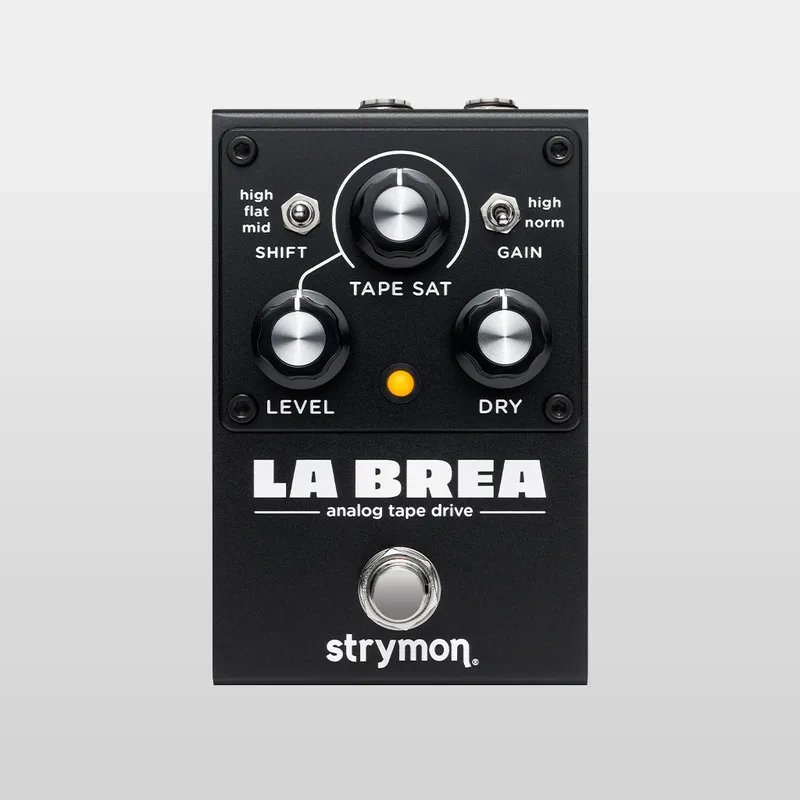
The La Brea keeps its control set compact, with two switches doing much of the voicing work.
| Control | Settings | What it does |
|---|---|---|
| Shift (EQ) | High / Flat / Mid | High increases the high end for added sparkle; Flat gives a flat full-frequency response; Mid increases the high midrange for added bite4 |
| Gain switch | High / Norm | Determines the gain range for the Tape Sat control; High generates significantly more gain than Norm4 |
| Tape Sat | Set by the Gain switch | The saturation control, whose range depends on the Gain switch position4 |
The Shift switch is the pedal's voice-shaping toggle. Delicious Audio calls it an "onboard voice-shaping toggle" that provides "instant high-frequency or combined mid-and-high boosts to cut effortlessly through" a live mix7. In practice: leave it Flat for the pedal's natural full-range character, flip it to High for a treble lift that helps a dark amp or a bass-heavy guitar, or use Mid to push the upper midrange where a guitar cuts in a band mix. Guitar World notes the Mid position is "for adding upper midrange frequencies," with Flat as the neutral setting8.
The Gain switch works a level below that, setting how hard the Tape Sat control can push. Strymon says the High position "generates significantly more gain than" Norm4, so Norm suits low-gain crunch and High opens up the aggressive, fuzz-like end of the range that gearnews described6.
Where the La Brea came from: the Deco connection
The La Brea's circuit has a documented lineage. Strymon says analog engineer Josh Forbes read the white paper that Pete Celi wrote on the development of the Deco, and began "experimenting with some of the tape-centric techniques used in Deco in a full analog drive pedal design"4. The product page describes the result as "All-analog tape saturation drive initially inspired by our classic Deco pedal's Saturation voices"4.
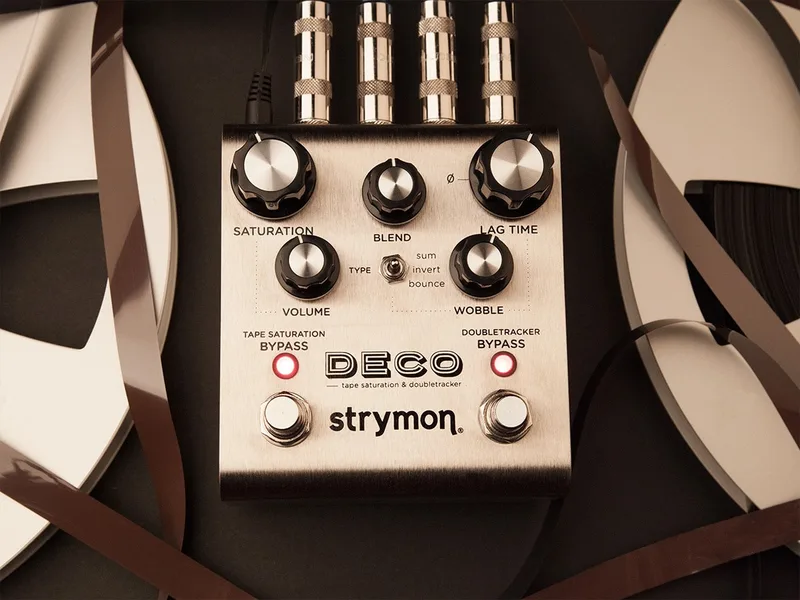
The Deco itself is a different animal. Premier Guitar's review of the Deco Tape Saturation & Doubletracker located its sound in "the big-ass SHARC DSP chip where the magic happens"9, meaning the Deco models tape behavior digitally, while the La Brea implements its saturation in analog circuitry. Strymon's own FAQ on the two pedals states plainly that "La Brea offers significantly more gain than Deco"2. So a Deco owner gets tape saturation plus doubletracking effects in a digital pedal at $379 for the V210, while the La Brea is a focused, higher-gain, all-analog drive at $199.
The Series A line
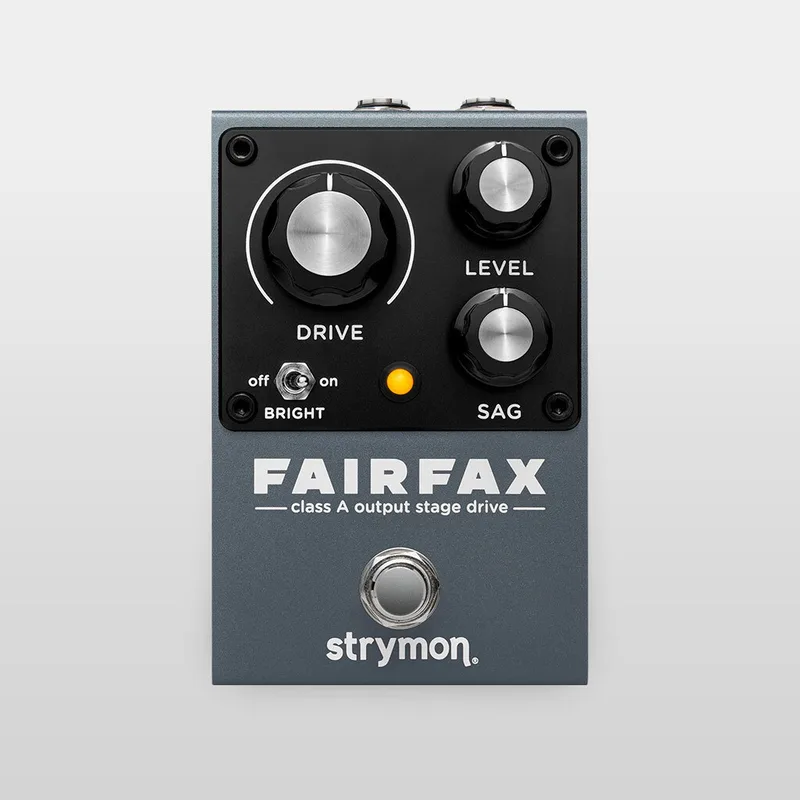
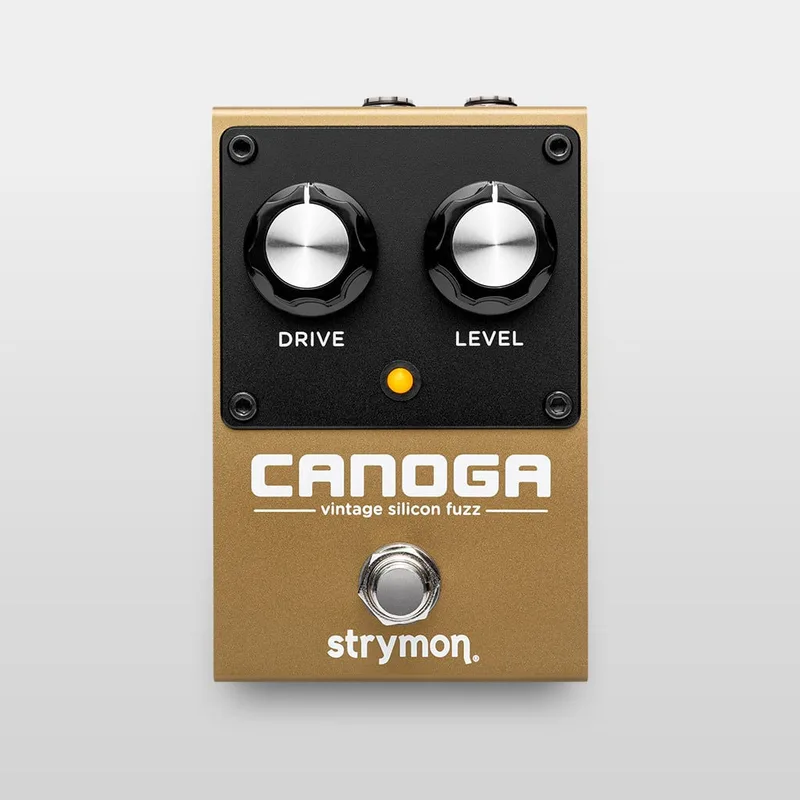
The La Brea is the third pedal in Strymon's Series A, the company's line of all-analog pedals31. The line began with the Fairfax Class A Output Stage Drive, released 9 December 2025, followed by the Canoga Vintage Silicon Fuzz111. GuitarPlayer reported at the Fairfax launch that Strymon planned "a number of pedals in the line by the end of next year"11.
Guitar Pedal X's reviewer placed the La Brea high among them: "This is probably the most appealing of the Series-A pedals, I'm still aiming to get the Fairfax at some stage, but I wou" place the La Brea first on the priority list1.
Price and availability
The La Brea sits in Strymon's Series A line, and reviewers have weighed it against its siblings: the reviewer at gearnews called it "probably the most appealing of the Series-A pedals, I'm still aiming to get the Fairfax at some stage, but I wou" place it higher on the priority list than the Fairfax for overall appeal1. Guitar Pedal X describes the pedal as delivering "a full-range analog overdrive - with that elegant warm saturated edge"1.
Videos
strymon
strymon
Peter “Danish Pete” Honoré
Questions
Is the Strymon La Brea analog or digital?
The La Brea is completely analog and discrete. It is part of Strymon's Series A line of all-analog pedals, which began with the Fairfax drive in December 2025. This sets it apart from the Deco, whose tape saturation is modeled digitally on a DSP chip29.
How much does the Strymon La Brea cost?
The La Brea lists at $199.00 USD from the Strymon Webstore, the same price Strymon has set across the Series A line. In Europe, gearnews reported it at 229 EUR416.
What does the Shift switch do on the La Brea?
Shift is a three-position EQ voicing switch. High boosts the top end for added sparkle, Flat gives a flat full-frequency response, and Mid lifts the upper midrange for added bite. Delicious Audio describes it as a way to cut through a live mix47.
Is the La Brea based on the Deco?
Yes, in lineage. Strymon says analog engineer Josh Forbes read Pete Celi's white paper on the development of the Deco and began experimenting with its tape-centric techniques in a fully analog drive circuit. The La Brea offers significantly more gain than the Deco32.
How many Series A pedals has Strymon released?
Three so far: the Fairfax Class A Output Stage Drive, the Canoga Vintage Silicon Fuzz, and the La Brea Tape Saturation Drive. Strymon launched the line in December 2025 and has said more pedals are planned111.
Where can I buy the Strymon La Brea?
Direct from the Strymon Webstore or from Strymon's international dealers. Gearnews also reported it available to order from retailers such as Thomann and Sweetwater at launch36.
Sources (11)
- Guitar Pedal X, Guitar Pedal X, 2026-10-01
- How are La Brea and Deco different?, Strymon, 2026-09-30
- Introducing La Brea Analog Tape Drive, Strymon (www.strymon.net), 2026-09-30
- La Brea Analog Tape Drive, Strymon
- Strymon La Brea Analog Tape Drive, Pedal of the Day, 2026-09-29
- Strymon La Brea Analog Tape Drive: Inspired by the Deco, gearnews.com, 2026-09-29
- New Pedal: Strymon La Brea Analog Tape Drive, Delicious Audio, 2026-09-29
- Strymon continues the Deco legacy with La Brea analog tape drive, Guitar World, 2026-09-30
- Strymon Deco Tape Saturation & Doubletracker Review, Premier Guitar, 2015-02-19
- Artist Feature: Harrison Whitford, Strymon (www.strymon.net), 2021-05-07
- Strymon announces Fairfax drive pedal and Series A line, GuitarPlayer (www.guitarplayer.com), 2025-12-09