

The Strymon Riverside Multistage Drive is a Strymon drive pedal that covers the whole span from clean boost to saturated distortion. Guitar World described it at launch as "from silky clean overdrive to colossal distortion and all points between," equally at home with sparkling cleans, mild overdrives, high-gain leads and heavy saturated distortions1. In Strymon's own demo video, Ethan Tufts calls it a pedal that can be "truly thought of as an 'amp in a box'"2.
What sets Riverside apart from a conventional overdrive is its multistage topology. Delicious Audio says the design came out of "a thorough analysis of numerous analog and vacuum tube circuits," and because of that multistage circuit, the company says it goes well beyond simple overdrive pedal territory3. It is a hybrid: an analog JFET front end that responds to your guitar's dynamics and feel, feeding digital gain stages13.
From clean boost to saturated distortion
The core idea is that Riverside is not one drive circuit with a volume control, but a series of gain stages that are retuned as you turn the Drive knob. As Guitar World put it, "As the Drive knob is turned, Riverside makes continuous adjustments, tuning the circuit for optimum tone"1. Delicious Audio repeats the same description: turning the Drive knob makes continuous adjustments, tuning the circuit for optimum tone3. In practice that means the pedal is voiced to stay usable across its whole range rather than only sounding good in one spot.
Strymon positions the result as an amp-in-a-box rather than a stompbox overdrive. In the maker's demo video, the signal path was Riverside into the Deco and then a Strymon BigSky with the speaker cab filter engaged and no reverb, straight into a recording interface, showing the pedal used as a full amp-style front end2.
Controls and switching
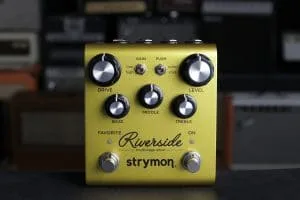
Guitar Pedal X lists the full control set7:
| Control | What it does |
|---|---|
| Drive | Sets the amount of drive; the circuit retunes itself continuously as it turns13 |
| Gain | Low / High, selects the gain range7 |
| Push | Norm / Mid, a midrange push option7 |
| Level | Output volume7 |
| Bass, Middle, Treble | Three-band EQ7 |
| Presence switch | Three positions, tailors the highest frequencies so the pedal integrates with any amp, however dark or bright3 |
| Favorite footswitch | Recalls a stored knob setting7 |
| On footswitch | Engages and bypasses the pedal7 |
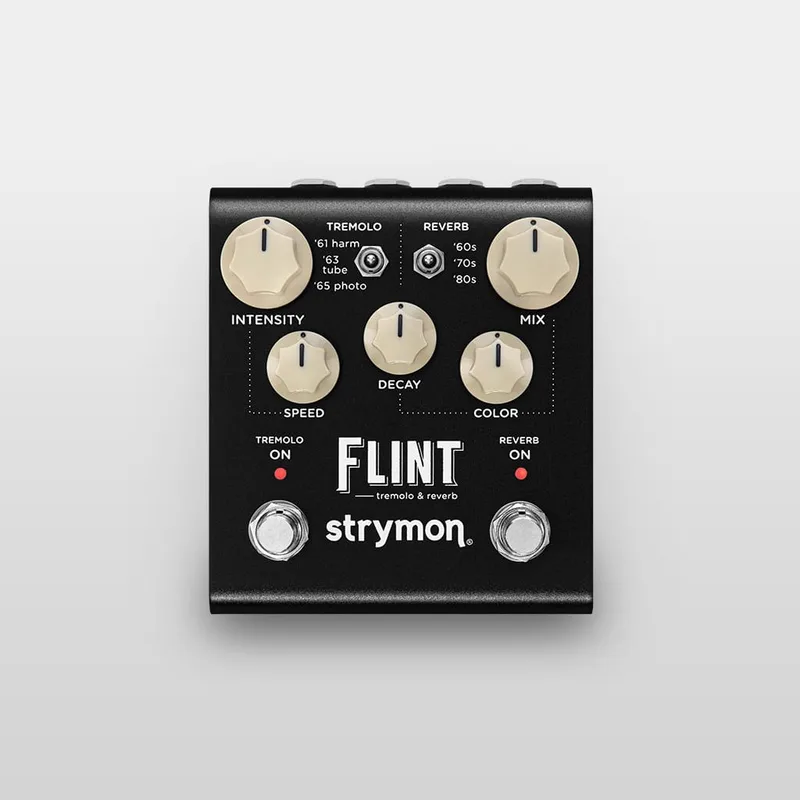
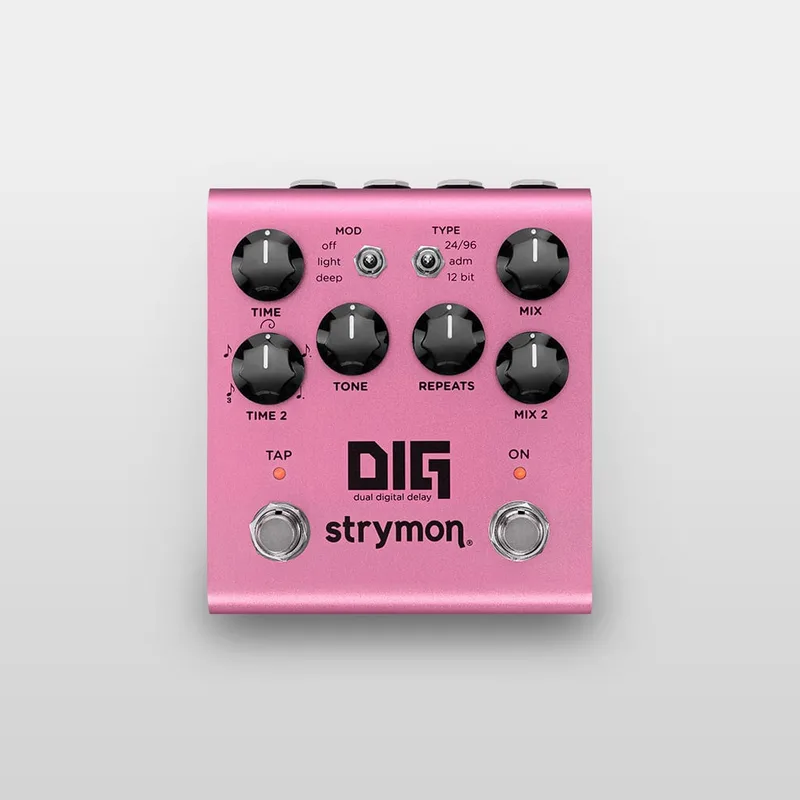
The twin-footswitch format is shared with other Strymon pedals such as the DIG and Flint, as MusicRadar noted when the pedal was teased6. The Favorite footswitch is the second switch: it stores a setting of the knobs so you can jump between two sounds without bending down, for example a low-gain rhythm setting and a boosted lead.
Riverside also has an expression input that offers control of any or all of the knobs, so a single expression pedal can sweep, for instance, Drive for volume-style swells or gain rides4.
Analog, digital, or both
Strymon's answer to the analog-versus-digital question is direct. Delicious Audio quotes the company's own line31:
"Digital or analog? We chose both."
Delicious Audio, on Strymon's Riverside page3
The analog part is the JFET front end, chosen so the pedal responds to your guitar's dynamics and feel the way a tube amp's input stage does3. The gain stages themselves are a mix of analog and digital1. GuitarPlayer's 2025 buying guide adds MIDI functionality to the feature list, which puts Riverside in the category of drive pedals that can be integrated into a larger programmable rig5.
Where it came from
Strymon teased the Riverside in October 2016, with MusicRadar noting the yellow enclosure and the twin-footswitch format shared with the DIG and Flint, and expecting it to appear at the company's annual Strymon Social on Saturday 22 October 20166. MusicRadar then reported it as available from November 2016 at £299/$299/€3494. Guitar World reported it sold directly through the Strymon online store and through select authorized Strymon dealers1. Guitar Pedal X dates the pedal to 2017, with a US list price of $2997.
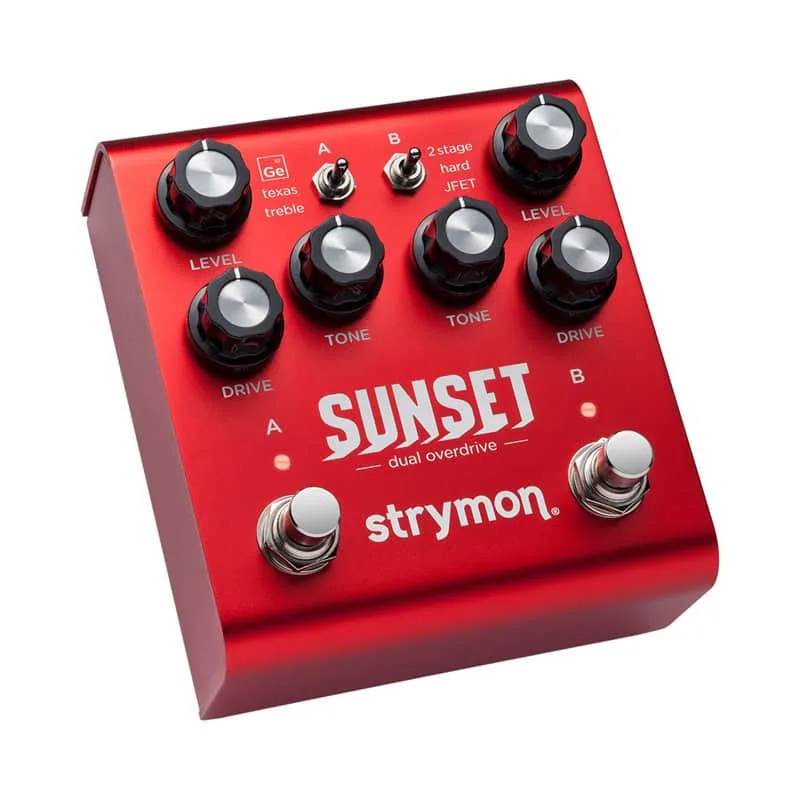
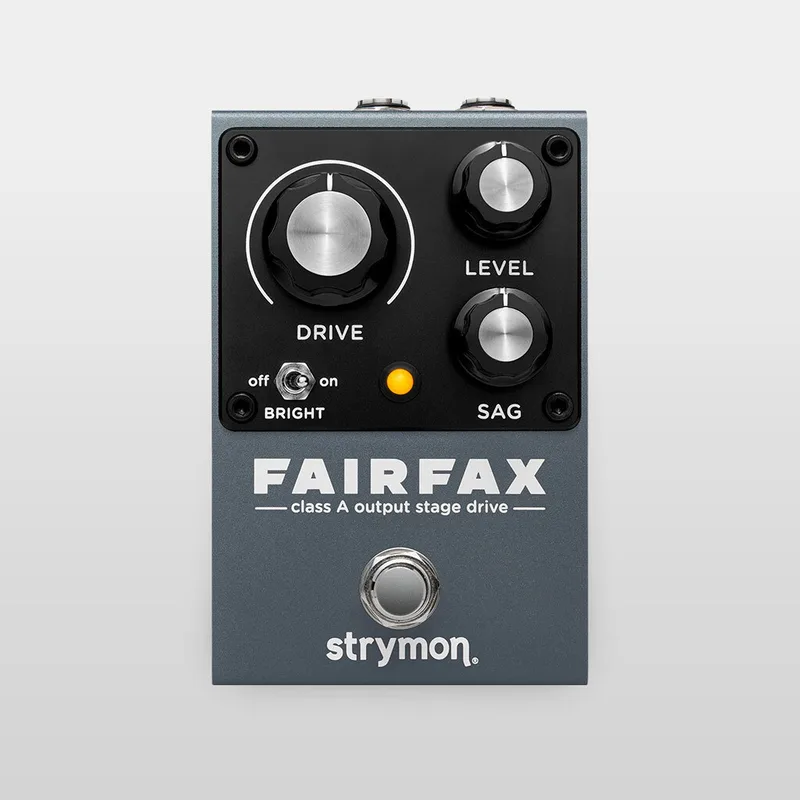
Strymon has since built out its drive line in other directions: the Strymon Sunset Dual Overdrive takes a two-stage approach, and the all-analog Series A pedals, such as the Strymon Fairfax and the Strymon La Brea Tape Saturation Drive, go the fully analog route that Riverside deliberately does not.
What reviewers said
Guitar Pedal X's Stefan Karlsson reviewed the Riverside in a piece on the Boss BD-2 Blues Driver and its relatives, and his verdict was positive on the Blues Driver comparison7:
"this has just the right core tonality, calibration and range to deliver fantastic Blues Driver style tones"7
Stefan Karlsson at Guitar Pedal X found the Riverside delivers convincing Blues Driver style tones, writing that "this has just the right core tonality, calibration and range to deliver fantastic Blues Driver style tones"7. He called it a long-term favorite and found it very easy to dial in7.
He also called it a long-term favorite and very easy to dial in7. So while Riverside is not a Blues Driver clone, a reviewer who knows the BD-2 family well found it can cover that ground convincingly, alongside the higher-gain settings a BD-2 cannot reach.
GuitarPlayer's 2025 distortion pedal buying guide still lists the Riverside among its picks, noting its MIDI functionality, switchable bypass and 9V DC power5.
Videos
Sweetwater
strymon
strymon
Questions
Is the Strymon Riverside analog or digital?
Both. Strymon describes it as a hybrid design: an analog JFET front end that responds to your guitar's dynamics and feel, feeding digital gain stages. The maker's own line on the question is "Digital or analog? We chose both."
Does the Riverside have MIDI?
Yes. GuitarPlayer's 2025 drive pedal buying guide lists MIDI functionality among the Riverside's features, alongside its switchable bypass and 9V DC power. That makes it usable from a larger MIDI-controlled rig.
Is the Strymon Riverside true bypass?
GuitarPlayer lists its bypass as switchable rather than fixed true bypass. That means you can choose between bypass modes, which is useful if you want the pedal buffered in a long signal chain or cleanest possible bypass.
What does the Favorite footswitch on the Riverside do?
The Riverside uses a twin-footswitch format, with an On footswitch and a Favorite footswitch. Favorite lets you recall a stored setting of the knobs, so you can jump between two sounds, for example a clean-ish setting and a high-gain one.
Does the Riverside sound like a Blues Driver?
According to Guitar Pedal X's reviewer, it can. He found it has the right core tonality, calibration and range to deliver fantastic Blues Driver style tones, and called it a long-term favourite that is very easy to dial in.
Sources (7)
- Strymon Announces Riverside Multistage Drive Pedal, Guitar World, 2016-12-14
- Riverside Drive and Deco Doubletracker, Strymon, 2016-12-29
- Strymon Riverside Multistage Drive, Delicious Audio, 2023-05-08
- Strymon takes a new approach to overdrive with Riverside Multistage Drive pedal, MusicRadar, 2016-10-24
- Best distortion pedals: dirty up your tone, GuitarPlayer (www.guitarplayer.com), 2022-08-26
- Strymon teases Riverside Multistage Drive guitar effects pedal, MusicRadar, 2016-10-21
- Guitar Pedal X, Guitar Pedal X, 2024-01-26