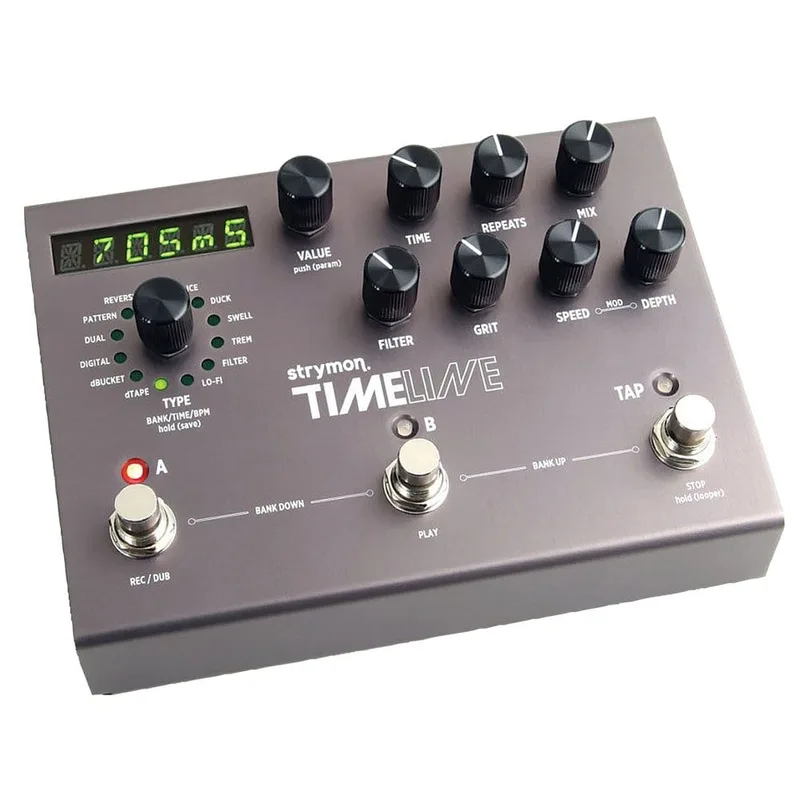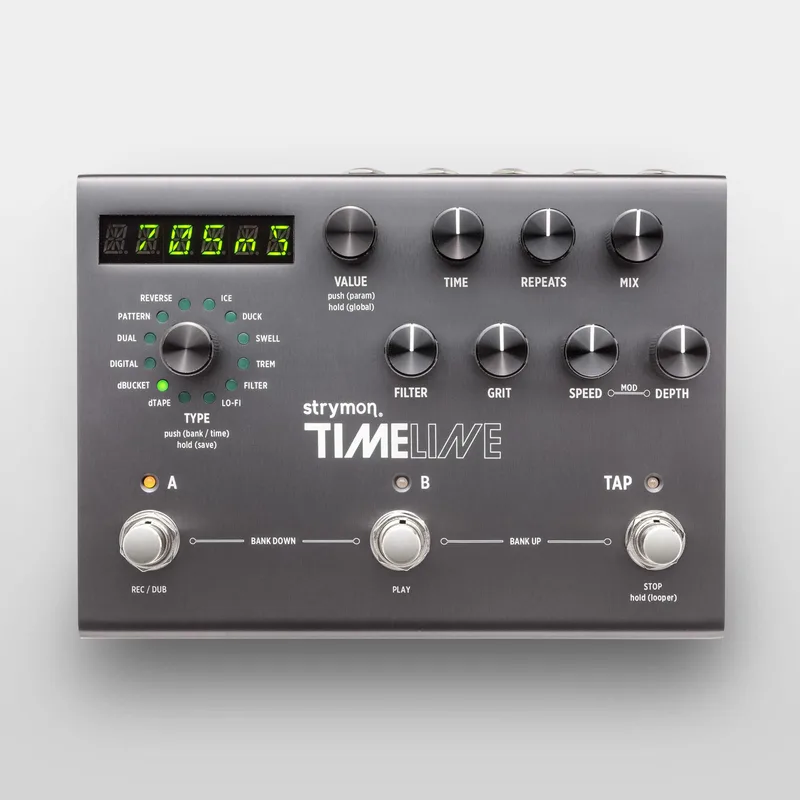


The Strymon TimeLine MX Multi Delay is the company's flagship delay pedal, released on 7 July 2026 as an upgraded version of the long-running TimeLine. It carries 12 delay machines, dual-engine processing that runs two of them at once, a five-minute stereo looper, and full MIDI control over USB-C, TRS, or DIN connections123. Strymon describes it as delivering "stunning studio quality delays and a host of new professional features in an elegant and intuitive stage-ready design"1.
Where the original TimeLine ran one delay machine at a time, the MX runs two simultaneously, with series, parallel, and split routing, all in a stereo pedal with TRS jacks throughout34. Guitar World called it a stereo delay pedal with 12 engines, dual simultaneous engines, a five-minute looper, and MIDI, available at launch for $67935.
What the TimeLine MX does
The TimeLine MX is a delay workstation: a single pedal that models many kinds of delay, from digital clarity to tape-style echo, and lets you stack two of them at once. Its 12 delay machines cover the range of the original TimeLine plus new engines, and Guitar Pedal X counts 12 core delay and reverb engines in total5. Delay times vary by machine: the Digital and Multitap machines each span 60 to 2500ms, and the Reverb machine offers 2 to 2500ms of pre-delay with 40 or more seconds of decay9.
The Multitap machine is one of the deepest of the set. Strymon describes it as an eight-tap delay with per-tap control over pan, level, feedback, filter type and cutoff frequency, with built-in or user patterns, configurable as eight parallel delay lines1. Pedal of the Day found it offers "an endless variety of multitap patterns perfect for both rhythmic and ambient uses"4.
Under the hood, Guitar World reports a tri-core ARM processor keeps everything running3, and the pedal carries a bright OLED screen that Pedal of the Day found easy to read even in harsh conditions, with user-friendly navigation4.
"One of the most powerful delay machines out there, the MX takes everything to a new level, in all the best ways."
Dual engines and routing
The headline feature over the original TimeLine is dual-engine processing: two delay machines running at the same time. The two engines can be routed in series, parallel, or split (right/left) modes, and each engine can be panned individually4. Guitar World describes the routing options as "fully expansive series, parallel, and split routing options with full stereo and MIDI support"3.
The original TimeLine had a Dual Delay machine with two independent delay lines configurable in series or parallel, where the second delay had its own Mix, Repeat, and Time values and could track the first delay's knob settings10. The MX generalizes that idea across the whole pedal, so any two of the 12 machines can be combined.
Stereo is built in from the jack plate out. All jacks are TRS stereo, and the pedal supports stereo I/O with a hardware insert24. Gearnews notes the TRS connections allow mono, stereo, wet/dry, or full wet/dry/wet rigs, including stereo or mono effects send and return7.
| Routing option | What it does |
|---|---|
| Series | Second engine feeds from the first |
| Parallel | Both engines run side by side |
| Split | Engines split right and left, individually pannable4 |
| Hardware insert | Stereo I/O with an insert point for other effects2 |
The controls and footswitches
The front panel carries nine control knobs and three footswitches3. One of the three is a dedicated TAP footswitch that blinks to show the current delay type's tempo; holding it enters Looper mode, where it works with the one-button looper15.
The EXP port expands control further. With a MultiSwitch accessory connected, the three footswitches can be assigned per mode: in Preset mode they load presets (footswitch A loads preset 0B, B loads 1A, C loads 1B), and in EXP Preset mode they step presets up and down. In Looper mode the MultiSwitch footswitches can access six looper functions, and the port can also be set to TRS MIDI for preset access and parameter control from an external controller11.
| Control | Function |
|---|---|
| Nine knobs | Delay and engine parameter control3 |
| TAP footswitch | Sets Delay Time, blinks at tempo, hold to enter Looper mode1 |
| Footswitches A/B/C | Preset selection, looper functions, or preset up/down depending on mode11 |
| EXP port | MultiSwitch accessory, expression, or TRS MIDI11 |
The three footswitches can also be extended with the MultiSwitch Plus: in Preset mode, Footswitch A loads preset 0B, Footswitch B loads preset 1A, and Footswitch C loads preset 1B11. In EXP MODE: PRESET, Footswitch A steps presets down and Footswitch C steps them up11. The MultiSwitch device's footswitches can also access six Looper functions, depending on whether TimeLine MX is set to Looper mode, which you enter by pressing and holding TAP for 3 seconds11.
Looper, price, and how it differs from the original TimeLine
The looper is a five-minute stereo version, a big jump from the original TimeLine's 30-second stereo looper, which was routable pre- or post-delay with MIDI capability310. Gearnews reports half-speed and reverse looper options available via MIDI7.
On price: Strymon announced the TimeLine MX at $679 at launch, and Guitar World and MusicRadar reported the same figure (MusicRadar's UK price was £699)2312. Gearnews listed it at $749 from a retailer at launch, against the maker's announced price of $6797. The original TimeLine Multi Delay was $449 as of 2023, so the MX sits at a higher tier13.
Strymon frames the MX as "the most powerful version of TimeLine yet, with 12 delay machines, dual engine processing, a five minute stereo looper"8, and says that while the original TimeLine is already capable of so much, the MX "received a full suite of upgrades and functionality additions that help it do even more"14. MusicRadar's reviewer summed up the sound as "Superb quality delay algorithms"15.
Videos
strymon
strymon
strymon
News
Questions
How much does the Strymon TimeLine MX cost?
Strymon announced the TimeLine MX at $679 when it launched in July 2026, and Guitar World reported the same $679 price. Gearnews listed it at $749 from a retailer at launch, so street prices vary depending on the seller. For comparison, the original TimeLine Multi Delay was $449 in 2023.
Does the TimeLine MX have a looper?
Yes. The TimeLine MX has a five-minute stereo looper, up from the 30-second stereo looper on the original TimeLine. Gearnews reports half-speed and reverse looper options available via MIDI, and the looper is accessed by holding the TAP footswitch.
Can the TimeLine MX run in stereo?
Yes. All of its jacks are TRS stereo, and it supports stereo I/O with a hardware insert. You can run it mono, stereo, wet/dry, or a full wet/dry/wet rig, with stereo or mono effects send and return.
Can I control the TimeLine MX with MIDI?
Yes. The TimeLine MX accepts MIDI over USB-C, TRS, or DIN connections, so you can change presets and control parameters from an external MIDI controller. Firmware updates in 2026 added MIDI CC assignments, MIDI clock, and a save-preset MIDI command.
How many delay machines does the TimeLine MX have?
The TimeLine MX has 12 delay machines, and its dual-engine processing lets you run two of them at the same time. Delay time ranges vary by machine: the Digital and Multitap machines go from 60 to 2500ms, and the Reverb machine offers 2 to 2500ms of pre-delay with 40 or more seconds of decay.
What is the difference between the TimeLine and the TimeLine MX?
The TimeLine MX is an upgraded version of the original TimeLine, which Strymon describes as receiving a full suite of upgrades and added functionality. The MX adds dual-engine processing, a five-minute stereo looper (up from 30 seconds), a new reverb engine, a tri-core ARM processor, and stereo TRS I/O with a hardware insert.
Sources (15)
- TimeLine MX Multi Delay, Strymon (www.strymon.net), 2026-07-07
- TimeLine MX Has Arrived!, www.strymon.net, 2026-07-07
- Strymon's TimeLine MX might be the most advanced delay pedal on the planet, Guitar World, 2026-07-09
- Strymon TimeLine MX Multi Delay, Pedal of the Day, 2026-07-07
- Guitar Pedal X, Guitar Pedal X, 2026-07-08
- Products Landing Page, Strymon (www.strymon.net), 2026-09-29
- Strymon TimeLine MX: The Ultimate Delay Pedal?, gearnews.com, 2026-07-08
- TimeLine Family Page, Strymon, 2026-10-08
- What are the delay time ranges for TimeLine MX?, Strymon
- TimeLine Multi Delay, Strymon (www.strymon.net), 2026-10-08
- How can I use TimeLine MX's EXP port?, Strymon
- Strymon unveils TimeLine MX, the "most powerful delay ever", MusicRadar, 2026-07-08
- Strymon's push towards compact pedals continues with its most affordable delay unit yet, Guitar World, 2023-07-19
- What's new with TimeLine MX?, Strymon
- Strymon TimeLine MX review, MusicRadar, 2026-10-07