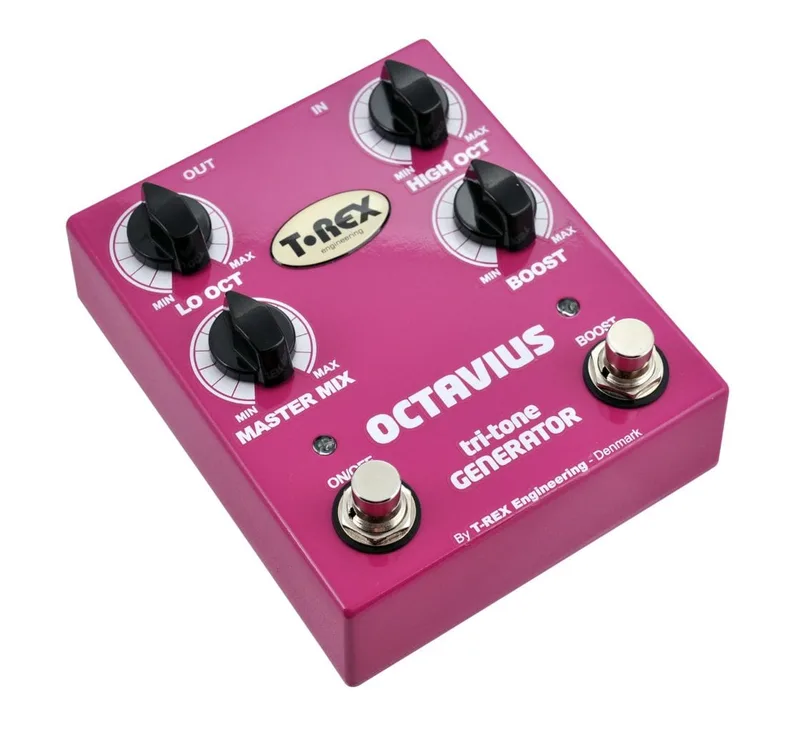


The T-Rex Octavius, sold as the Octavius Tri-Tone Generator, is a polyphonic octave divider pedal from T-Rex. It produces an octave above and an octave below your guitar's signal while maintaining the original, giving you three voices at once: your dry note, one octave up and one octave down1. T-Rex pitches it as a way to "triple your impact," and the maker describes its tone as warm and vintage sounding2.
Because both generated octaves and the direct signal each get their own level control, the pedal works as anything from a subtle thickener to a full three-voice stack. Premier Guitar's reviewer found that mixing the three sounds creates "a wide assortment of big, fat doubling effects, and thicker-than-thou guitar lines"1.
What the Octavius does
An octave divider, or octave and pitch pedal, generates new notes at fixed intervals from what you play rather than shifting pitch over time like a vibrato. The Octavius generates one octave up and one octave down from your input, and keeps your original signal in the mix1. T-Rex calls the result a tri-tone generator: three tones from one note2.
The feature T-Rex emphasizes most is tracking speed. The maker states the pedal "reacts on the spot" with no latency, on chords as well as single notes2. That claim matters because many octave pedals, especially analog octave-down circuits, track only single notes cleanly and glitch when you play chords. Premier Guitar's 2010 review backed the maker up:
"The coolest thing about this pedal is that you don't have to turn it off to play chords. You can arpeggiate! The tracking is seamless."
The reviewer found that chords and single notes alike sounded transparent, clean and bigger with the pedal engaged1.
The controls: Lo Oct, High Oct, Master Mix and Boost
Four knobs and two footswitches run the whole pedal4. Each generated octave has its own volume control, and a master control sets how both sit against your dry signal.
| Control | What it does |
|---|---|
| Lo Oct | Sets the volume of the lower octave signal2 |
| High Oct | Controls the volume of the higher octave signal2 |
| Master Mix | Sets the overall volume of your low and high octaves compared to your direct signal2 |
| Boost | Volume boost, engaged by its own footswitch4 |
The On/Off footswitch bypasses the effect; the second footswitch kicks in the Boost function4. Because Master Mix balances both generated octaves against the dry signal, you can run the octaves well underneath your original tone for thickening, or push them up front for a more obvious doubled sound2.
Power and connections
The Octavius runs on external DC power only. Its connectors are an input jack, an output jack and a 9 to 12V DC power jack2. T-Rex's specifications list a current draw of 150 mA at 9V DC2. The pedal ships with a 12V DC, 1250 mA external supply that runs on 100/115/230V AC at 50 to 60 Hz depending on the country2. Premier Guitar's review noted the same 12V supply and reported a 155 mA draw at 9V DC, slightly higher than the maker's current figure1.
There is no battery option. The 9 to 12V DC jack is the only power input, so the Octavius needs the included supply or a pedalboard power output that delivers at least its 150 mA draw at 9V DC2.
Other specifications from T-Rex: input impedance higher than 1M Ohm at 1 kHz, output impedance lower than 1K Ohm at 1 kHz, and a maximum input signal of 2,5V p-p2. The 2010 press release listed a slightly higher maximum input of 2,7 Vp/p, so the two published figures differ4.
Where it came from
T-Rex Effects has been building pedals since 19961. The Octavius appeared in 2010: Premier Guitar covered it in a June 2010 press release alongside the Mudhoney II distortion, and the pedal was shown as new at the 2010 Summer NAMM show that August13. At launch it carried a US street price of $2791.
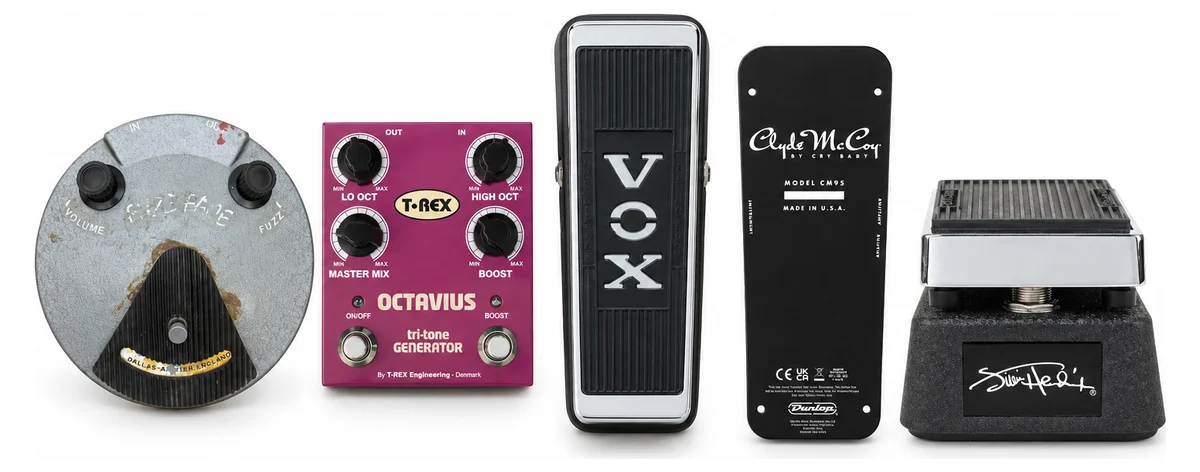
T-Rex frames the pedal as its take on an unusual and powerful effect, one with a lineage the maker traces back to Jimi Hendrix and his innovative use of distortion, wah-wah, vibe and phase shifter pedals2.
What reviewers said
Published coverage of the Octavius has been positive on its core function. Premier Guitar's 2010 review, part of a "Tone Games" roundup of ten stompboxes, found the tracking seamless and praised that chords stay usable with the effect on1. The same review highlighted the mixing flexibility as the pedal's strength, from doubling effects to thick lead lines1.
Videos
ProGuitarShopDemos
Guitar World
Premier Guitar
Questions
Does the T-Rex Octavius track chords?
Yes. T-Rex says the pedal reacts on the spot with no latency, and Premier Guitar's reviewer found the tracking seamless, reporting that chords and single notes sounded transparent, clean and bigger, and that you can arpeggiate without switching the pedal off.
Is the T-Rex Octavius polyphonic?
Yes. Premier Guitar described the Octavius Tri-Tone Generator as a polyphonic octave divider, meaning it tracks more than one note at a time rather than glitching on chords the way many older monophonic octave pedals do.
Can I power the Octavius with 12V?
Yes. The pedal accepts 9 to 12V DC through its power jack, and T-Rex lists a maximum supply voltage of 12.5V DC. It ships with a 12V DC, 1250 mA external power supply, and the maker's current draw figure is 150 mA at 9V DC.
Can the T-Rex Octavius run on a battery?
No. The Octavius has no battery compartment. Its only external connectors are an input jack, an output jack and a 9 to 12V DC power jack, so it needs an external supply or a powered pedalboard to run.
Does the Octavius run on a 9V battery?
No. There is no battery option. Power comes solely through the 9 to 12V DC jack, with a minimum supply voltage of 8V DC and a maximum of 12.5V DC according to T-Rex's specifications.
When did the T-Rex Octavius come out?
The Octavius was introduced in 2010. Premier Guitar covered it as a new pedal in a June 2010 press release and showed it at the 2010 Summer NAMM show that August, alongside the T-Rex Mudhoney II distortion.
Sources (4)
- T-Rex Octavius Tri-Tone Generator Pedal Review, Premier Guitar, 2010-10-28
- → T-REX EFFECTS ← Pedals for guitar and bass players!, T-Rex Effects
- Summer NAMM '10, Premier Guitar, 2010-08-24
- T-Rex Effects Introduces Mudhoney II and Octavius, Premier Guitar, 2010-06-21