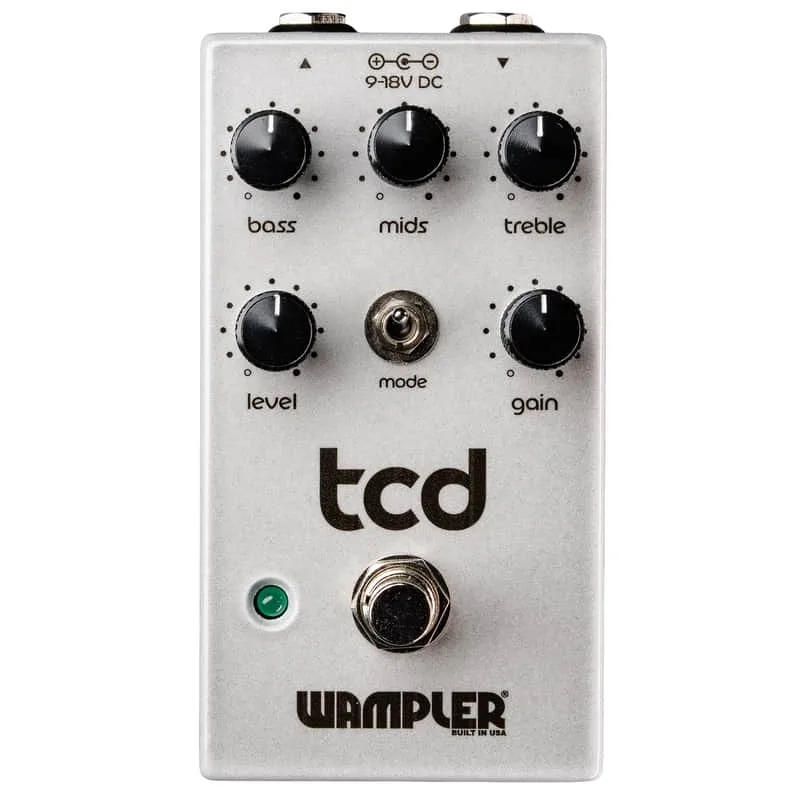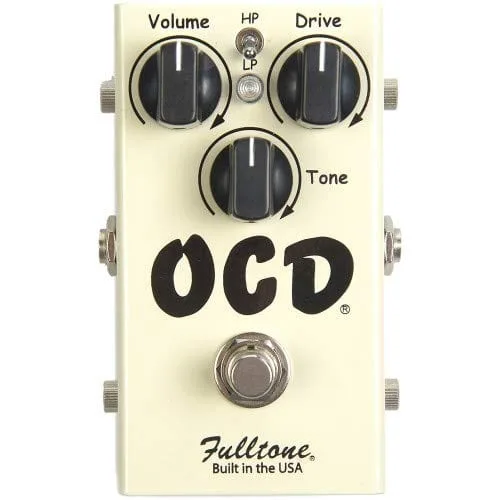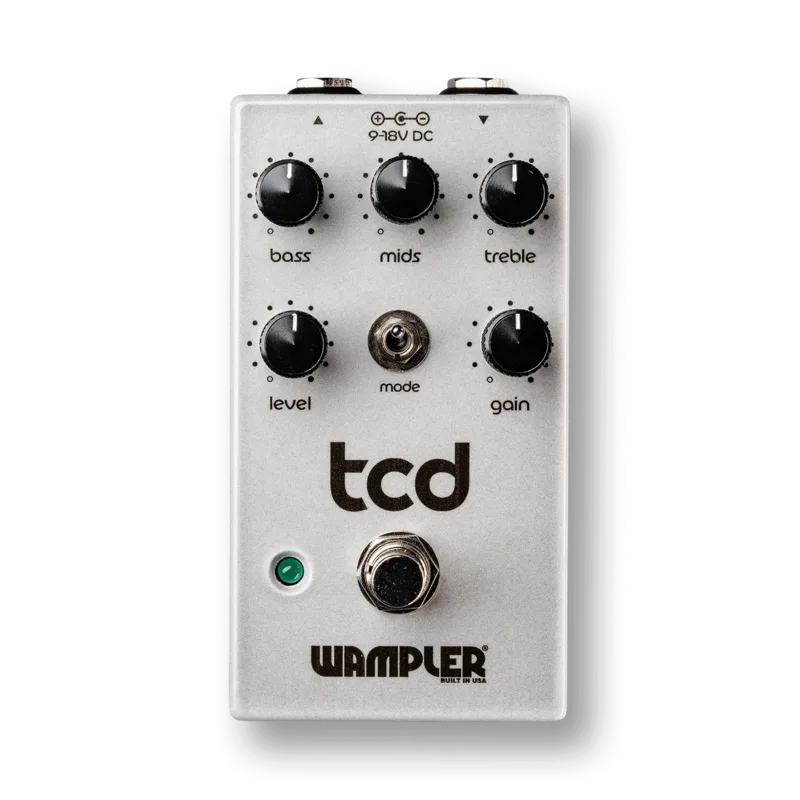


The Compulsion Drive, also listed by Wampler as the TCD, is a compact overdrive/distortion pedal from Wampler, announced on 2 December 20251. It is Brian Wampler's take on the Fulltone OCD, a circuit MusicRadar calls "a bona-fide modern classic," rebuilt with a three-band EQ, two clipping modes and internal DIP switches that select four variations of the original circuit1.
Wampler describes the pedal as coming alive under your fingers, "cleaning up to shimmering grit when you back off, and exploding into searing distortion when you dig in"2. MusicRadar's Jonathan Horsley found it retains what he calls the OCD magic: how it sits with your amp, makes it sing, and plays nice with other drive pedals, with an amp-like quality especially at lower gain settings1.
What the Compulsion Drive does
The pedal sits in the overlap between overdrive and distortion. Wampler's Gain control is described as taking you "anywhere from edge-of-breakup crunch to roaring full-on distortion"2, so a player can set it as a light push into an already-driven amp or as the main dirt source on a clean platform.
The circuit it reimagines has its own lineage. MusicRadar's technical analysis of the Fulltone OCD notes that "the original OCD is essentially a Voodoo Labs Overdrive, itself similar to a cascaded MXR Distortion+"3. Aion FX likewise describes the OCD as a modified version of the Voodoo Labs Overdrive with several added features and tweaks. What Wampler adds on top of that foundation is tone shaping the original never had: a three-band EQ, a Mode switch with two clipping flavors, and internal switching for four circuit variations1.
A player review quoted on Wampler's site, from a player named Michael, reports using it in "a very hi-fi, modern pop punk band where it delivers flawlessly"2.
The controls
The pedal carries five knobs: Gain, Level, and the Bass, Mids, and Treble controls of its three-band EQ, plus an external Mode toggle and two internal DIP switches2.
| Control | What it does |
|---|---|
| Gain | From edge-of-breakup crunch to full-on distortion2 |
| Level | Sets output level, from pushing the amp harder to sitting balanced in the mix2 |
| Bass | Low-end shaping, part of the three-band EQ2 |
| Mids | Midrange shaping, part of the three-band EQ2 |
| Treble | High-end shaping; MusicRadar notes it does exactly the same thing as the Tone control on the original OCD1 |
| Mode switch (toggle) | Down: traditional gain structure. Up: harder hitting and more tube-like, using cascaded MOSFET gain stages2 |
The three-band EQ is the biggest departure from the OCD it is based on. MusicRadar notes that "Wampler has added a 3-band EQ to the pedal," something the original never offered, giving the Compulsion Drive far more tone shaping than its inspiration1.
Inside the enclosure, two DIP switches open up four circuit variations:
- Fat switch: adds deep low-end warmth for a thicker foundation2
- Diode switch: shifts the gain profile with an extra clipping diode for tighter, more saturated distortion2
MusicRadar describes these as "two internal dip-switches to avail players of four different iterations of the original pedal's circuits"1, so a player chasing a specific era of the original circuit can dial in the closest match.
The Fat and Diode switches are internal DIP switches, not footswitches or external toggles. Changing them means opening the enclosure, so it is best done while setting the pedal up rather than mid-gig.
Power: 9V to 18V DC
The Compulsion Drive runs on 9V DC to 18V DC, and Wampler states clearly: do not exceed 18V DC2. Current draw is 20mA at 9V and 25mA at 18V2, low enough for any isolated pedalboard power supply. MusicRadar confirms it "can be run on 9V or 18V DC from a pedalboard power supply"1. Running it at 18V is an option for players who want more headroom out of the Level control, which MusicRadar notes has "plenty of gain hiding under it, so you can hit the front end of your guitar amp hard"1.
The 18V ceiling is a hard limit. Powering the pedal above 18V DC risks damage, so check the output of any supply or daisy chain before plugging in.
Where it came from and how it is built
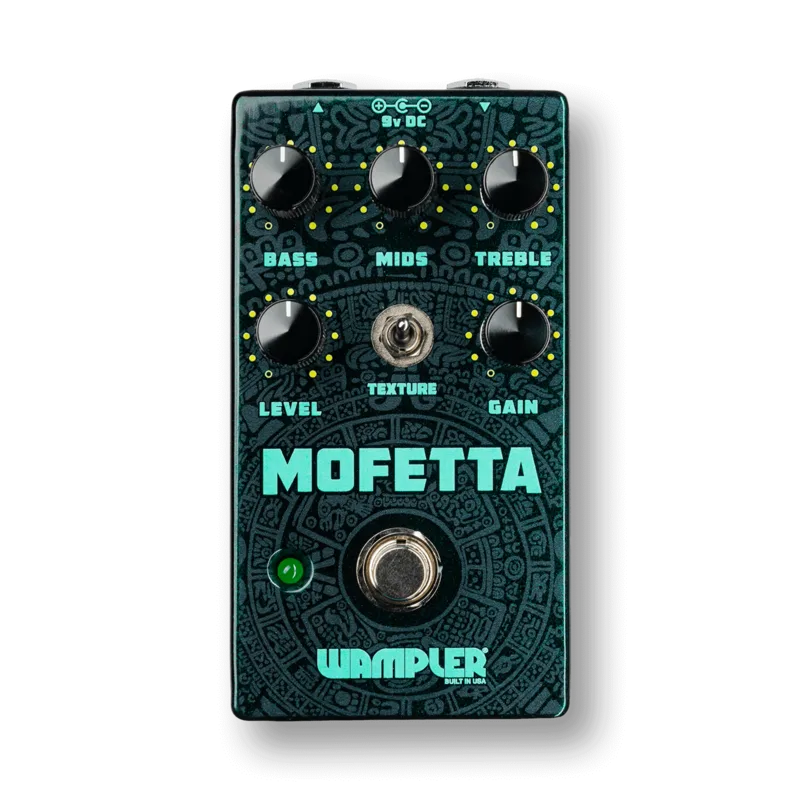
The Compulsion Drive was announced on 2 December 2025, priced at £/$199 and available immediately1. Wampler's current product page lists it at $199.97 USD2. It is built in the U.S.A., which Wampler states applies to every Wampler pedal, and it includes a limited 5-year warranty2. Its compact footprint, 2.5" x 4.8" x 2.3" (64mm x 125mm x 60mm), matches the standard small-pedal size of the rest of the Wampler drive line, such as the Wampler Mofetta and Wampler Sovereign2.
Videos
Sweetwater Soundcheck
Mike Hermans
Shawn Tubbs
Questions
Who designed the Wampler Compulsion Drive?
The Compulsion Drive was designed by Brian Wampler, founder of Wampler Pedals. Wampler describes it as his obsessive reimagining of one of the most legendary distortion circuits in modern guitar pedal lore, which MusicRadar identifies as the Fulltone OCD.
What does the Fat switch do?
The Fat switch is one of two internal DIP switches. Wampler says it adds deep low-end warmth for a thicker foundation. The other internal switch, the Diode switch, shifts the gain profile with an extra clipping diode for tighter, more saturated distortion.
Where is the Wampler Compulsion Drive made?
It is built in the U.S.A. Wampler states that, as with every Wampler pedal, The Compulsion Drive is built in the U.S.A. using only the highest-quality components. MusicRadar's review also confirms it is made in the USA.
What warranty does the Compulsion Drive have?
The pedal includes a limited 5-year warranty, according to Wampler's product page. The same five-year limited warranty appears across Wampler's current USA-built drive pedals.
What are the dimensions of the Compulsion Drive?
Wampler lists the dimensions as 2.5 inches by 4.8 inches by 2.3 inches, which is 64mm by 125mm by 60mm. That is a standard compact-pedal footprint that fits easily on most pedalboards.
Is the Wampler Compulsion Drive based on the Fulltone OCD?
Yes. MusicRadar describes it as inspired by the Fulltone OCD but with an expanded set of features. Wampler's own page calls it a reimagining of one of the most legendary distortion circuits in modern pedal lore without naming the circuit, and its internal DIP switches offer four iterations of the original pedal's circuits.
Sources (3)
- Brian Wampler just reimagined a bona fide modern classic with The Compulsion Drive, MusicRadar, 2025-12-02
- tcd | Wampler Pedals, Wampler Pedals, 2026-02-10
- The FX files: Fulltone OCD, MusicRadar, 2019-02-05