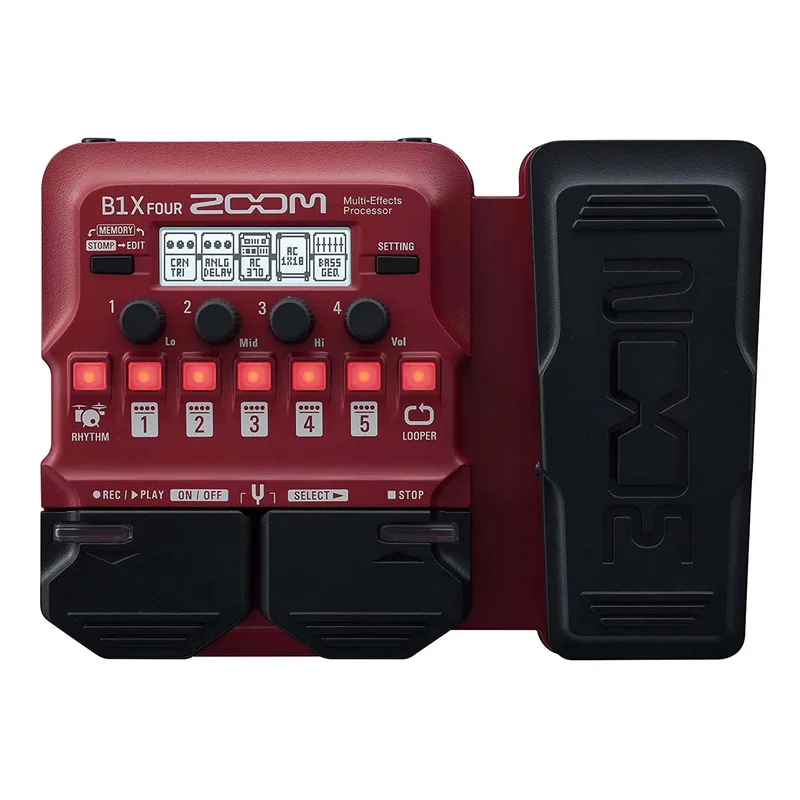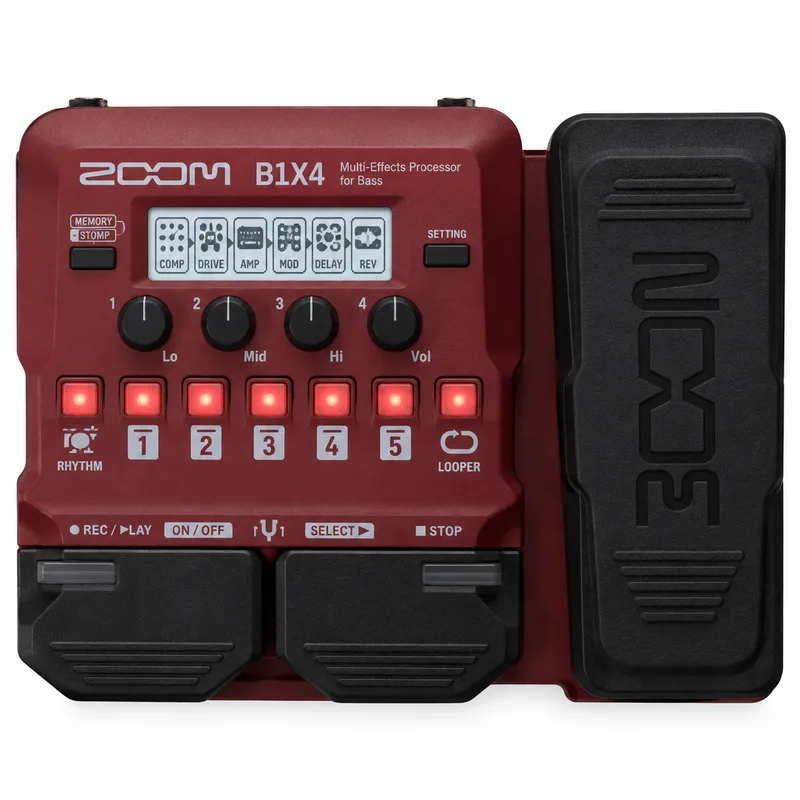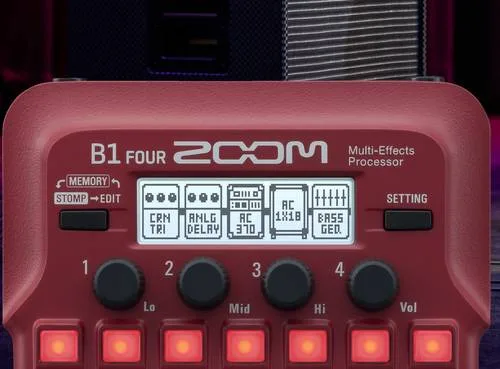


The Zoom B1 Four is a digital bass multi-effects processor made by Zoom, a single compact pedal that replaces a whole board of separate units. It carries over 70 effects and amp models, covering the traditional bass staples as well as sounds like octaver, bass synth and fuzz, and it adds a looper and a built-in rhythm section for practice and songwriting1. It was announced at Winter NAMM in January 2019, shown alongside its sibling the Zoom B1X Four21.
For a bass player building a first setup, the appeal is simple: one pedal, one power source, and a wide palette of bass pedal sounds to explore before committing to individual boxes.
What it does to your sound
Zoom describes the B1 Four as a bass multi-effects processor with over 70 effects and amp models1. Within that count, the US product page breaks out more than 60 traditional and boutique effects, naming the octaver, bass synth and fuzz as examples6. That range spans the effect families a bass player reaches for most: compressor, overdrive and distortion, fuzz, chorus and other modulation, delay and reverb, plus octave and pitch effects and amp and cabinet simulation.
The amp and cab models matter here as much as the effects. In a February 2025 budget multi-effects buying guide, Guitar World's reviewer found the compressors to be particularly good and described the amp and cab sims as fantastic4. The same guide reports that you can save 40 presets, which it says can cover anything from clean, round and warm tones through to grinding bass tones with distortion4. Presets store a complete patched sound, so a whole chain of effects and an amp model can be recalled with one selection rather than rebuilt each time.
Alongside the effects, the B1 Four includes a looper and a built-in rhythm section1. The rhythm section supplies drum patterns, so you can practice, loop a bassline, and play against a beat without any other gear. The looper puts the B1 Four in the same category as dedicated looping pedals, if in a simpler form.
Performance modes and connections
The B1 Four gives you two performance modes, which Zoom frames as a way to switch patches and effects seamlessly during live shows1.
| Mode | What it does |
|---|---|
| PRESELECT | Lets you jump from patch to patch without affecting your current sound1 |
| STOMP | Lets you turn individual effects on and off1 |
The difference is the mental model. PRESELECT mode lets you jump from patch to patch without affecting your current sound, while STOMP mode lets you turn individual effects on and off. Players who think in terms of "kick in the fuzz for the chorus" will prefer STOMP; players who think in complete sounds will prefer PRESELECT8.
On the back panel, Guitar World lists the sockets as one 1/4" instrument input, one 1/8" aux input, one 1/4" output, and one USB Micro-B port4. The aux input lets you play along with audio from a phone or player, and the USB port handles both the USB bus power option and the connection to Zoom's Guitar Lab software.
Power: batteries, adapter or USB
Zoom gives the B1 Four three power options1:
- Four AA batteries
- An optional Zoom AD-16 AC adapter
- USB bus power
The battery option is the one that sets the B1 Four apart from most metal-box multi-effects units, which need a mains supply or a pedalboard power brick. Four AAs make it a genuinely portable practice tool, usable on a couch, a train, or a street corner168.
Where it came from and how it compares
Zoom announced the B1 Four and B1X Four at Winter NAMM in January 2019, as the bass versions of the same four-series format Zoom built for guitar. In Sweetwater's demo video from the show, Mitch Gallagher and Zoom's John introduced the pair simply as the bass voices of the line: "we also have those voice for bass as well the B1 X4 and b14"21.
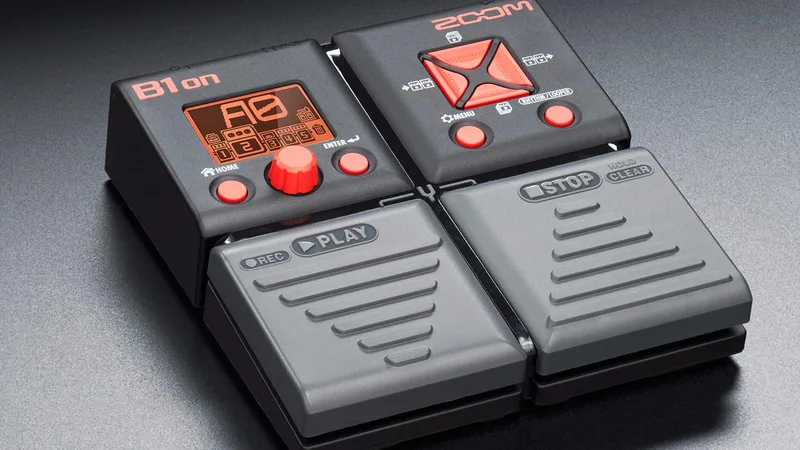
The B1 Four is not Zoom's first compact bass multi-effects pedal. The earlier Zoom B1on offered 100 bass effects and amp models, more than the B1 Four's 70-plus, but without the B1 Four's looper and built-in rhythm section9. The B1X Four, the B1 Four's sibling, adds an expression pedal to the same effects engine, which matters for volume swells and wah-style control.
The B1 Four and B1X Four share the same effects, presets, modes and power options; the practical difference between them is the B1X Four's built-in expression pedal. Choose based on whether you want foot control of a parameter while playing.
What reviewers said
Guitar World's February 2025 guide to budget multi-effects pedals is the published review coverage of the B1 Four. Beyond the verdict on the compressors and amp sims, the guide notes the 40-preset capacity and the range it covers, from clean and warm through to distorted tones4. The guide treats the B1 Four as a budget option, which is the category it was built for: a first multi-effects pedal that lets a bass player try the whole effects landscape before buying individual units.
Sweetwater's NAMM 2019 demo video walks through the pedal at the point of announcement2:
In the video, Mitch Gallagher talks with Zoom's John about the B1 Four and B1X Four as the bass versions of the four-series format, covering the effects and amp models voiced for bass2.
Videos
ZoomSoundLab
Patrick Hunter
HowTwo Music Tech
Questions
Does the Zoom B1 Four run on batteries?
Yes. Zoom states that the B1 Four can operate with four AA batteries, which makes it usable anywhere without a power supply. It can also run on an optional Zoom AD-16 AC adapter or on USB bus power, so you have three ways to power it at home, at a gig, or on the street.
How many presets can the Zoom B1 Four save?
Guitar World's buying guide reports that you can save 40 presets on the B1 Four, covering a wide range of bass tones from clean, round and warm through to grinding distorted sounds. Presets let you recall a full patched sound instantly rather than rebuilding it each time.
What is the difference between PRESELECT and STOMP mode?
PRESELECT mode lets you jump from patch to patch without affecting your current sound, so you can queue up the next preset while you keep playing. STOMP mode lets you turn individual effects on and off within a patch, working more like a row of separate pedals.
Does the Zoom B1 Four have a looper?
Yes. Zoom lists a looper and a built-in rhythm section among the B1 Four's features, alongside its over 70 effects and amp models. The rhythm section gives you drum patterns to practice and loop against without needing another device.
Is the Zoom B1 Four analog or digital?
The B1 Four is a digital multi-effects processor. Its over 70 effects and amp models, looper and rhythm section are all handled digitally, which is how it fits that many sounds into one compact pedal at a budget price.
What power adapter does the B1 Four use?
Zoom specifies an optional Zoom AD-16 AC adapter, or you can run the pedal on USB bus power. RockBoard's listing gives the power requirement as 9V DC, center negative, with a current draw of 500mA, and four AA batteries work as well.
Sources (9)
- B1 Four / B1xFour, ZOOM
- Zoom Multi-effects Pedals at Winter NAMM 2019, Sweetwater, 2019-01-28
- B1 FOUR by ZOOM, RockBoard (rockboard.de PedalPedia), 2026
- Best budget multi-effects pedals: a world of effects, Guitar World, 2022-09-27
- B1 Four / B1xFour, ZOOM
- B1 Four / B1xFour, ZOOM
- B1X Four by ZOOM, RockBoard PedalPedia, 2026
- B1 Four / B1xFour | ZOOM, ZOOM
- | ZOOM, Zoom Corporation