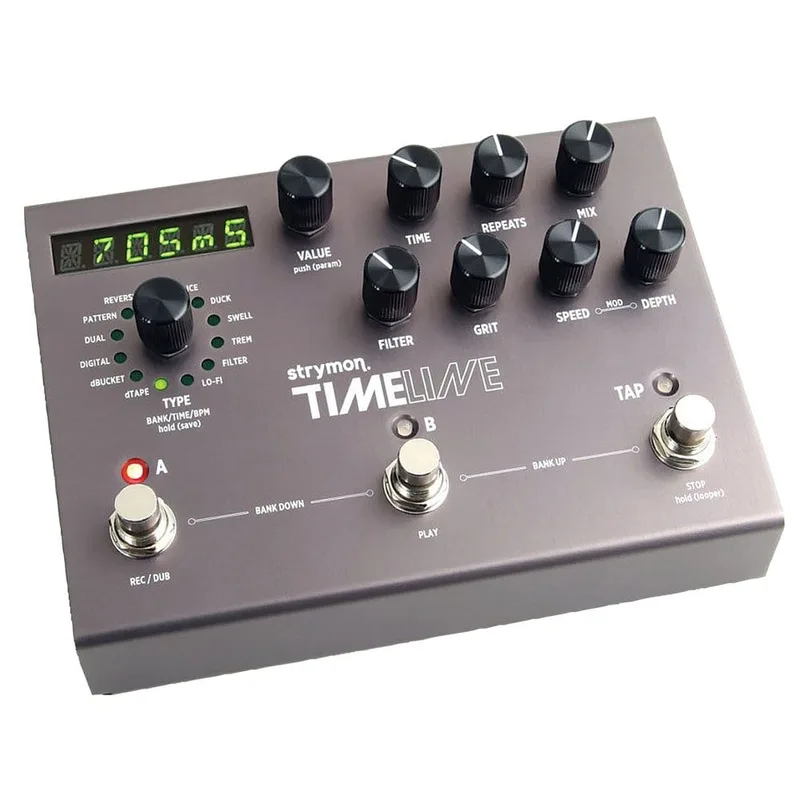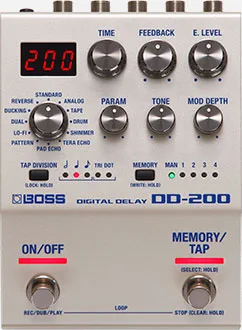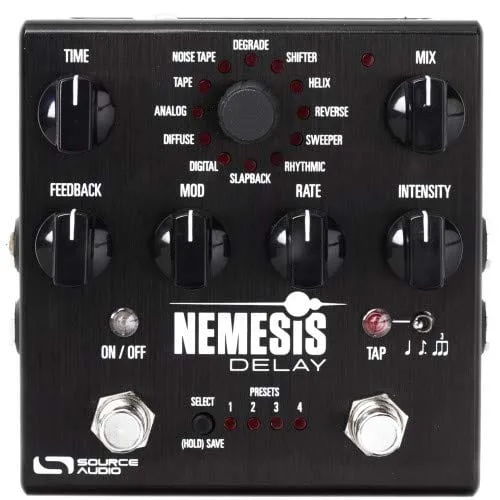


The Source Audio Nemesis is a stereo digital delay pedal that puts a dozen delay engines behind one selector wheel, from clean digital repeats to tape, analog bucket brigade, pitch-shifting and reverse delays12. It belongs to Source Audio's One Series, a line of pedals designed in the USA and made in China, and it sits in the same do-everything delay category as the Strymon TimeLine and the Boss DD-5003. Source Audio describes it as a powerful multi-delay pedal with unmatched tone and flexibility4.
Under the hood it is fully digital, with a 56-bit signal path and a 24-bit delay line for clean repeats15. Every engine operates in stereo multi-tap mode, with six delay taps available for stereo ping-pong patterns and stereo phase inversion, though it works fine in a standard mono signal chain32.
What it does: a 12-engine stereo delay in one pedal
The centerpiece of the control set is the delay engine selector, which Premier Guitar called "a dozen departure points from which you can explore the Nemesis' formidable echo-shaping powers"7. Around it sit Time, Feedback, Mix, Modulation Depth, Modulation Rate and Effect Intensity knobs1. The Time knob offers a repeat time between 10 milliseconds and 2.6 seconds2, and the Intensity knob adjusts the unique coloring configuration of each engine, so the same knob does a different job in every mode2.
| Engine | What it does |
|---|---|
| Digital | Classic clear digital delay; Intensity controls high pass or low pass filtering1 |
| Diffuse | Diffusion smears the attack of repeats, softening them to blend with the dry signal1 |
| Analog | Classic bucket brigade character, warm, resonant and increasingly lo-fi1 |
| Tape / Noise Tape | Tape delay; Noise Tape focuses on the grittier sounds of degraded tape3 |
| Degrade | Primitive lo-fi digital delay with bit crushing and sample rate reduction1 |
| Shifter | Polyphonic pitch-shifting on the delayed signal: octaves, 3rds, 4ths, 5ths1 |
| Helix | Reverse delay combined with an octaver310 |
| Sweeper | Resonant low pass filter, a synth-like effect10 |
| Slapback | Short single-repeat echo based on early tape delay machines1 |
The pedal has two footswitches: one for bypass, and a clickless tap tempo switch with quarter, dotted eighth and triplet beat divisions that doubles as a hold function to freeze a small portion of the delay in a continuous loop23. In Sweeper mode, Premier Guitar found the hold function adds synth-like functionality7. There are several ways to configure the outputs, including true stereo and a stereo signal from a mono input, and the spare outputs can serve as an external loop inside the delay feedback loop32.
Hidden engines and the Neuro app
Twelve of the Nemesis delay engines are only accessible with MIDI or the Neuro app8. The free Neuro app, available for PC, Mac, iOS and Android, provides extra delay engines including Dub, Lo-Fi Retro, Oil Can and Warped Vinyl, plus dozens of parameter adjustments for minutiae like "wow modulation noise" and pan settings711. Hidden engines named by Source Audio's own documentation include Warped Record, Tremolo and Complex Rhythmic8. Via MIDI, a Control Change message number 1 with the appropriate value calls up each hidden engine directly8.
Premier Guitar's reviewer called the Neuro app "one of the Nemesis' biggest assets," highlighting its sharable presets function, and found it easy to download and use even on a small iPhone screen7. In a head-to-head with the Boss DD-200, Guitar Pedal X's Stefan Karlsson credited the Nemesis with "the more capable Neuro App and access to 12/14 further algorithms with more scope for Algorithm tweakability and replacement," while noting he personally prefers everything surfaced on the device itself10.
On That Pedal Show, Dan and Mick walked through the hidden engines, from Diffuse's softer attack to the Oil Can delay, and showed how the app exposes the wow and flutter of the tape models12. Dan also noted that the bypass sound is really good because the pedal models not just the delay sounds but the preamp the delay runs through, such as a 2290 or Memory Man preamp12.
MIDI control and presets
The Nemesis stores 128 presets: 8 are accessible from the pedal's own controls, and all 128 are available via MIDI48. It has 5-pin MIDI in and MIDI through plus USB MIDI; Program Change messages recall presets, with preset slots 1 to 128 corresponding to PC numbers 0 to 127, and Control Change messages control multiple knob parameters418. MIDI clock data can sync delay time with other time-based effects8.
The MIDI implementation is deep. Documented CC numbers cover the core controls (Feedback on CC #5, Modulation Depth on CC #7, Modulation Rate on CC #8, Diffusion on CC #11) and extend to a pitch shift table on CC #24 that maps values to shifts from +31 semitones down to -31 semitones, and a tempo division control on CC #42 that includes golden ratio divisions of 1.618 and 0.61813. Bypass is reachable over MIDI on CC #38, where values of 64 and above engage the effect and values of 63 and below bypass it8.
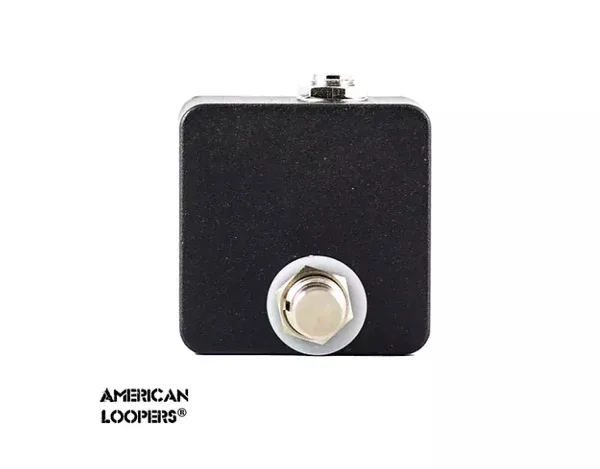
An expression pedal can be connected to control any combination of knobs, with programmable depth and direction for each, and the pedal also accepts Source Audio's Dual Expression Pedal or the Hot Hand wireless controller311. External footswitches work too: presets can be changed with an external footswitch and TRS cable5, and third-party aux switches such as the American Loopers 1 Button Aux External Switch are built for it14.
From the pedal's own footswitches you can reach only 8 of the 128 preset slots, without an indication of which preset you are selecting; full preset access needs MIDI or an external controller8. MusicRadar lists "no instant switching of presets from the pedal's own footswitches" among its reasons to avoid the pedal9.
History and the Nemesis Delay ADT
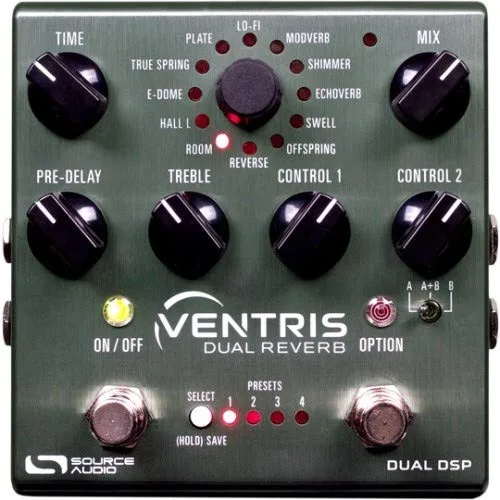
The Nemesis emerged from Source Audio's 2015 lineup announcements, one of seven new stompboxes the firm previewed that January15, and was available in June 20151. Three years of research and development went into its sound engineering and design, and the engineering team spent over a year studying numerous iconic and sought-after tape and bucket brigade delay units to identify their every nuance and idiosyncrasy2. Source Audio's owner and president, Roger Smith, said he "challenged Jesse, Bob and Brett to create the industry's most powerful and flexible delay pedal in a small easy-to-use format"6. Its success set up the follow-up Ventris Reverb, announced in 201716.
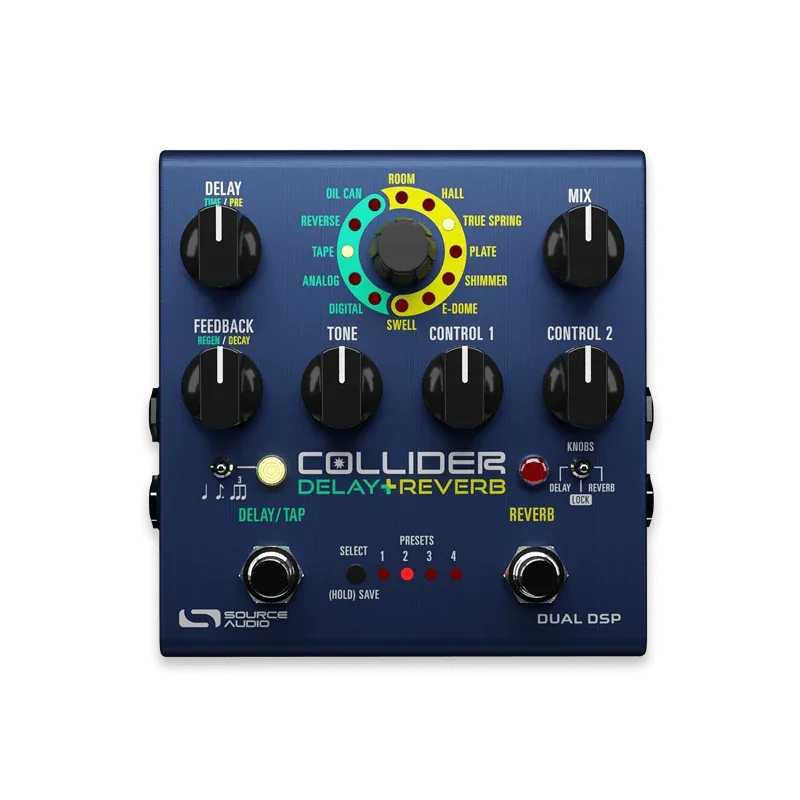
In 2023 Source Audio released the Nemesis Delay ADT, a version with an analog dry through signal path, so the signal runs completely unchanged through the pedal in bypass mode117. The updated SA 260A One Series Nemesis Delay ADT raised the engine count from 24 to 26, with twelve on the pedal and the rest in the Neuro app, and went up for pre-order at $309.00 with shipping expected around mid-January 202417. Source Audio later merged the Nemesis delay engines with the Ventris reverb in the Collider delay/reverb pedal18.
What reviewers said
Premier Guitar's review was enthusiastic, praising "powerful, accessible, and easy-to-use sound-sculpting tools," an easy-to-navigate Neuro app, rangeful controls and great organic delay sounds, with no cons listed7. The reviewer found it "can shine dishing authentic slapback sounds at the grimiest, most beer-soaked punkabilly gig, or perform precise sound-sculpting functions in the hands of a top-tier producer or engineer in a state-of-the-art studio"7, and called it "an intuitive and fantastically fun way to explore the possibilities of digital delay"7. At modest settings, the modulation controls were found to feel like natural, integral parts of the delay tone, sounding like light chorus on the analog and digital engines and convincingly replicating mechanical pitch modulation on the tape modes7.
MusicRadar's Trevor Curwen concluded that "it's easy to use, has a pedalboard-friendly footprint and features a wide range of very usable sounds, all with practical control options"3. That Pedal Show called the Nemesis and the Boss DD-500 "incredibly capable, modern, multi-feature delay units that offer you an almost infinite amount of sonic and creative potential"19. Guitar Pedal X's Stefan Karlsson, comparing it with the Boss DD-200, still felt "the Nemesis is a great delay, and in several ways is ahead of the Boss DD-200 I acquired instead"20, though he preferred the DD-200's Tone control over the Nemesis's Rate knob and found the Nemesis's preset switching less footswitch-friendly10.
In Sweetwater's deep dive, Daniel Fisher demonstrated that from the front panel you can get to twelve engines, "but you can actually get to 24 different engines by using MIDI commands or the application," and highlighted the external loop mode for putting an effect on the delay repeats only2111. In an earlier Sweetwater demo, Don Carr played a Gibson ES-335 through the classic analog tape settings, the Shifter engine pitched up a fifth, and the Helix engine's added octave11.
Videos
ProGuitarShopDemos
Pete Thorn
News
Questions
How many delay engines does the Source Audio Nemesis have?
Twelve delay engines are accessible from the front panel, from Digital and Analog through Tape, Reverse, Shifter and Slapback. Another twelve engines, including Dub, Lo-Fi Retro, Oil Can and Warped Record, are hidden and reachable only through the Neuro app or MIDI, for 24 engines in total.
What is the maximum delay time on the Nemesis?
The Time knob offers a repeat time between 10 milliseconds and 2.6 seconds. Tap tempo subdivisions include quarter notes, dotted eighth and triplets, and the MIDI tempo division control adds further options including golden ratio divisions.
Is the Nemesis true bypass?
It offers both. Source Audio's Universal Bypass uses signal relays for true bypass and transparent buffers for analog buffered bypass, so the player chooses which mode to run. Reviewers noted the bypass sound is very good either way.
Does the Nemesis have MIDI?
Yes. It has 5-pin MIDI in and MIDI through plus USB MIDI. Program Change messages recall up to 128 presets, Control Change messages reach every knob parameter and the hidden engines, and MIDI clock can sync delay time to other gear.
What is the difference between the Nemesis and the Nemesis ADT?
The Nemesis Delay ADT, released in 2023, adds an analog dry through signal path, so the dry signal runs completely unchanged through the pedal in bypass mode. It also raises the engine count from 24 to 26, with 12 onboard and 14 in the Neuro app.
Can the Nemesis freeze or hold repeats?
Yes. Pressing and holding the tap tempo switch freezes a small portion of the delay in a continuous loop. Premier Guitar noted that in Sweeper mode the hold function adds synth-like functionality.
Sources (21)
- Source Audio Nemesis Delay ADT, Delicious Audio, 2025-02-28
- Source Audio Introduces the Nemesis Delay, Premier Guitar, 2016-01-28
- Source Audio Nemesis Delay review, MusicRadar, 2016-05-09
- Nemesis Delay ADT, Source Audio
- Source Audio Nemesis Delay, Pedal of the Day, 2016-08-04
- Eagerly Awaited Nemesis Delay Pedal Available Through Select Retailers, Guitar Interactive Magazine, 2016-02-01
- Source Audio Nemesis Delay Review, Premier Guitar, 2016-08-22
- Source Audio Nemesis & MC6 Midi Controller, Morningstar, 2018-07-29
- Best delay pedals: add extra dimension to your tone, MusicRadar, 2022-05-17
- Guitar Pedal X, Guitar Pedal X, 2020-07-26
- Source Audio Nemesis Delay Pedal Demo, Sweetwater, 2018-12-06
- That Pedal Show, That Pedal Show (YouTube), 2016-12-30
- Voes | MIDI-CC, Voes (voes.be), 2025
- American Loopers (www.americanloopers.com), American Loopers (www.americanloopers.com)
- NAMM 2015: 7 new Source Audio stompboxes, MusicRadar, 2015-01-21
- Source Audio Unveils the Ventris Reverb, Premier Guitar, 2017-04-07
- Source Audio SA 260A, gearnews.com, 2023-11-20
- Source Audio Collider Delay+Reverb review, Guitar World, 2020-05-04
- That Pedal Show, That Pedal Show, 2016-12-30
- Guitar Pedal X, Guitar Pedal X, 2026-07-13
- Source Audio Nemesis Delay Deep Dive, Sweetwater, 2020-05-07