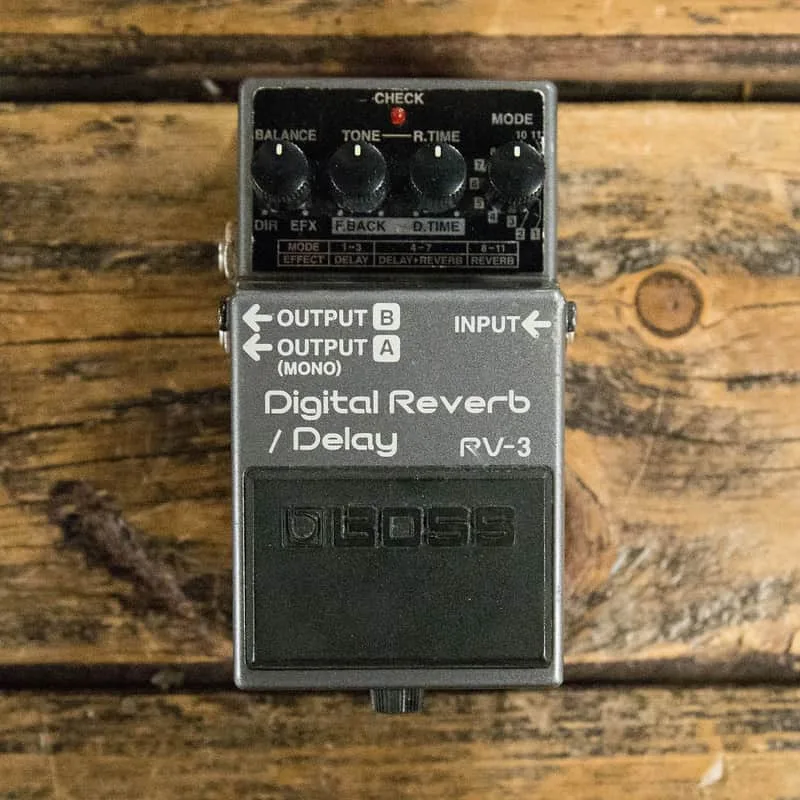


The Boss RV-3 Digital Reverb/Delay is a compact pedal that puts reverb and delay in a single enclosure, released by Boss in 19941. It offers straight delay with times up to two seconds, plus modes that combine delay with the pedal's four reverb types1. Boss has since discontinued the RV-3; Delicious Audio's Christopher Scapelliti lists it among now-discontinued pedals capable of these effects2.
What the RV-3 does
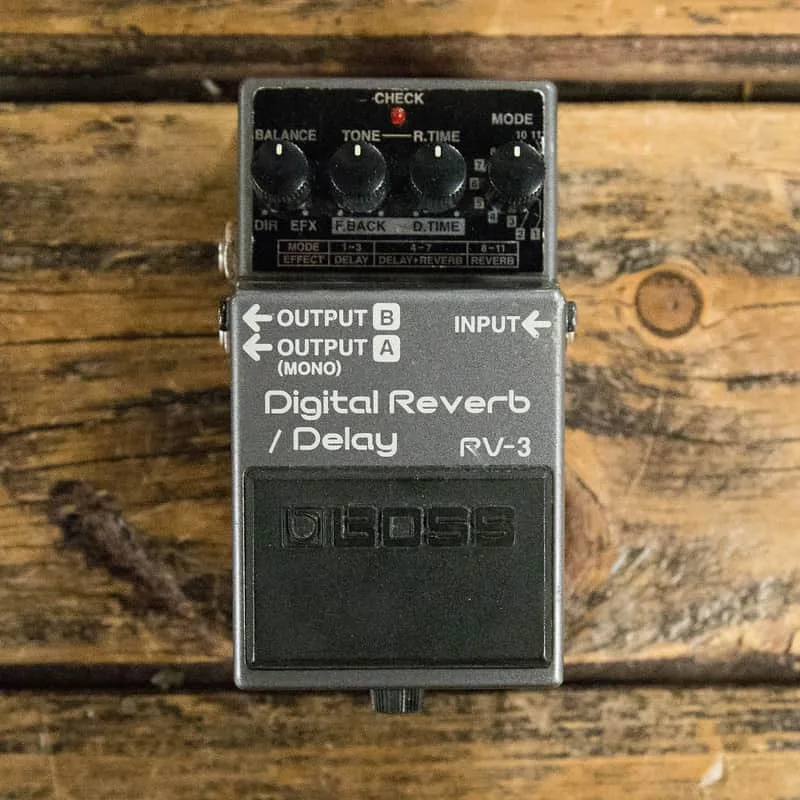
The RV-3's seven modes split into two groups. Pedal of the Day's Mike B. describes three Delay modes offering times up to 2,000 ms, plus four Reverb modes with simultaneous delay, ranging from 32 to 1,000 ms and using Room, Hall and Plate reverb types4. Boss's own history article, written by Jim Bybee, puts the same capability another way: "Straight delay with up to two seconds was available, as well as modes that combine the delay effect with the pedal's four reverb types"1.
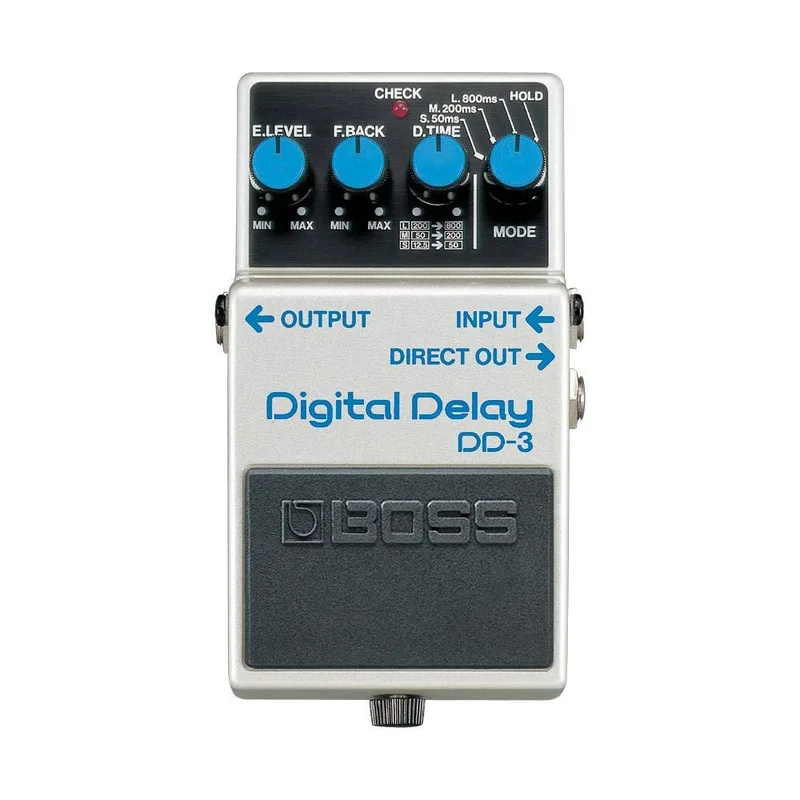
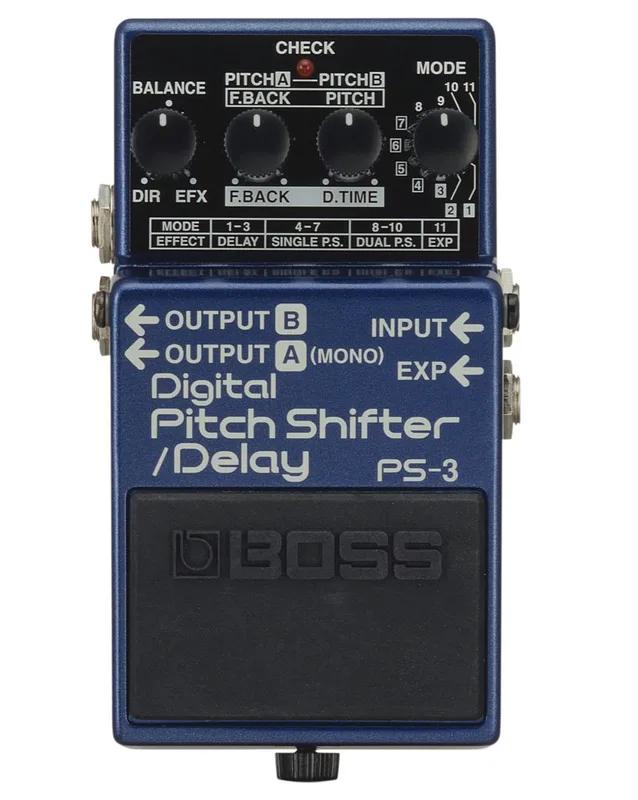
That two-second ceiling was a step forward in its day. MusicRadar notes that "The RV-3 reverb and PS-3 pitch shifter delay had delay times of up to two seconds that far outstripped the 800ms" available on the earlier Boss DD-3 Digital Delay5. The Boss PS-3 Pitch Shifter / Delay shared that longer delay time.
One point worth flagging: RockBoard's PedalPedia listing gives the RV-3's circuit type as analog3, while the pedal's own name and Boss's history describe it as a digital reverb/delay31. The two sources disagree on that label.
Controls and connections
The front panel carries four knobs plus the mode selector. According to Pedal of the Day, "Time and Mode knobs let you select how much of each effect you want in the mix, while the Balance and Tone knobs let you customize the sound coming through your chain"4.
| Control | What it does |
|---|---|
| Mode | Selects among the three Delay modes and four Reverb modes4 |
| Time | Sets the delay time within the selected mode4 |
| Balance | Blends the amount of effect in the mix4 |
| Tone | Shapes the tone of the effected sound4 |
The pedal is stereo capable. Its jacks are INPUT-A (MONO), INPUT-B, OUTPUT-A (MONO) and OUTPUT-B, plus a dedicated AC adaptor jack for DC 9 V4. The A jacks carry a mono signal on their own; the B jacks extend the pedal to stereo.
Specifications
| Specification | Value |
|---|---|
| Nominal input level | -20 dBu4 |
| Input impedance | 1 M ohms4 |
| Nominal output level | -20 dBu4 |
| Recommended load impedance | 10 k ohms or more4 |
| Residual noise | -93 dBu (IHF-A, Typ.), all knobs at center4 |
| Current draw | 50 mA (DC 9 V)4 |
The RV-3 draws 50 mA at DC 9 V4, which is more than some simple daisy-chain outputs supply comfortably. It runs on a 9 V dry battery or an AC adaptor4, and Boss's Jim Bybee noted the battery option was part of the pedal's appeal: "It also cost less and could run on a 9-volt battery"1.
The JHS Dual Mode Mod
Alongside the stock pedal, a modified version exists. The JHS Pedals Dual Mode Mod is offered for the RV-3, RV-5 or RV-6 pedals6, and Pedal of the Day reviewed an RV-3 fitted with it in May 2017, having previously reviewed the pedal in its original form6.
The site's verdict was positive: "We're always fans of modding and making great pedals exquisite, which is exactly what has happened to the RV-3 Digital Reverb/Delay"6. The reviewer added that the modification made it "even more impressive and useful than before"6.
Where it sits among Boss delays
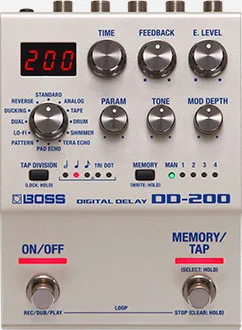
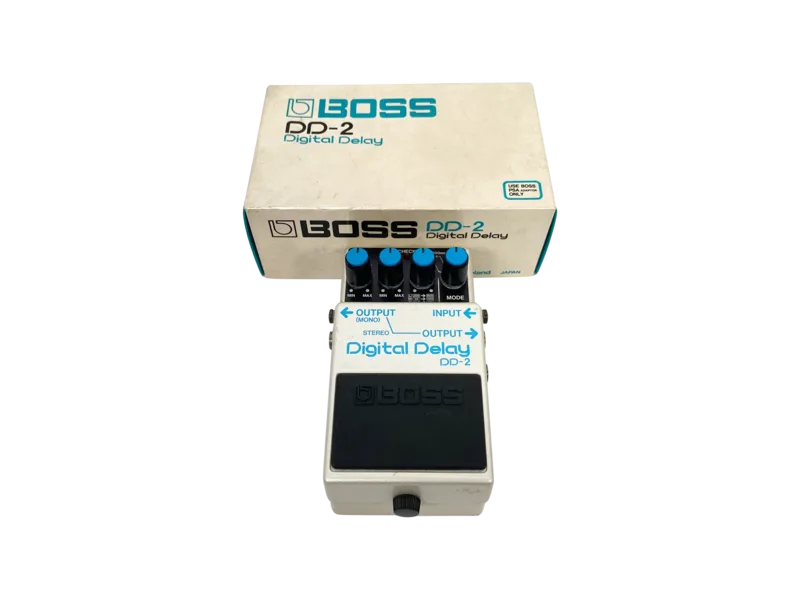
Within Boss's delay line, the RV-3 is the reverb-plus-delay combination pedal of its era, sitting apart from dedicated delay units like the Boss DD-3 Digital Delay, the Boss DD-8 or the Boss DD-200 Digital Delay, and from reverb-focused pedals covered on the site's Reverb Pedals and Delay Pedals pages. Its two-second maximum delay time matched the Boss PS-3 Pitch Shifter / Delay of the same period5.
Videos
Reverb
intheblues
Stompbox Breakdown
Questions
Does the Boss RV-3 take a battery?
Yes. The RV-3 runs on DC 9 V power, and Pedal of the Day lists a 9 V type dry battery among its power options alongside an AC adaptor. Boss's own history of its delay pedals also notes that the pedal could run on a 9-volt battery, which was part of how it kept costs down. A dedicated AC adaptor jack on the pedal accepts a 9 V DC supply.
How long can the delay time go on the RV-3?
In its straight delay modes the RV-3 offers delay times up to 2,000 ms, or two seconds. In the four reverb modes, which combine delay with the reverb effect, the delay range is 32 to 1,000 ms. Boss's history article describes straight delay of up to two seconds, and MusicRadar notes that this outstripped the 800 ms available on earlier Boss pedals.
Is the Boss RV-3 stereo?
Yes. The RV-3 has two inputs and two outputs: an INPUT-A (MONO) jack, an INPUT-B jack, an OUTPUT-A (MONO) jack and an OUTPUT-B jack. Using both jacks on each side allows stereo operation, while the A jacks work as mono input and output on their own.
What power supply does the Boss RV-3 need?
The RV-3 needs 9V DC, center negative, and draws 50 mA at DC 9 V. It can run from a 9 V dry battery or an AC adaptor through its dedicated DC 9 V jack. Because of the 50 mA draw, a standard low-current daisy-chain output may not be enough on its own, so a supply with adequate current is the safer choice.
What is the JHS Dual Mode Mod for the RV-3?
The JHS Pedals Dual Mode Mod is a modification offered for the Boss RV-3, RV-5 and RV-6 pedals. Pedal of the Day reviewed an RV-3 fitted with the mod in 2017 and concluded that modding makes great pedals exquisite, saying the modification made the RV-3 even more impressive and useful than before.
Sources (6)
- Echoes in Time: The History of BOSS Delay Pedals, BOSS (articles.boss.info), 2024-01-10
- The Best Glitch, Stutter And Granular Pedals In 2024, Delicious Audio, 2024-05-27
- RV-3 Digital Reverb/Delay by BOSS, RockBoard PedalPedia, 2026
- Boss RV-3 Digital Reverb / Delay, Pedal of the Day, 2014-04-01
- The FX files: Boss DD-3, MusicRadar, 2019-02-12
- Boss RV-3 Digital Reverb/Delay (JHS Dual Mode Mod), Pedal of the Day, 2017-05-03