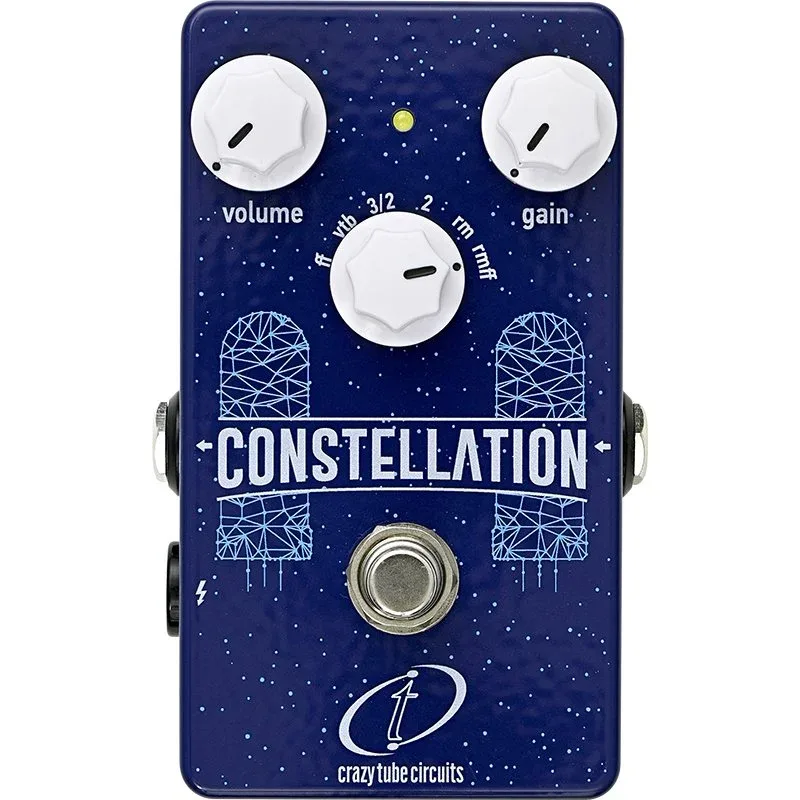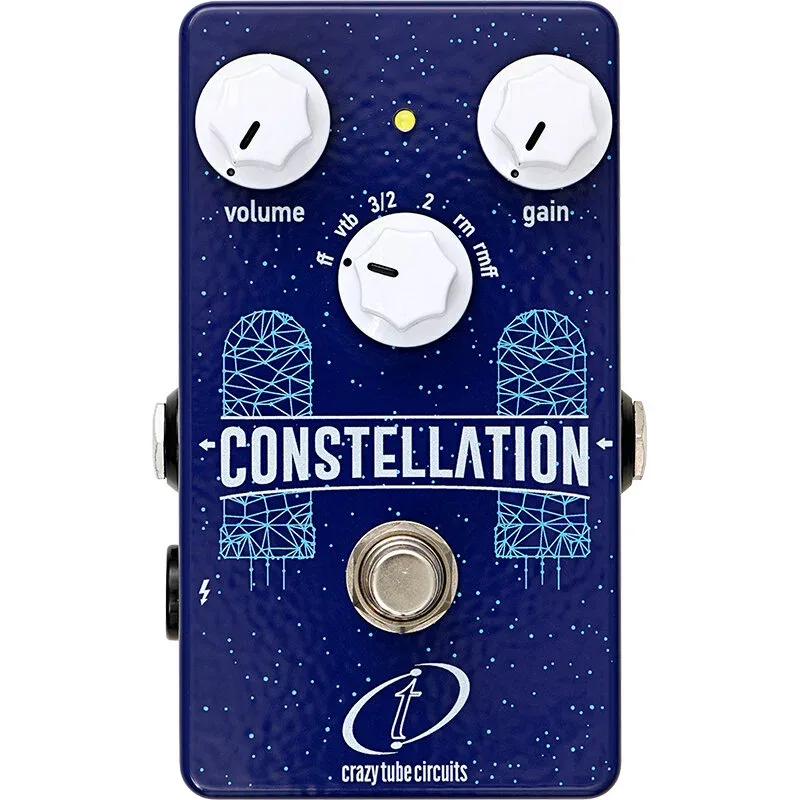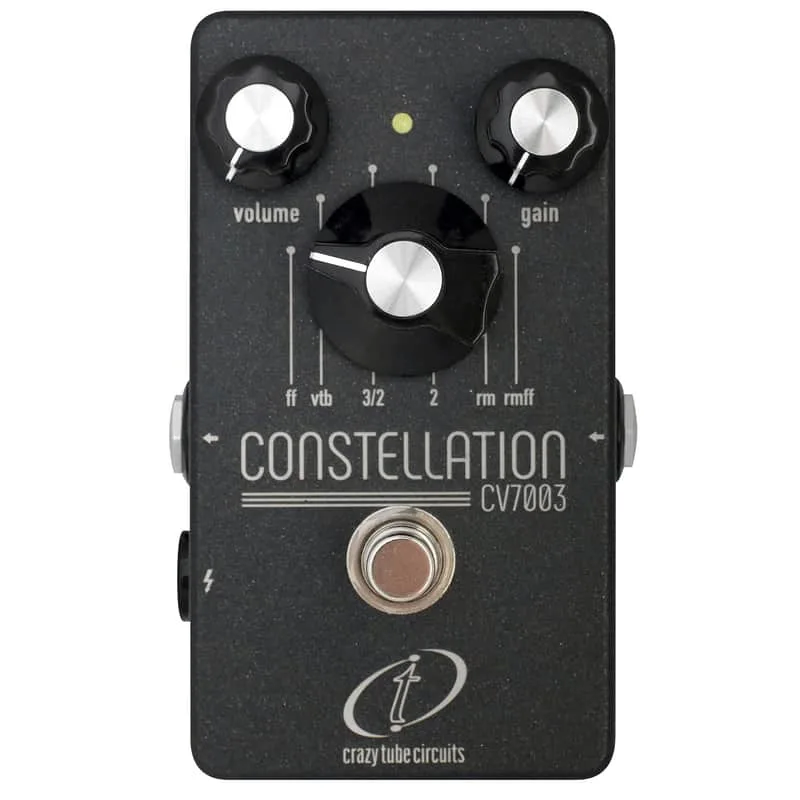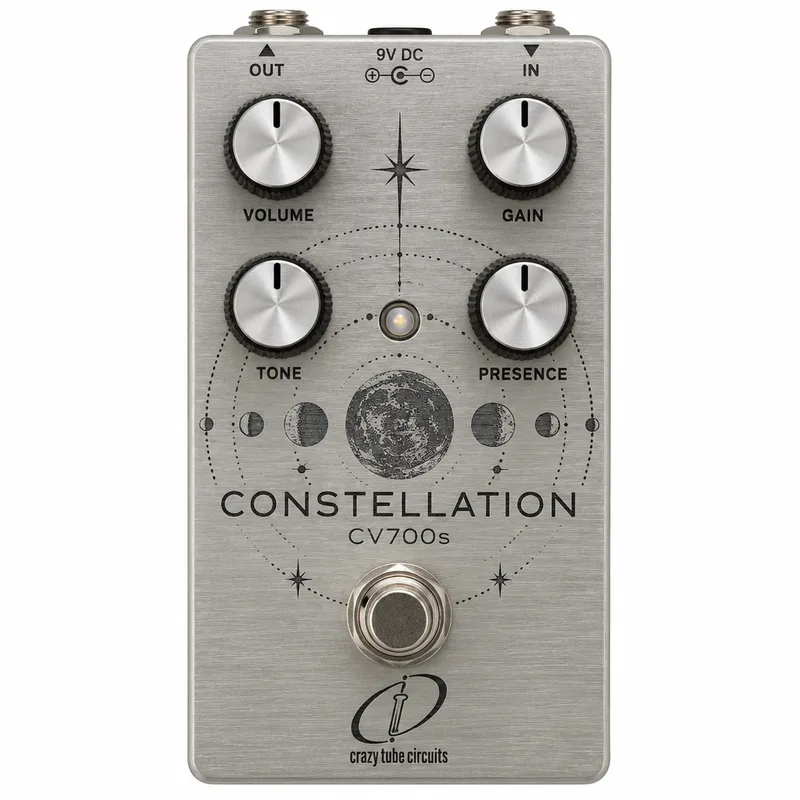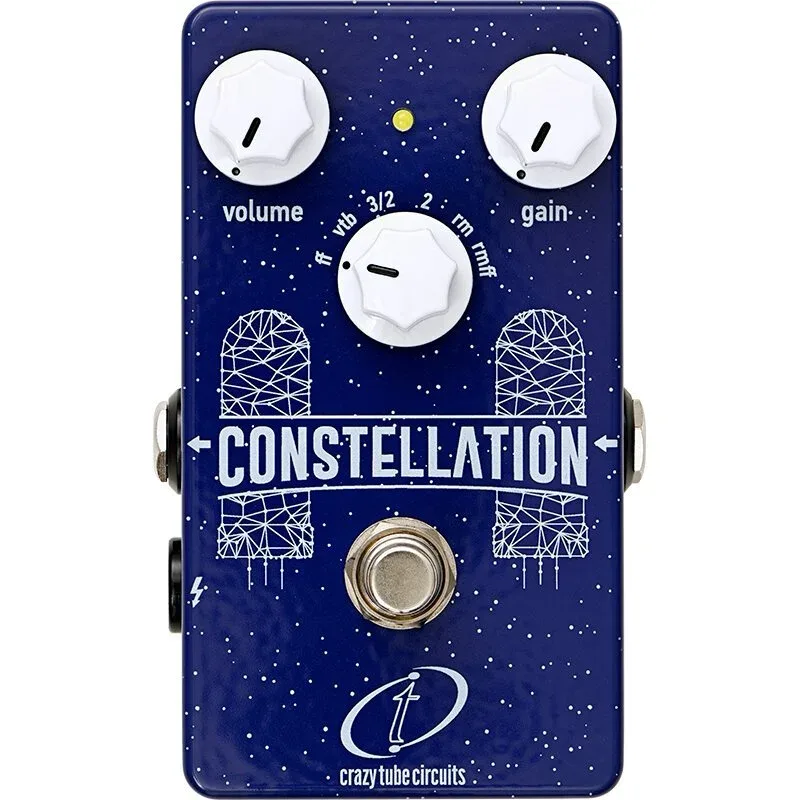
The Crazy Tube Circuits Constellation OC45 is a germanium multi-fuzz pedal that packs six vintage voicings into one enclosure: Fuzz Face, Vox Tone Bender, MKI.V, MKII, RangeMaster, and RangeMaster into Fuzz Face. The maker describes it as "Inspired by 6 classic British Fuzz boxes of the past", and it is built with three selected germanium transistors, in this case Valvo Black Glass OC45s12.
What it does
The Mode control selects among the six voicings, with Volume and Gain shaping level and fuzz amount2. Guitar Pedal X's reviewer, Stefan Karlsson, highlighted the pedal's "the ability to dial back the gain significantly with your guitar volume knob", which matters for players who want one fuzz to cover both full-on sounds and cleaned-up rhythm parts2.
On the overall character, Karlsson wrote that "it's quite evident just how full-frequency and rich-sounding these pedals are - with beautiful raspy harmonic textures". He also judged that this quality "makes these among the very best and most versatile vintage-style fuzz pedals available anywhere"2.
OC45 versus the other Constellations
Crazy Tube Circuits built the Constellation line in several transistor variants, each with its own character. The Constellation OC41 switched to Philips Black Glass OC41 transistors in summer 2019, and the Constellation CV7003 is the third variant of the trio24.
| Version | Transistors | Reviewer's character |
|---|---|---|
| Constellation OC45 | Valvo Black Glass OC45 | brightest and most open-pored of the trio, least low-end, pronounced dry/reedy edge in Fuzz Face mode4 |
| Constellation OC41 | Philips Black Glass OC41 (from summer 2019) | the most neutral and balanced option, particularly strong for Led Zep / Jimmy Page MKII stylings42 |
Karlsson described the original OC45 edition as "slightly more open-pored and with that slightly reedier dry edge" compared with its siblings2. On the Tone Bender voicings specifically, he was emphatic: "While there are a few pedals out there which share MK I.V and MK II Tone Bender voicings - none come close to replicating what these two pedals deliver on MK I.V and MK II Tone Bender voicings"2.
Availability and how to spot the versions
The Constellation OC45 is no longer in production. Crazy Tube Circuits' own product page lists the remaining B-Stock unit as sold out as of October 2026, at a sale price of €220.00 EUR, down from an original price of €259.00 EUR13. Guitar Pedal X had already reported in April 2021 that the original OC45 varieties had "pretty much long since sold out", with a single unit available in Finland on Reverb at that time4. The later OC41, which the maker was still building regularly with no production limit as of that 2021 review, is now also listed as sold out on the maker's site45.
Early and later Constellations can be told apart by their graphics: the earliest pedals had all-white graphics onto navy blue, while later versions changed the tube icons to cyan when the transistors changed to Philips Black Glass OC41 in summer 20192.
If you are shopping used, the enclosure graphics tell you which transistor set a Constellation carries: white-on-navy points to the early Valvo OC45 build, cyan tube icons to the later OC41 version2.
Questions
What is the difference between the Constellation OC45 and OC41?
The two versions differ mainly in their germanium transistors and their character. The original OC45 uses Valvo Black Glass OC45 transistors, while the later OC41 switched to Philips Black Glass OC41 transistors in summer 2019. Reviewer Stefan Karlsson of Guitar Pedal X called the OC41 the most neutral and balanced option of the Constellation trio, while he described the OC45 as the brightest and most open-pored of the three, with the least low-end and a pronounced dry, reedy edge in Fuzz Face mode.
Which classic fuzzes does the Constellation OC45 cover?
The pedal offers six vintage voicings: Fuzz Face, Vox Tone Bender, MKI.V, MKII, RangeMaster, and RangeMaster into Fuzz Face. Crazy Tube Circuits describes the Constellation as inspired by six classic British fuzz boxes of the past. Guitar Pedal X's reviewer noted that while a few other pedals share MK I.V and MK II Tone Bender voicings, none come close to what the Constellation delivers on those settings.
What transistors does the Constellation OC45 use?
The original Constellation OC45 uses Valvo Black Glass OC45 germanium transistors. Like the other Constellation variants, it is a multi-fuzz pedal built with three selected germanium transistors, according to Guitar Pedal X's review.
Is the Crazy Tube Circuits Constellation OC45 still available?
No. As of October 2026 the maker's own product page lists the Constellation OC45 B-Stock as sold out, and Guitar Pedal X reported back in April 2021 that the original OC45 varieties had long since sold out. The later OC41 version, which Crazy Tube Circuits was still building regularly, has also been listed as sold out on the maker's site.
Does the Constellation OC45 clean up with the guitar volume knob?
Yes. Guitar Pedal X's reviewer highlighted the pedal's ability to dial back the gain significantly with your guitar volume knob, a trait players of germanium fuzzes generally look for when a pedal needs to move from full fuzz to a cleaner edge-of-breakup sound within one song.
How can you tell early Constellation pedals from later ones?
By the graphics. According to Guitar Pedal X, the earliest Constellation pedals had all-white graphics on a navy blue enclosure, while later versions changed the tube icons to cyan when the transistors changed to Philips Black Glass OC41 in summer 2019.
Sources (5)
- Constellation OC45 (B-Stock), Crazy Tube Circuits
- Guitar Pedal X, Guitar Pedal X, 2021-03-18
- Constellation OC41 (B-Stock), Crazy Tube Circuits
- Guitar Pedal X, Guitar Pedal X, 2021-04-26
- Constellation OC41 (discontinued/old-stock), Crazy Tube Circuits