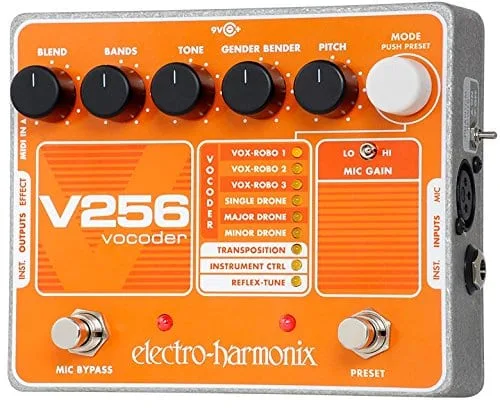


The Electro-Harmonix V256 is a digital vocoder pedal that, in the maker's words, "welds your voice to your axe": you sing into a microphone while your guitar (or an internal synthesizer) supplies the carrier signal, and the vocoder reshapes your voice with that signal1. It is a floor unit in pedal format rather than a rackmount, aimed at players who want robotic vocal effects, pitch transposition and drone synths on a pedalboard.
The V256 offers vocoder band adjustment from 8 bands up to 256 bands, and Premier Guitar's reviewer described that range as running from "a miniscule 8 bands all the way up to a smooth-sounding 256 bands"2. It carries an MSRP of $286 and a street price of $215, as reported by Premier Guitar in 20232.
The controls: Bands, Mode and Mic Gain
The front panel is built around a handful of knobs and one toggle, each with a clear job1:
| Control | What it does |
|---|---|
| BANDS | In most modes, sets the number of bands for the vocoder, from 8 to 2561 |
| MODE KNOB | Scrolls through the 9 modes1 |
| TONE | Adjusts the tonal quality of the effect1 |
| PITCH | In the first six modes, controls the pitch of the internal synthesized voices1 |
| GENDER BENDER | Formant shift, which corresponds roughly to the length of the vocal tract1 |
| MIC GAIN TOGGLE SWITCH | Changes the sensitivity of the mic pre-amp1 |
The Bands control is the heart of the vocoder character: fewer bands give a coarser, more obviously synthetic result, while the full 256 bands sound smoother, as Premier Guitar's reviewer put it2. The Gender Bender works on formants rather than pitch, effectively changing the apparent size of the vocal tract behind the processed voice1.
Premier Guitar's reviewer noted the mic side of the equation in practice: "The V256 has a Mic Gain switch, but at the time it was switched to the Low setting," and found that "the V256's mic input is rather sensitive (which is a good thing)"2. For a quiet microphone, the toggle's higher sensitivity setting is where to look.
The nine modes
The Mode knob selects between nine modes, which Premier Guitar broke down into three groups2:
- Three robotic synth modes
- Three drone synth modes (single, major or minor)
- Three transposition modes: Instrument Ctrl, Transposition and Reflex-Tune
The instrument input behaves differently depending on the mode. In the vocoder modes, the instrument signal can be used as the carrier signal for the vocoder effect. In Instrument Ctrl mode, the instrument signal determines the note that replaces the pitch of the sung note. In Reflex-Tune mode, with the Pitch knob set fully counterclockwise, the instrument signal determines the diatonic key and the V256 quantizes to notes in that key's scale1.
Inputs and outputs: XLR and TRS
The V256 has dual inputs and dual outputs, one on each side: an XLR connection for a microphone and a standard 1/4" TRS instrument plug2. Each jack has its own role1:
- Mic input (XLR): connect your microphone directly to this jack.
- Instrument input (1/4"): carries the guitar or bass signal used as the vocoder carrier, the pitch reference in Instrument Ctrl mode, or the key reference in Reflex-Tune mode.
- Effect output (XLR): the vocoder effect, plus the dry and bypassed vocals, come out of this jack on the side of the unit.
- Instrument output (1/4"): outputs a blend of the effected signal with the dry instrument signal or the MIDI-controlled internal synthesizer.
The audio path is mono, not stereo1, so both outputs carry the same single channel of audio in their respective formats.
MIDI control
Every function in the V256 is MIDI controllable: the unit can receive control messages from a MIDI controller or other MIDI device3. Over MIDI program change, program numbers 11 to 19 select the V256's modes without presets loaded, with 11 being VOX ROBO 1 and 19 REFLEX-TUNE3.
For players who want foot control, Microdesignum makes the MIDI Piccolo 2F1D, a MIDI footswitch controller specially adjusted for controlling the V2564.
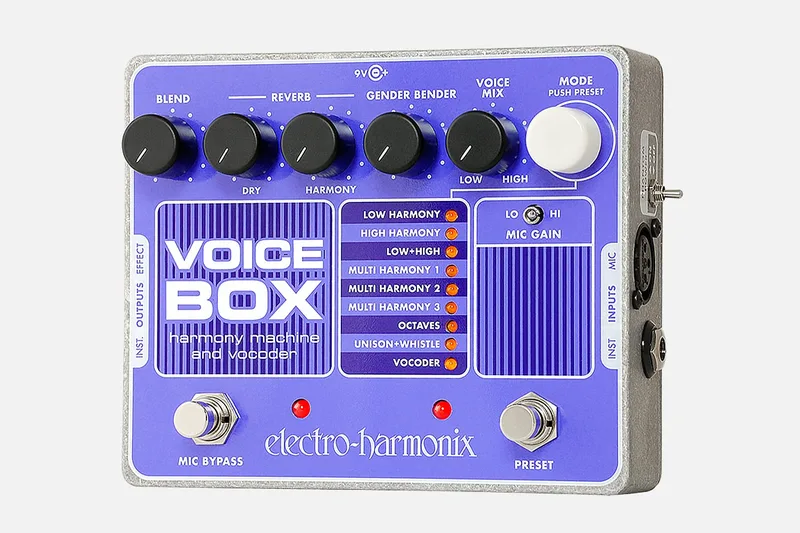
The V256 and the Voice Box
The V256 shares some things in common with the Voice Box, another Electro-Harmonix vocal processor, as Premier Guitar noted in its review2. Where the V256 centers on the vocoder itself, with its 8 to 256 band range and nine modes spanning robotic synths, drone synths and transposition, the Voice Box sits alongside it in the maker's vocal-effects lineup rather than replacing it.
What reviewers found
Premier Guitar reviewed the V256 and covered it with real gear: the review clip was recorded with a '78 Les Paul Custom through a Mesa Boogie Electra-Dyne half stack, and the reviewer also used a 1978 set-neck Ibanez Iceman, moving from an SM58 to an SM57 microphone2. Beyond the band range and the sensitive mic input already noted, the review's breakdown of the nine modes and the dual XLR and TRS connections on each side of the unit gives a picture of a unit designed to sit between a microphone and a guitar rig at once2.
Videos
Made on Tape
S- Knob
EHX
Questions
Can you plug a microphone straight into the EHX V256?
Yes. The V256 has a dedicated XLR mic input jack on the unit, and you connect your microphone directly to it. Premier Guitar's reviewer found the mic input rather sensitive, which they considered a good thing, and the Mic Gain toggle switch lets you change the sensitivity of the mic pre-amp to match your microphone.
Is the V256 stereo?
No. Electro-Harmonix lists the V256's audio as mono. It has dual inputs and dual outputs, one on each side: an XLR connection for a microphone and a standard quarter-inch TRS instrument plug, but the audio path itself is a mono design.
What are the nine modes on the V256?
The Mode knob scrolls through nine modes: three robotic synth modes, three drone synth modes (single, major or minor), and three transposition modes consisting of Instrument Ctrl, Transposition and Reflex-Tune. Over MIDI, program numbers 11 to 19 select the modes without presets loaded, with 11 being VOX ROBO 1 and 19 REFLEX-TUNE.
What is the difference between the V256 and the Voice Box?
The V256 shares some things in common with the Voice Box, but the V256 is built around the vocoder itself, with band adjustment from 8 up to 256 bands and nine modes covering robotic synths, drone synths and transposition. The Voice Box sits alongside it in the maker's vocal-effects lineup rather than replacing it.
Sources (4)
- V256 | Vocoder - Electro-Harmonix, Electro-Harmonix (www.ehx.com)
- Electro-Harmonix V256 Vocoder Pedal Review, Premier Guitar, 2010-01-08
- Voes | MIDI-CC, Voes, 2024
- MIDI footswitch controller for EHX V256 vocoder, Microdesignum