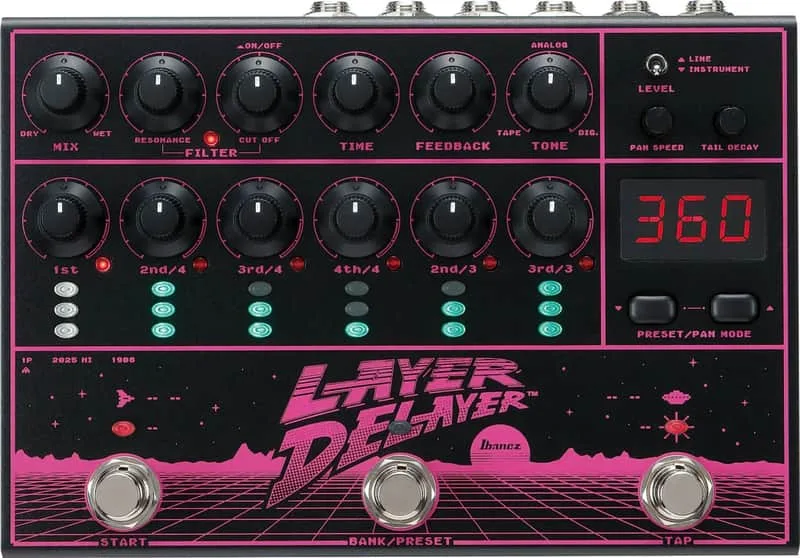


In practice, Delicious Audio found the pedal suits players who want more than a simple echo: it excels at creating evolving soundscapes, precise dotted-note rhythms, and textured ambient beds1. The pedal offers three delay engine modes, emulations of warm Tape, colored Analog, and pristine Digital delay, and Guitar Pedal X notes these tones gradually transition in between, with a simulated low-pass ladder filter in the signal path21.
What the Layer Delayer does
The core idea is per-repeat level control. The eight REPEATS controls set individual levels for the 1st Repeat, 2nd/4, 3rd/4, 4th/4, 2nd/3 and 3rd/3 positions, with up to a +3dB boost available on each and a visual meter to regulate the strength of the repeats2. Because the repeats are subdivided into 16th notes or triplets, you can build rhythmic delay patterns, dotted-note figures and sequenced textures that a standard feedback control cannot produce. Delicious Audio calls this bank of sliders its most innovative feature1.
Guitar World frames the pedal as an ambitious, feature-packed delay that aims to do things a little differently3. Beyond the repeat engine, it offers:
- Three delay engine modes: Tape, Analog and Digital emulations1
- Eight auto-panning modes with a Pan Speed knob, controlling the spatial quality of the delay in stereo23
- Dual-parameter Filter controls, cutoff and resonance, that shape the repeats from dark, lo-fi washes to bright clarity1
- Tail Decay, which lets echoes ring out naturally even after you bypass the pedal1
Guitar Pedal X's reviewer summed up the concept:
"It offers a certain cool simplicity overall for a multi-tap delay - which marks it out as somewhat unique!"2
Delicious Audio's verdict was similarly positive, calling it an ideal choice for the player or composer seeking a single powerful delay, from classic slap-back to sequenced moving stereo panoramas, with desktop-level programmability in a pedal format1.
The controls
The front panel mixes knobs, sliders and switches. Time and Feedback settings tailor the delay time, 40ms to 1,500ms, and the number of repeats2. The full control set as reported by the press:
| Control | What it does |
|---|---|
| Time | Sets delay time, 40ms to 1,500ms, or 40 to 1500 BPM2 |
| Feedback | Sets the number of repeats2 |
| REPEATS (8 sliders/buttons) | Individual volume per 16th and/or triplet note, up to +3dB boost, with a visual meter2 |
| Mix | Wet/dry blend, from Dry to Wet2 |
| Filter | Dual-parameter cutoff and resonance, from dark lo-fi washes to bright clarity1 |
| Pan Speed | Controls the spatial quality of the delay across the eight pan modes2 |
| Level switch | Selects Line or Instrument level2 |
| Preset / Pan Mode Down / Up | Steps through presets and pan modes2 |
Three footswitches handle the rest: a Start footswitch, a Bank/Preset footswitch and a Tap Tempo footswitch2. The Level switch matters if you run the pedal in a studio or with a line-level source rather than straight after a guitar, since it matches the input stage to the signal you feed it.
Stereo, FX loop, MIDI and USB-C
The LD-303 is a true stereo delay, with 1/4" TS right and left/mono jacks on both input and output, so a mono rig works fine and a stereo rig gets the full effect231. In stereo, the delay's pan speed between speakers is highly customizable via eight different modes3.
The built-in FX loop sits on the delay signal path, with Send and Return jacks, so external effects can be layered in tandem with the delay repeats2. For a player, this means anything in the loop colors only the echoes, not the dry signal: a fuzz in the loop gives you degraded, distorted repeats over a clean dry tone, a classic studio trick brought to the pedalboard.
Connectivity for the rest of the rig:
- MIDI: 5-pin DIN In and Thru for controlling parameters and presets in real time2. Guitar World reports MIDI compatibility for nearly all of the pedal's parameters3.
- USB-C: A USB-C port is equipped for future updates3.
- Presets: 50 slots across five banks, A to E, with 20 factory presets on board and 30 user slots for your own sounds213.
The LD-303 is built for stereo use, with 1/4" Right and Left/Mono TS inputs and the same pair on the output side, so it can sit in a stereo rig or run in mono13.
Videos
Ibanez Guitars
Ibanez Guitars and Jack Gardiner
Ibanez Guitars and 千愛Chiaki
News
Questions
Does the Ibanez Layer Delayer LD-303 have tap tempo?
Yes. The pedal has a dedicated Tap Tempo footswitch alongside a Start footswitch and a Bank/Preset footswitch, so you can set the delay time in time with the music while playing. Delay time can also be set directly, from 40ms to 1,500ms, or expressed as BPM from 40 to 1500.
How many presets does the LD-303 hold?
It stores 50 presets across five banks, A to E. Twenty of the slots hold factory presets when the pedal arrives, and 30 user slots are free for your own sounds. Presets can be recalled from the front panel or switched in real time over MIDI.
Is the LD-303 a stereo delay?
Yes. It has stereo 1/4-inch TS inputs and outputs, with a right jack and a left/mono jack on each side, so it works in mono or stereo. In stereo, eight auto-panning modes and a Pan Speed knob control how the repeats move between the speakers.
What delay times can the LD-303 produce?
Delay time runs from 40ms to 1,500ms, which covers everything from tight slap-back to long ambient washes. The same range can be expressed as BPM from 40 to 1500, and tap tempo sets it in time with your playing.
Can the LD-303 connect to MIDI gear?
Yes. It has 5-pin DIN MIDI In and Thru connections for controlling parameters and presets in real time, and Guitar World reports MIDI compatibility for nearly all of its parameters, so it can be integrated into a larger MIDI rig.
Does the LD-303 have an effects loop?
Yes. A built-in FX loop sits on the delay signal path, with Send and Return jacks, so you can layer external effects in tandem with the repeats. Placing a drive or filter in the loop lets those effects process only the delayed signal, not your dry sound.
Sources (3)
- New Pedal: Ibanez Layer Delayer Delay, Delicious Audio, 2026-01-15
- Guitar Pedal X, Guitar Pedal X, 2026-01-13
- Ibanez's Layer Delayer is its most ambitious pedal yet, Guitar World, 2026-01-14