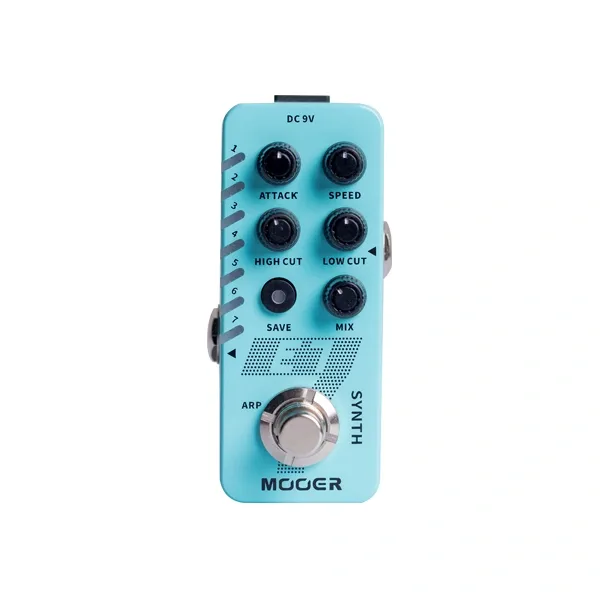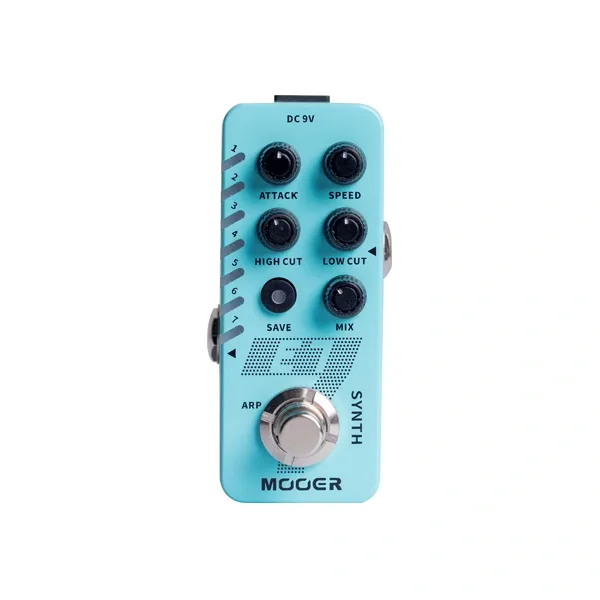


The MOOER E7 is a polyphonic guitar synth pedal in the company's Micro Series of mini stompboxes, and it was the first synth pedal of this kind in a mini format when MOOER launched it in late 201912. It turns your guitar into an electronic synthesizer without the need for special pickups or instrument modifications: you plug in with a standard 1/4 inch cable and play, and the pedal converts what you play into synth voices3. Because it is polyphonic, it tracks chords as well as single notes, and each of its seven voices has its own built-in arpeggiator13.
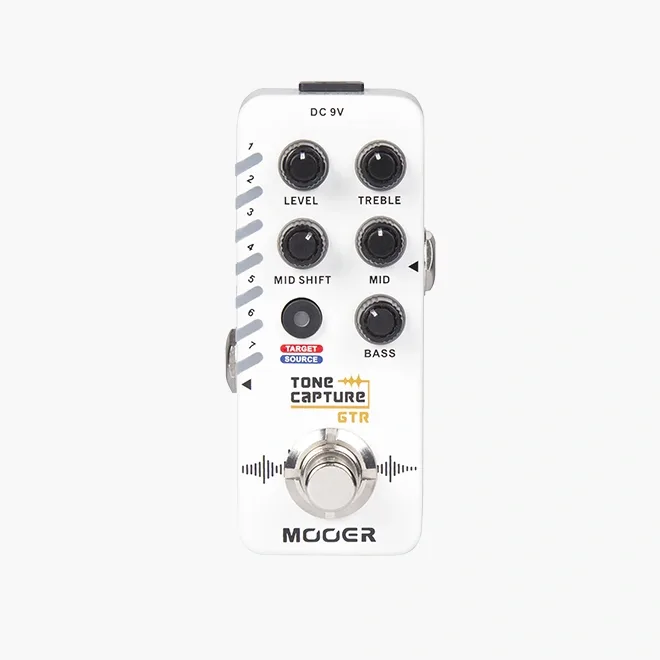
The E7 is the second pedal of MOOER's New Micro series, and it uses the same form factor as the Tone Capture GTR pedal14. Its synth engine comes from a bigger sibling: gearnews.com reported at launch that the E7 is based on the synth engine of MOOER's flagship GE300 multi-effect5.
The controls and presets
The E7 is named for its seven different MOOER custom synthesizer tones, and each tone has an individual arpeggiator plus high/low frequency cut, attack and speed functions1. Delicious Audio lists the synth types as Trumpet, Organ, Sea wave, Weeyo, Saw wave, 8bits, EDM and Pad3. gearnews.com described the range as running from organ-like effects to ambient synth pads, an 8-bit setting reminiscent of classic video game soundtracks, and a trumpet5.
| Control | What it does |
|---|---|
| Attack | Shapes how quickly each note's synth voice ramps in6 |
| Speed | Sets the rate of the arpeggiator6 |
| High Cut / Low Cut | Trims the top and bottom of the synth voice's frequency range2 |
| Mix | Blends the synth voice with your dry guitar signal6 |
| Save button | Stores up to seven presets7 |
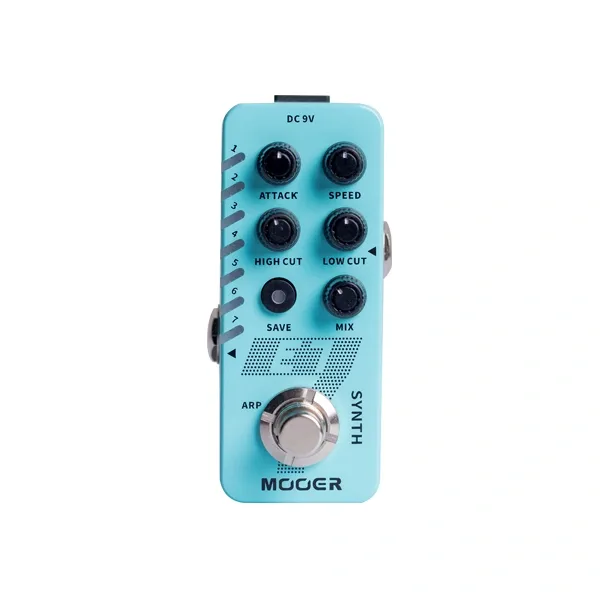
Seven LED indicators on the side of the shell show which of the seven patches is selected, and the four top knobs, Attack, Speed, High Cut and Low Cut, edit the chosen patch12. Guitar World's mini pedal buying guide noted that the attack, speed, mix and EQ settings help you dial in a patch, though it added that the pedal sounds best with the mix dimed6.
"It has attack, speed, mix and EQ settings which help you dial in a patch"
Guitar World's verdict on the pedal in that same guide summed it up as a polyphonic synth with 7 modes, a built-in arpeggiator, and no special pickups or cables required, with no listed downsides at its price6.
Power, connections and size
The E7 runs on a 9V DC transformer with internal negative, external positive polarity, and MOOER recommends its Micro Power supply1. There is no battery option, and at 150mA the current draw is high for a micro pedal, well beyond what a typical analog mini stompbox draws, so it needs a proper 9V supply rather than a shared low-current daisy chain1.
The E7 draws 150mA, which is substantial for a Micro Series enclosure. Plan a power supply output that can deliver it, and match the center-negative polarity the pedal requires1.
Connections are simple: one 1/4 inch mono jack input at 2.2M Ohms impedance and one 1/4 inch mono jack output at 100 Ohms impedance1. The enclosure measures 93.5mm deep by 42mm wide by 52mm high and weighs 155g1. Guitar World's buying guide gives the dimensions as 2" x 1.6" x 3.68", and describes the pedal as a polyphonic synth with an arpeggiator that fits in the palm of your hand6.
The firmware is upgradeable via USB, so the pedal's sounds can be revised after purchase34.
Where it came from
MOOER launched the E7 as the second pedal of its New Micro series, using the same form factor as the TONE CAPTURE GTR pedal48. The company added 7 LED indicators on the right side of the shell, a feature it highlighted in the pedal's own description1.
The E7 shares its mini enclosure with the TONE CAPTURE GTR pedal, keeping it in the compact format of the New Micro series4. Its seven LED indicators on the side of the shell show the selected patch, tying the display into the pedal's small footprint12. ===
How it compares with other synth pedals
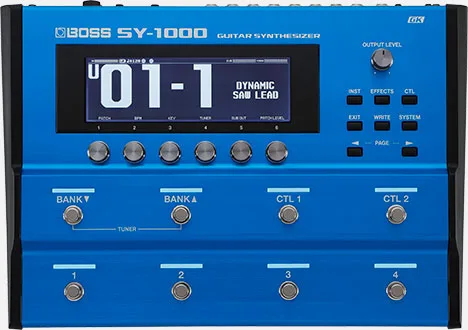
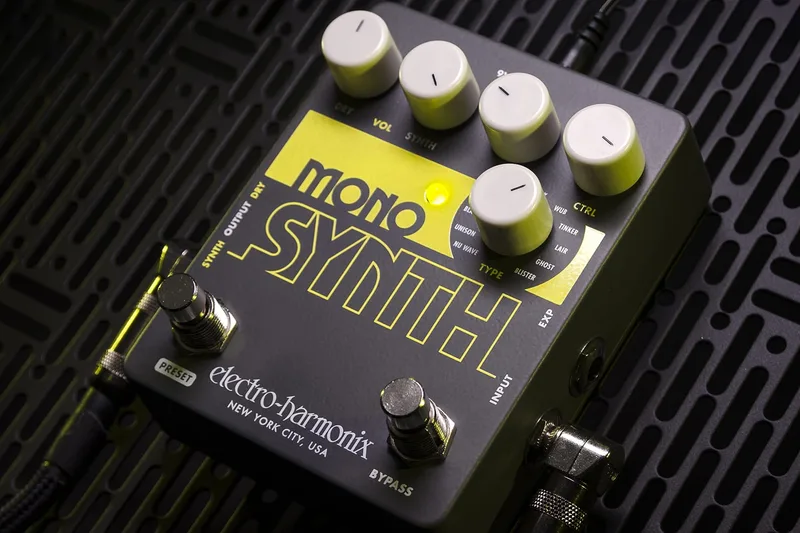
Most polyphonic guitar synths before the E7 came in larger enclosures or required special pickups, like the Roland and BOSS GR-series approach. The E7's pitch is the combination: full polyphonic tracking, an arpeggiator and seven savable presets in a Micro Series box that costs a fraction of a flagship unit like the BOSS SY-1000 or Meris Enzo. For players who want a single synth voice rather than a deep engine, smaller monophonic options such as the Electro-Harmonix Mono Synth or the DigiTech Dirty Robot sit at the simpler end of the same category, while the Source Audio C4 Synth offers far deeper editing at a higher price. See the synth pedals category page for the full range.
Videos
MOOER Audio
Brett Kingman
TheGuitarGeek
News
Questions
Is the MOOER E7 analog or digital?
MOOER describes the E7's seven synth voices as analog synth effects. The pedal is based on the synth engine of Mooer's flagship GE300 multi-effect, so the sounds are analog-style synth voices rather than modeled instruments.
Does the MOOER E7 take a battery?
No. The E7 is powered by a 9V DC transformer with internal negative, external positive polarity, and MOOER recommends its Micro Power supply. There is no battery option, and at 150mA it draws more than a typical analog mini pedal.
How many presets can the MOOER E7 store?
Seven. The pedal has 7 slots for storing user presets, and a dedicated Save button lets you program up to seven presets. Seven LED indicators on the side of the shell show which patch is selected.
Can the MOOER E7 firmware be updated?
Yes. The E7's firmware is upgradeable via USB, so MOOER can add or revise synth voices after the pedal ships. Connect the pedal to a computer by USB to install updates.
Does the MOOER E7 track chords?
Yes. The E7 is a polyphonic synth pedal, so it converts every note you play, including full chords, into synth voices. It does this without special pickups or instrument modifications, using a standard 1/4 inch guitar cable.
How big is the MOOER E7?
The E7 measures 93.5mm deep by 42mm wide by 52mm high and weighs 155g, the same form factor as MOOER's Tone Capture GTR pedal. It is part of MOOER's Micro Series of mini pedals and fits in the palm of your hand.
Sources (8)
- E7_MOOER Audio, MOOER Audio
- Best Synth Pedals For Guitar In 2025 (Monophonic & Polyphonic), Delicious Audio, 2025-02-21
- Mooer E7 Polyphonic Synth Micro Pedal, Delicious Audio, 2021-10-19
- Introducing the E7, the second member in the New Micro Series of Pedals from MOOER, MusicPlayers.com, 2019-10-30
- Mooer E7 Synth Micro Pedal: Synthesis for guitarists (with added trumpet), gearnews.com, 2019-10-30
- Best mini-pedals for guitarists: top space-saving stomps, Guitar World, 2020-09-25
- Mooer Audio launches the small-format E7 Synth pedal for guitar, MusicRadar, 2019-10-30
- Mooer returns to mini pedals with the funky-sounding E7 Synth, Guitar World, 2019-10-31