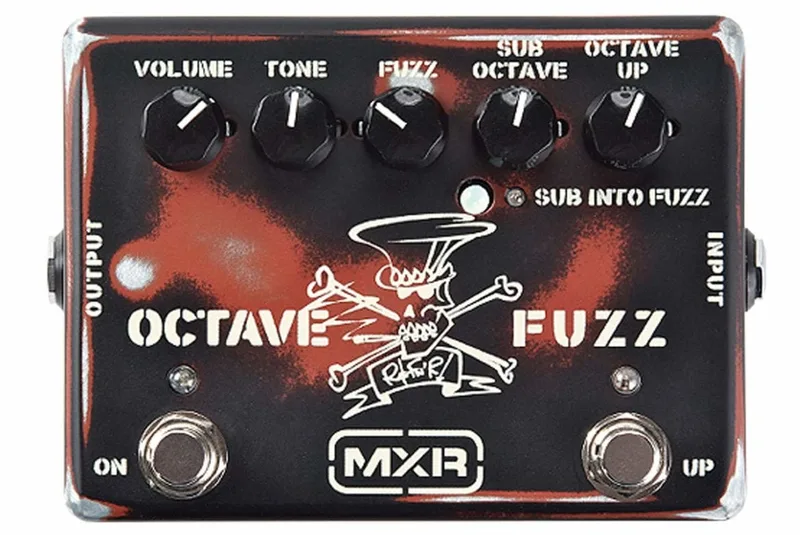


The MXR SF01 Slash Octave Fuzz is a signature octave fuzz pedal from MXR, developed with Slash and MXR's design team1. It combines fuzz with octaves both above and below the note you are playing, giving three fuzz voices in one box: Sub-Octave, Fuzz, and Octave Up21. MusicRadar describes it as a signature octave fuzz designed to add girth to your tone, and it can be heard on Slash's second solo album, Apocalyptic Love2.
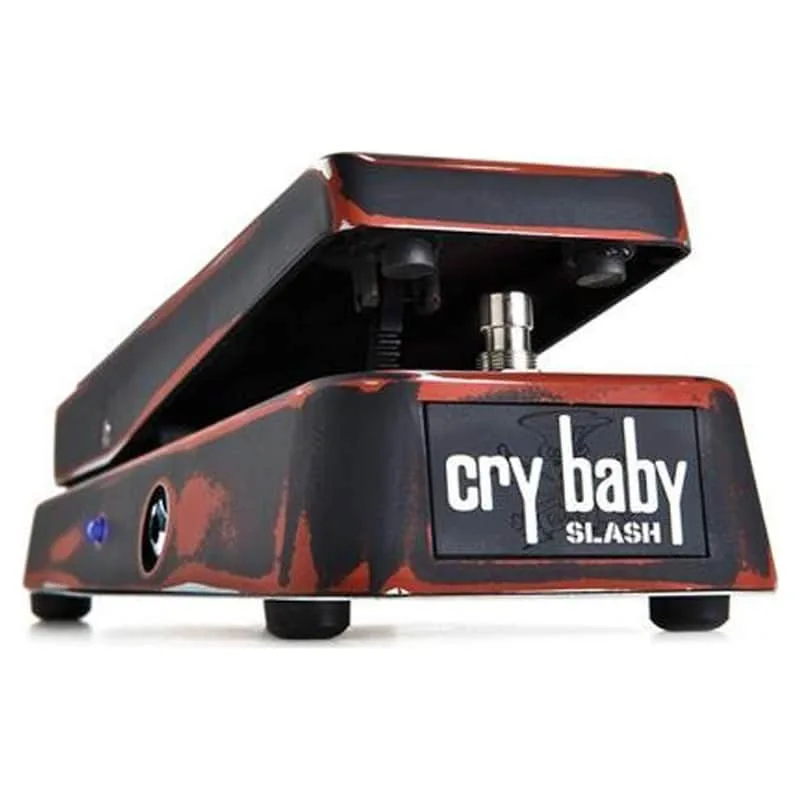
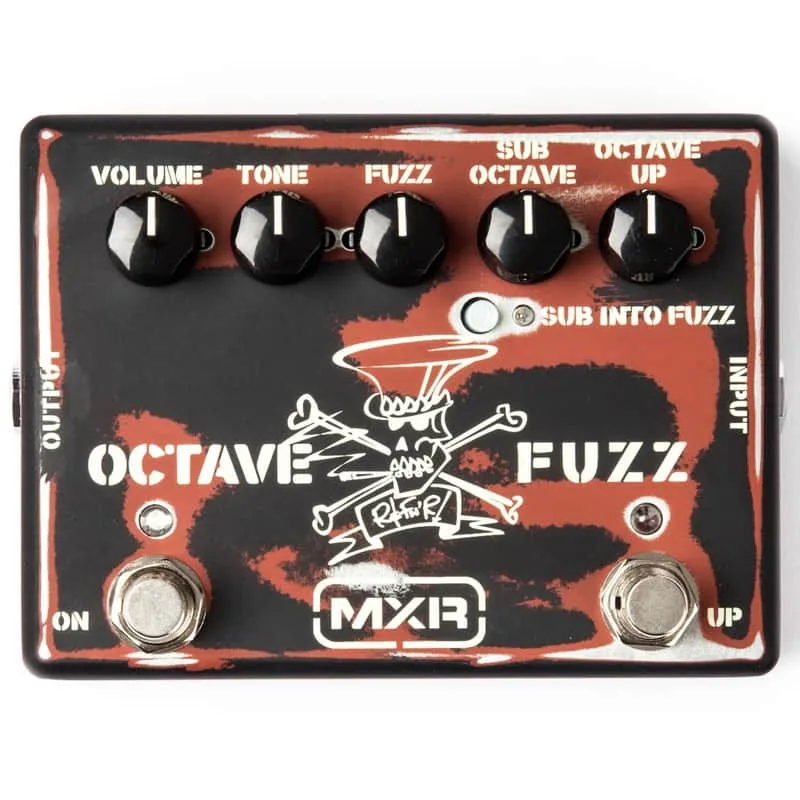
The pedal is built with analog circuitry, true-bypass switching, and a heavy-duty housing3. It wears a distressed hot-rod finish with the trademark Slash-and-crossbones logo, the same distressed finish as the Dunlop SC95 Slash Cry Baby Classic wah24.
Fuzz with an octave up and an octave down
The SF01's core idea is stacking octaves around a fuzz. The Sub Octave knob progressively dials in a single note an octave below what you are playing2. Stomping the right footswitch, labeled Up, adds an extra fuzzed octave-up note on top of whatever mode you have configured23. The Octave Up knob controls the volume of that octave-up fuzz1. With the levels balanced, MusicRadar's Simon Bradley writes that "you'll have a colossal sonic bombardment of three-octave artillery at your disposal"2.
The octave-up circuit has gain and tone trim pots on the inside of the pedal, so its character can be adjusted internally2. The main fuzz itself, in Bradley's assessment, "sounds more Fuzz Face than Big Muff Pi"2.
Guitar World's reviewer found the pedal's approach distinct from a typical octave fuzz: rather than dominating the signal, "Slash's signature Octave Fuzz, however, produces vintage-style fuzz that blends with your sound at a lower volume than the original signal"4. In their view, "the Slash SF01 shines when used to thicken the signal and create a wider soundstage of pitch and depth variations"4.
On tracking, the SF01 behaves like most octave circuits of this kind. Bradley found that "The SF01 is best suited to single notes; chords tend to present a few grim glitches, though lo-fi junkies will probably love them"2. He also found that "Hendrix-style tones are faithfully recreated"2.
The controls and footswitches
There are two footswitches on the pedal. The left one, labeled On, engages the pedal; the right one, labeled Up, engages the octave-up fuzz in addition to whatever mode you have configured13. Guitar World describes the same layout from a different angle: the left switch activates the sub-octave effect, and stomping the right footswitch adds the upper-octave fuzz circuit4.
| Control | What it does |
|---|---|
| Sub Octave knob | Progressively dials in a single note an octave below what you are playing2 |
| Octave Up knob | Controls the volume of the octave-up fuzz1 |
| Volume knob | Dials in dry signal volume when Sub Into Fuzz is disengaged; controls main fuzz volume when it is engaged3 |
| Sub Into Fuzz button | Activates the main fuzz on the note you are playing2 |
| Mini top-panel button | Engages the fuzz with the sub-octave4 |
| Left footswitch (On) | Engages the pedal1 |
| Right footswitch (Up) | Engages the octave-up fuzz in addition to the configured mode1 |
| Internal trim pots | Gain and tone adjustments for the octave-up circuit2 |
The Sub Into Fuzz button is the key to how the fuzz and sub-octave interact. As Bradley puts it, "The Sub Into Fuzz button activates the main fuzz," and "If SIF is not on, you get no fuzz on the main note"2. With the button off, the Volume knob governs your dry signal; with it on, the same knob governs the main fuzz's volume3.
This layout makes the pedal more flexible than a straight fuzz. Vintage Guitar called out one feature as particularly cool: "the ability to bypass the fuzz" and deliver a different sort of overdrive or distortion along with a sub-octave effect1. Going the other way, Guitar World notes the pedal can be used as a standalone fuzz by activating the left switch with the mini top-panel button engaged and turning down the sub-octave4. Vintage Guitar tried exactly that: "we bypassed the sub-octave effect and used the pedal as a straight fuzz unit, which rendered some hairy, mind-bending tones"1.
Slash and Apocalyptic Love
The SF01 came out of a collaboration: in developing the Octave Fuzz, Slash worked with MXR's design team1. According to Vintage Guitar, he uses it on occasion to color his sound, not overpower it, and one place you can definitely hear it is on his studio album Apocalyptic Love1. MusicRadar likewise credits its use on the former Guns N' Roses guitarist's second solo album2.
The SF01 and the MXR Blue Box
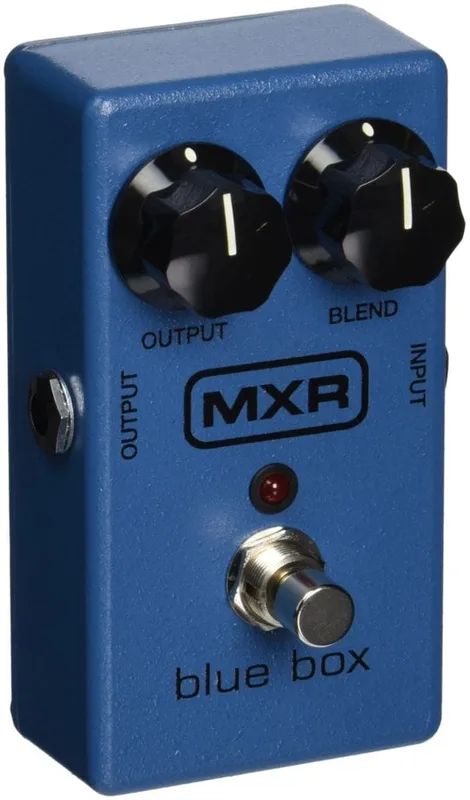
The SF01 has a direct ancestor. According to Vintage Guitar, one of Dunlop's goals was to develop a more predictable version of the '70s MXR Blue Box fuzz pedal, and the Slash Octave Fuzz achieves that3. Where the Blue Box combined sub-octave and fuzz in a famously unpredictable package, the SF01 splits the voices into separately switchable circuits, adds a dedicated octave-up fuzz with its own volume knob and internal trim pots, and lets you run the sub-octave without any fuzz on the main note at all213.
Videos
GSharpMedia
Westside Distribution
Nazzareno Zacconi
Questions
Is the MXR Slash Octave Fuzz true bypass?
Yes. Reviews in Vintage Guitar and Guitar World both describe the SF01 as having true-bypass switching, alongside its analog circuitry and heavy-duty housing. When the pedal is off, your dry signal passes through without the circuit coloring it.
Can you use the SF01 sub-octave without fuzz?
Yes. Vintage Guitar highlighted bypassing the fuzz and getting a different sort of overdrive or distortion together with the sub-octave effect. MusicRadar notes that if the Sub Into Fuzz button is not on, you get no fuzz on the main note, so the sub-octave can run on its own.
Does the MXR SF01 track chords well?
Not particularly. MusicRadar's reviewer found the SF01 best suited to single notes, with chords tending to present a few grim glitches, though he noted lo-fi players will probably love that character. Single-note lines are where the octave effects stay clean.
Is the Slash Octave Fuzz analog?
Yes. Vintage Guitar describes the pedal as built with analog circuitry, along with true-bypass switching and a heavy-duty housing. The octave-up circuit also has internal gain and tone trim pots for adjusting its character.
What is the difference between the SF01 and the MXR Blue Box?
The SF01 grew out of a goal at Dunlop to build a more predictable version of the 1970s MXR Blue Box fuzz pedal, developed with Slash and MXR's design team. It adds a dedicated octave-up fuzz circuit with its own footswitch and internal trim pots, where the Blue Box kept things simpler.
Can the MXR Slash Octave Fuzz be used as a standalone fuzz?
Yes. Guitar World describes using it as a standalone fuzz by activating the left switch with the mini top-panel button engaged and turning down the sub-octave. Vintage Guitar also used it as a straight fuzz with the sub-octave bypassed and got what they called hairy, mind-bending tones.
Sources (4)
- MXR Slash Octave Fuzz SF01 and Slash Cry Baby Classic SC-95, Vintage Guitar magazine, 2014-01-27
- MXR SF01 Slash Octave Fuzz review, MusicRadar, 2012-09-20
- MXR Slash Octave Fuzz SF01/Slash Cry Baby Classic SC-95, Vintage Guitar magazine, 2013-12-09
- Review: Dunlop SC95 Cry Baby Classic Slash Signature Wah and MXR SF01 Slash Signature Octave Fuzz, Guitar World, 2013-05-01
 Slash