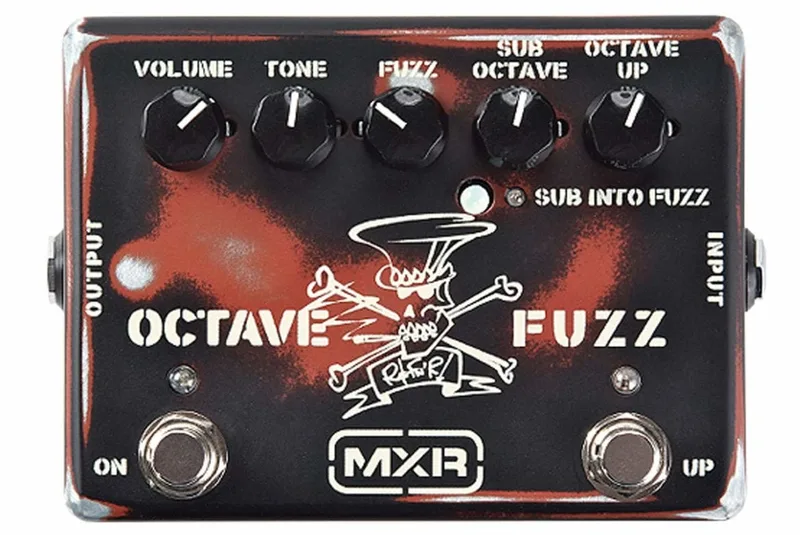


The MXR Slash Octave Fuzz SF01 is a signature fuzz pedal from MXR, developed with Slash and first shown in May 2012123. It packs three voices into one analog box: a main '70s-style fuzz, a sub octave an octave below what you play, and an octave-up fuzz, which MXR describes as a way of "thickening up your tone with a sinister growl"34. Vintage Guitar called it three fuzz "flavors", Sub-Octave, Fuzz, and Octave Up, offering "a palette of distinctive, utilizable sounds"1.
The pedal came out of a direct collaboration. Slash explained the process at launch:
"Basically, I explained the sound I was looking for to the Dunlop design team, and we compared those ideas to similar pedals and effects."
Vintage Guitar reported that Slash provided input to the Dunlop design team while they tweaked prototypes, and that the pedal can be heard on his album Apocalyptic Love1.
Three voices: sub octave, fuzz and octave up
The SF01 is really three effects in one enclosure, and its strength is that you can use them individually or stacked. The Sub Octave voice can be run dry or switched into the '70s-style "shag" fuzz circuit43. The main fuzz is what MXR calls "thick '70s shag"3, and the Octave Up Fuzz adds what the manual calls "Psychedelic Octave Up fuzz"3 with a chainsaw grind on top3.
MusicRadar's reviewer, Simon Bradley, found the main fuzz "sounds more Fuzz Face than Big Muff Pi"2, and that with the sub and high octaves balanced against the fuzz "you'll have a colossal sonic bombardment of three-octave artillery at your disposal"2. Guitar World's reviewer found the pedal "shines when used to thicken the signal and create a wider soundstage of pitch and depth variations"8.
Vintage Guitar's verdict on the architecture:
"No doubt, though, the pedal's strong suit is the ability to utilize the Sub Octave and Octave Up features, individually or together."
Controls and footswitches
There are two footswitches. The left one (On) engages the pedal, while the right one (Up) engages the octave-up fuzz in addition to whatever mode you have configured9. A mini top-panel button, Sub Into Fuzz, activates the main fuzz28.
| Control | What it does |
|---|---|
| ON footswitch (left) | Turns the effect on and off7 |
| UP footswitch (right) | Adds the fuzzed octave-up note82 |
| Sub Into Fuzz button | Activates the main fuzz, engaging it with the suboctave28 |
| Sub Octave knob | Progressively dials in a single note an octave below what you're playing2 |
| Volume knob | Sets dry signal volume when Sub Into Fuzz is off; sets main fuzz volume when it is engaged9 |
| Tone knob | Shapes the overall EQ of the main fuzz7 |
The Volume knob's dual behavior is worth understanding: with Sub Into Fuzz disengaged it controls your dry level, and with it engaged it controls the amount of main fuzz97. If Sub Into Fuzz is not on, you get no fuzz on the main note at all2.
The pedal can also be run as a standalone fuzz: activate the left switch with the mini top-panel button engaged and turn down the suboctave knob8. Vintage Guitar highlighted the flip side, the ability to bypass the fuzz entirely and "deliver a different sort of overdrive or distortion along with a sub-octave effect"1.
Internal trim pots and sample settings
Inside the pedal are two trim pots for the octave-up circuit: a GAIN trim pot that controls the intensity of the Octave Up fuzz, and a TONE trim pot that shapes the overall EQ72. These are internal controls, so shaping the octave-up voice means opening the box10.
The manual also includes three sample settings, named SLASH 1, SLASH 2 and SLASH 3, covering both octaves, octave up alone, and sub octave alone7. They give a starting point for each of the pedal's main configurations.
Power and connections
Setup is conventional: run a cable from your guitar to the INPUT jack and another from the OUTPUT jack to your amplifier7. Power comes from a 9-volt battery, a Dunlop ECB003 9-volt adapter, or the DC Brick, Iso-Brick and Mini Iso-Brick power supplies, none of which are included3. Current draw is 17 mA7, light enough that battery power is practical.
Other manual specifications: fuzz gain range of 40 dB, octave up gain range of 20 dB, sub octave corner frequency of 149 Hz, dry max gain of +1.6 dB, and signal to noise greater than 85 dB with all controls at mid position, A-weighted7.
At launch in May 2012 the pedal was exclusive to Guitar Center in the US, alongside the Slash Cry Baby Classic and Slash Pick Tin11. Vintage Guitar's December 2012 street price was $1291; Dunlop's current list price is $179.996.
Designed with Slash, from the Blue Box and Octavia
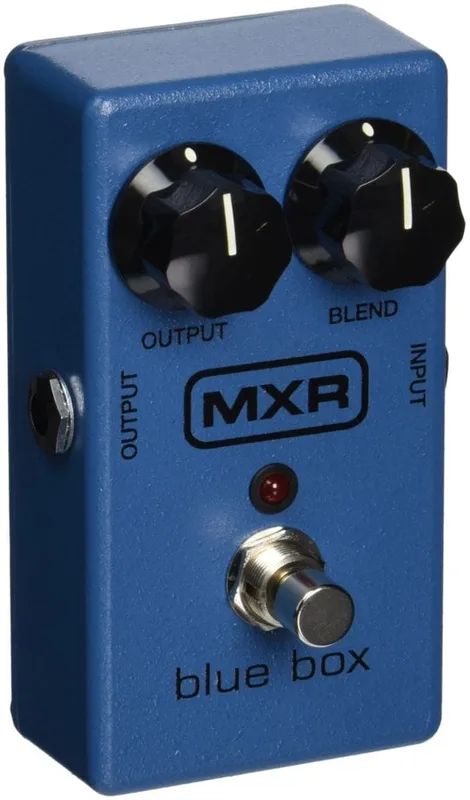
The SF01 has a clear circuit lineage. Vintage Guitar reported that one of Dunlop's goals was "to develop a more-predictable version of the '70s MXR Blue Box fuzz pedal, and the Slash achieves that"19. The original Blue Box was an octave/fuzz pedal used by Jimmy Page on Led Zeppelin's "Fool In The Rain"12. Premier Guitar placed the Slash Octave Fuzz "closest in spirit to, say, a Fuzz Face and Octavia in tandem", noting it pays homage to the Tycobrahe Octavia and Boss OC-3 Super Octave, and that the silicon-based circuit is voiced with plenty of brash midrange boost, which is how Slash tends to set his own EQs13.
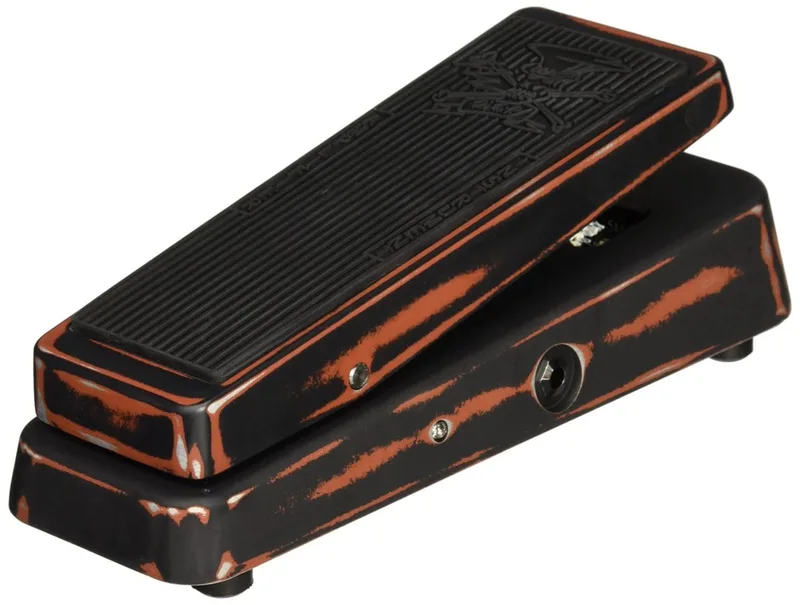
Vintage Guitar noted that few listeners associate Slash with octave fuzz, but that he uses it on occasion to color his sound rather than overpower it1. The enclosure carries his identity plainly: a heavy-duty housing with custom artwork featuring Slash's tophatted-skull-and-crossbones motif1, in a distressed finish matching the Dunlop SC95 Slash Cry Baby Classic wah released alongside it28.
What reviewers said
Published reviews were broadly positive about the concept and the build, with one consistent caveat about tracking.
- Premier Guitar: "Sub octave and octave up circuits offer many tone options. Built for the road. Voiced for searing, shaggy fuzz."13
- MusicRadar (Simon Bradley): "The SF01 is best suited to single notes; chords tend to present a few grim glitches, though lo-fi junkies will probably love that!"2
- MusicRadar also found "Hendrix-style tones are faithfully recreated, but it's when the sub and high octaves are used with the fuzz that the walls begin to crumble."2
- Guitar World: the pedal "shines when used to thicken the signal and create a wider soundstage of pitch and depth variations"8.
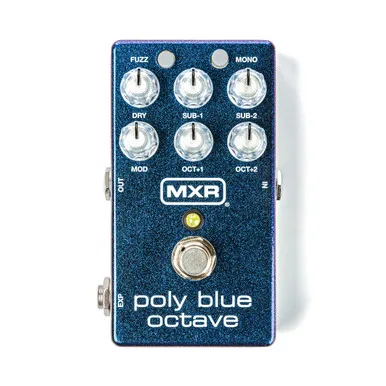
The chord-tracking point matters if you are comparing this against a modern polyphonic octave and pitch pedal: the SF01 is an analog, monophonic-minded design, and its glitches are part of that character. Players wanting the Blue Box idea with polyphonic tracking and more control can also look at the later MXR M306 Poly Blue, which expanded the concept with four octaves, modulation and a switchable fuzz circuit.
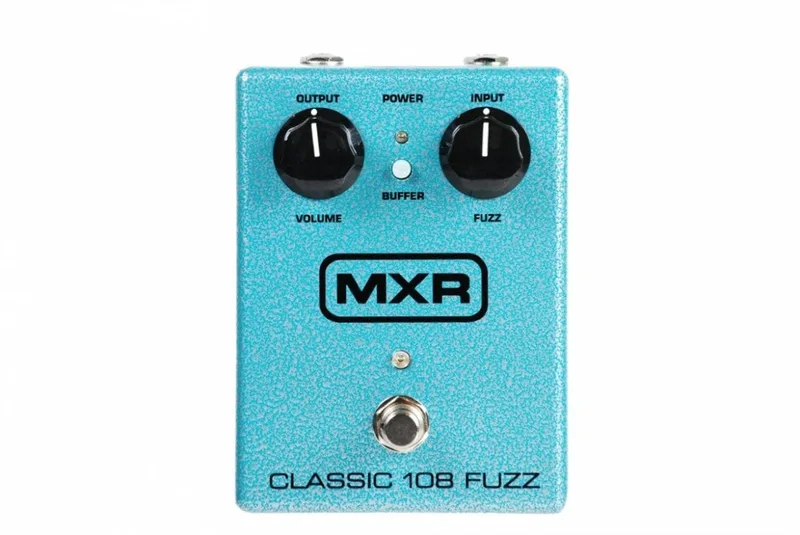
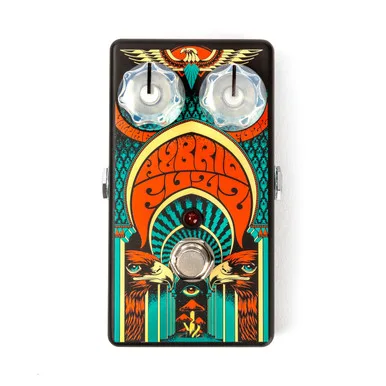
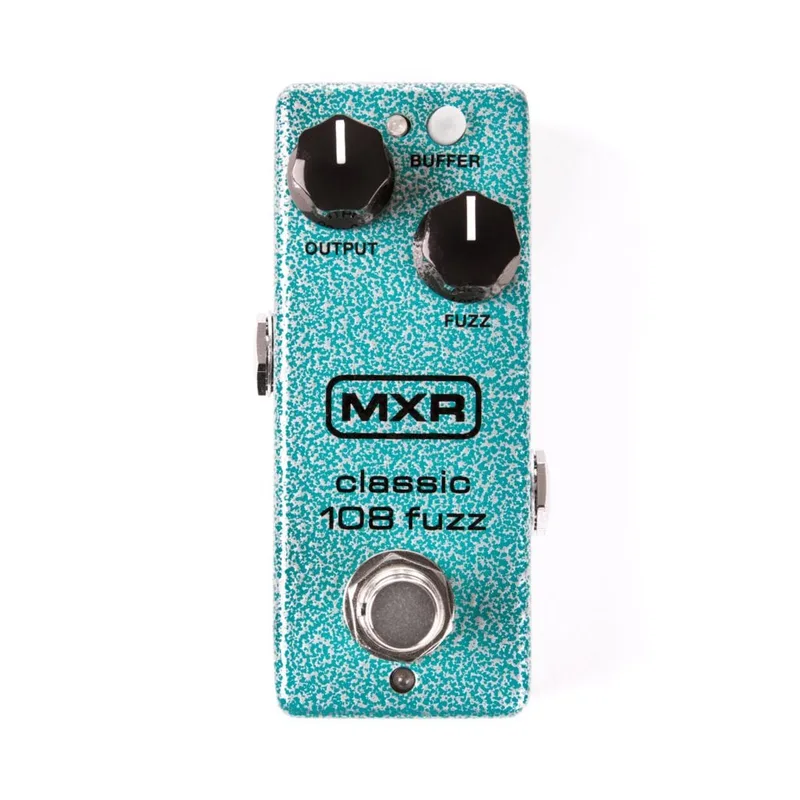
For fuzz alone, MXR's range includes the Classic 108 Fuzz and the Hybrid Fuzz, but the SF01 remains the one that stacks sub octave, fuzz and octave up in a single analog signal path, tuned to Slash's taste.
Videos
GSharpMedia
jimdunlopusa
Gear Reviews by Myke
Questions
Is the MXR Slash Octave Fuzz true bypass?
Yes. The Dunlop manual lists the bypass as True Hardwire, and Guitar World and Vintage Guitar both describe the pedal as having true-bypass switching. When the effect is off, your dry signal passes through without buffering or coloration.
Can the Slash Octave Fuzz run on a battery?
Yes. MXR says the pedal can be powered by a 9-volt battery, a Dunlop ECB003 9-volt adapter, or the DC Brick, Iso-Brick and Mini Iso-Brick power supplies, none of which are included. Current draw is a modest 17 mA, so a battery lasts a reasonable while.
Is the MXR Slash Octave Fuzz exclusive to Guitar Center?
It was at launch. When Dunlop introduced the pedal in May 2012, the MXR Slash Octave Fuzz, Slash Cry Baby Classic and Slash Pick Tin were exclusive to Guitar Center in the US. Vintage Guitar listed the street price at $129 at the time.
Is the Slash Octave Fuzz analog?
Yes. MXR's product page states the pedal features all analog circuitry, and Vintage Guitar's review describes it as built with analog circuitry. There is no digital processing in the signal path.
Can you use the SF01 sub-octave without fuzz?
Yes. The Sub Octave voice can be run dry, and Vintage Guitar highlighted the ability to bypass the fuzz entirely and get a different sort of overdrive or distortion along with the sub-octave effect. If the Sub Into Fuzz button is not on, you get no fuzz on the main note.
Does the MXR SF01 track chords well?
Not really. MusicRadar's reviewer found the SF01 is best suited to single notes, and chords tend to present a few grim glitches, though he noted lo-fi players will probably love that. For clean sub-octave tracking on chords, a dedicated polyphonic octave pedal is the better tool.
Sources (13)
- MXR Slash Octave Fuzz SF01 and Slash Cry Baby Classic SC-95, Vintage Guitar magazine, 2014-01-27
- MXR SF01 Slash Octave Fuzz review, MusicRadar, 2012-09-20
- MXR® SLASH OCTAVE FUZZ, Dunlop (jimdunlop.com)
- MXR Slash Octave Fuzz signature pedal unveiled, MusicRadar, 2012-05-01
- Jim Dunlop Introduces MXR Slash Octave Fuzz, Slash Cry Baby Classic, Guitar World, 2012-05-07
- MXR® TALK BOX TUBE, Dunlop (www.jimdunlop.com)
- SF01.pdf, Dunlop Manufacturing, Inc., 2019
- Review: Dunlop SC95 Cry Baby Classic Slash Signature Wah and MXR SF01 Slash Signature Octave Fuzz, Guitar World, 2013-05-01
- MXR Slash Octave Fuzz SF01/Slash Cry Baby Classic SC-95, Vintage Guitar magazine, 2013-12-09
- Dunlop Introduces The MXR Slash Octave Fuzz & Slash Cry Baby, Guitar Interactive Magazine, 2012-05-04
- New MXR Slash Octave Fuzz & Cry Baby Pedals Unveiled, Premier Guitar, 2012-05-04
- MXR Poly Blue expands the classic Blue Box octave-fuzz with additional controls, features and modulation, MusicRadar, 2022-01-13
- MXR Slash Octave Fuzz Pedal Review, Premier Guitar, 2012-09-05
 Slash