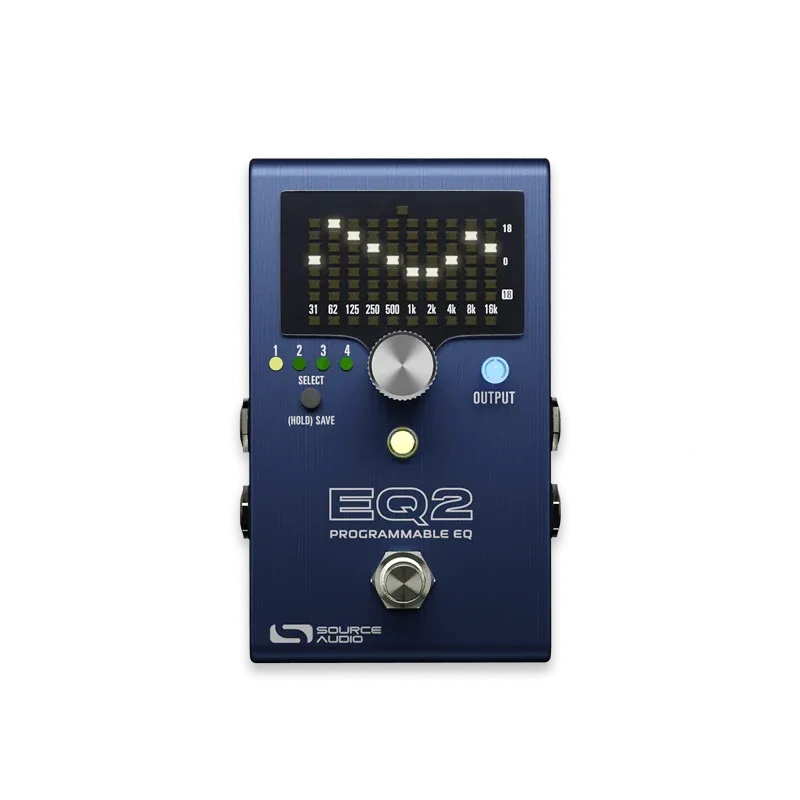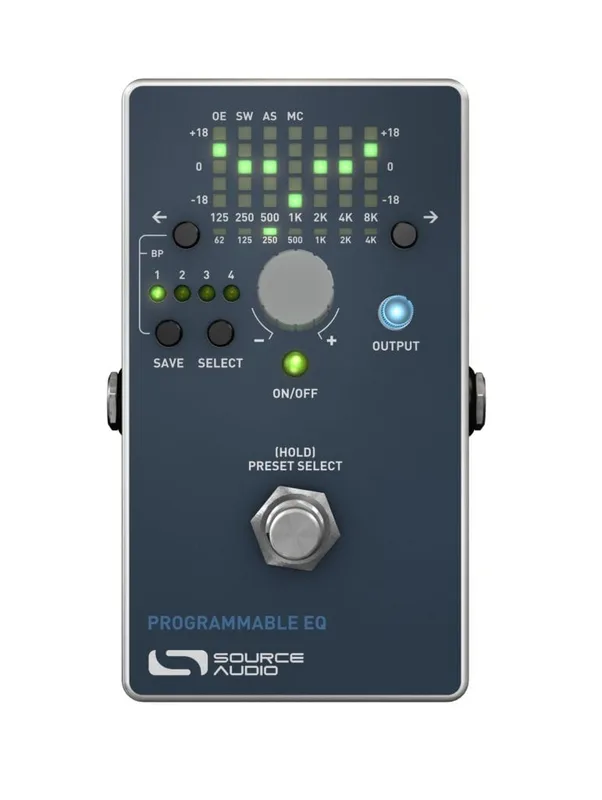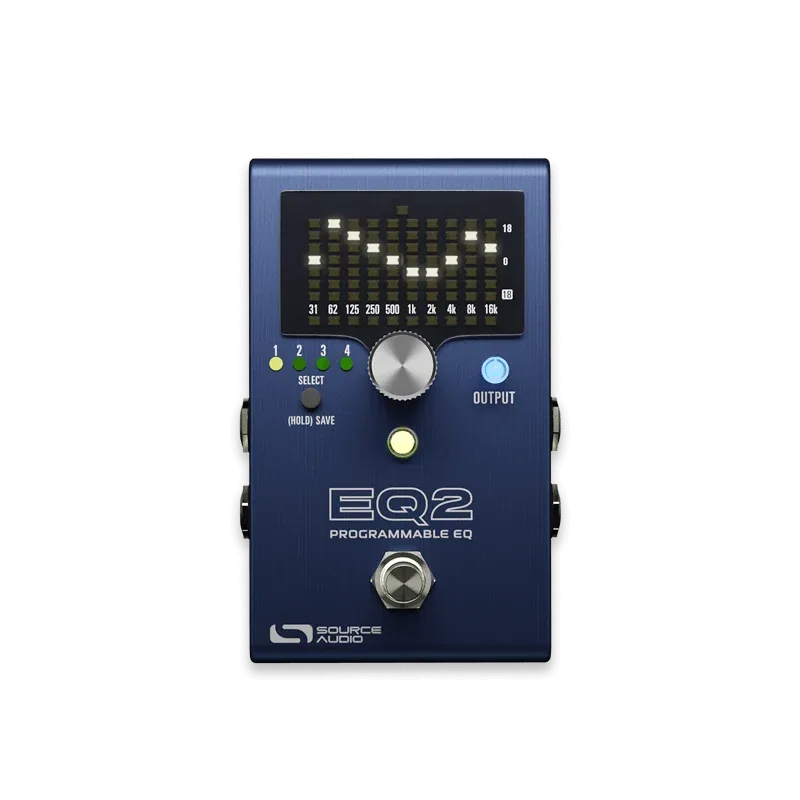


The Source Audio EQ2 Programmable Equalizer is a combination graphic and parametric EQ pedal with 10 fully adjustable frequency bands, stereo inputs and outputs, and a preset system that scales from 4 front-panel slots up to 128 with MIDI12. It is the follow-up to Source Audio's earlier Programmable EQ, announced at Winter NAMM in January 2020 and released that May at a $269 street price34.
For a player, the pitch is flexibility: each of the 10 bands can be moved anywhere on the frequency spectrum from 20 Hz to 20 kHz, with up to 18dB of boost or cut per band and an adjustable Q (bandwidth) that can be made wider or up to 10 times narrower15. Source Audio describes it as "the most powerful and advanced equalizer pedal on the planet"1, and it adds an onboard chromatic tuner, a configurable noise gate and limiter, and full MIDI control1.
What it is: graphic and parametric EQ in one pedal
A graphic EQ gives you fixed bands at set frequencies; a parametric EQ lets you choose the frequency and bandwidth of each band. The EQ2 does both. In graphic mode it offers 10 bands ranging from 31Hz to 16kHz with 18dB of boost or cut1. In parametric mode, each of the 10 bands can be placed anywhere from 20 Hz to 20 kHz, and each band's Q can be widened or narrowed by up to 10 times15.
The stereo routing is where it gets more elaborate. Signal routing options include mono to stereo, stereo to stereo, and a split mode that runs two discrete EQ presets simultaneously, one for each stereo output2. Source Audio suggests using the Neuro editor's routing options together with Split Mode to get the most out of that flexibility1.
The EQ2 also carries dynamics features configured in the Neuro 3 editor: an optional noise gate threshold and an optional limiter to eliminate digital clipping1. Premier Guitar's press coverage lists the same features, along with alternate signal routing options, as things the Neuro Editors unlock3.
The controls
The front panel is deliberately small for a pedal this deep. MusicRadar's review lists the hardware controls as11:
| Control | What it does |
|---|---|
| Encoder knob | Adjusts band values, frequencies and settings; scrolls presets |
| Output (illuminated mini-knob) | Master output level, with an additional 12dB of boost available1142 |
| Select button | Steps through bands and presets; held with the encoder, reaches all 128 presets1 |
| Control input switch | Sets how the 1/8" control input behaves |
| Bypass footswitch | Engages and bypasses the effect |
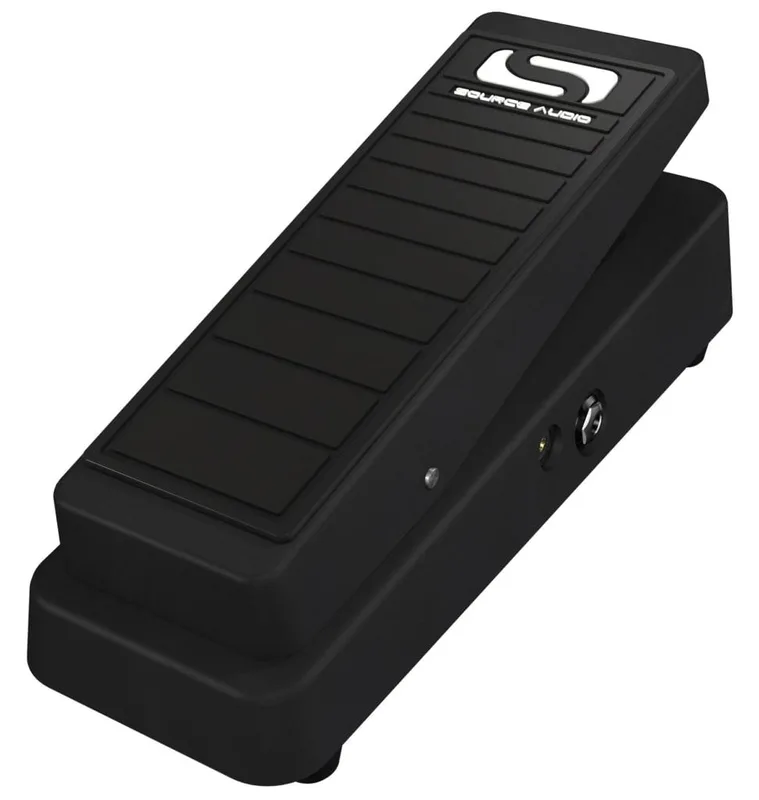
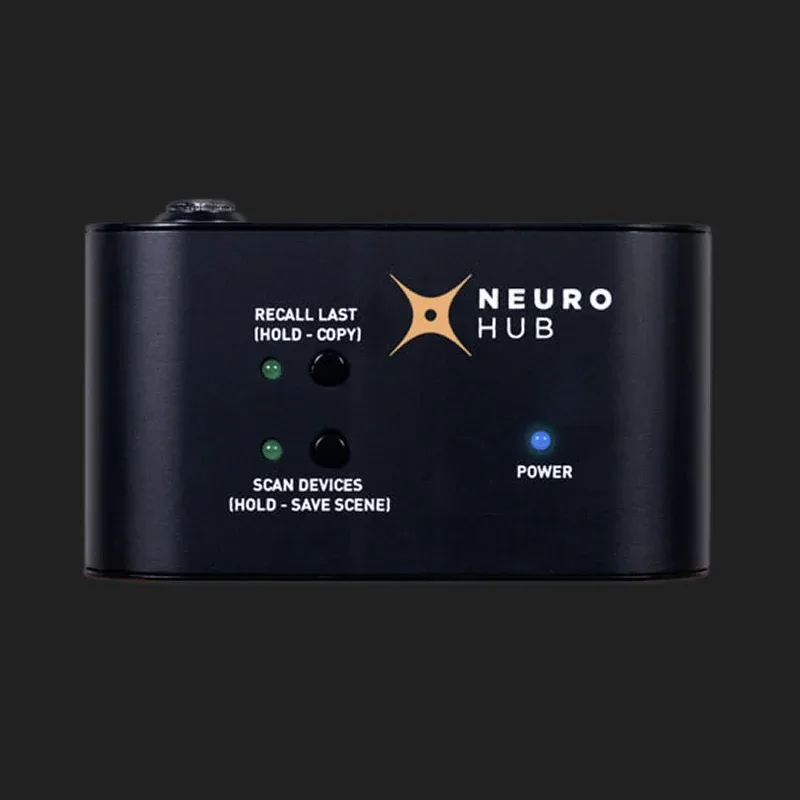
The 1/8" CONTROL INPUT jack connects with either the Source Audio Dual Expression Pedal or the Source Audio Neuro Hub3. Channel gain is handled separately: you can cut or boost the overall output gain as much as +12dB over unity, with independent gain controls for separate output levels on each channel1.
Power and connections
The EQ2 draws 180 mA1, which is well beyond what a battery or a small daisy chain typically supplies.
At 180 mA1, the EQ2 needs a dedicated output on a powered pedalboard rather than a shared daisy-chain tap; plan power accordingly.
Connections include standard inputs 1 and 2, standard outputs 1 and 2, MIDI In, MIDI Thru, USB, and the 1/8" control input11. Guitar World's review lists the same set, including MIDI Thru and USB12.
MIDI and the Neuro editor
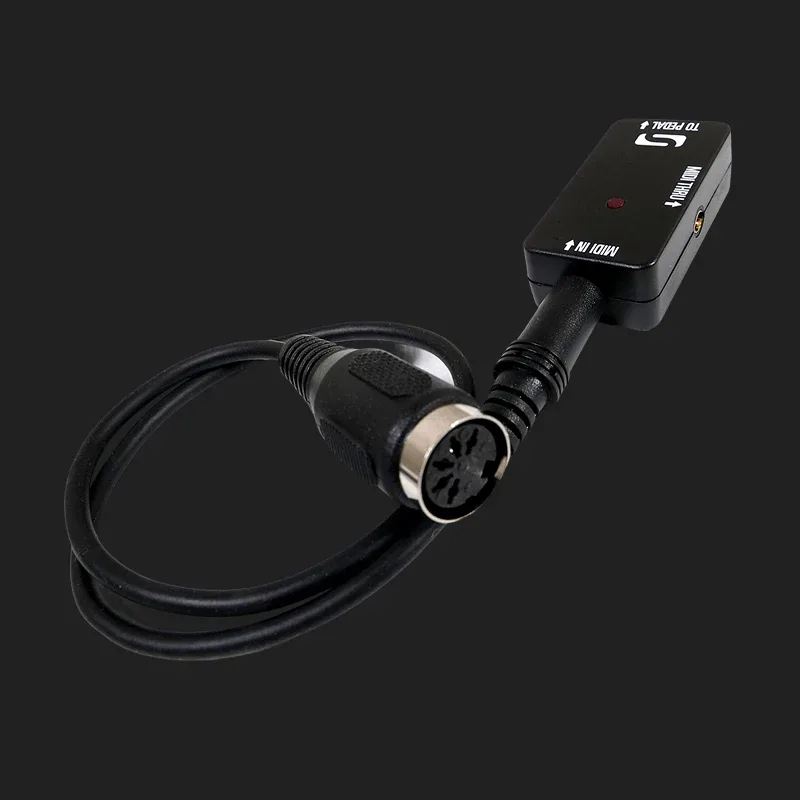
The EQ2's preset system scales with how you connect it: on its own it runs onboard presets, and connected to the Neuro Hub or any MIDI Adapter, MIDI control provides up to 128 presets, recallable with MIDI program change messages1. MIDI continuous controller (CC) messages can be mapped to a comprehensive list of parameters, and the Neuro 3 Desktop Editor makes the mapping easy1.
The free Neuro software editor opens up the deeper customization: adjustable frequency band and Q controls, the optional dynamic limiter and noise gate, alternate signal routing, and the ability to run two discrete EQ presets at once, one per stereo output313. Pedal of the Day describes the free Neuro editor as opening up deep customization options beyond what the front panel offers13.
Where it came from
The EQ2 builds on the legacy of Source Audio's earlier Programmable EQ514. Source Audio expected to ship it in March at a $269 street price4, and Guitar World and Premier Guitar both reported its launch in May 202038.
What reviewers said
MusicRadar's review called it "a 10-band EQ offering heaps of control over your sound"11, and Guitar World's Trevor Curwen reviewed it with the feature set of selectable bypass, tuner, 128 presets and the parametric 10-band graphic equalizer12. Guitar World's 2026 EQ pedal buying guide notes it can store 128 presets, with 4 accessible via quick selection on the front panel15.
"it's a super simple pedal to use uh you won't even need to crack the manual really to get started with"
In Pete Thorn's demo video, he walks through the pedal's features and notes it builds off the legacy of its predecessor, the Source Audio Programmable EQ14.
Delicious Audio's Alex Maiolo called the EQ2 "the ultimate Swiss-army knife for your tone" and the perfect companion for any musician looking to enhance or add flexibility to their tone, useful for guitar, bass and keyboard players of all genres5. Gearnews made the same point about instrument range, noting it suits bass, keys and synthesizers, and with an adapter and level converter probably vocals to a degree7.
Videos
Premier Guitar
sourceaudioeffects
News
Questions
Is the Source Audio EQ2 true bypass?
It is selectable. Source Audio's Universal Bypass lets you choose between relay-based true bypass and a transparent analog buffer, so you can run it either way depending on your rig. Reviewers at MusicRadar and Guitar World both list selectable analog buffered or relay based true bypass among its features.
Does the EQ2 have a built-in tuner?
Yes. The EQ2 includes an onboard chromatic tuner, which Source Audio describes as adding to the pedal's flexibility and feature set. MusicRadar's review and Pedal of the Day both confirm the built-in chromatic tuner.
Can the EQ2 be used as a clean boost?
Yes. The channel gain control can cut or boost overall output gain by as much as +12dB over unity, with independent gain controls for each output. Pedal of the Day describes it as up to 12dB of clean boost for pushing the front end of your amp.
Does the EQ2 work on bass?
Yes. Delicious Audio calls it useful for guitar, bass and keyboard players of all genres, and Gearnews notes it suits bass, keys and synthesizers as well as guitar. The parametric bands can be placed anywhere from 20 Hz to 20 kHz, so low frequencies are fully addressable.
How many presets does the EQ2 hold?
It holds 128 presets in total. On the front panel you get 4 onboard presets, 8 in Preset Extension Mode, or all 128 by turning the encoder while holding the Preset Select button. MIDI program change messages can recall any of the 128.
Sources (15)
- EQ2 Programmable Equalizer, Source Audio
- Source Audio Announces the EQ2 Programmable Equalizer, Premier Guitar, 2020-05-22
- Source Audio Introduces the EQ2 Programmable Equalizer, Premier Guitar, 2020-01-18
- Source Audio Introduces EQ2 Programmable Equalizer Pedal, MusicPlayers.com, 2020-01-14
- Source Audio EQ2 Programable Equalizer, Delicious Audio, 2025-05-09
- EQ2 Programmable Equalizer: Source Audio releases The Ultimate Tone Sculpting Machine, MusicPlayers.com, 2020-05-20
- NAMM 2020: Source Audio EQ2, gearnews.com, 2020-01-14
- Source Audio's EQ2 might just be the most powerful EQ pedal on the planet, Guitar World, 2020-05-21
- Source Audio EQ2 Ultrawave Multiband Processor review, Guitar World, 2021-11-12
- Source Audio’s EQ2 brings extensive EQ capabilities to your ‘board, Guitar.com, 2020-05-22
- Source Audio EQ2 Programmable EQ review, MusicRadar, 2022-03-06
- Source Audio EQ2 Programmable EQ review, Guitar World, 2021-10-29
- Source Audio EQ2 Programmable Equalizer, Pedal of the Day, 2023-09-07
- THE TONE SWISS ARMY KNIFE! Source Audio EQ2 Programmable Dual EQ, youtube.com, 2020-07-28
- Best EQ pedals 2026: tame your tone, Guitar World, 2021-12-22