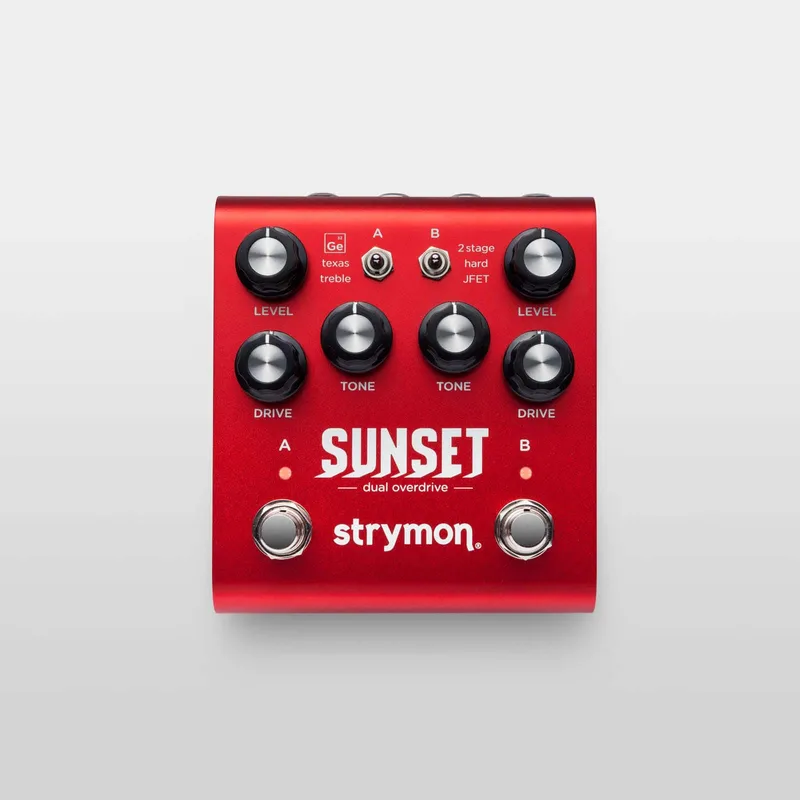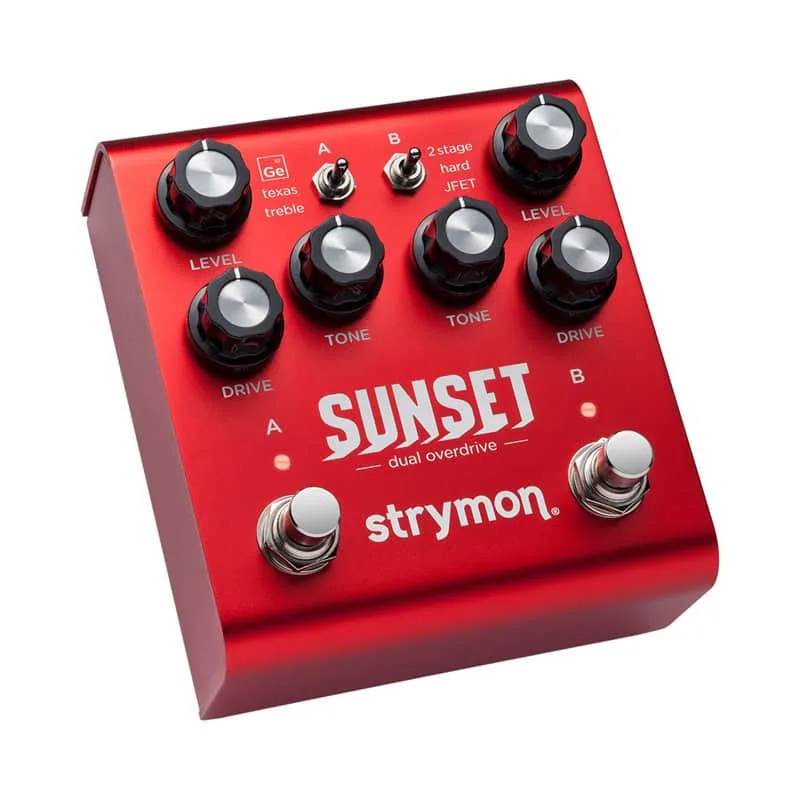


The Strymon Sunset Dual Overdrive is a dual overdrive pedal from Strymon, announced in March 2017. It gives you two drive channels in one box, each with three selectable circuits, for six classic overdrive tones in total, and it lets you stack or reroute those channels against each other1. MusicRadar described it at launch as promising "the best of the best classic overdrive circuits"2.
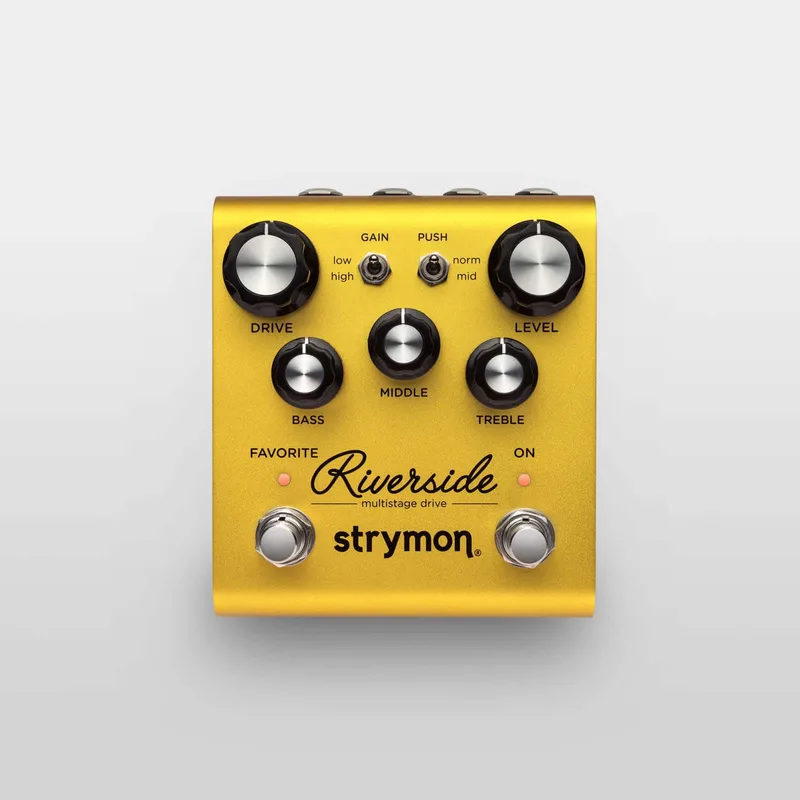
It followed on from the Strymon Riverside, Strymon's first overdrive pedal, which came out at the end of 201634. The Sunset shipped at a list price of $299 in the US32.
Two drive channels, six circuits
The Sunset gives you two channels that are almost identical in their layout, and each channel holds three distinct circuits, so six core drive tones are on hand31. Delicious Audio noted that the six circuits "each feel and react differently in your hands," ranging from a transparent "more amp" character on up1.
Channel A can be switched between three circuits3:
- Germanium: a germanium-based overdrive sound32
- Texas: the mid-forward "Texas" overdrive sound32
- Treble: a treble booster32
Channel B takes a different approach with three circuits of its own2:
- A two-stage soft-clip overdrive2
- A single-stage hard-clipping stage2
- A JFET clean boost2
Under the hood, the Sunset is based on SHARC DSPs combined with an analog circuit3. MusicRadar described the signal path as running through an analog class-A JFET circuit and a SHARC digital processor2. In practice that means the pedal is a hybrid: analog JFET stages at the front, with the SHARC chips doing the work of modeling the six drive circuits.
The two channels can be stacked, and the routing between them is flexible: they can be re-routed A>B, B>A, or run in parallel2. Running the channels in series lets you push one circuit into another for layered gain, while parallel routing keeps the two drives side by side, blending their characters without one loading the other.
The controls
Each channel has three knobs, six in total: Level, Drive and Tone1. The Drive knob sets the amount of gain on that channel, the Tone knob shapes the top end, and Level sets the output volume.
| Control | What it does |
|---|---|
| Level (per channel) | Sets output volume for that channel1 |
| Drive (per channel) | Sets gain for that channel1 |
| Tone (per channel) | Shapes the tone of that channel1 |
| Circuit switch (per channel) | Selects one of the three circuits on that channel32 |
| A/B Config Switch | Controls signal flow when two drive circuits are stacked: series, reverse series, or parallel1 |
| Bright switch | Three positions, to match the pedal to your amp2 |
The A/B Config Switch is the key to the stacking: it allows control over signal flow when two drive circuits are stacked, in series, reverse series, or parallel1. The three-position bright switch lets you match the pedal to brighter or darker amps2.
Two rear-panel connections extend the control options. An external expression pedal can be connected to override both channels3. The FAV (favorite) input allows you to save and recall presets by connecting an optional MiniSwitch or other external latching footswitch1.
Sunset and Riverside
The Sunset's layout is similar to that of the Riverside1, and the two pedals are natural companions. The Riverside was Strymon's first foray into the world of overdrive4, a single-channel multistage drive, while the Sunset splits its drive across two channels with six selectable circuits and routing options between them.
Strymon's own technical article on the two pedals points out that both are MIDI controllable6. On That Pedal Show, Dan and Mick put the two head to head in a Riverside and Sunset quick A/B comparison7.
Both the Sunset and the Riverside are MIDI controllable, so either pedal can sit at the center of a larger MIDI-switched pedalboard6.
What reviewers said
GearNews reviewed the Sunset at launch and came away positive about its range3:
"It covers a lot of ground and seems to do a good job at attaining really useful sounds"3
The same review noted that with six core drive tones on hand, "that gives you a hell of a lot of options"3.
Strymon's own site later highlighted player response to the pedal, including a cover of "Domino Line" by Casiopea by Raihan Krishna using the Sunset5.
Videos
Sweetwater
strymon
strymon
Questions
Is the Strymon Sunset analog or digital?
It is a hybrid. The Sunset uses a combination of analog and digital processing: an analog class-A JFET circuit feeds SHARC DSPs, which model the six drive circuits. So the front end and output path are analog, while the drive tones themselves are digital.
Can you use an expression pedal with the Strymon Sunset?
Yes. An external expression pedal can be connected to override both channels, letting you sweep parameters in real time. There is also a FAV (favorite) input for an optional MiniSwitch or other external latching footswitch to save and recall presets.
Does the Strymon Sunset save presets?
Yes. The FAV (favorite) input lets you save and recall presets by connecting an optional Strymon MiniSwitch or another external latching footswitch. Without a switch connected, the pedal runs at its current knob settings.
What is the difference between the Strymon Sunset and the Riverside?
The Riverside, released at the end of 2016, was Strymon's first overdrive pedal and is a single-channel multistage drive. The Sunset, which followed it, has two channels with six selectable circuits and routing options for stacking them. Both are MIDI controllable.
Sources (7)
- Strymon Debuts Sunset Dual Overdrive At Austin Stompbox Exhibit, Delicious Audio, 2017-03-08
- Strymon's Sunset Dual Overdrive pedal gives you “the best of the best classic overdrive circuits”, MusicRadar, 2017-03-09
- Strymon Sunset Dual Overdrive, gearnews.com, 2017-03-10
- Strymon Riverside Multistage Drive, Pedal of the Day, 2017-02-14
- Sunset Dual Overdrive: Photos and More, Strymon, 2017-08-31
- Single Stage and Multistage Gain Topologies, Strymon (www.strymon.net), 2017-03-08
- That Pedal Show, That Pedal Show, 2017-04-14