The Univox Super-Fuzz is a 1968 octave fuzz: a fuzz pedal that adds a high octave alongside the distorted note, turning any note or chord into a thick, searing texture1. JHS describes the effect as one that "turns any note or chord into a thick and searing texture"2. It is the fuzz behind Pete Townshend's Live at Leeds tone, and it was used on countless recordings in the late 60s and 70s13.
The circuit was created by Shin-Ei, a Japanese effects maker, and sold under dozens of brand names around the world, of which Univox, the American brand, is the one players remember most34. The original is long out of production, but it saw a resurgence in the 90s during the grunge and alternative rock era, and today it survives in a long line of clones, re-creations and DIY projects3.
Where the Super-Fuzz came from
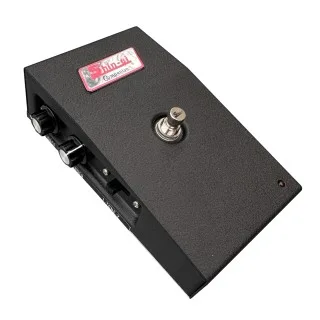
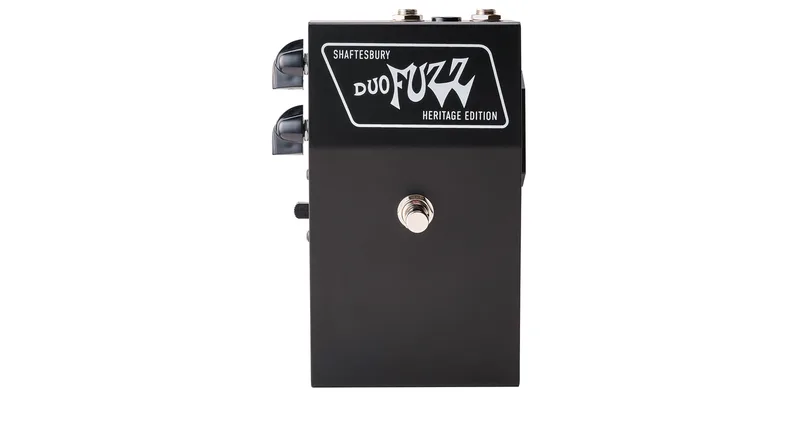
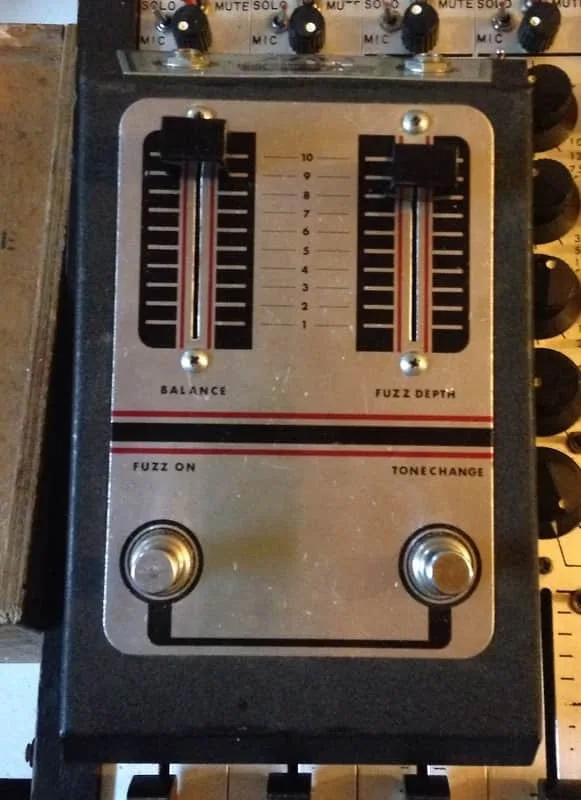
The Super Fuzz came from Shin-Ei, and the original Univox Super Fuzz dates to 19681. Its first incarnation was not a compact pedal at all but a large unit called the Psychedelic Machine6. Shin-Ei's circuit also appeared under a long list of OEM brands, including Ace Tone, Apollo, Companion, Crown, Jax, Kent, Memphis, Teisco and Univox, plus Rose Morris's Shaftesbury imprint7.
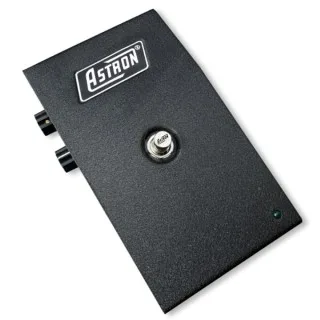
Because of legal issues, the Super Fuzz circuit was rebranded and sold under different names by various companies4. Tru-Fi's history of the pedal names the notable variations: the Univox Super Fuzz, the Ibanez Standard Fuzz, and the FY-6 Super Fuzz by Yamaha4. Shin-Ei itself still lists the FY-6 Super Fuzz on its own site today, under both the Shin-Ei and Astron brand names58.
The pedal's look is as remembered as its sound: Godlyke calls it "that legendary blue and orange monster"9. Its best known user association is the Who. Godlyke's account states the pedal "was used on countless recordings in the late 60's & 70's, most notably the Who classic 'Live at Leeds'"3, and General Guitar Gadgets calls the circuit "the 1968 octave fuzz behind Pete Townshend's Live at Leeds tone"1.
How it works: an octave fuzz with a phase splitter
What separates the Super-Fuzz from a plain fuzz pedal is how it generates its octave. The circuit uses six transistors and two germanium diodes1. Two of those transistors, Q4 and Q5, form a phase splitter that doubles the signal for the octave-up effect1. Godlyke describes the same stage from the signal's point of view: the Super Fuzz "used dual germanium diodes and a unique full-wave rectification circuit to produce sizzling upper octave" harmonics3.
In practical terms, the rectification turns the waveform's negative halves into positive ones, which stacks even harmonics an octave above what you play. Single notes and higher fretwork give the strongest octave effect; the result is a fuzz that sits in the same octave-up family as the Octavia, though the two circuits get there by different means3110.
Not every Super-Fuzz was built identically. Some versions did not have the R22 trimmer used to balance the Q4 and Q5 transistors1, a detail that matters to anyone rebuilding the circuit, since the balance of that phase splitter is what keeps the octave effect strong.
Controls: Balance, Expander and the tone switch
The control layout is minimal. Shin-Ei's own FY-6 pages describe it: "The unit is controlled by the Balance/Expander knobs and the slider switch (Tone 1 & 2) which are located on the left side" of the unit5, and the Astron FY-6 page repeats the same arrangement8.
| Control | What it does |
|---|---|
| Balance | Volume. Tru-Fi's re-creation labels this control "Balance (volume)"11 |
| Expander | Fuzz level. GUP Tech's clone labels it "Expander (Fuzz level)"12 |
| Tone slider switch | Selects Tone 1 or Tone 2, the two voicings5 |
The tone switch is the pedal's personality control. On the General Guitar Gadgets replica, up is the stock notched sound with the mids cut, and down is flat and fuller1. The kit's documentation describes the two positions as a switch "between the popular nasally, raspy fuzz sound of the sixties to a more full bodied fuzz"1. The scooped, notched position is the sound most players associate with the pedal.
The replica project also leaves room for modifications, including replacing the tone switch with a tone potentiometer, using a 10k linear taper pot in the R26 position1.
Germanium and silicon versions
The original circuit's clipping comes from a pair of germanium diodes: the General Guitar Gadgets replica specifies two 1N270 germanium diodes at D1 and D21. The transistors in the original units were part of a six-transistor circuit1, and the question of germanium versus silicon comes up mostly in modern rebuilds rather than in distinct factory versions.
Modern makers approach the germanium/silicon split in different ways, which is useful context for anyone comparing fuzzes:
- Jed's Pedals' Grimm Reaper is a silicon and germanium hybrid fuzz13.
- Dingotone's Germanium Hybrid Fuzz is a hybrid silicon/germanium circuit14.
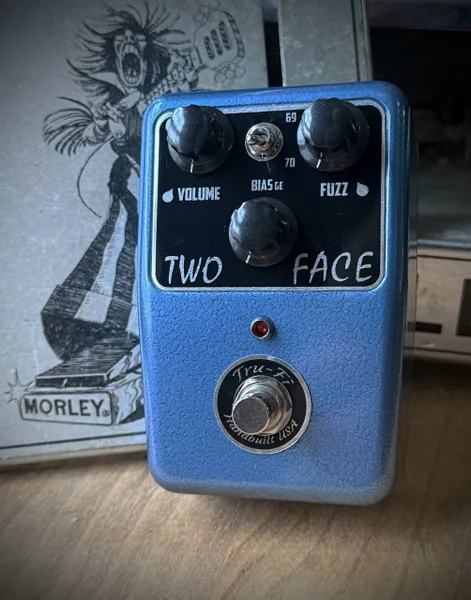
- Tru-Fi's Two Face Fuzz combines two circuits in one unit, a germanium-transistor circuit and a silicon-transistor circuit15.
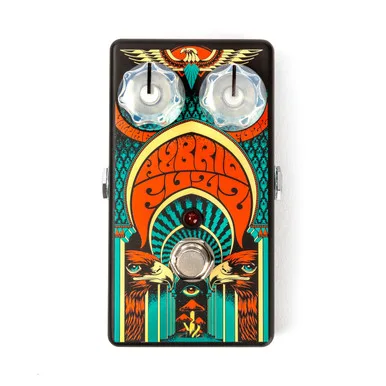
- MXR's Hybrid Fuzz combines a silicon transistor and a germanium transistor in a single circuit16.
The classic Fuzz Face circuit was originally available in two versions using germanium or silicon transistors1773, which is the pattern most players know; the Super-Fuzz's own story is centered on its germanium diodes and its transistor phase splitter rather than on two factory transistor options.
The many brands that sold the Shin-Ei circuit
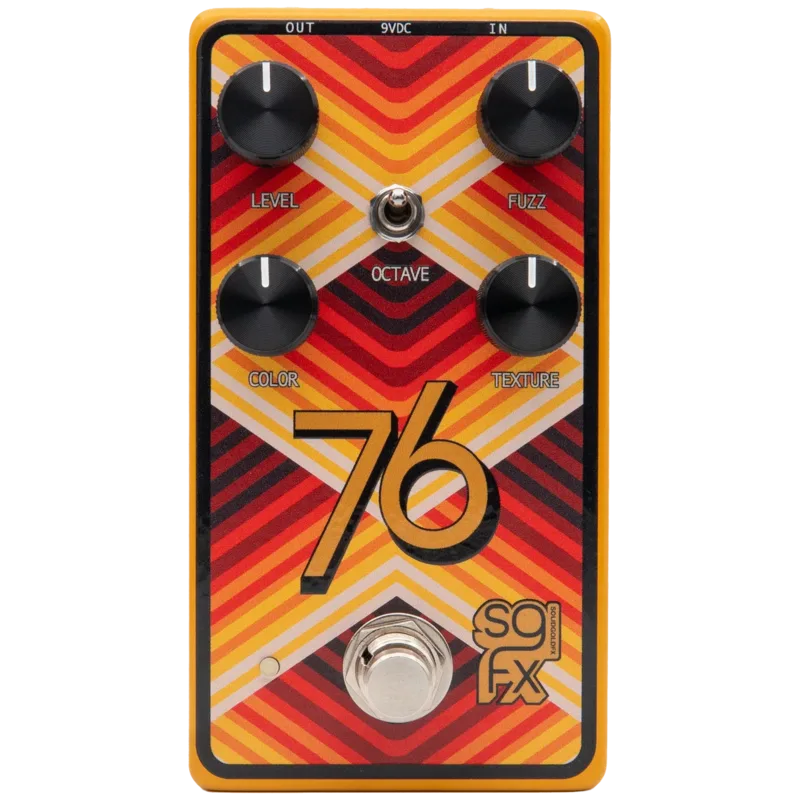
The Super Fuzz circuit is one of the most rebranded circuits in fuzz history. SolidGoldFX places it in a distinct era of Japanese and Asian fuzzes: "the Univox Super Fuzz, Ibanez Standard Fuzz, Ace Tone Fuzz Master, Shin-Ei Companion and several others"18, a list RockBoard's PedalPedia entry for the 76 MKII repeats, calling those pedals fuzz legends of that era19.
The brands that sold the circuit include:
- Univox, the American brand it is best known by3
- Apollo, Shaftesbury, JAX, Tiesco and Memphis3
- Shaftesbury, Kent, Crown and Jax, among dozens of others Shin-Ei produced circuits for2
- Ibanez, as the Standard Fuzz4
Pedals based on the Super-Fuzz
Because the original has been out of production for decades, a steady stream of makers has built pedals on the circuit327:
| Pedal | Maker's description |
|---|---|
| Tru-Fi Compact Super Fuzz | A re-creation of the Univox Super Fuzz in a smaller, modern enclosure11 |
| GUP Tech Hot Foazz | A Univox Super-Fuzz clone with Balance (volume) and Expander (fuzz level) controls12 |
| GUP Tech Lab Series #9 Fuzz+ | Based on the vintage Univox Super Fuzz20 |
| PedalPCB Uberfuzz | A DIY board compared to the Univox Super-Fuzz, with a tone control on a toggle switch21 |
| Basic Audio Super Fuzz | An octave fuzz based on the Univox Super Fuzz22 |
| N.O.C. Pedals Super Fuzz | A fuzz from N.O.C. Pedals23 |
| Oneder Fuzz | Based on dual-voiced, octave-inducing fuzz pedals from the 60s and the 90s, "the Super one, and the Hyper one"24 |
| TWA WX-01 Wahxidizer | A fuzz circuit inspired by the vintage Univox Super Fuzz9 |
Tru-Fi describes its re-creation plainly: "This a re-creation of the Univox Super Fuzz which is a unique aggressive fuzz that is very retro!"11. The Oneder Fuzz's reference to "the Super one, and the Hyper one" points at the circuit's 90s second life, when the Super Fuzz saw a resurgence during the grunge and alternative rock era243.
DIY layouts and builds
The Super-Fuzz is a well documented DIY project. Guitar FX Layouts publishes a vero (stripboard) layout for the Univox Super Fuzz sized for a 1590BB enclosure, and the builder reports having built it and that it works well25. The layout is drawn for modern NPN silicon transistors with CBE pinout, such as the 2N5088, 2N5089, MPSA18, 2N2222 and 2N3904, so these can slot right in25. One builder's version added a 10k trimmer for the Q4-Q5 octave biasing, a 10k trimmer for saturation control of the diode pair, a 10k mid scoop pot, a 300pF cap on Q6 base-collector, and an SPST switch to bypass the saturation trimmer825. A 1590B friendly version of the layout was planned but had not yet been made25.
The Guitar FX Layouts blog published a vero (stripboard) layout for the circuit in January 2012, sized for a 1590BB enclosure, with a 1590B friendly version planned25. The layout was verified working by builders, one of whom reported in June 2012: "I have built this one, it works good"25. The layout is built for modern NPN silicon transistors with CBE pinout, such as the 2N5088, 2N5089, MPSA18, 2N2222 or 2N3904, so common parts slot straight in25.
Builders have also documented modifications to the circuit, from a 2014 build25:
- A 10k trimmer for the Q4-Q5 octave biasing.
- A 10k trimmer for saturation control of the diode pair.
- A 10k pot for a mid scoop.
- A 300pF cap on Q6's base-collector.
- An SPST switch to bypass the saturation trimmer.
GuitarPCB's Fzzz Bxxx board, another take on the circuit family, reports that it "cleans up amazingly well with the twist of your Guitar volume producing powerful chiming clean tones" on the brink of breakup before full fuzz26. That is the maker's claim for its own board rather than a documented property of every vintage unit, but it is the kind of behavior DIY builders of the Super-Fuzz circuit often explore through the mods above.
Pedals on this page
Questions
Who made the Univox Super-Fuzz?
The circuit was created by Shin-Ei, the Japanese effects maker, and produced under its own Companion brand as well as for dozens of other companies. Univox was the United States brand name it is best remembered by. Shin-Ei still lists the FY-6 Super Fuzz, under both the Shin-Ei and Astron names, on its own site today.
Did Pete Townshend use a Univox Super-Fuzz?
Yes. The Super Fuzz is widely identified as the fuzz behind Pete Townshend's tone on the Who's Live at Leeds, and it appears on countless recordings from the late 60s and 70s. That association is a large part of why the circuit is still cloned and rebuilt by pedal makers and DIY builders.
What does the tone switch on a Super-Fuzz do?
The slider switch selects between two voicings. One position gives the notched, scooped-mid sound with the mids cut, the nasally and raspy fuzz sound of the sixties. The other position is flat and fuller, a more full bodied fuzz. Some replica kits let you replace the switch with a tone potentiometer.
Does the Univox Super-Fuzz clean up with the guitar volume?
The original's behavior with the guitar volume knob is not documented in the maker's own material. Builders of modern Super Fuzz circuit boards report that the circuit can clean up well with the guitar volume, moving from chiming clean tones on the brink of breakup to full fuzz.
Sources (26)
- Univox™ Super-Fuzz™ Clone Kit: Octave Fuzz with Tone Switch, generalguitargadgets.com, 2014-06-02
- SUPREME - JHS Pedals, JHS Pedals
- AIR (FA10), Godlyke Distributing, Inc.
- The Super Fuzz, tru-fi.com
- Shin-ei FY-6 Baby Crying Super Fuzz, Shin-ei (shin-ei.com)
- PEDALS I WISH I MADE, JHS Pedals
- Guitar Pedal X, Guitar Pedal X, 2025-02-14
- Astron FY-6 Super Fuzz, Shin-ei (shin-ei.com)
- TWA WAHXIDIZER™ one-of-a-kind Gloss Black Finish for NAMM (B-STOCK), Godlyke Distributing, Inc.
- Rift Octave Fuzz / Univox Superfuzz - Aion FX, Aion FX, 2019-02-03
- NEW Compact Super Fuzz Guitar Pedal in smaller and modern enclosure, tru-fi.com
- Hot Foazz (Super-Fuzz Clone), GUP Tech (guptech.ca)
- Grimm Reaper, Jed's Pedals (jedspeds.co.uk)
- Germanium Hybrid Fuzz by Dingotone, RockBoard PedalPedia, 2026
- Two Face Fuzz by Tru-Fi Pedals, RockBoard PedalPedia, 2026
- MXR® HYBRID FUZZ, Jim Dunlop (jimdunlop.com)
- CC Hybrid 2 by Foxrox Electronics, RockBoard PedalPedia, 2026
- 76 MKII - OCTAVE-UP FUZZ | SOLIDGOLDFX - SolidGoldFX, SolidGoldFX
- 76 MKII by SolidGoldFX, RockBoard PedalPedia, 2026
- Lab Series #9, GUPtech (guptech.ca)
- Uberfuzz, PedalPCB.com
- Super Fuzz, Basic Audio
- Ultimate NOCtave by N.O.C. Pedals, RockBoard PedalPedia, 2026
- Oneder Fuzz, Oneder Effects
- Guitar FX Layouts: Univox Super Fuzz, Guitar FX Layouts (tagboardeffects.blogspot.com), 2012-01-25
- Fzzz Bxxx, GuitarPCB