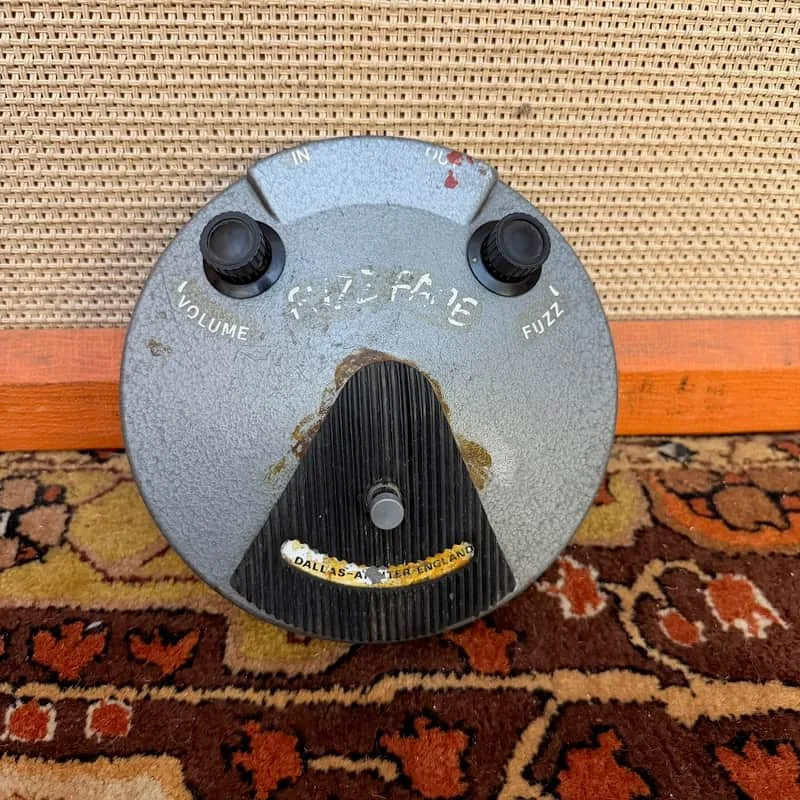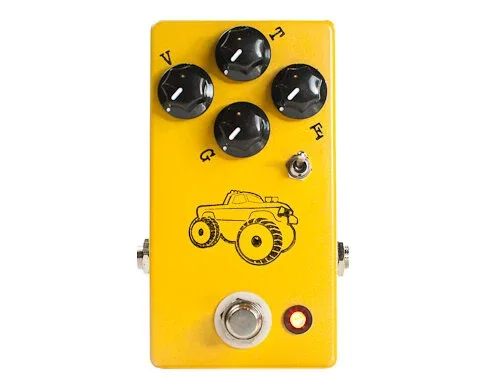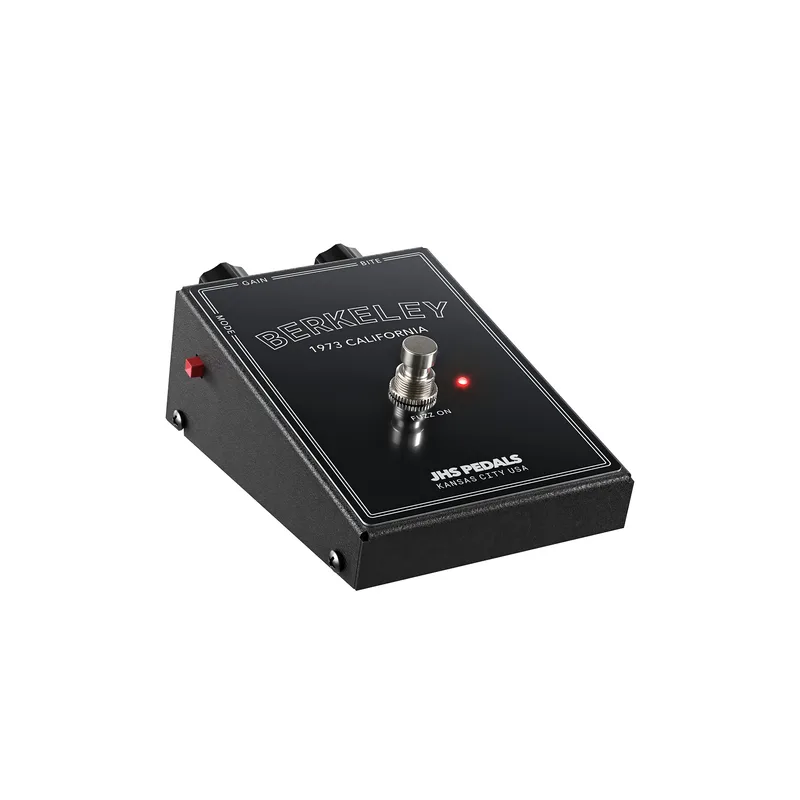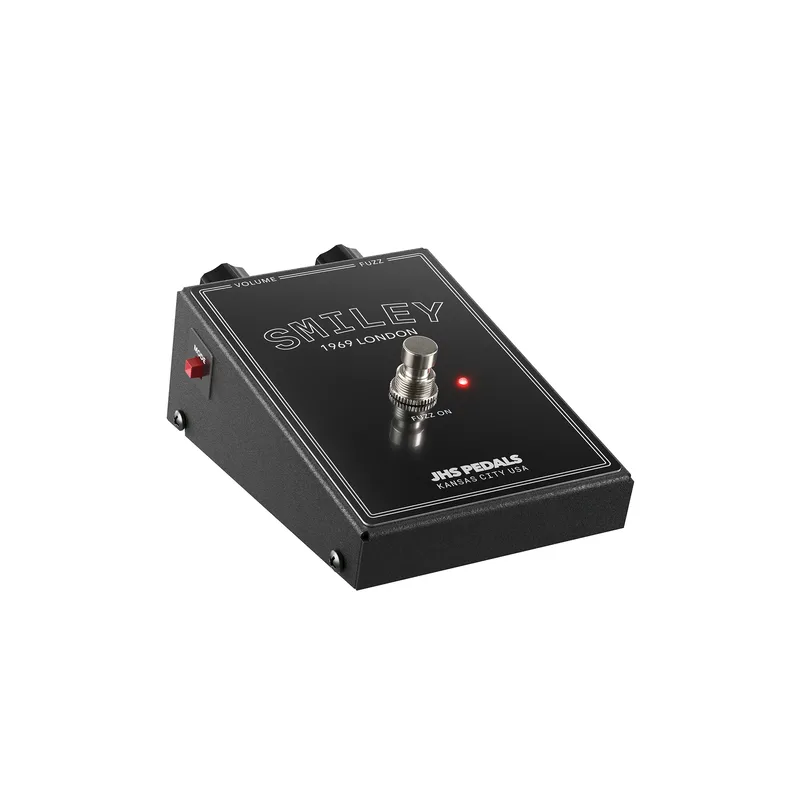


The JHS Smiley is a fuzz pedal from JHS Pedals' Legends of Fuzz series, a line the maker describes as "our tribute to the most important fuzz circuits ever made"1. The Smiley recreates the late-'60s silicon-transistor iteration of the Arbiter Fuzz Face, the circuit famously used by Hendrix, Clapton, Gilmour and many more2. JHS describes its sound as "clear and defined, straddling the line between distortion pedal and a searing sustain," with sustaining low end and crisp mid-range bite1.
Where a stock Fuzz Face copy would give you two knobs and nothing else, the Smiley adds a JHS Mode button that pushes the circuit into gated, high-gain fuzz. It is currently listed at $89.50 USD as a final sale item, with no cancels, returns or exchanges1.
The Fuzz Face circuit behind the Smiley
The Smiley is inspired by the first-era silicon model Arbiter fuzzes1. GuitarPlayer's Dave Hunter explains the lineage: the pedal "recreates the late-'60s iteration of the legendary Arbiter Fuzz Face, whose circuit featured silicon transistors, giving it the tighter, crispier tone Jimi Hendrix was said to prefer"2. Delicious Audio calls it "a sonically faithful recreation of what makes these early silicon Fuzz Faces great"4.
Silicon Fuzz Faces differ from the earlier germanium versions in character. Hunter notes the circuit is "a pretty spitty, spluttery fuzz circuit to begin with, which is part of the fun"2. MusicRadar's reviewer frames the Smiley as "a more straightforward take on the silicon Fuzz Face, but with an extra JHS-developed modified mode"5.
One behavior the Smiley keeps from the original is the cleanup trick. JHS calls this "one of the most revered characteristics of a good Fuzz Face," its ability to clean up when the guitar's volume is rolled back1. In practice that means you can ride your guitar's volume knob for anything from a dirty edge to full fuzz without touching the pedal.
The controls: Volume, Fuzz and JHS Mode
The Smiley keeps the original's two-knob layout and adds one button. GuitarPlayer highlights "its inclusion of just two control knobs, like the original, for fuzz and volume"2.
| Control | What it does |
|---|---|
| Volume | Sets the overall output level of the effect; turn it up and it gets louder1 |
| Fuzz | The distortion control; the more you turn it clockwise, the more fuzz you create4 |
| JHS Mode | Push-button on the left side; switches in JHS's modified gated high-gain mode2 |
Pedal of the Day found the simple layout sufficient: "Volume and Fuzz controls are all you need here"6.
What JHS Mode does
The JHS Mode button is the pedal's one departure from the original circuit. JHS says "this mode sends the Smiley into high gain / gated fuzz territory that you may never want to come back from"1. Hunter's take on the button: "the JHS mode engaged with its left-side push-button switch induces a severely gated high-gain fuzz tone"2. Pedal of the Day described it as "really ramping everything up and crushing everything"6. A gated fuzz cuts the signal off abruptly rather than letting it decay, which suits stabs and single-note riffs.
Power: 9V DC, 4mA
The Smiley runs on 9V DC, center negative, with a 4mA draw1. It also takes a single 9V battery, installed in a battery clip under the backplate1, so it works on a board or standalone.
JHS warns: do not use more than 9V DC, or the warranty will be voided1. The pedal is also sold as a final sale item with no cancels, returns or exchanges, and is excluded from the WELCOME15 and SMS/text discounts1.
The 4mA draw is low enough that the pedal is easy to place on a shared pedalboard supply alongside other compact effects1.
What reviewers said
The Smiley traces back to the original Arbiter Fuzz Face, a fuzz famously used by Hendrix, Clapton, Gilmour and many more4. JHS positions the pedal's single Fuzz control in straightforward terms: "Fuzz is the distortion control; the more you turn it clockwise, the more fuzz you create"4.
"It's a pretty spitty, spluttery fuzz circuit to begin with, which is part of the fun."
The Legends of Fuzz series
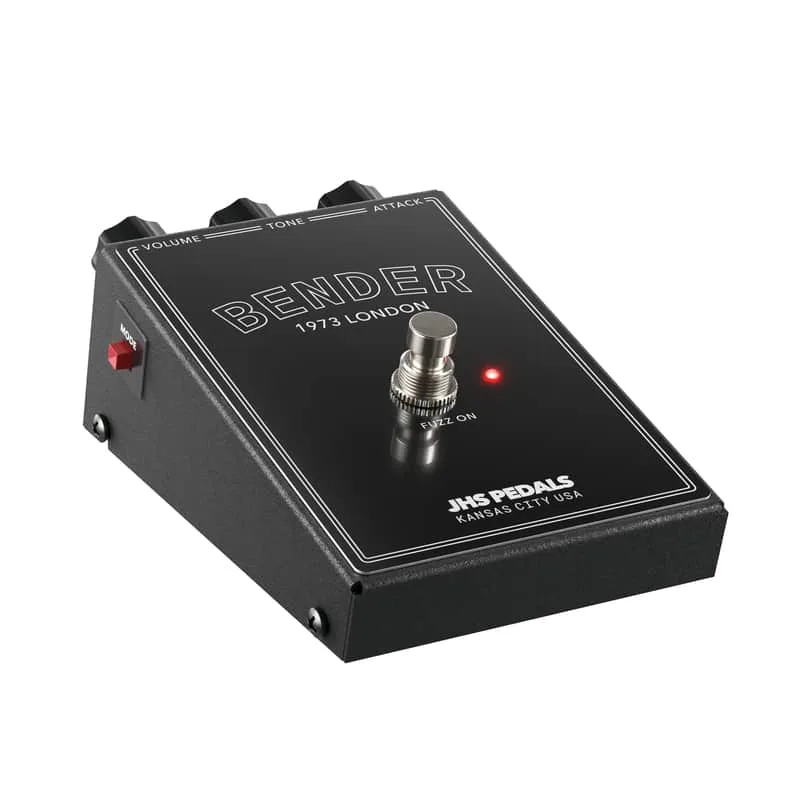
The Smiley belongs to JHS Pedals' Legends of Fuzz series, which the maker describes as "a collection of the world's most historic, rare, and sought after circuits"1. Each pedal in the series recreates a landmark fuzz; the Smiley is the silicon Fuzz Face entry, while the JHS Legends of Fuzz Bender takes on the Tone Bender circuit2. For players comparing fuzz types more broadly, the series is one route into vintage circuits without hunting original units.
Videos
Eirik Stordrange
EytschPi42
shnobel
Questions
Is the JHS Smiley a Fuzz Face clone?
It is a recreation of the late-'60s silicon-transistor Arbiter Fuzz Face, part of JHS Pedals' Legends of Fuzz series, which the maker describes as a tribute to the most important fuzz circuits ever made. Delicious Audio calls it a faithful recreation of the Dallas-Arbiter Fuzz Face, and MusicRadar describes it as a more straightforward take on the silicon Fuzz Face with an extra JHS-developed modified mode.
What does the JHS Mode button do on the Smiley?
The push-button on the left side of the pedal switches in a JHS-developed modified mode. JHS says it sends the pedal into high gain, gated fuzz territory. GuitarPlayer's reviewer found it induces a severely gated high-gain fuzz tone, and Pedal of the Day described it as ramping everything up and crushing everything in its path.
Does the JHS Smiley take a battery?
Yes. The pedal allows battery operation via a single 9V battery, installed in a battery clip under the backplate. It also has a 9V DC center-negative adapter input, so you can power it either way.
What power supply does the JHS Smiley need?
It uses 9V DC, center negative, with a current draw of 4mA. JHS warns not to use more than 9V DC or the warranty will be voided. The low current draw means it is easy to run on most pedalboard power supplies.
Does the Smiley clean up when you turn down the guitar volume?
Yes. JHS calls this one of the most revered characteristics of a good Fuzz Face, and the Smiley keeps it: rolling back your guitar's volume cleans the fuzz up, the classic behavior of the original silicon Fuzz Face circuit.
What is the Legends of Fuzz series?
It is a JHS Pedals series the maker describes as a tribute to the most important fuzz circuits ever made, a collection of the world's most historic, rare and sought-after circuits. The Smiley is the series' take on the silicon Arbiter Fuzz Face, alongside other recreations such as the Bender.
Sources (6)
- SMILEY - JHS Pedals, JHS Pedals
- JHS Legends of Fuzz Bender and Smiley Fuzz Pedals Review, GuitarPlayer (www.guitarplayer.com), 2021-03-22
- The Four Pillars Of Fuzz Guitar Tones JHS Legends vs Our Current Faves, That Pedal Show, 2020-06-05
- JHS Pedals Smiley Fuzz, Delicious Audio, 2020-09-28
- “Even without its connection to the studio, it's simply a killer fuzz pedal”: EarthQuaker Devices Dirt Transmitter, MusicRadar, 2025-07-23
- JHS Pedals Legends of Fuzz, Pedal of the Day, 2020-06-11