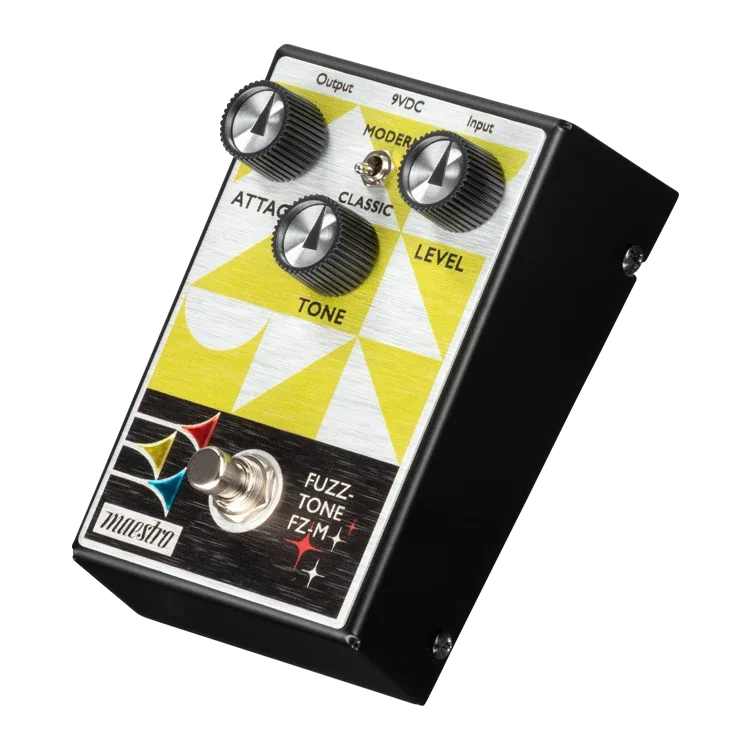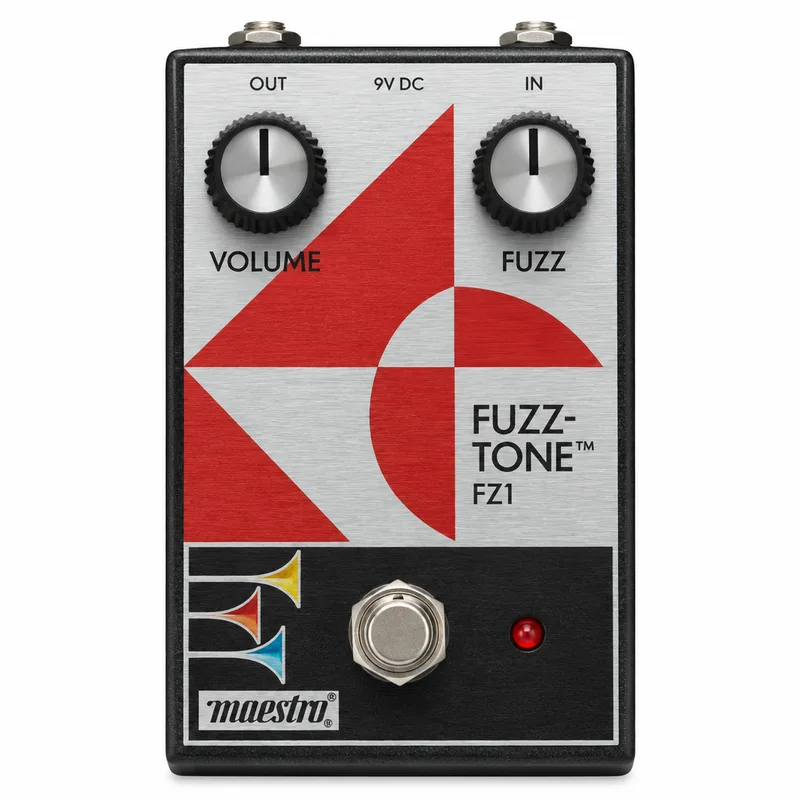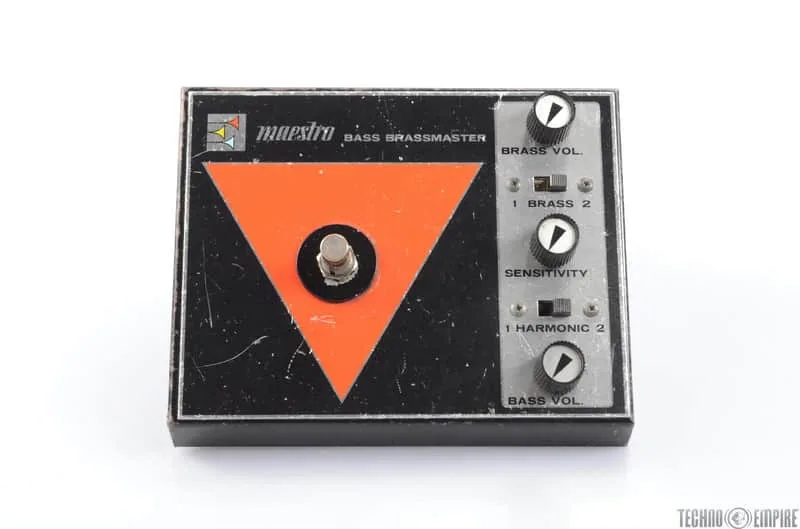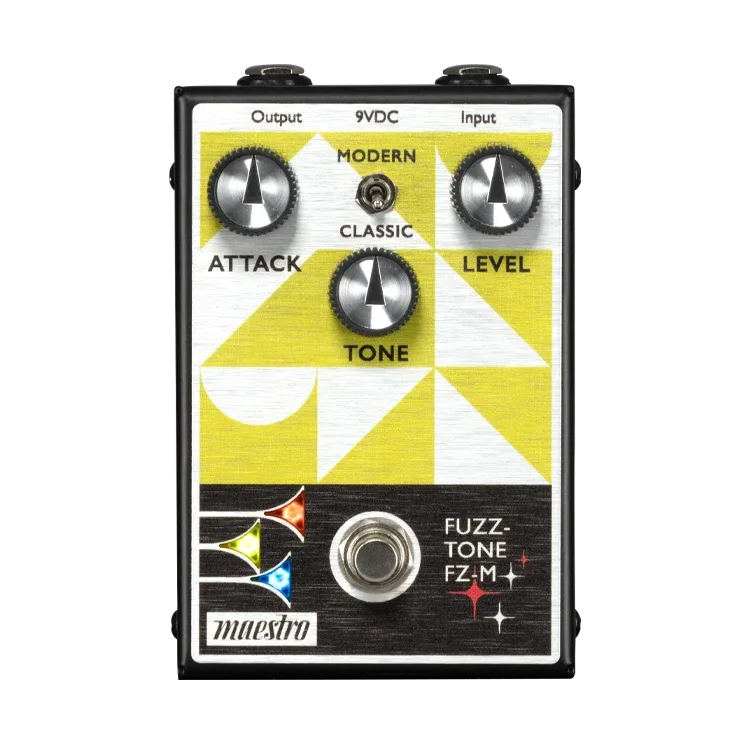


The Maestro Original Collection Fuzz-Tone FZ-M is a fuzz pedal from Gibson's revived Maestro brand, an update of the FZ-1 that Gibson introduced in 1962 and that the company's own product page calls "the sound of rock and roll"1. Where the original was a single-voiced circuit in a wedge-shaped enclosure, the FZ-M adds a classic/modern switch, a conventional three-knob layout and true bypass, and it is built as a standard stompbox for a modern pedalboard2.
From the FZ-1 to the Original Collection
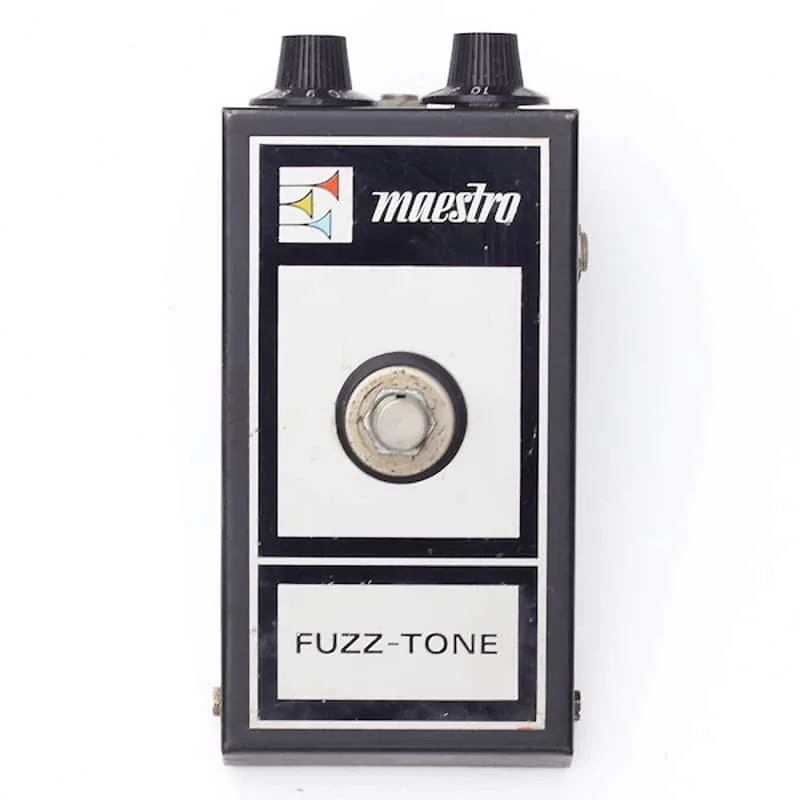
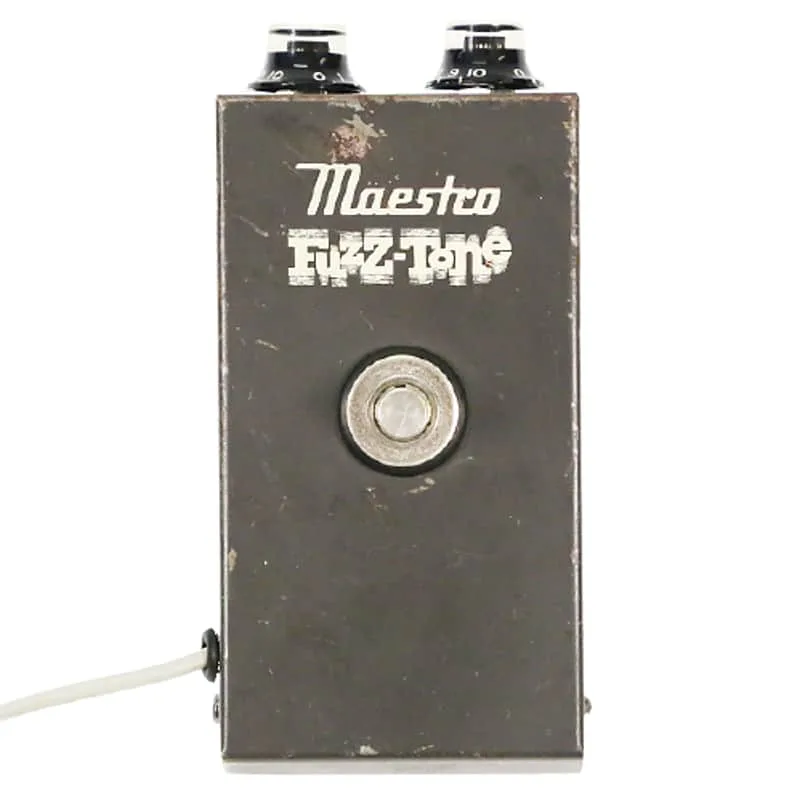
The FZ-1 has a long line behind it. Gibson's history of the pedal records that the original arrived in 1962, that the circuit was later revised as the FZ-1a using 2N2614 or 2N2613 transistors powered by a single 1.5-volt battery, and that the design changed again in 1968 with the FZ-1B redesign41. One Control's page on the lineage notes the original "was later refined in 1965 and reborn as the FZ-1A"5, and Guitar World's history of the Tone Bender quotes a player of the era on the launch: "When the Fuzz-Tone came out in '62, they weren't selling"6.
Gibson brought the name back in January 2022 with the Original Collection, a range of five pedals: the Fuzz-Tone FZ-M, Invader Distortion, Ranger Overdrive, Comet Chorus and Discoverer Delay3. The FZ-M is the line's nod to where it all started: Guitar.com's Richard Purvis described it as "an update of the FZ-1 that harks back to the original's wedge-shaped enclosure"2.
Controls and voicings
The FZ-M keeps things simple: Attack, tone and level knobs, plus a classic/modern switch that selects between two fuzz voicings2.
| Control | What it does |
|---|---|
| Attack | Fuzz amount2 |
| Tone | Voicing2 |
| Level | Output volume2 |
| Classic/modern switch | Selects between classic and modern voicings2 |
Guitar.com's reviewer found a real difference between the two settings. Of the classic mode, he wrote: "there's a tightness to the bottom end that balances the raspy aggression of the treble. Single notes can sound scratchy"2. The modern mode he summed up as "a much thicker, less fizzy voicing that's instantly addictive and will probably prove more useful to most players"2.
What reviewers said
Guitar.com scored the FZ-M 9/10, concluding: "Gutsy and distinctive, this multi-voiced fuzz is much more than just a straight retro reboot"2. MusicRadar's review of the whole collection put the FZ-M among the range's strongest pedals: "The highlights of the collection are in the distortion arena, ie the Ranger Overdrive and Fuzz Tone FZ-M"7.
Power and practicalities
The FZ-M runs on a 9-volt battery or a mains supply and is true bypass, so it works standalone or on a board without buffering your signal when off2. That is a marked change from the vintage originals: the 1962 FZ-1 ran on 3 volts from AA batteries81, and the FZ-1a revision used a single 1.5-volt battery4, supply arrangements no modern pedalboard is set up for. At 130 x 85 x 61mm2, the FZ-M is a compact box that fits a standard board, unlike the wedge-shaped original it honors2.
Videos
Sweetwater
Gibson TV
guitarguitar
Questions
Is the Maestro Fuzz-Tone FZ-M true bypass?
Yes. Both the Guitar.com review and MusicRadar's review of the Original Collection list the FZ-M as true bypass, so the pedal takes itself out of the signal path completely when it is off. It is powered by a 9-volt battery or a mains supply, so it can sit on a board or run standalone.
Does the Maestro FZ-M run on a battery?
It does. Guitar.com lists the FZ-M as powered by a 9-volt battery or mains supply. That is a step up in convenience from the original FZ-1, which ran on low-voltage batteries: the 1962 pedal drew 3 volts from AA batteries, and the later FZ-1a revision used a single 1.5-volt battery.
What is the difference between the classic and modern modes on the FZ-M?
A classic/modern switch selects between two voicings. Guitar.com's reviewer found the classic mode has a tightness to the bottom end that balances raspy treble aggression, with single notes sounding scratchy. The modern mode he described as a much thicker, less fizzy voicing that is instantly addictive and probably more useful to most players.
What is the Maestro Original Collection?
It is the five-pedal range Gibson launched in January 2022 to revive the Maestro name: the Fuzz-Tone FZ-M, Invader Distortion, Ranger Overdrive, Comet Chorus and Discoverer Delay. MusicRadar's reviewers called the distortion pedals, the Ranger Overdrive and the Fuzz Tone FZ-M, the highlights of the collection.
How big is the Maestro FZ-M?
Guitar.com lists the FZ-M's dimensions as 130 x 85 x 61mm, a compact enclosure in the standard stompbox mould rather than the wedge shape of the 1962 original it honours.
Sources (8)
- Maestro Fuzz-Tone FZ-M, Gibson (www.gibson.com)
- The Big Review: Maestro Original Collection pedals, Guitar.com, 2022-02-10
- Gibson revives Maestro as a fully-fledged pedal brand with five new stompboxes, Guitar.com, 2022-01-18
- The history and origins of the iconic Maestro FZ-1 Fuzz-Tone, Guitar World, 2021-10-20
- BALTIC BLUE FUZZ (OC-BBFn), One Control USA
- The history of the Sola Sound Tone Bender, Guitar World, 2021-03-26
- Maestro Original Collection pedals review, MusicRadar, 2022-05-25
- Crazy Tube Limelight Review, Premier Guitar, 2019-09-30