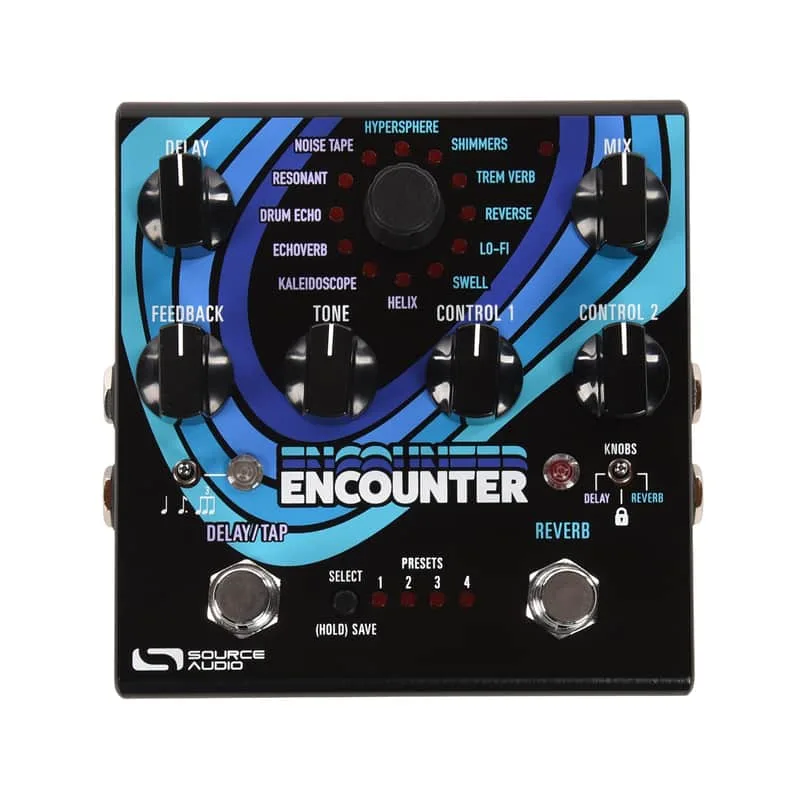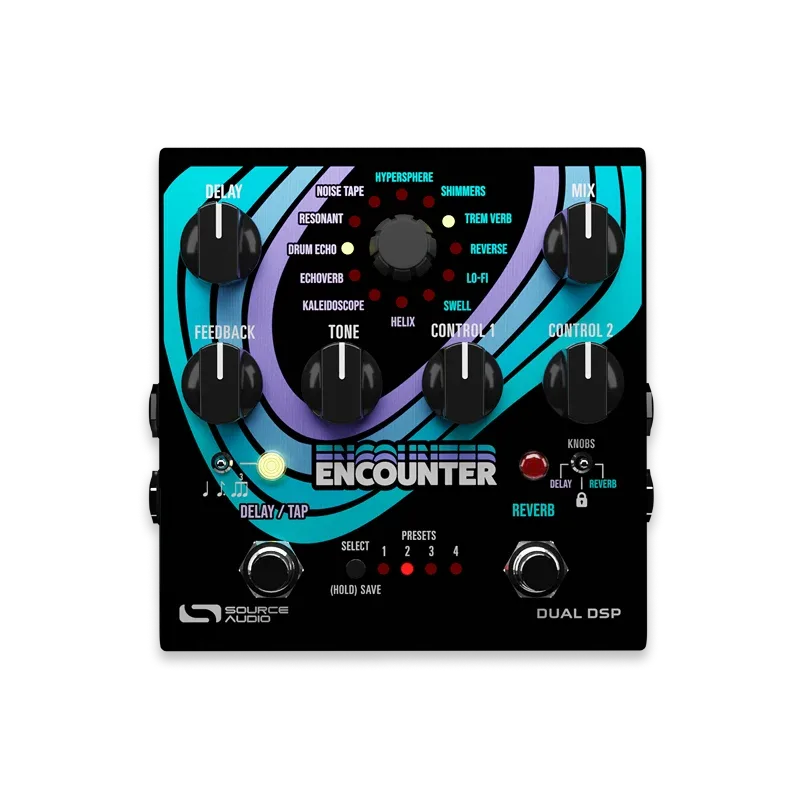


The Source Audio Encounter Ambient Delay+Reverb is a dual-engine reverb and delay pedal that puts six ambient delay engines and six reverb engines in one box. The two engines run on independent footswitches, so you can use a delay on its own, a reverb on its own, or combine any two of the twelve engines, including dual delay and dual reverb setups1. Source Audio positions it as its most expansive and textured take on reverb processing to date2.
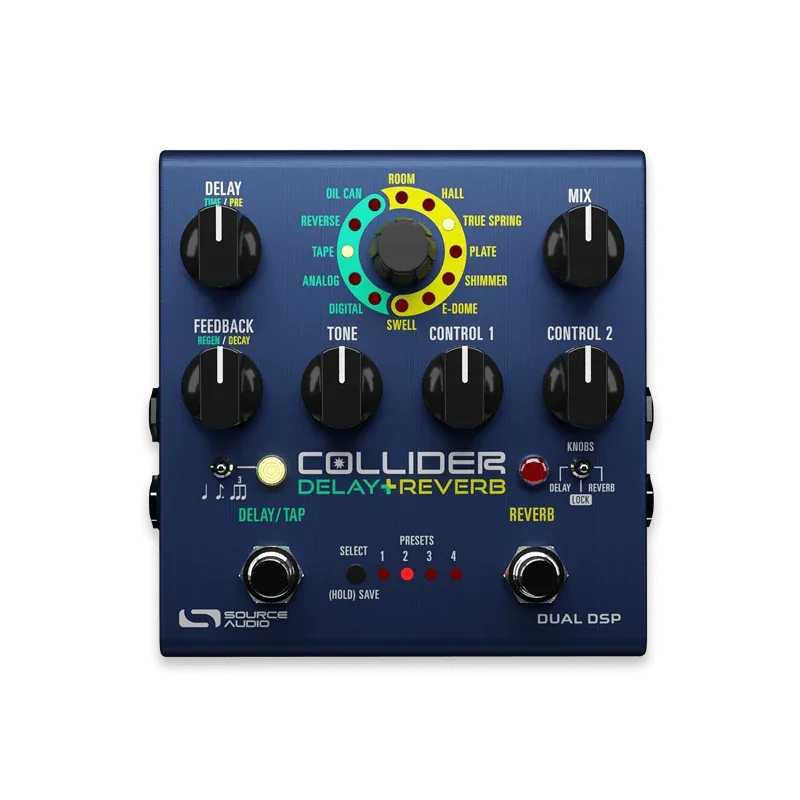
It is the direct successor to the Source Audio Collider Delay+Reverb34. The Encounter is the fourth pedal to use the dual-footswitch form factor seen in previous Source Audio pedals5. The brain of the pedal is digital, but the dry signal stays analog: Source Audio's Analog Dry Through keeps the instrument's dry signal completely unprocessed, running a 100% pure analog path alongside the effects2.
The twelve engines
You select engines with a central rotary encoder: six on the delay side and six on the reverb side58. The delay engines are Helix, Kaleidoscope, Echoverb, Drum Echo, Resonant and Noise Tape; the reverb engines are Hypersphere, Shimmers, Trem Verb, Reverse, Lo-Fi and Swell5.
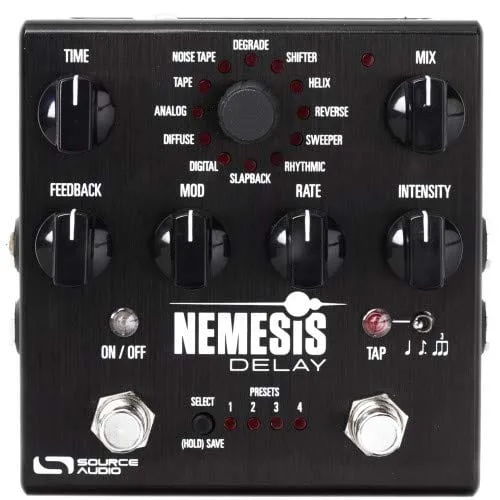
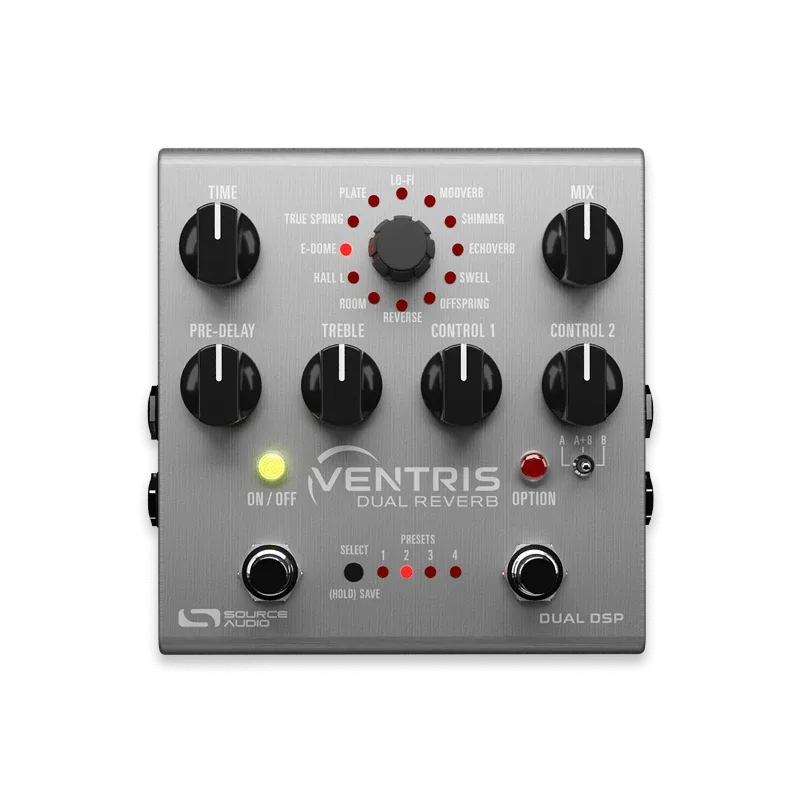
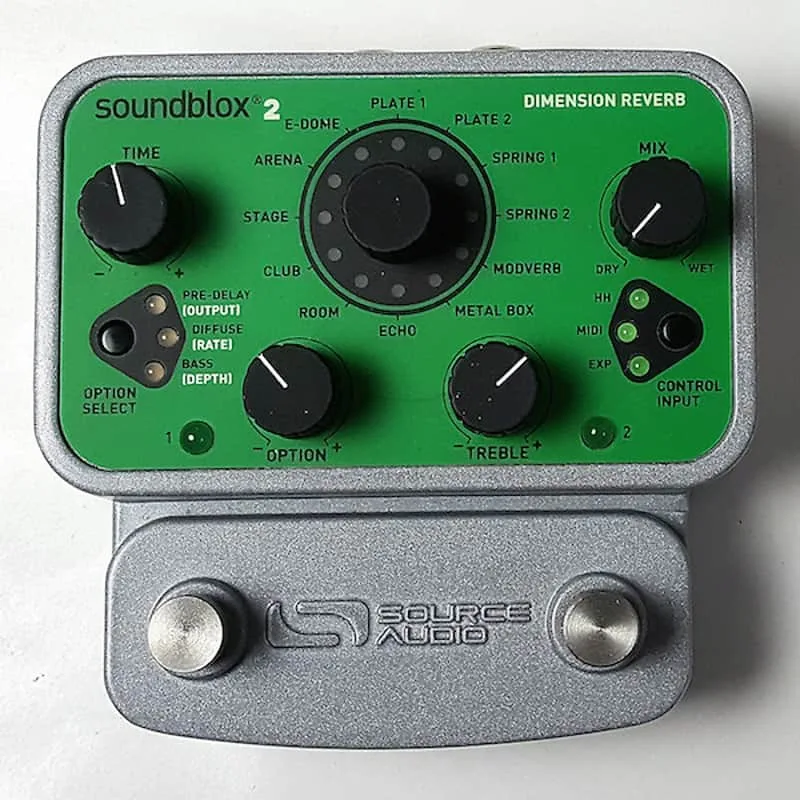
Several engines have documented lineage in earlier Source Audio pedals. The pedal builds on the legacy of the Nemesis Delay, the Ventris Dual Reverb and the Collider9. Guitar World notes the Encounter is the fourth pedal to use this dual-footswitch form factor, after the Ventris, the Nemesis and the Collider5.
| Delay engine | What it is |
|---|---|
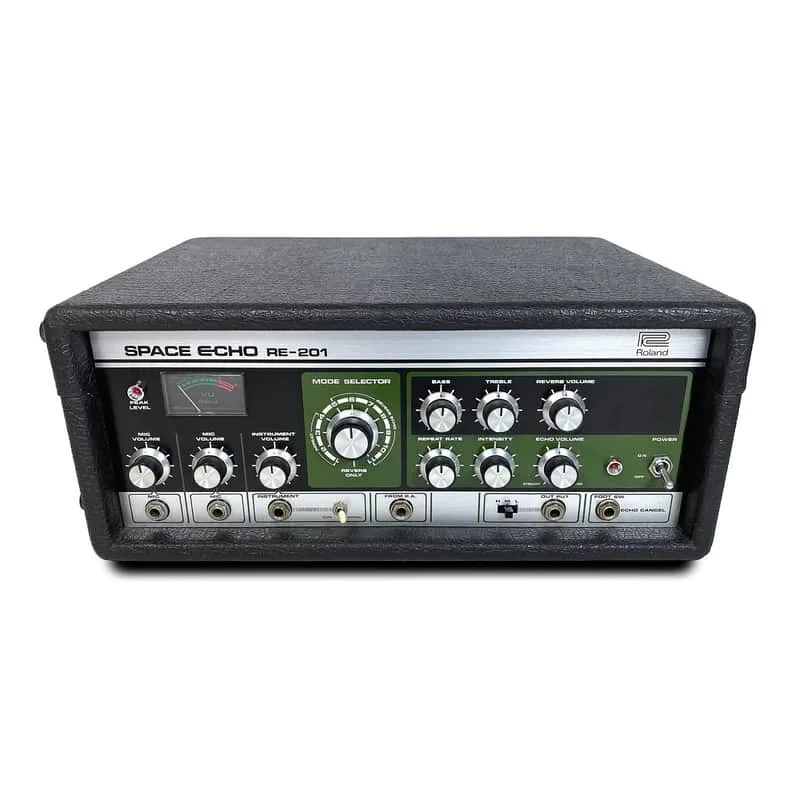
| Noise Tape | Based on the tape delay section of the Roland Space Echo, from clean modulation-free delay to degraded tape sounds2 |
| Drum Echo | Inspired by the vintage Echorec multi-head drum echo, with eight variations and a Wash control2 |
| Resonant | Analog-inspired delay rolling off highs with each repeat, with a modulating resonant filter in the repeats2 |
| Helix | Octave-up and reversed delay from the Nemesis, updated with 5th, octave down and unison pitch options2 |
| Echoverb | A Ventris algorithm included here on the delay side3 |
| Kaleidoscope | New to the Encounter3 |
| Reverb engine | What it is |
|---|---|
| Hypersphere | Source Audio's most expansive and textured reverb, with reverberations circling back from all directions2 |
| Shimmers | Dual-voiced pitch-shifting reverb, two independent pitch voices above or below the dry signal2 |
| Trem Verb | Tremolo fused with a reverb derived from the Ventris E-Dome algorithm, five tremolo LFO shapes2 |
| Reverse | Reverse reverb modeled on the studio trick of flipping 2-inch tape, inverting the reverb's amplitude envelope2 |
| Lo-Fi | Reverb that can be distorted or mangled by modulation via the two CONTROL knobs2 |
| Swell | Envelope-controlled volume swell on wet and dry signals, with ducking and blooming textures via the Neuro editor2 |
Guitar Pedal X notes that Shimmers here is a different shimmer algorithm from the stock Ventris one, despite the similar name3.
Controls, routing and connections
The left footswitch is the on/off for the delay and doubles as tap tempo when the delay is engaged; the right footswitch is the on/off for the reverb23. A Mix knob adjusts the wet/dry balance from 100% and includes a global Kill-Dry mode3. A sub-division switch sets the delay to quarter note, dotted eighth or triplets3. A KNOBS switch in the center position locks the controls in place, protecting settings from accidental bumps on stage2.
Routing is where the dual-engine design pays off. The delay and reverb can run independently or combined, and dual effect combinations can be routed in series, parallel, or split stereo18. Gearnews describes the options as parallel, series, or sending the two effects to separate outputs6.
Connections include standard inputs 1 and 2, standard outputs 1 and 2, MIDI In, MIDI Thru, an expression pedal input, a control input and USB5. The expression input has a selector switch for choosing an external expression pedal or a switch as the control source3.
Presets, MIDI and editing
The pedal holds 128 presets in memory: 8 are accessible from the pedal's own controls, and all 128 are available via MIDI21. MIDI is full implementation over both 5-pin DIN and USB: PC messages recall presets, CC messages control multiple knob parameters simultaneously, and MIDI clock syncs delay time to external clock messages21. Editing also extends to the Neuro 3 app, which can, for example, assign any pitch to either voice of the Shimmers engine29.
Power
The Encounter runs on a 9V DC supply, center negative, and the supply is included3. Source Audio lists power consumption at 300 mA2; MusicRadar reports it draws a minimum of 280 mA7. There is no battery option, and the draw is high enough that a shared daisy chain should be sized with headroom in mind.
How it differs from the Collider
The Collider Delay+Reverb is the pedal the Encounter directly succeeds4. The Encounter keeps the same basic format of two footswitchable sides for reverb and delay with a centralised rotary that selects which delay and reverb algorithm you're currently using8. The algorithm set is where they part ways: the Encounter's six delay engines are Helix, Kaleidoscope, Echoverb, Drum Echo, Resonant and Noise Tape, and its six reverb engines are Hypersphere, Shimmers, Trem Verb, Reverse, Lo-Fi and Swell4. Several of those engines carry over ideas from earlier Source Audio pedals: Resonant and Helix first appeared in the Nemesis Delay, and Trem Verb's reverb side is derived from the E-Dome algorithm in the Ventris Dual Reverb2.
What reviewers said
Guitar.com's Jason Mays called the Encounter "one of the most sonically adventurous pedals I've ever played"8. Of the Noise Tape engine, he reported that the Space Echo emulation was both dynamic and nearly identical to his actual 1984 RE-2018.
"A masterpack of huge, ethereal tones, Encounter collides other-worldly whimsy with grounded, useful staples."
Delicious Audio highlighted its "noteworthy versatility for crafting evolving pads, rhythmic delays, and immersive reverbs"4. On price, MusicRadar noted that "at £369/$399, it's a considerable investment"7. Gearnews reported the launch price as $398/£349/€399, slightly below the $399/€429/£369 MAP/RRP given elsewhere36.
Videos
sourceaudioeffects
sourceaudioeffects
sourceaudioeffects
Questions
Is the Source Audio Encounter true bypass?
It is selectable. Source Audio calls it Universal Bypass: you can choose high-quality signal relays for true or soft bypass, or transparent buffers for analog buffered bypass. Guitar World's review lists it as selectable buffered or true bypass, so you can set it to suit the rest of your pedalboard.
How is the Encounter different from the Collider?
MusicRadar describes the Encounter as an evolutionary remodelling of the Collider, and it is the fourth Source Audio pedal to use the same dual-footswitch form factor. The big difference is the algorithms: Guitar.com notes the Encounter deals exclusively in ambient and unusual sounds, with no room, spring or conventional tape emulations, where the Collider carried more standard fare.
Does the Encounter have a spring reverb?
No. Guitar.com's reviewer found the Encounter is exclusively dealing in the most ambient and weird sounds, with no room, spring, tape or the like. Its six reverb engines are Hypersphere, Shimmers, Trem Verb, Reverse, Lo-Fi and Swell. Players wanting spring from Source Audio can look at the True Spring reverb pedal instead.
Can the Encounter run in stereo?
Yes. It has true stereo inputs and outputs, with TS Input 1 and 2 and TS Output 1 and 2. Dual effect combinations can be routed in series, parallel, or split stereo, so you can send the delay and reverb to separate outputs or run a lush stereo spread.
How many presets does the Source Audio Encounter have?
There are 128 presets in memory. Eight are accessible directly from the pedal's controls, and all 128 are available via MIDI, with PC messages recalling presets. Presets can also be reached with external preset switching hardware connected to the control input.
What power supply does the Encounter need?
It runs on 9V DC, center negative, 2.1 mm, and a power supply is included. Source Audio lists power consumption at 300 mA, while MusicRadar reports a minimum of 280 mA, so plan for a supply with at least 300 mA available. There is no battery option.
Sources (9)
- Source Audio Unveils Encounter Delay+Reverb, Premier Guitar, 2025-09-16
- Encounter Delay + Reverb, Source Audio
- Guitar Pedal X, Guitar Pedal X, 2025-09-16
- New Pedal: Source Audio Encounter Delay + Reverb, Delicious Audio, 2025-09-16
- Source Audio Encounter review, Guitar World, 2025-11-25
- Source Audio Encounter: Atmospheric Delay & Reverb, gearnews.com, 2025-09-18
- “Players have asked us to push further, MusicRadar, 2025-09-17
- Source Audio Encounter review: “sonically adventurous”, Guitar.com, 2026-01-12
- Source Audio Encounter Ambient Delay+Reverb, Pedal of the Day, 2025-10-15