

The Source Audio Ventris Dual Reverb is a stereo reverb pedal whose defining feature is that it holds two completely independent reverb processors in one box, essentially a pair of high-powered reverb pedals sharing an enclosure1. You can run either reverb on its own, or select the A + B toggle position and run both at once in parallel, in series, or split across the left and right stereo channels2. Source Audio describes the idea as weaving any pair of the pedal's reverb effects into a single unified soundscape2.
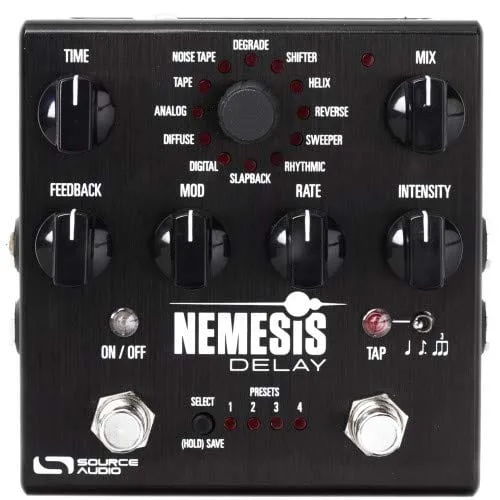
The pedal sits in Source Audio's One Series, which pairs an intuitive set of knobs on the face of the pedal with a much larger set of editing parameters in the Neuro Mobile App3. It was announced in April 2017 alongside the company's Nemesis Delay, which press coverage described as its "brother" unit45.
Two reverbs in one pedal
Most reverb pedals give you one algorithm at a time. The Ventris instead carries two independent signal processors, which is what makes features like preset spillover (a reverb tail that continues when you change presets) and dual reverb effects possible2. MusicRadar's experts framed it plainly: "In the Ventris, finally we have a pedal with a relatively modest footprint that contains two totally independent reverbs that can be used singly or combined in parallel, in series or Left/Right"6.
The dual routing options were one of MusicRadar's stated reasons to buy, alongside the modest footprint and easy operation; their stated reason to avoid was that the Neuro app is required for in-depth parameters6. Pedal of the Day went further in a 2018 review:
"Spillover between presets, dual DSP architecture and massive processing power catapult the Ventris to the top-of-the-line where reverb pedals are concerned, much to the delight of anyone who's listening."
Guitar World's buying guide gives the Ventris a score of 4.5 out of 5 and calls its ability to run two fully independent reverbs from one modestly proportioned pedal its "killer app"7.
Controls and footswitches
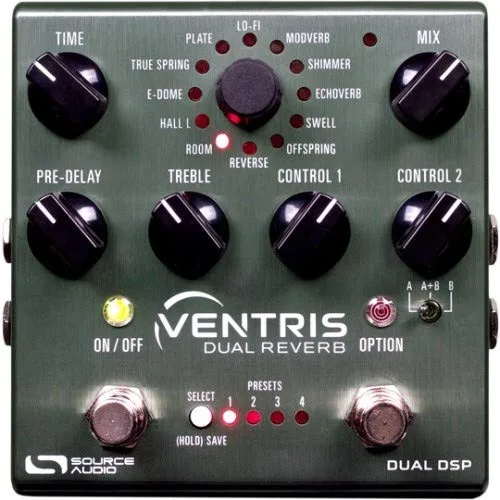
The front panel carries Time, Type, Mix, Pre-delay, Treble, and two variable Control knobs63. Those two variable knobs change function depending on the selected reverb engine, so each algorithm gets controls suited to it3. A third, selectable OPTION footswitch can be assigned to preset scrolling, A to B or A+B reverb toggling, reverb hold, runaway reverb, or tap tempo210.
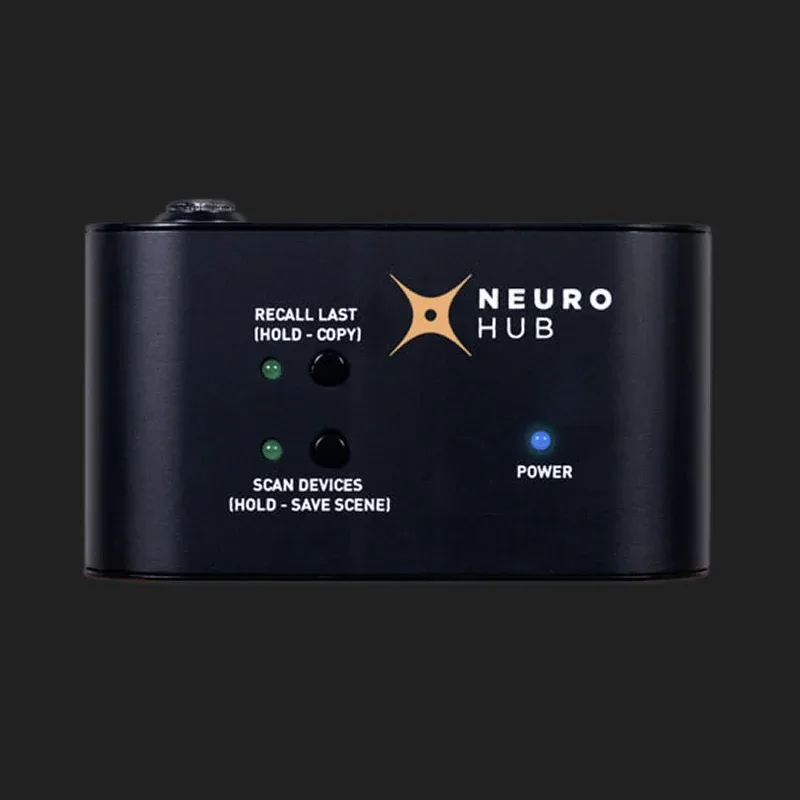
An expression input allows control of up to three parameters at a time11, and connecting the Neuro Hub lets you attach any TRS (tip hot) expression pedal and assign expression control to any combination of knob parameters2.
Reverb engines
The Ventris ships with 12 onboard reverb engines, with an expanding collection of additional reverb effects available through the Neuro Mobile App or Neuro Desktop Editor1. Guitar Pedal X counted 14 engines in total, 12 onboard via the center selector wheel plus extended modes1012. The default and extended modes are13:
| # | Engine | What it does |
|---|---|---|
| 1 | Room | Ambient reverberations of a real acoustic space, from a warm household room to a theater-sized space2 |
| 2 | Hall | The lush sounds of high-powered Lexicon rack units from the 1980s1 |
| 3 | E-Dome | Expansive reverberations of a gargantuan space at the top of the room size range1 |
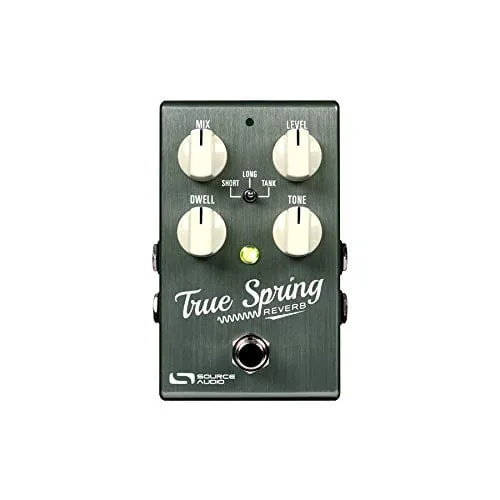
| 4 | True Spring | The "drip" of vintage spring reverb tanks1 |
| 5 | Plate | The lush, diffuse effect of classic plate fixtures from the late 1950s1 |
| 6 | Lo-Fi | Lo-fi reverb character |
| 7 | Modverb | Modulated reverb |
| 8 | Shimmer | Pitch-shifting ambience |
| 9 | Echoverb | Reverb with echo |
| 10 | Swell | Swelling ambience |
| 11 | Offspring | A rhythmic, melodic effect tied to tempo |
| 12 | Reverse | Reverse reverb |
| + | Outboard Spring | Extended mode |
| + | Metal Box | Extended mode |
The True Spring engine got particular attention. Delicious Audio reported that Source Audio put substantial effort into a digital spring reverb that sounded as natural as the coils in vintage amps, calling it "a massive undertaking, requiring a deep understanding of the physical characteristics of reverb springs, advanced experience in sound design, and exceptional processing power"141. MusicRadar's review of the later True Spring pedal noted that the Ventris "featured great spring reverb emulation, and that is carried on here"15.
The Offspring engine is the unusual one. On his demo video, Pete Thorn described shimmer, echo, stereo balancing and filtering that "really comes alive" with chords16. JHS Pedals' Josh Scott was more effusive:
"The offspring setting sets off this rhythmic, melodic, crazy thing that ties into the tempo, and I've never heard anything like it."
MIDI control and presets
The Ventris has full MIDI control over 5-pin MIDI DIN and USB MIDI, and saves up to 128 effect presets recallable with MIDI program change messages23. Eight presets live onboard the pedal itself3. Pete Thorn's demo also confirmed MIDI in, MIDI out, a USB port for deep editing via Source Audio's computer editor, and true stereo input and output16.
MIDI continuous controller messages map to both reverb engines separately. Reverb Engine A sits on CC #1 and Reverb Engine B on CC #25, with each engine selected by CC value18:
| CC message | Assignment |
|---|---|
| CC #1 | Reverb Engine A (value 1 = Hall, 2 = E-Dome, 4 = Plate, 6 = Modverb, 11 = Reverse)18 |
| CC #25 | Reverb Engine B18 |
| CC #2 to CC #14 | Engine A parameters: Time, Mix, Pre-Delay, Treble, Output, Bass, Diffusion, Modulation Depth, Modulation Rate, Pre-Delay Feedback, Pre-Delay Mod Depth, Size, Input Low Cut18 |
| CC #26 to CC #38 | Engine B parameters, mirroring Engine A18 |
For most reverb engines and routing options the dry signal stays analog and never passes through the signal processor while the pedal is engaged, an approach Source Audio calls Analog Dry Through10.
Stereo and connections
The Ventris has stereo inputs and outputs, soft bypass (or "trails"), a hold function, and deep editing through the free Neuro Mobile App for Android and iOS3. The stereo jacks can also be used to set up an external effects loop10. Pedal of the Day argued stereo is not optional with this pedal:
"These two reverbs ABSOLUTELY should be run in a Stereo configuration, because this pedal encompasses all that a 2-amp setup should be about, and could even be the lone reason for you to add another combo or head to your setup."
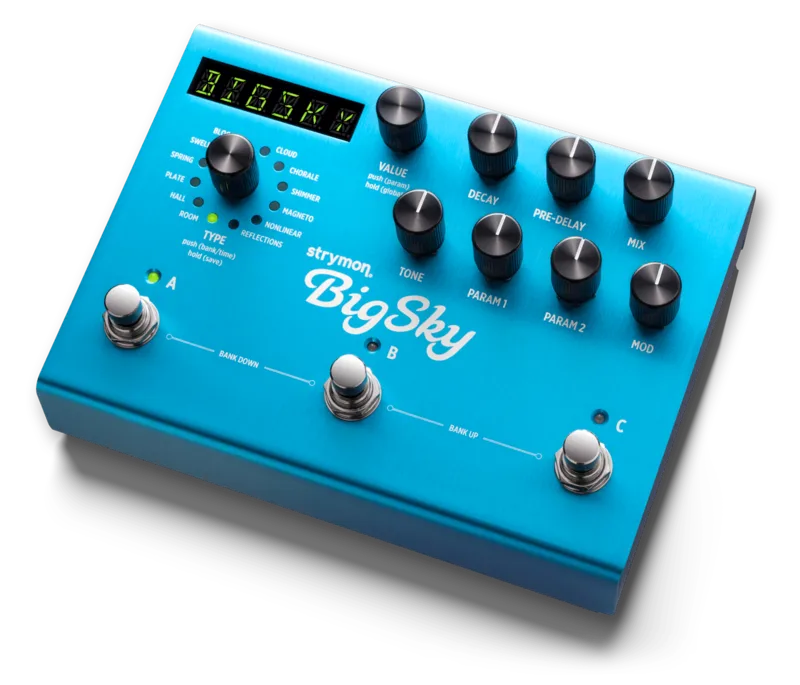
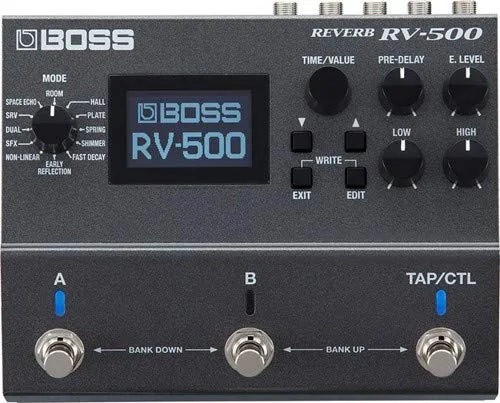
Guitar Pedal X's reviewer, Stefan Karlsson, compared his path from the Strymon BigSky to the Boss RV-500 to the Ventris, writing that he "much preferred the more compact form factor combined with the ability to play back dual reverbs simultaneous - and split across Left and Right stereo channels"13.
Where it came from
Source Audio announced the Ventris Reverb in April 2017 as a powerful stereo reverb pedal, in a regular pedal case that sits nicely on a pedalboard and looks similar to the company's Nemesis Delay14. At announcement it was described as part of the One Series, with eight onboard presets and dual reverb stacking3. It was shown at the Brooklyn Stompbox Exhibit in September 2017, not yet shipping, and "awaited with anticipation after the success of its 'brother' the Nemesis Delay"5.
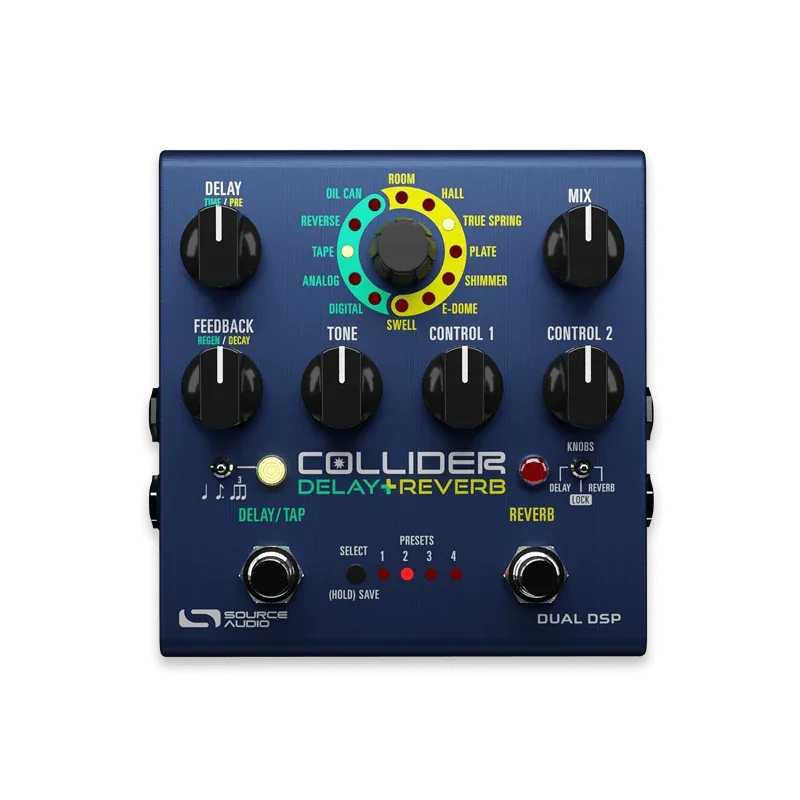
The pedal later fed back into Source Audio's range: Guitar Pedal X reports the company merged the Nemesis and Ventris into the Collider delay/reverb workstation, with many Ventris engines carried over1318. Guitar World's Trevor Curwen noted that anyone with both the Nemesis Delay and the Ventris Dual Reverb on their pedalboard "has a pretty comprehensive arsenal of ambience effects underfoot"19.
Pete Thorn's demo
Pete Thorn demoed the Ventris on his YouTube channel in January 2018, calling it "a deep deep reverb pedal, all reverb one should ever need, a super powerful pedal." He walked through the engines, pointed out the expression pedal input, the USB port for deep editing via Source Audio's computer editor, and the MIDI in, MIDI out and true stereo input and output16.
Videos
Premier Guitar
News
Questions
How many presets does the Ventris hold?
The Ventris saves up to 128 effect presets, recallable with MIDI program change messages over its 5-pin MIDI DIN or USB MIDI connection. Eight presets are available directly on the pedal itself, with the full 128 accessible through MIDI.
Does the Ventris have true bypass?
Yes, and buffered bypass too. Source Audio calls it Universal Bypass: you select between high-quality signal relays for true bypass and transparent buffers for analog bypass, so you can choose whichever suits your signal chain.
Can I add new reverb engines to the Ventris?
Yes. The pedal ships with 12 onboard reverb engines, and Source Audio offers an expanding collection of additional reverb effects through the free Neuro Mobile App and Neuro Desktop Editor, which also handle deep editing and preset sharing.
How much current does the Source Audio Ventris need?
The Ventris runs on 9V DC and draws 280mA. That is well above what a standard 100mA output supplies, so plan on an isolated power supply with a higher-current output rather than a daisy chain.
Is the Ventris stereo?
Yes. It has true stereo input and output, plus MIDI in and out, USB, an expression pedal input and a control input. Reviewers note the two reverbs really should be run in stereo to hear what the pedal can do.
Can the Ventris run two reverbs at the same time?
Yes. Two independent signal processors let you run two reverbs simultaneously in parallel, in series, or split across the left and right signal paths. Select the A + B toggle position to create the dual reverb effects.
Sources (19)
- Source Audio Ventris Dual Reverb, Delicious Audio, 2017-11-07
- Ventris Dual Reverb, Source Audio
- Source Audio Unveils the Ventris Reverb, Premier Guitar, 2017-04-07
- Source Audio's new Ventris Reverb pedal springs into life with an App, gearnews.com, 2017-04-11
- Source Audio Ventris Dual Reverb, Delicious Audio, 2017-09-13
- Best reverb pedals: Top picks from subtle to extreme, MusicRadar, 2022-04-29
- Best reverb pedals 2026: Deep dive into the world of 'verb, Guitar World, 2022-03-23
- Source Audio Ventris Dual Reverb, Pedal of the Day, 2018-06-13
- Immerse Reverberator Mk II, Quilter Labs
- Guitar Pedal X, Guitar Pedal X, 2021-08-16
- Best Stereo Reverb Pedals For Synths For Texture, Ambiance, And Automation, Delicious Audio, 2024-02-23
- Immerse Reverberator Mk II, Quilter Labs (neunaber.net)
- Guitar Pedal X, Guitar Pedal X, 2019-10-08
- Source Audio True Spring Reverb, Delicious Audio, 2022-12-05
- Source Audio True Spring Reverb pedal review, MusicRadar, 2019-01-09
- SOURCE AUDIO VENTRIS, YouTube (Pete Thorn channel), 2018-01-20
- 10 EXTRAORDINARY REVERBS, JHS Pedals
- Voes | MIDI-CC, Voes, 2025
- Source Audio Collider Delay+Reverb review, Guitar World, 2020-05-04