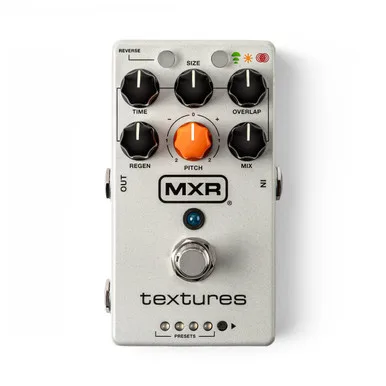



The MXR Textures Granular Synth Engine is a granular synth pedal from MXR that takes your playing apart and rebuilds it. Instead of treating your signal as one continuous sound, it records short snippets of it, called grains, and replays them in layers: as cascading repeats, as sustained frozen washes, or as stacked notes that fade in and out under your fingers1. Alongside the granular engine it carries built-in reverb, filter and vibrato effects for shaping the result further1.
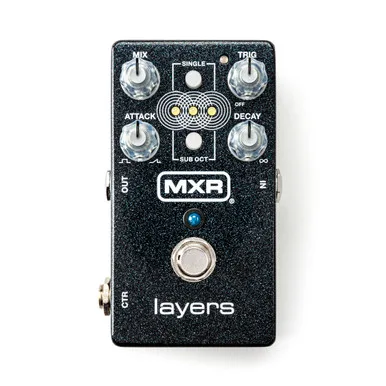
MXR positions it as a granular take on the MXR Layers pedal, whose Layers mode it reinterprets with four smaller buffers2. It launched in late July 2026 and was described by press as already widely stocked3.
What granular synthesis does here
Granular synthesis works by slicing audio into very short pieces and replaying many of them at once. On the Textures, your notes and chords are continuously recorded and played back as grains, and the knobs decide how big those grains are, how many overlap, and in which direction and at what pitch they replay1. Delicious Audio describes the result as a pedal that chops your playing into "cascading repeats, clean echoes, smeared trails, pitch-shifted ghosts"5.
The pedal also ships with default randomization settings for grain time, size and overlap. MXR notes that randomizing size and overlap reduces the audible ringing you can otherwise get from small grains with high overlap1.
The three modes
The Mode button selects how the engine captures and replays your audio2. Each mode is color-coded on the pedal.
| Mode | What it does | Key ranges |
|---|---|---|
| Delay (green) | Notes and chords continuously recorded and played back as grains; Delay and Regen push grains through time15 | Time 50ms to 2s, grain size 60ms to 2s3 |
| Auto Freeze (orange) | Listens for what you play, captures it, and sustains it as evolving washes of tone; adapts when a new note or chord is played23 | Time 50ms to 2s (record time)3 |
| Layers (red) | Sustains up to four notes or chords at a time, each in its own buffer with its own fade-in and fade-out; a fifth note replaces the oldest13 | Grain size 60 to 500ms3 |
In Layers mode, Time sets the attack, or fade-in, of each layer and Regen sets its decay, or fade-out1. The mode is based on the MXR Layers pedal, a sustain pedal MXR released in 2024, but with four smaller buffers instead of that pedal's layer arrangement16.
The controls
The front panel keeps the granular engine to a handful of knobs, with a second layer of parameters hidden behind button holds5.
| Control | What it does |
|---|---|
| Time | Delay mode: grain delay time, 50ms to 2s. Auto Freeze: also sets recording length before the freeze engages. Layers: attack, or fade-in, of each layer1 |
| Regen | Delay mode: feedback or regeneration. Auto Freeze: same, with no feedback when the buffer is frozen. Layers: decay, or fade-out, of each layer1 |
| Size | Length of each grain: 60ms to 2s in Delay and Auto Freeze, 60 to 500ms in Layers1 |
| Overlap | Density of the grains, 1 to 30 simultaneous grains13 |
| Pitch | Playback speed, up to ±2 octaves35 |
| Reverse | Reverse probability of grain playback3 |
| Mix | Blends your dry signal with the granular wash5 |
| Mode button | Selects Delay, Auto Freeze or Layers; the LED flashes when the effect is frozen1 |
| Presets button | Selects one of the eight presets1 |
Hidden parameters and presets
Hold down the Reverse or Mode button while turning any knob and a second layer of parameters opens up: randomization, the onboard reverb, filter, vibrato and tap tempo5. For example, Mode plus Time sets Reverb Mix and Mode plus Regen sets Reverb Decay, while Reverse plus Time sets Randomized Time3. A Size Random secondary parameter sets how random the grain sizes are1.
There are further knob actions for Preset Scroll Mute, Trails, Output Mode, Footswitch Hold Mode, Output Gain and Tap Switch Hold Mode3.
The pedal holds eight presets, four green and four red, plus a live mode that follows the current knob settings and automatically saves switch and secondary parameter states1. Named red presets in the manual include:
- Stutter Pad: polyphonic pad with a bit of glitch1
- Mellow Cello: sub-octave pad with vibrato1
- Sub Octave Ripple: quickly cascading sub-octave effect that adds depth and weight1
- Slow Attack Soundtrack: slowly evolving pad with random octave blips sprinkled in1
Expression, stereo and connections
The CTR jack accepts an expression pedal over a TRS cable, with control over any parameter, and both live mode and each preset can store their own expression state15. The input and output are both TRS jacks that allow stereo, with stereo input enabled by an internal mono/stereo switch under the bottom plate1. The output can be configured for mono, wet/dry or true stereo; in stereo mode the pedal creates a stereo image by randomly panning the grains across the field, and the reverb effect also builds a stereo image15.
Price and what reviewers said
Press coverage at launch did not quote a single price, but reviewers commented on value. Delicious Audio's reviewer called it "a decent price for what you're getting", with "plenty to get stuck into" and "cool tones and textures to be found", and noted the pedal was already widely stocked3.
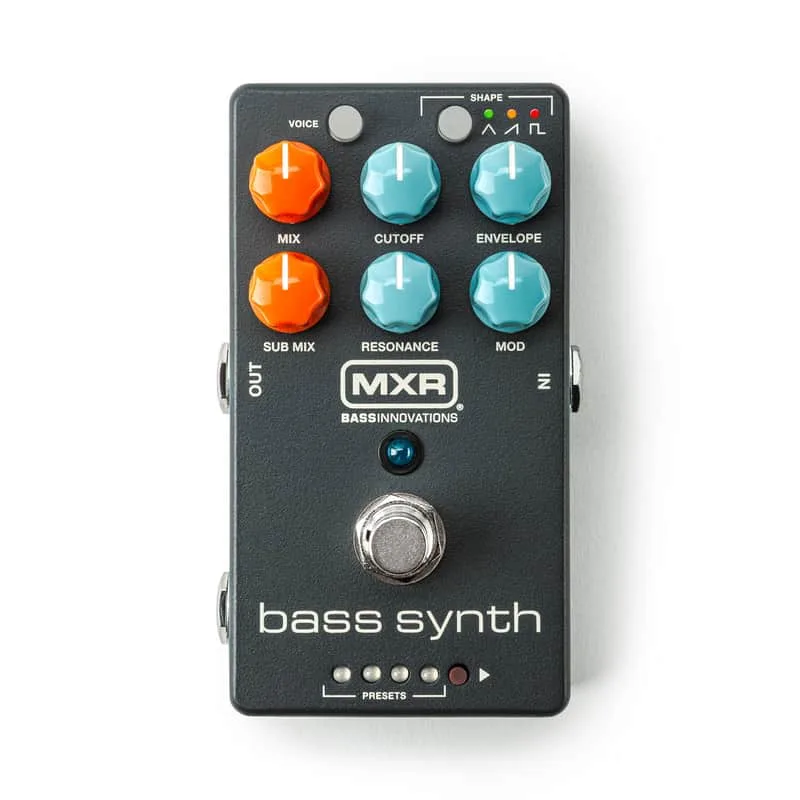
Guitar Pedal X called it "a decent price for what you're getting - certainly plenty to get stuck into - and some really cool tones and textures to be found"3, and noted that the preset-strip format came in with the MXR Bass Synth the year before3.
MusicRadar's reviewer, comparing it with the Walrus Audio Lum texture engine, found that "this texture pedal also boasts three modes with perhaps an easier to use design", that you can produce similar textural soundscapes on both, and that putting the reverse effect on a separate button gives the Textures slightly more flexibility than having it take up an entire mode slot7.
Videos
Premier Guitar
jimdunlopusa
ambienttrash
News
Questions
Is the MXR Textures stereo?
Yes. The input and output are both TRS jacks that carry stereo, and a fully clockwise Output Mode setting pans the grains randomly across the stereo field to build a stereo image. The built-in reverb also creates a stereo image. Stereo input is enabled with an internal mono/stereo switch under the bottom plate.
How many presets does the MXR Textures have?
Eight: four green and four red, selected with the Presets button. There is also a live mode that simply follows the current knob settings, and it automatically saves your switch and secondary parameter states. Each preset can also store its own expression pedal state.
How long can the MXR Textures grains be?
Grain size runs from 60 milliseconds to 2 seconds in Delay and Auto Freeze modes, and from 60 to 500 milliseconds in Layers mode. Time runs from 50 milliseconds to 2 seconds, and up to 30 grains can sound at once depending on the Overlap setting.
Can you use an expression pedal with the MXR Textures?
Yes. The CTR jack accepts an expression pedal over a TRS cable, and it can control any parameter. Live mode and each of the eight presets can store their own expression state, so a preset can recall exactly how the expression pedal was mapped.
How much does the MXR Textures cost?
Press prices at launch disagree slightly: Guitar Pedal X listed it at $270 and Gearnews at $279.00, both in late July 2026. UK and EU prices were also reported differently, from £255 to £275 and around €299. It was described as already widely stocked at launch.
Sources (7)
- M310.pdf, Jim Dunlop (jimdunlop.com), 2026
- MXR® TEXTURES™ GRANULAR SYNTH ENGINE, Jim Dunlop (jimdunlop.com)
- Guitar Pedal X, Guitar Pedal X, 2026-07-30
- MXR Textures Granular Synth Engine: Packed with 3 Ambient Modes, gearnews.com, 2026-07-30
- New Pedal: MXR Textures Granular Synth Engine, Delicious Audio, 2026-07-28
- MXR's Layers can create chord voicings “never thought possible”, Guitar World, 2024-08-27
- Walrus Audio Lüm Texture Engine review, MusicRadar, 2026-09-05