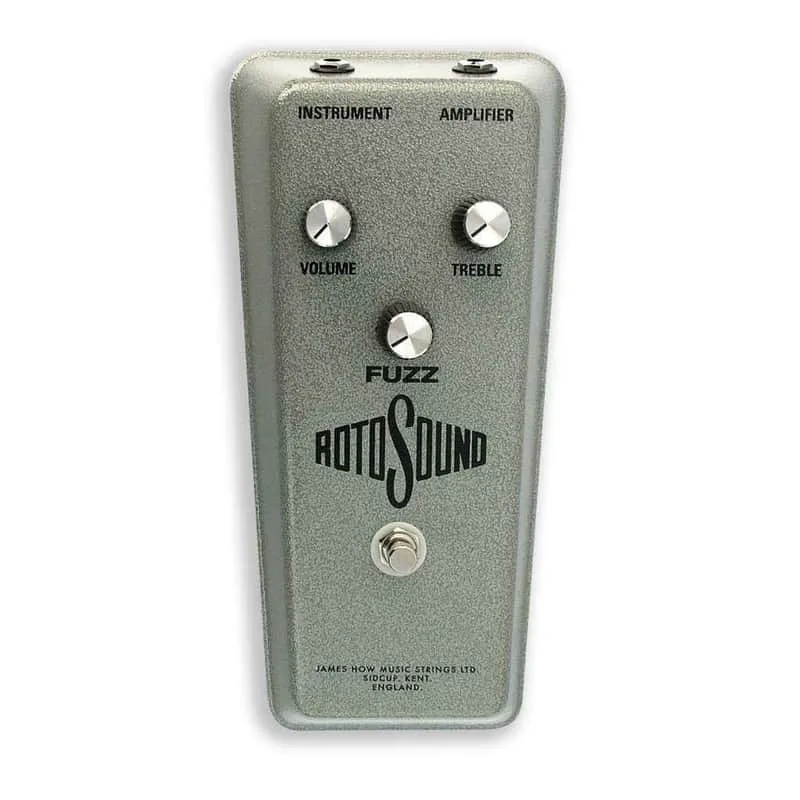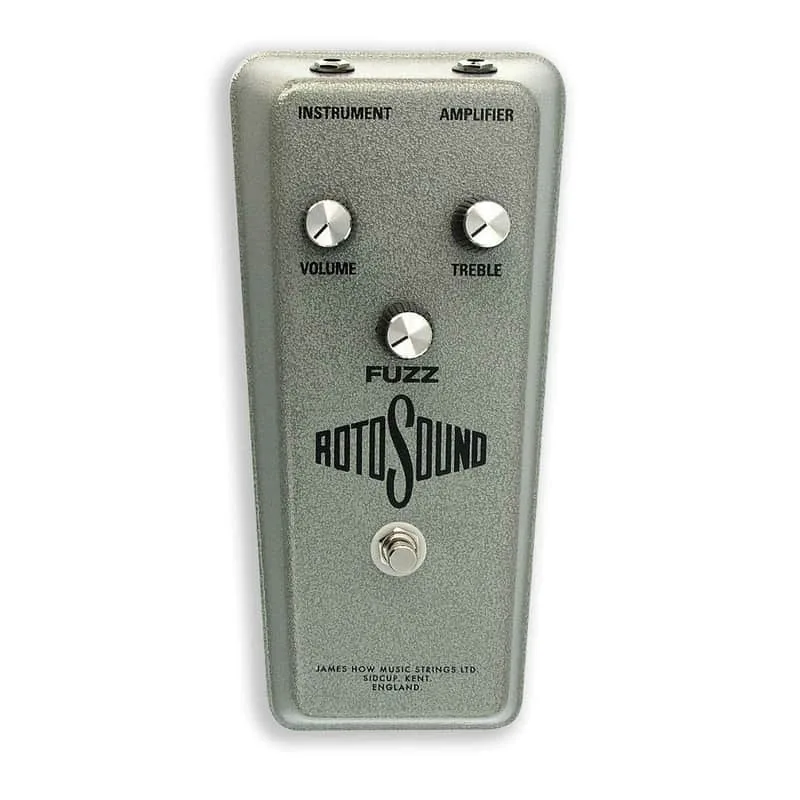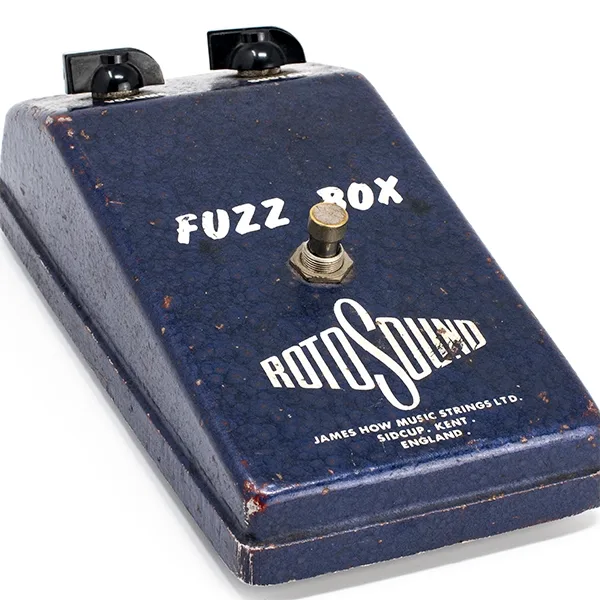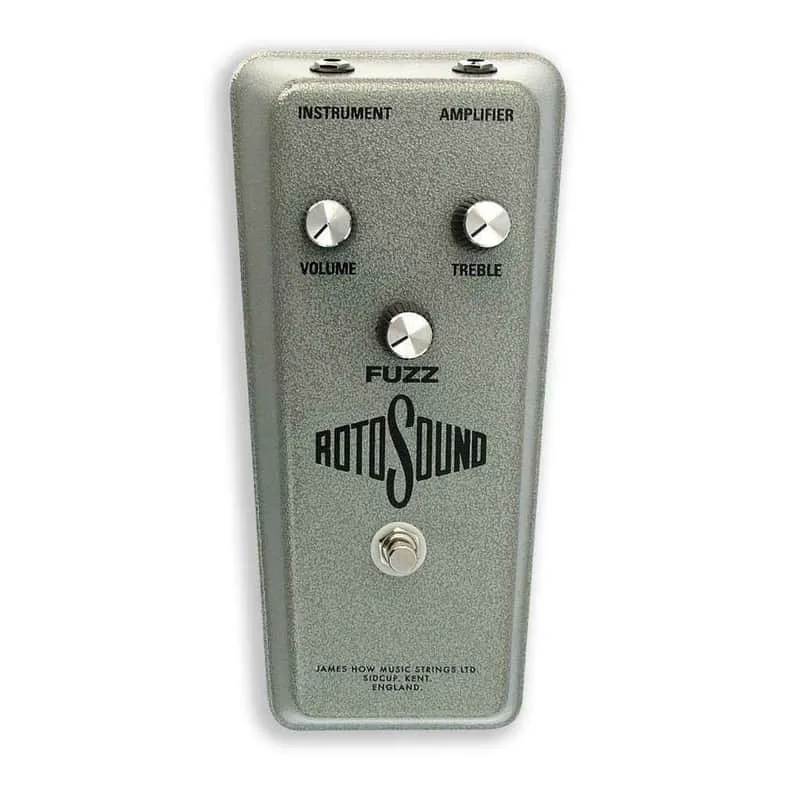


Rotosound is a name players mostly associate with strings, but in the late 1960s the UK-based company also made a fuzz pedal. Originals are now very rare: MusicRadar's Chris Vinnicombe notes that Jimmy Page was photographed using a Rotosound fuzz on several occasions in 1969, but originals were few in number1. The pedal returned to the market decades later as the Rotosound Vintage Fuzz reissue, and today lives on as the Rotosound RFB1 1960s Fuzz Pedal Reissue, one of several fuzz designs covered on the site's Fuzz Pedals page.
From rare original to reissue
The original pedal was never a normal shop item. Guitar World reports that the original prototype pedals were only available in limited numbers and were never released for general sales, though the company described it at launch in the UK as one of the easiest effect pedals to use3. A product listing did exist: MusicRadar's reviewer located one complete with the 1968 purchase price of 12 guineas1. Guitar World also notes that these prototype pedals were found all over the place, and that there is even a picture of Jimmy Page playing one3.
The story did not end in the 1960s. The original pedal had a reputation that outlasted its years on the market: Rotosound describes it as "renowned as one of the easiest effect pedals to use when first launched in the UK"3. The pedal's original price has also survived: a product listing records the 1968 purchase price of 12 guineas1.
The RFB1 reissue
The Rotosound RFB1 is the current expression of that circuit. MusicRadar's review notes that Rotosound's original 1960s fuzz pedal is so rare that even the firm itself did not have one to call its own, and that the company obtained an original model to base the reissue on1. Jason How believes the original was most likely designed by Gary Hurst1.
The controls are simple. MusicRadar found that the RFB1's volume, fuzz and treble pots are simple to use but allow a broad range of tones to be sculpted1. One omission is deliberate to the vintage design: there is no LED power indicator on the pedal1.
As for where it sits tonally, MusicRadar's reviewer offers a rough guide: think somewhere between the frying-pan sizzle of a Fuzz Face and the fat sustain of a Sovtek Big Muff, without the Muff's tendency to go missing in a live band mix1. His overall verdict listed amazing vintage and contemporary sounds and robust construction among the reasons to buy1.
"There may be no LED power indicator on this pedal, but you sure as hell know when it's switched on."
The fuzz in Rotosound's wider pedal range
The RFB1 became the foundation for more. In 2013, MusicRadar reported that Rotosound's new pedal additions follow the design of the original RFB1 Fuzz and aim to replicate the sounds of the '60s with their hand-wired build4. MusicRadar later described the company as branching out after the success of the fuzz pedal reissue, teaming up with electronics guru John Oram for a new range of effects5. That range has since grown to include designs such as the Rotosound Germanium Fuzz.
Videos
Premier Guitar
RotoSound France
daCod77
Questions
Who designed the original Rotosound fuzz pedal?
According to MusicRadar's review, Jason How believes the original was most likely designed by Gary Hurst. After Rotosound obtained an original model, the company used it as the basis for the RFB1 reissue circuit.
How rare are original Rotosound 1960s fuzz pedals?
Very rare. MusicRadar's Chris Vinnicombe notes that Jimmy Page was photographed using a Rotosound fuzz on several occasions in 1969, but originals were few in number. The reissue is so rare that even Rotosound itself did not have one to call its own until it obtained an original.
Did Jimmy Page use a Rotosound fuzz?
Yes. MusicRadar reports that Jimmy Page was photographed using a Rotosound fuzz on several occasions in 1969, and Guitar World notes there is even a picture of him playing one of the original 1960s prototype pedals.
What is the Rotosound RFB1 reissue?
The RFB1 1960s Fuzz Pedal Reissue is Rotosound's rebuilt version of its original 1960s fuzz, based on an original model the company obtained. MusicRadar's reviewer praised its amazing vintage and contemporary sounds and robust construction, with volume, fuzz and treble controls.
Was the original Rotosound fuzz ever sold to the public?
Not in any general sense. Guitar World reports that the original prototype pedals were only available in limited numbers and were never released for general sales, although a product listing did exist with a 1968 purchase price of 12 guineas.
Sources (5)
- Rotosound RFB1 1960s Fuzz Pedal Reissue review, MusicRadar, 2013-04-05
- Video: Rotosound Announces Reissue of its Classic Vintage Fuzz Pedal, Guitar World, 2012-03-26
- Rotosound Reissues Vintage Fuzz Pedal Using 1960s Circuit Configuration, Guitar World, 2012-08-30
- Rotosound rolls out six new pedals, MusicRadar, 2013-07-17
- Rotosound The King Henry Phaser review, MusicRadar, 2014-06-25