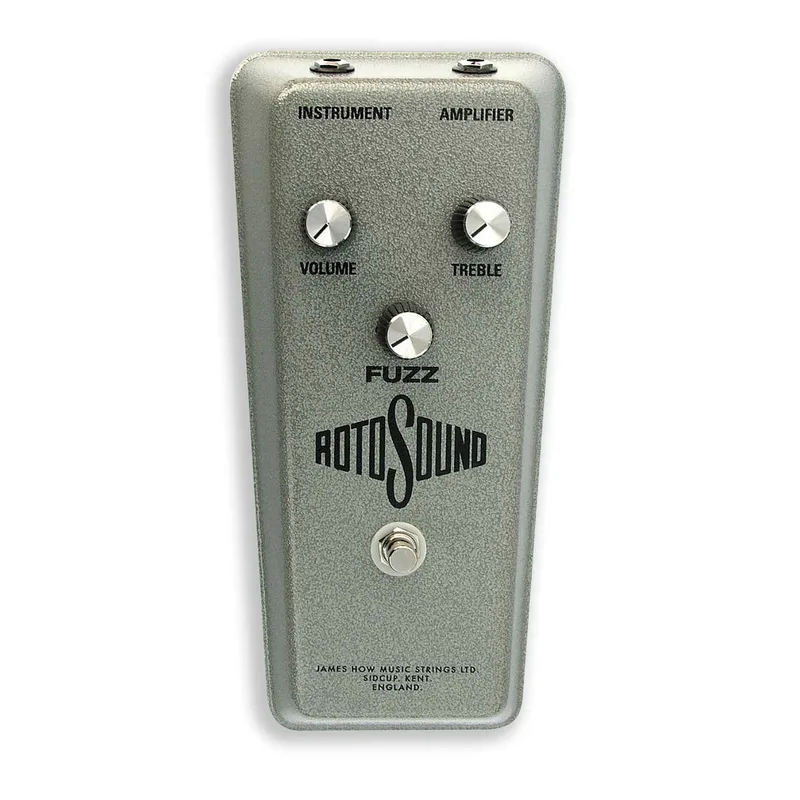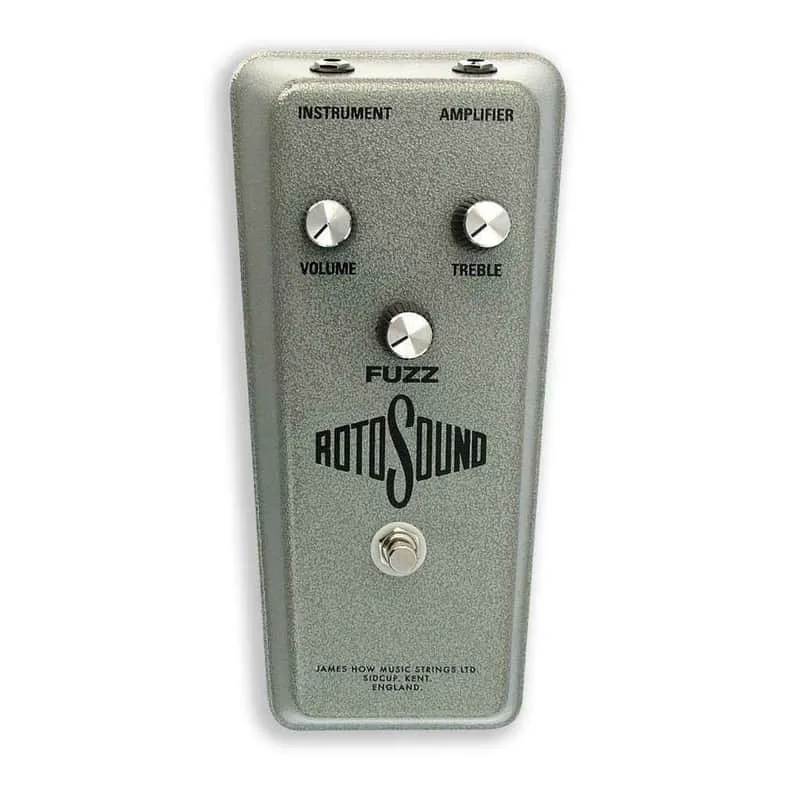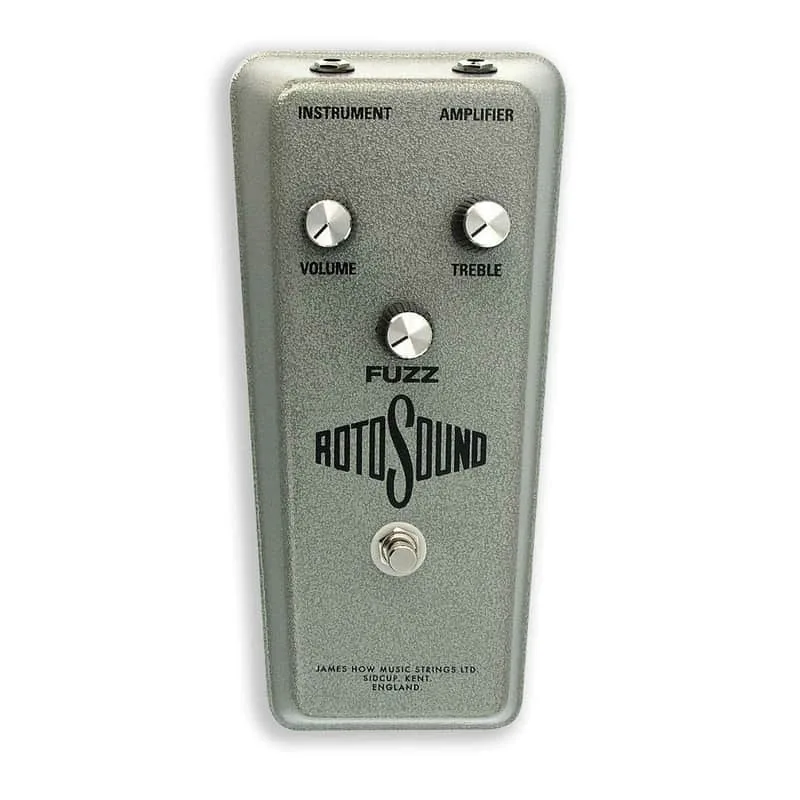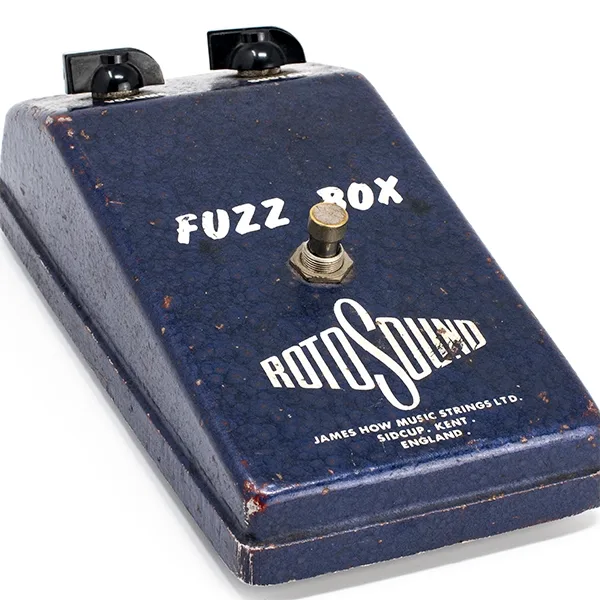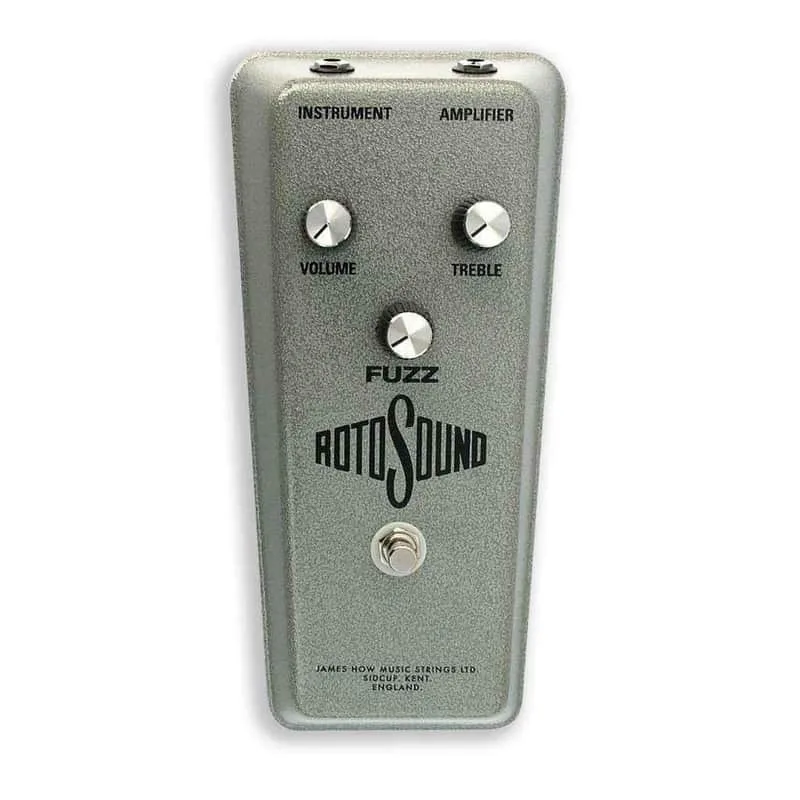


The Rotosound RFB1 is a fuzz pedal reissue: a hand-wired reproduction of Rotosound's original 1960s fuzz, built in England with the same circuit configuration as the original design and original germanium transistors paired with modern resistors and capacitors1. Rotosound is best known as a British string maker, but in the 1960s it also put its name on a small run of fuzz boxes, and the RFB1 is the only original Rotosound fuzz pedal of that era to be reissued1. The pedal is now discontinued1.
What the RFB1 does to your sound
The RFB1 is a three-knob germanium fuzz. MusicRadar's reviewer Chris Vinnicombe found that "the RFB1's volume, fuzz and treble pots are simple to use but allow a broad range of tones to be sculpted"2.
| Control | What it does |
|---|---|
| Volume | Sets the output level |
| Fuzz | Sets the amount of fuzz |
| Treble | Shapes the top end |
For players placing it against better-known fuzzes, Vinnicombe gave a useful reference point: the RFB1 sits "somewhere between the frying-pan sizzle of a Fuzz Face and the fat sustain of a Sovtek Big Muff, without the Muff's tendency to go missing in a live band mix"2. His overall verdict listed "amazing vintage and contemporary sounds" and "robust construction" among the reasons to buy2.
Rotosound itself describes the pedal in marketing terms as combining "yesterday's mojo and tone flavour with the reliability and stability of today's technology"1.
Circuit and power
The core tone-generating elements of the original circuit were retained in the reissue. MusicRadar describes the topology as "a 'Darlington Pair' of NOS germanium input transistors driving a third, temperature-compensated 'fuzz' transistor on a neatly hand-wired board"2. The temperature compensation on that third transistor addresses the drift that germanium circuits are known for.
Power comes from a single PP3 battery. Vinnicombe noted that "the pedal has a very low current drain, so expect a single PP3 battery to survive months of heavy usage"2.
The RFB1 is a hand-wired stompbox made in England1.
History: prototypes, Solasound and the reissue
The original Rotosound fuzz dates from the late 1960s3. The prototype pedals were produced alongside Solasound Tonebender fuzzes, and were only ever available in limited numbers, never released for general sale1. Sola Sound was the London builder known for constructing Tone Bender fuzz boxes supplied to Vox, Marshall and Rotosound, as well as the Colorsound range4. MusicRadar reports that the original Rotosound fuzz was most likely designed by Gary Hurst, the designer associated with the Tone Bender from its first prototype in a wooden box in April 1965, through the MKI (September 1965), MK2 (mid 1966) and MK3/MK4 (February 1970) versions25.
The RFB1 is a hand-wired stompbox made in England1.
The RFB1 is a hand-wired stompbox made in England1.
Jimmy Page and the original pedal
The best-known player linked to the original is Led Zeppelin's Jimmy Page. Rotosound's own page for the RFB1 notes "there is even a picture of Led Zeppelin's Jimmy Page playing one" of the original prototype pedals1. British Pedal Company's Tone Bender history documents Page using the Rotosound version of the three-knob Tone Bender, the MK3, in 19696.
Related Rotosound fuzzes
The RFB1 is one of the hand-wired stompboxes Rotosound makes in England1.
Videos
Guitarist
Peter “Danish Pete” Honoré and Rotosound
Guitar Interactive Magazine
Questions
Is the Rotosound RFB1 still made?
No. Rotosound lists the RFB1 as discontinued. The reissue first appeared in 2012 as a limited production run of 2000 units, which sold out almost immediately, and the pedal was later brought back as part of a limited-run series before being retired again.
Does the RFB1 use germanium transistors?
Yes. The reissue keeps the original circuit configuration and uses original germanium transistors, paired with modern resistors and capacitors. MusicRadar describes a Darlington Pair of NOS germanium input transistors driving a third, temperature-compensated fuzz transistor on a hand-wired board.
Where is the Rotosound RFB1 made?
In England. Rotosound builds its hand-wired stompboxes at its factory in Sevenoaks, Kent, and the RFB1 reissue was manufactured there using the same circuit configuration as the original 1960s design.
Did Jimmy Page use a Rotosound fuzz?
Yes. Rotosound's own page for the RFB1 notes a picture of Led Zeppelin's Jimmy Page playing one of the original prototype pedals, and British Pedal Company documents him using the Rotosound version of the three-knob Tone Bender in 1969.
Is the RFB1 related to the Tonebender?
Yes. The original Rotosound prototype pedals were produced alongside Solasound Tonebender fuzzes, and MusicRadar reports the original was most likely designed by Gary Hurst, the designer behind the Tone Bender line.
Sources (6)
- RFB1 Rotosound 'Fuzz' Guitar Effects Pedal • Rotosound Music Strings, Rotosound, 2025-06-27
- Rotosound RFB1 1960s Fuzz Pedal Reissue review, MusicRadar, 2013-04-05
- Rotosound rolls out six new pedals, MusicRadar, 2013-07-17
- Vox Tone Bender Professional MKII • Fuzzboxes, Fuzzboxes.org, 2021-05-20
- BENDER - JHS Pedals, JHS Pedals
- Tone Bender History, britishpedalcompany.com, 1969