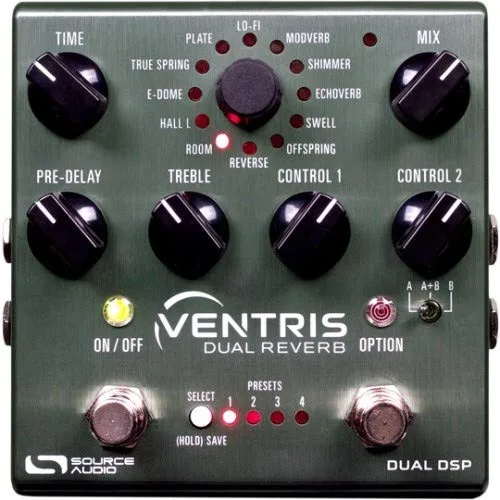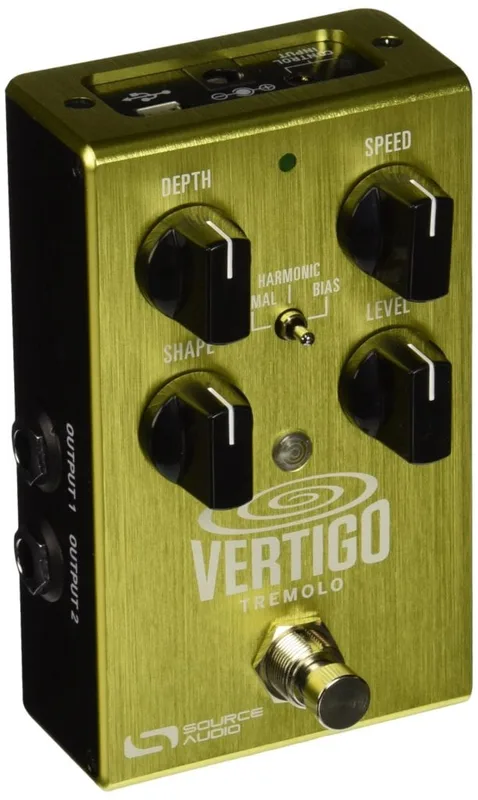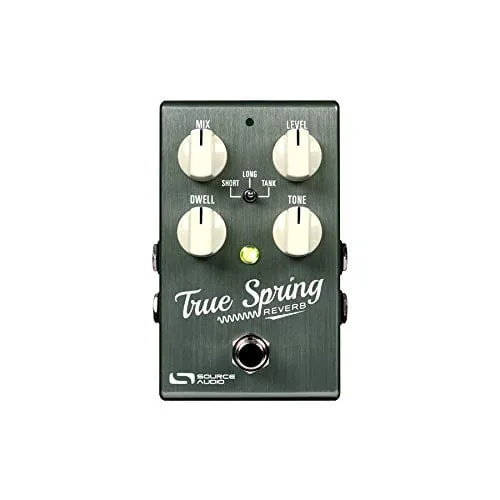


The Source Audio True Spring is a compact, stereo pedal that teams digital spring reverb simulations with tremolo effects in one box1. Released on October 2, 2018, following the success of the Ventris Dual Reverb, it was built specifically to deliver what Source Audio considers the most authentic spring reverb sound, using the spring reverb algorithm adopted from the Ventris Dual Reverb23. Its tremolo functions were extracted from Source Audio's popular Vertigo Tremolo circuit4.
The pedal is aimed squarely at players who want vintage amp-style spring and tremolo textures on a pedalboard. MusicRadar's Trevor Curwen found it perfect for surf instrumentals and Spaghetti Western and spy movie soundtracks, but noted it goes beyond those genres5.
Where the sounds come from
The True Spring's reverb effects are based on a mechanical spring reverb design originated by the Hammond Organ Company in the late 1930s, which used a pair of input and output transducers to inject a dry signal into spring coils39. Source Audio's engineering team of Bob Chidlaw and Jesse Remignanti put years of collective man-hours into capturing that sound digitally3.
The tremolo side has its own lineage: the tremolos are the same organic effects that originally appeared in Source Audio's Vertigo Tremolo9. Premier Guitar's reviewer described them as "superb tremolo models derived from Source Audio's excellent Vertigo tremolo pedal," with optical, bias, and brownface-style harmonic emulations selectable via the toggle switch7.
The three spring types
A three-way toggle switch selects the reverb type5. Source Audio describes each mode on its product page6:
| Mode | What Source Audio says it does |
|---|---|
| Short Spring | A taut sound with a quick decay and smooth trails, modeled after the twang of 1960s "blackface" amplifiers6 |
| Long Spring | Deep reverb decays with noticeable "drip" and highly animated trails, an authentic representation of livelier vintage reverb tanks6 |
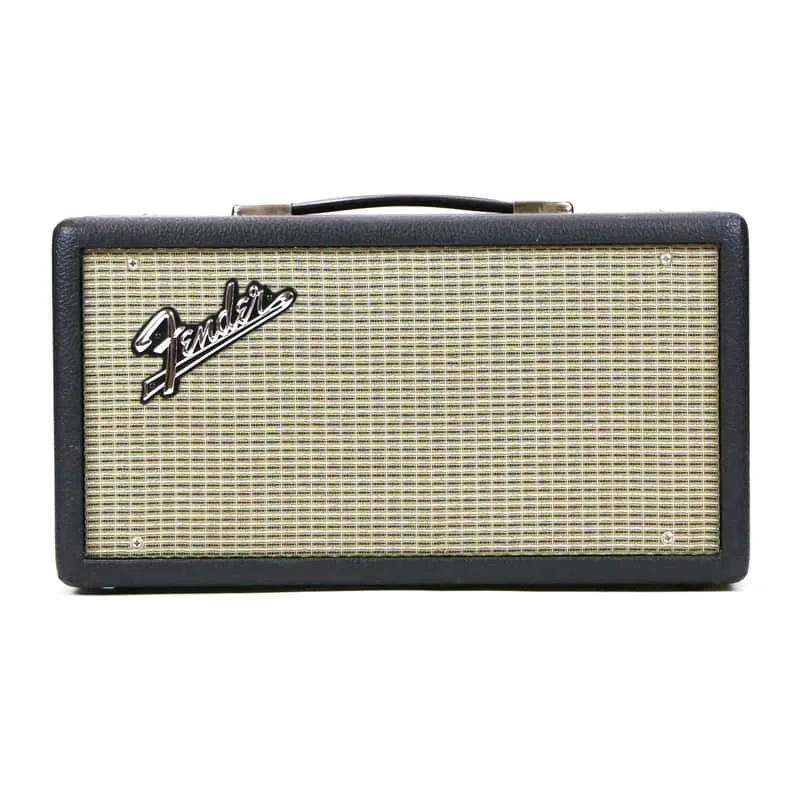
| Tank Spring | Captures the tube-driven outboard spring tanks of the 60s, like the classic Fender 6G156 |
Premier Guitar's reviewer heard distinct characters in each: the short spring is the most succinct in terms of attack overtones and trails, and a nice match for fuzz; the long spring has darker, more cave-like overtones and an explosive, dripping-wet attack; and the tank setting is "beautiful, and it's arguably the True Spring's centerpiece," with effervescent, pleasantly granular trailing overtones7.
"The tank reverb setting is beautiful, and it's arguably the True Spring's centerpiece."
The three tremolo types
The same toggle switch gives you three different styles of tremolo: Bias, Harmonic and Optical3. Source Audio describes how each works6:
| Tremolo | How Source Audio describes it |
|---|---|
| Opto | Relies on a neon light bulb and a light dependent resistor called an "optocoupler"6 |
| Harmonic | First appeared in Fender "brownface" amps made between 1959 and 1963, alternately modulating the levels of bass and treble frequencies6 |
| Bias | A smooth amplitude modulation with a mild overdrive created by tube saturation6 |
Premier Guitar's reviewer found the optical tremolo, associated with Fender's bigger blackface amps, the choppiest of the bunch, and the brownface-style harmonic setting colored with subtle pitch-shifting effects that smooth the waveforms. The bias tremolo strikes a middle ground, generating pitch-regular rhythmic pulses with smoother contours7. MusicRadar's verdict on the tremolos: "all three versions of the tremolo sound true to the original in-built amp versions, and between them adequately cover the vintage scene"5.
The controls and presets
The face of the pedal is a four-knob array for mix, dwell, effect level, and tone, plus the spring-type toggle, which Premier Guitar's reviewer said "really couldn't be more intuitive"7. Gearnews likewise found that with four controls (Dwell, Tone, Mix, and Level), dialing in a reverb texture is fast and intuitive8.
| Control | What it does |
|---|---|
| Mix | Sets the reverb mix7 |
| Dwell | Reverb dwell; tremolo depth in tremolo mode75 |
| Effect Level | Sets the effect level7 |
| Tone | Reverb tone; tremolo rate in tremolo mode75 |
| Toggle switch | Selects the reverb type, and the tremolo style73 |
To get at the tremolo, press and hold the control input button: this momentarily converts the reverb's Dwell and Tone knobs to tremolo depth and rate controls675. The pedal has one footswitch, and a press-and-hold puts you into preset mode, indicated by a red LED instead of green5.
Preset behavior differs slightly between accounts. Source Audio's product page describes Preset Mode saving up to 6 user presets, including reverb/tremolo effects and knob positions6. MusicRadar describes three presets, one for each toggle switch position, storing reverb, tremolo or combined sounds for instant recall5, and Premier Guitar likewise reports up to three presets stored using the footswitch if you prefer to skip the Neuro editor7. In a demo video, Pete Thorn confirmed you can store presets on three different positions on the switch10.
Stereo, MIDI and the Neuro app
The True Spring is equally at home in a mono or stereo rig, with Stereo to Stereo, Mono to Mono, Mono-to-Stereo, Stereo Sum-to-Mono and External Loop Mode options6. Premier Guitar's reviewer noted the routing options include basic mono-to-mono, mono-to-stereo, and stereo-sum-to-mono7. The second audio input also doubles as a connection for the Neuro Mobile app7.
Beyond the knobs, the pedal connects to the free Neuro software (Mac/Windows) or Neuro Mobile App (iOS/Android) to download, customize, and share effects6. The Neuro Mobile App offers alternate virtual spring lengths, extended EQ possibilities, advanced signal routing, reverb pre-delay, reverb modulation, and tremolo placed before or after the reverb tank2. Gearnews describes this deep integration as what sets the pedal apart, unlocking advanced parameters, additional effects like tremolo, and full MIDI functionality via the Source Audio Neuro Hub8.
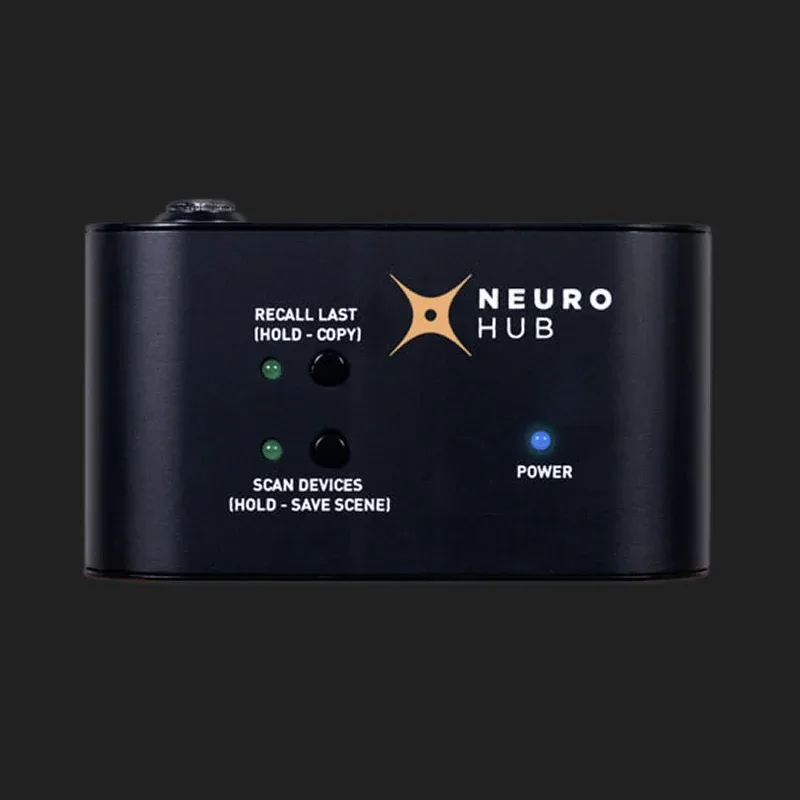
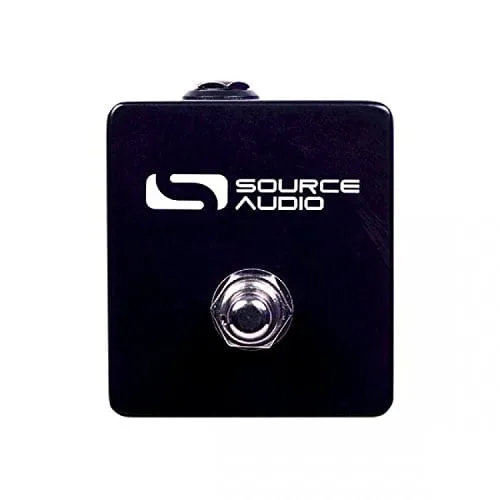
MIDI works two ways. Coupled with the Neuro Hub, the pedal has full MIDI capability with PC and CC messages6. MIDI control is also available through the single USB port, which you also use to interface with the desktop Neuro editor7. You can sync your tremolo rate with external MIDI clock messages6, and connect the Neuro Hub to any TRS (Tip Hot) expression pedal to manually control effect modulation or assign expression control to any adjustable parameter6. External tap tempo and tremolo engage/bypass are available with the Source Audio Tap Switch2.
At 165 mA6, the True Spring draws more current than a standard 100 mA power supply output, so check your pedalboard power supply before adding it.
The box includes the pedal, a Mini USB to USB-A cable, a USB-A to USB-C adapter and a quick reference card6. The enclosure is brushed anodized aluminum6, and Source Audio covers it with a 2 year warranty6.
What reviewers said
Reviews were positive across the board. MusicRadar's reasons to buy list included the authentic-sounding spring reverb, the Neuro app for deep editing, easily accessed presets, and having both effects in one relatively compact pedal5. Premier Guitar's reviewer called the tones superb and remarkable for the many ways the pedal manages authenticity, concluding that "the True Spring is a smart compromise between size, power, price, and functionality"7. At just less than 2 3/4" wide and about 4 1/2" long, the reviewer noted it is barely bigger than a Boss pedal7.
In Pete Thorn's demo video, he found the pedals in this series deceptively simple: simple on the surface and really easy to use, with exceptional sounds10.
Gearnews included the True Spring in a 2025 guide to the best spring reverb pedals, calling it a feature-rich digital spring reverb pedal that delivers authentic tube-style tones with modern flexibility, covering everything from subtle vintage bounce to deep, surf-ready wash8.
Videos
Premier Guitar
sourceaudioeffects
Questions
Is the Source Audio True Spring analog or digital?
It is digital. The True Spring is a digital spring reverb-modeling stompbox whose spring algorithm was adopted from Source Audio's Ventris Dual Reverb, and its tremolo effects were extracted from the company's Vertigo Tremolo circuit. The pedal is built specifically to deliver an authentic spring reverb sound.
Can you use the reverb and tremolo at the same time on the True Spring?
Yes. The pedal pairs spring reverb simulations with tremolo effects, and presets can store reverb, tremolo or combined sounds for instant recall. Press and hold the control input button to access the tremolo effects, which momentarily convert the Dwell and Tone knobs to tremolo depth and rate controls.
How much current does the True Spring draw?
Source Audio lists the True Spring's power consumption as 165 mA. That is more than a standard 100 mA output on many pedalboard power supplies will provide, so plan on a higher-current output when powering it.
Does the True Spring have true bypass?
It has Source Audio's Universal Bypass, which lets you select between high-quality signal relays for true bypass and transparent buffers for analog bypass. Reviewers also describe it as offering selectable true or buffered bypass.
Does the True Spring need the Neuro Hub for MIDI?
The pedal has full MIDI capability, including program change and CC messages, when coupled with the Neuro Hub. MIDI control is also possible through the pedal's single USB port, which is the same port used to interface with the desktop Neuro editor.
Sources (10)
- Source Audio debuts True Spring Reverb pedal, MusicRadar, 2018-10-05
- Source Audio Unveils the True Spring Reverb, Premier Guitar, 2018-10-02
- Source Audio True Spring Reverb, Delicious Audio, 2022-12-05
- Source Audio launches the True Spring Reverb, Guitar.com, 2018-10-03
- Source Audio True Spring Reverb pedal review, MusicRadar, 2019-01-09
- True Spring Reverb, Source Audio
- Source Audio True Spring Review, Premier Guitar, 2019-03-12
- Best Spring Reverb Pedals 2025: Sunny Sounds for Surf Rock and Skate Punk, gearnews.com, 2025-07-07
- Source Audio True Spring Reverb, Pedal of the Day, 2021-04-26
- THE BEST SPRING VERB IN A PEDAL I'VE HEARD, youtube.com, 2019-04-10