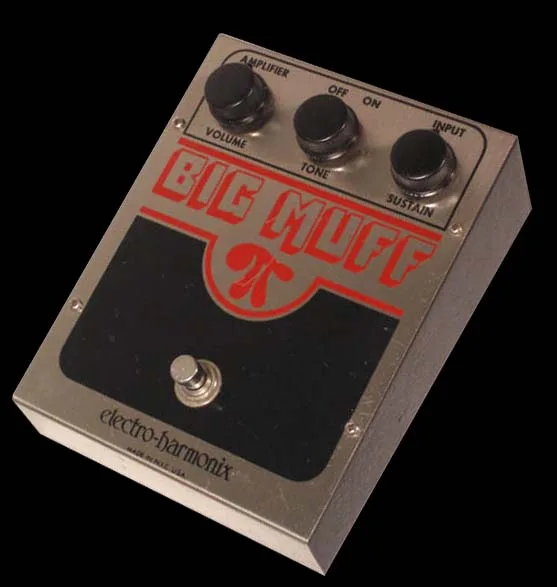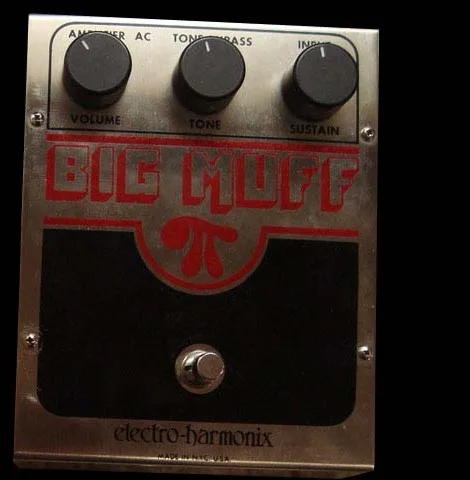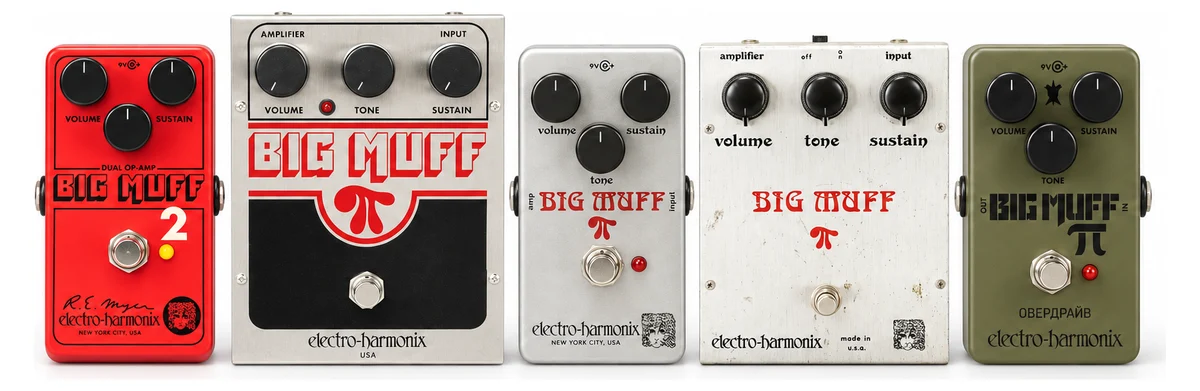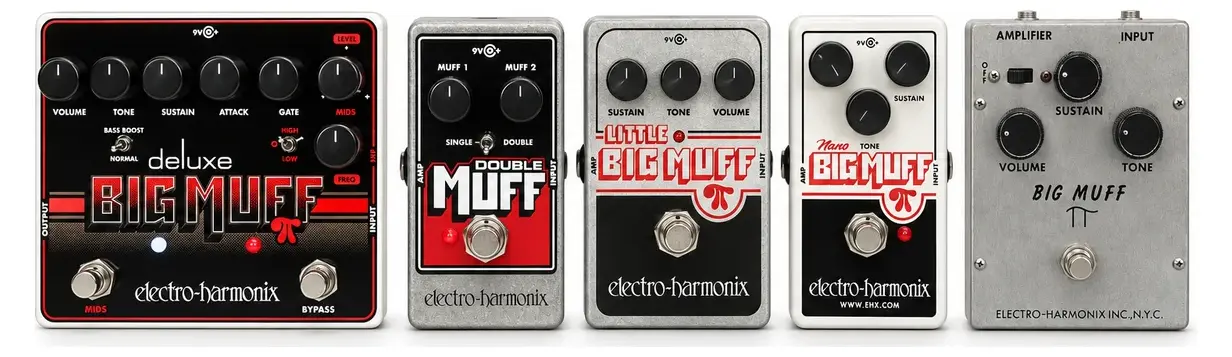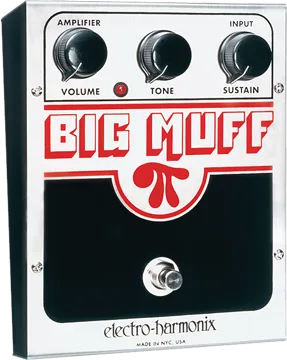


The Big Muff Pi is Electro-Harmonix's fuzz / distortion / sustainer pedal, first introduced in 1969 and in production ever since through many versions12. The pedal sold today as the Big Muff Pi is the New York City reissue, released in 2000 and in production since34. Electro-Harmonix describes it as delivering "crushing distortion" and "singing sustain with attitude," and says it has been "revered by contemporary guitarists and rock legends for its rich, creamy, violin-like sustain, from Pink Floyd to The White Stripes"3.
The original circuit was designed by Bob Myer and Mike Matthews in 1969 and mass produced in 197056. The 2000 reissue kept the classic four-transistor circuit: Analogman notes it "looks just like the old one from the late 70s and has the same sound with the classic 4 transistor circuit"7.
The NYC reissue of 2000 and its circuit variants
Electro-Harmonix began producing a US-made Big Muff in 2000, taking the graphics of the V3 "Red and Black" and adding an LED to the face8. The Stompbox Book's Derek See describes its tone as "similar to a '70s model but with more noticeable low end girth"8. The original circuit design is by Bob Myer, with V9 reissue circuit modifications by E-H engineer Fran Blanche4.
Kit Rae's history documents six circuit variants of the Version 9 NYC Classic, with model numbers EC3003 (2000), EC3003A (2000), EC3003B (2007), EC3003C (2008), EC3003D and EC3003E (2013)4. The changes a player might hear or notice:
| Year | Board | Change |
|---|---|---|
| 2000 | EC3003 | Four 2N5088 transistors; EHX switched to 1N6263 Silicon Schottky clipping diodes for the reissue4 |
| 2007 | EC3003-B | BC550C transistors4 |
| 2008 | EC3003-C | Volume pot changed to 500k logarithmic taper; tone and sustain pots remained 100k linear; EHX changed back to 1N4148 diodes around 20084 |
| 2013 | EC3003E | Sixth documented circuit variant4 |
Kit Rae notes the tone "is in the same family as the old version 6 Big Muffs from the early 1980s, though this is not actually a reissue of that version," and that the 2007-and-later revisions "have a thicker and bassier sound than the Rev A and B circuits, with less note clarity, but a thicker and heavier sound when playing chords"4. Early production was not true bypass, but after 2001 all USA Big Muffs were made true bypass4. Delicious Audio's buying guide calls the current NYC iteration "affordable, iconic, and the best-selling Muff of all time," with a sound that is "very smooth and versatile, lending itself equally well to garage rock, punk, and metal"9.
Special editions included a 2001 limited run silk-screened for the Scottish band Mogwai to promote their album Rock Action, and a 2010 tie-in with Premier Guitar's Pedal Issue1048.
Controls and circuit
The NYC Big Muff Pi has three knobs and one footswitch53:
| Control | What it does |
|---|---|
| Volume | Sets the output level3 |
| Sustain | Adjusts the amount of sustain and distortion3 |
| Tone | Provides a range of sounds from high treble to deep bass3 |
| Footswitch and status LED | Toggles between effect and bypass; the effect is active when the LED is lit3 |
The jacks are simple: an input jack for the audio input and an amplifier jack for the audio output3.
Under the hood, the typical Big Muff Pi circuit is made up of 46 components: 4 transistors, 22 resistors, 13 capacitors, 4 diodes, and 3 potentiometers11. The circuit is built in five stages: an input/gain stage, first clipping stage, second clipping stage, a tone stage, and an output stage11. What makes the circuit distinctive, in Kit Rae's analysis, is "two nearly identical clipping sections in a row, one clipping an already distorted signal, and subtle changes in capacitor and resistor values to smooth out and tame that signal"12. The four silicon diodes clip the signal back to back in symmetric pairs, and the output signal never exceeds about plus or minus 0.6V5.
The tone stage is where the Muff gets its character. The signal splits into a high pass and a low pass filter, blended back together by the tone potentiometer, which introduces a mid-frequency scoop at 1KHz at its mid position511. Kit Rae notes that every Big Muff Pi circuit variant since 1969 has had a scooped mids sound12. The circuit's input impedance is about 39K, which GuitarPCB's analysis calls low enough that the guitar signal might suffer some loss of high frequencies, compensated by the rest of the circuit5. Delicious Audio adds that the Big Muff has a higher impedance than the Fuzz Face and Tone Bender, so the guitar's volume knob has less effect on the fuzz character9.
Little Big Muff π
The Little Big Muff Pi, released in 2006, is the same circuit in a smaller box. Electro-Harmonix says it "took the classic Big Muff circuit and simply shrunk it without any change to the sweet violin-like sustaining sound"13. It measures 4.75 x 4 x 2.25 inches, draws 4mA, and lists at $83.5013. Kit Rae describes it as sounding "very similar to the NYC reissue V9 described above, but a bit brighter and a bit less bottom end to the sound"4.
MusicRadar reviewed it positively, with the verdict: "Textbook Big Muff sound in spades. Practical upgrades inspire confidence. Smaller footprint"14. The review found the tone control's position critical, with "a vast sweep and a huge impact on where the sound sits in the mix," and noted that past halfway on the sustain knob, players should not expect much transparency or natural instrument character to come through14. On pickups: "Single-coil pickups appeal to the trashier side of the Little Big Muff's nature, while humbuckers deliver the cream"14. The review also flagged one practical drawback: the die-cast housing lacks an access hatch for battery changes, so you have to unscrew the back14.
MusicRadar's reviewer found the Little Big Muff delivered the goods whatever guitar it was paired with, writing that "the Little Big Muff does the business whether you're playing a £3,000 custom build or a scrag end of plywood"14.
An earlier pedal with the same name existed in the late '70s, in a Small Clone-sized enclosure with a single volume control and a two-way tone slider switch, with a milder level of distortion14.
Nano Big Muff π
The Nano Big Muff Pi, released in 2013, packs the circuit into the smallest BMP enclosure to date1512. Electro-Harmonix says it "works and sounds identical in every way to our classic NYC Big Muff Pi," having taken "the Big Muff Pi circuit and simply shrunk it"15. It carries the standard volume, tone and sustain controls, measures 4.5 x 2.75 x 2.1 inches, draws 3mA, and lists at $87.1012153. Kit Rae notes the circuit uses through-hole transistors, capacitors and diodes with surface-mount resistors to fit the smaller board12.
Power and connections
All three current three-knob Muffs run on a 9V battery (included) or an optional 9.6VDC adapter (not included)31315. The Little Big Muff and Nano use a standard barrel socket with negative tip polarity, taking standard Boss-type adaptors414.
The full-size NYC Big Muff Pi is different: its power jack takes a 1/8" (3.5mm) plug with tip positive, the reverse polarity of typical pedals. Kit Rae advises using an E-H power supply or a converter adaptor4.
Price
| Version | List price (USD) | Dimensions (in) | Released |
|---|---|---|---|
| Big Muff Pi (NYC) | $101.603 | 5.5 x 2.95 x 6.883 | 20003 |
| Little Big Muff Pi | $83.5013 | 4.75 x 4 x 2.2513 | 200613 |
| Nano Big Muff Pi | $87.103 | 4.5 x 2.75 x 2.115 | 201315 |
| Deluxe Big Muff Pi | $150.6016 | 5.75 x 4.75 x 2.516 | 201416 |
For historical context, a handmade Big Muff Pi cost $39.00 in 197017.
The Deluxe Big Muff π
The Deluxe Big Muff Pi, introduced in 2014, "delivers all the classic sounds of the original NYC Big Muff Pi, plus more"168. It adds a Bass Boost, a Noise Gate, and a footswitchable Mids section that boosts or cuts up to +/- 10dB at an adjustable frequency16. An expression pedal input lets you sweep the mids center frequency with your foot16. It draws 22mA and includes a 9V battery16. Kit Rae's assessment of the midrange controls: "Not only do these midrange controls surpass practically anything that has come before, but you can now make a Big Muff sound good on just about any amplifier"12.
Who uses it
Documented Big Muff players span five decades:
- David Gilmour of Pink Floyd used the Ram's Head Big Muff, and it was his go-to fuzz unit for the majority of his career118. Kit Rae spent time replicating Gilmour's various tones on the Deluxe with "very good success"12.
- Jack White used the early 2000s NYC reissue on the White Stripes albums9.
- J Mascis used a 1980s Deluxe Big Muff Pi on the debut album by Dinosaur Jr10.
The Big Muff Pi celebrated its 50 year anniversary in 20198.
Videos
ProGuitarShopDemos
EHX
News
Questions
Is the Big Muff π true bypass?
Yes. The current NYC Big Muff Pi lists true bypass, as do the Little Big Muff Pi, the Nano Big Muff Pi and the Deluxe Big Muff Pi. Early production of the 2000 NYC reissue was not true bypass, but according to Kit Rae's history of the pedal, after 2001 all USA Big Muffs were made true bypass.
What is the difference between the Big Muff π, the Little Big Muff and the Nano Big Muff?
The circuit is the point of common ground: Electro-Harmonix says the Little and Nano versions use the Big Muff Pi circuit shrunk into smaller boxes. The full-size NYC pedal measures 5.5 x 2.95 x 6.88 inches, the Little Big Muff 4.75 x 4 x 2.25 inches, and the Nano 4.5 x 2.75 x 2.1 inches. Kit Rae notes the Little Big Muff sounds very similar to the NYC reissue but a bit brighter with a bit less bottom end.
What does the Deluxe Big Muff π add?
The Deluxe Big Muff Pi, released in 2014, keeps the NYC Big Muff Pi sound and adds a Bass Boost, a Noise Gate, and a footswitchable Mids section that boosts or cuts up to +/- 10dB at an adjustable frequency. It also has an expression pedal input for sweeping the mids frequency with your foot.
Where is the Big Muff π made?
The NYC Big Muff Pi is assembled and tested in Long Island City, New York, USA, according to Kit Rae's history of the pedal. The same is documented for the Nano Big Muff Pi and the Deluxe Big Muff Pi.
Sources (18)
- Electro Harmonix and the Big Muff, tru-fi.com, 1990
- CRIMSON - JHS Pedals, JHS Pedals
- Big Muff Pi, Electro-Harmonix (www.ehx.com)
- The Big Muff History of All Versions 3, kitrae.net, 2017-03
- Big Muff Pi Analysis, GuitarPCB
- Big Muff Versions_Quick Identifier, Kit Rae (kitrae.net), 2026
- aNaLoG.MaN Guitar Effects Electro-Harmonix pedals, analogman.com, 2024
- Big Muff Pi, Stompbox Book, 2020-03-21
- Best Big Muff Pedals In 2025: Reissues, Clones & Evolutions, Delicious Audio, 2025-04-07
- A Fuzz and Muff pedal Timeline, Kit Rae (kitrae.net), 2014-07
- BIG MUFF TRANSISTORS AND OTHER COMPONENTS, Kit Rae (kitrae.net), 2012-07
- The Big Muff History of All Versions 3, Kit Rae (kitrae.net), 2017-09
- Little Big Muff Pi, Electro-Harmonix (ehx.com)
- Electro-Harmonix Little Big Muff Pi review, MusicRadar, 2008-01-03
- Nano Big Muff Pi, Electro-Harmonix
- Deluxe Big Muff Pi, Electro-Harmonix (ehx.com)
- FAQ #8: Why should I buy a $200 distortion pedal?, Caroline Guitar Company, 2011-01-19
- Iron Bell, MojoHandFX
 J Mascis