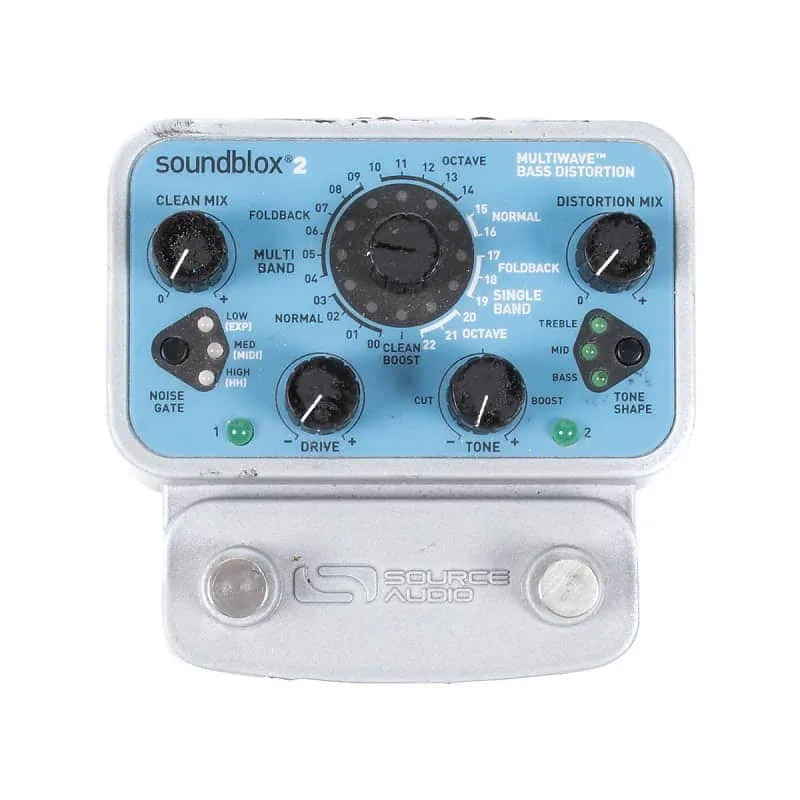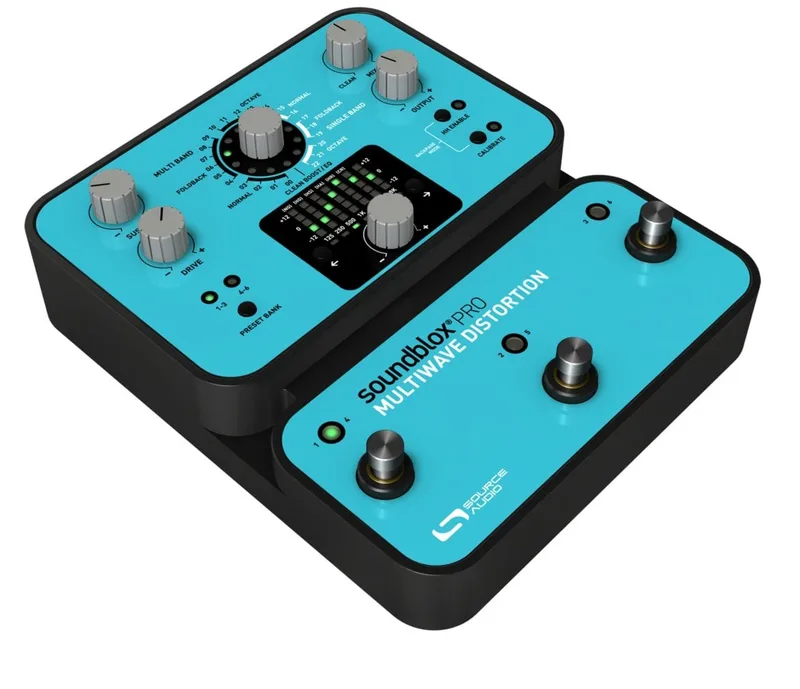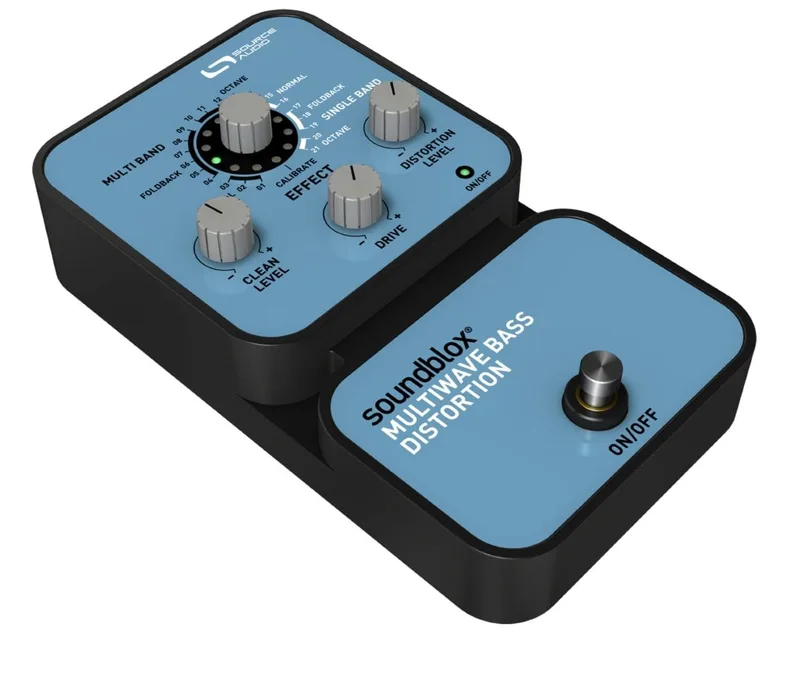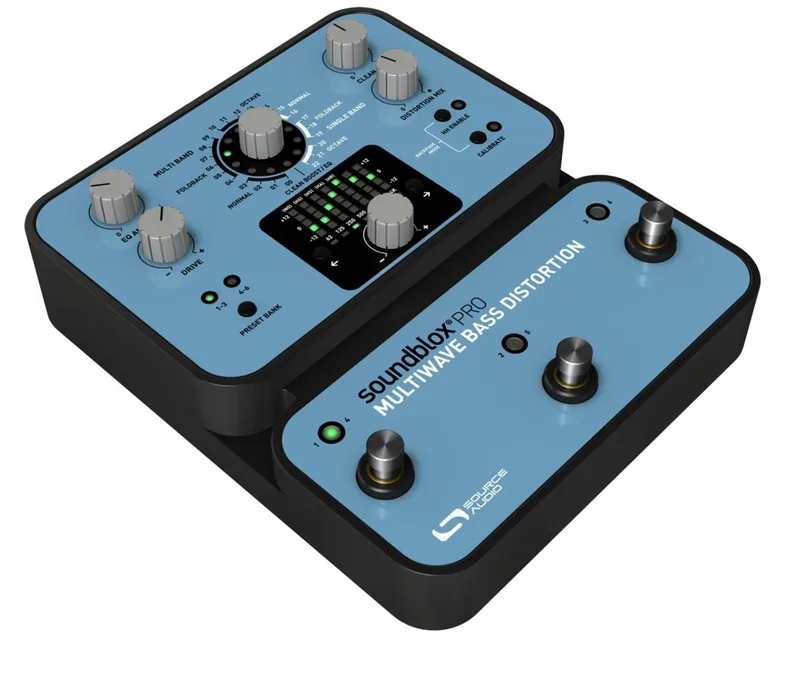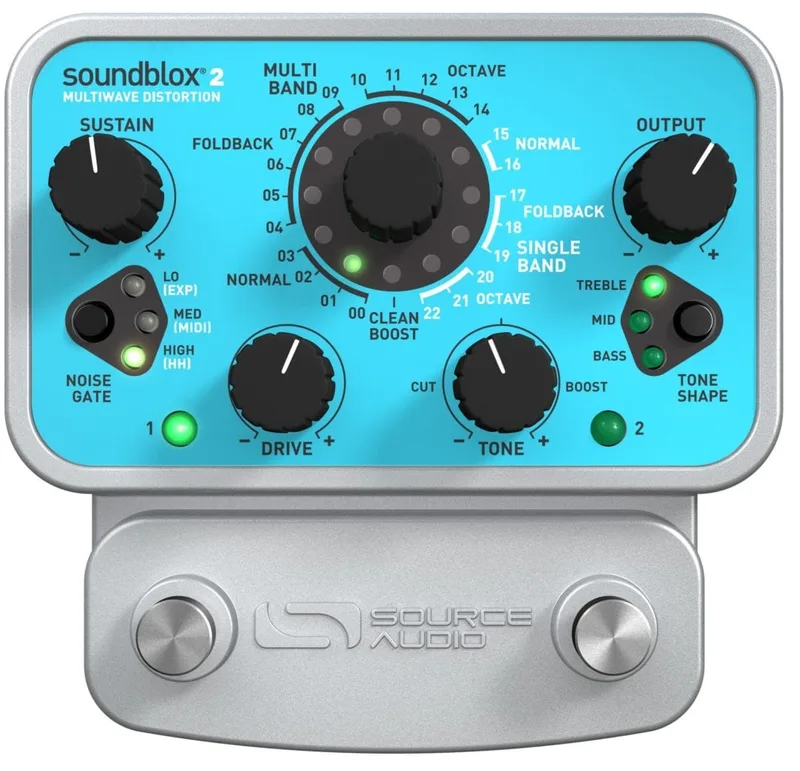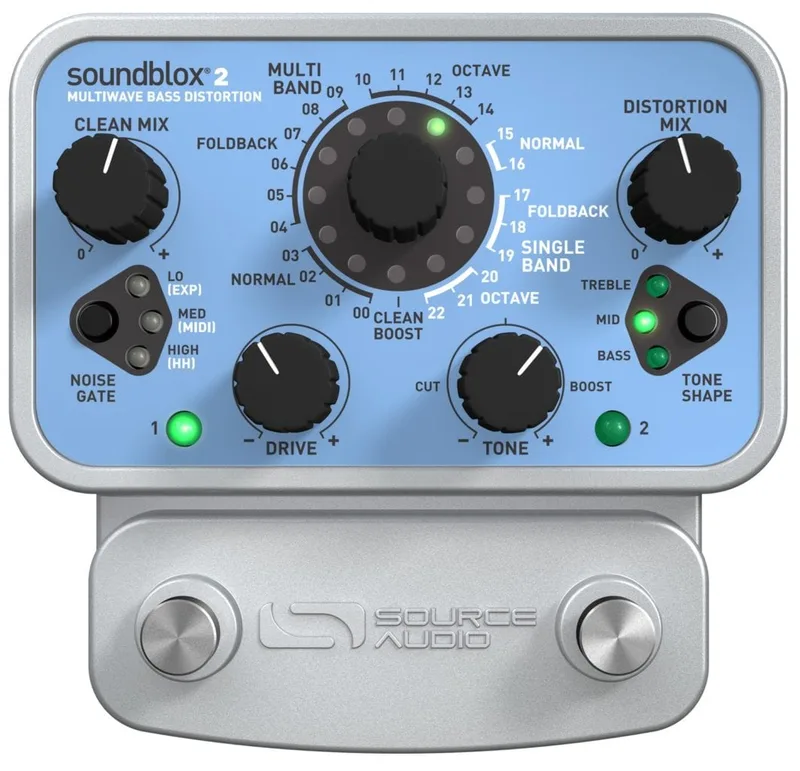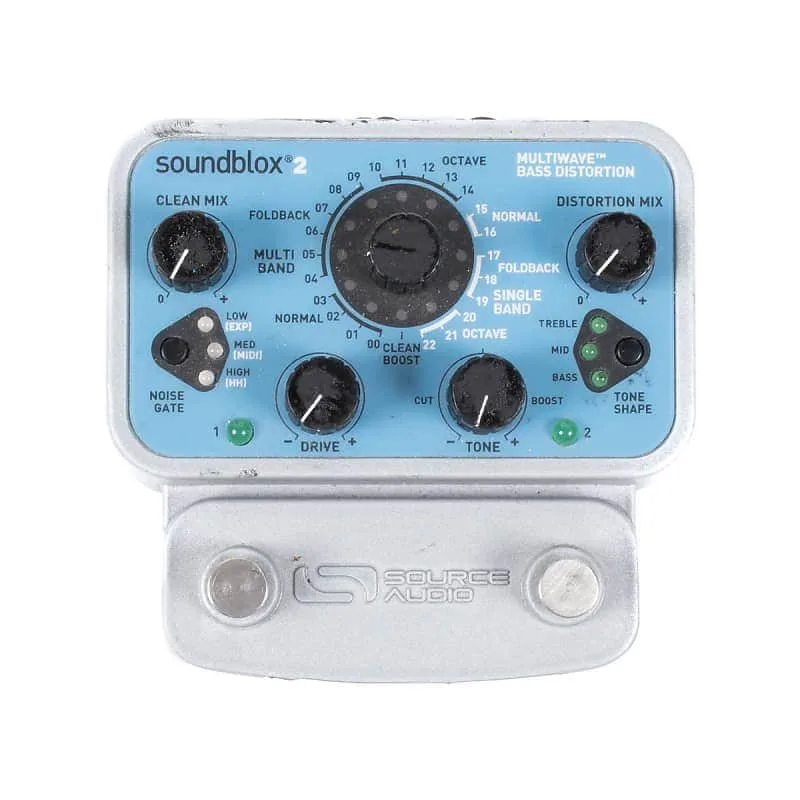


The Source Audio Multiwave Distortion is a distortion pedal from Source Audio built around one central idea: instead of distorting the whole guitar signal at once, it divides the input into multiple frequency bands, distorts each band separately, and then recombines the signal1. The payoff is clarity. Premier Guitar's reviewer found the result to be "a distorted guitar tone with an incredible amount of clarity between the notes," and reported pulling off a complex G7b13+9 chord through distortion with clarity that single-band pedals typically turn to mush1.
The pedal arrived in 2008 as part of Source Audio's Soundblox line, giving guitarists what the company's press release called "21 truly unique and modern distortion effects"2. It was later expanded into a Pro version with MIDI and a bass version, and the Soundblox 2 line went on to repackage the Multiwave Distortion in guitar and bass models34.
What the Multiwave Distortion does
Multiband processing is the whole point of this pedal. The technique divides a signal into multiple bands and then distorts them individually, which gives musicians more clarity and articulation than distorting everything together5. In the original pedal's Multi-Band mode, the input signal is split into several frequency bands, distorted separately, and then recombined3.
The bass version takes the same approach further, dividing the input into ten frequency bands, distorting each one, and recombining them8. Premier Guitar's Rebecca Dirks described the range of distortion types as running "from normal, for a somewhat traditional distortion curve, to extreme foldback and octave settings for more aggressive and synth-like tones"3.
Because the bands are processed separately, the pedal addresses a problem familiar to any player who has pushed a conventional distortion pedal hard: complex chords collapsing into mush. Premier Guitar's reviewer put it directly138:
"The Multiwave Distortion definitely solves that problem. I pulled off a complex G7b13+9 chord through distortion with unbelievable clarity."
Delicious Audio's reviewers noted that this multiband approach is a technique "that would only be available in the digital domain," which is why the Multiwave line is a DSP pedal rather than an analog circuit9.
The versions: Soundblox, Pro, and Soundblox 2
The Multiwave Distortion appeared in several forms over its life, and the differences matter if you are comparing used units or older listings10411.
| Version | Effect types | Notable features |
|---|---|---|
| Soundblox Multiwave Distortion (guitar) | 212 | Sustain, Drive, Output, Effect Selection controls1 |
| Soundblox Multiwave Bass Distortion | 233 | Parallel dry blend, adapted to bass frequencies83 |
| Soundblox Pro Multiwave Distortion | 235 | MIDI input for external access to presets and parameters5 |
| Soundblox Pro Multiwave Bass Distortion | 235 | MIDI capabilities, multiband processing for bass5 |
| Soundblox 2 Multiwave Distortion | 236 | MIDI capable, Tone Shape button, 3-band tone control6 |
| Soundblox 2 Multiwave Bass Distortion | 234 | 56-bit digital processor, 3-band tone shaping4 |
The Pro versions add the programming layer. A MIDI input allows external access to presets and parameters, and the Soundblox Pro Multiwave Distortion is described as a MIDI-enabled distortion pedal5. The standard Soundblox Multiwave Bass Distortion is the same pedal without the programming abilities11.
The Soundblox 2 version: tone shaping, presets and MIDI
The Soundblox 2 Multiwave Distortion keeps the front panel simple. Performer Mag's Chris Devine described the controls as "Drive, Voice, Tone, and Output," backed by a 3-band tone control7. Each of the 23 distortion algorithms is further customizable via the drive control3.
Two features set it apart from a basic multiband pedal:
- Tone Shape: a button that "allows more customization of the tones at the touch of button," in Devine's description7.
- Morphing with an expression pedal: the player can pan between two different modes of their choosing to get a unique blend of the two at the same time6.
The pedal is also MIDI capable, with Performer Mag describing it as "MIDI Capable State-of-the-art DSP"7. For players building a rig around MIDI pedals, that puts preset switching and parameter control within reach of a larger board setup.
On the bass side, Premier Guitar's reviewer found the Soundblox 2 Multiwave Bass Distortion to be "an excellent tool for adding grind and grit to your bass tone, with more than enough sonic options to carve a place in a rock or metal band's mix," listing "tons of range, great response" among its strengths and noting that "multi-band modes are just the ticket for keeping even the wildest distortions tight and crisp"4. The same reviewer found the multi-band modes "possessed wider, more 3-D qualities that greatly helped the overdriven tones' low end and midrange even after piling on large amounts of gain"4.
Guitar versus bass versions
The guitar and bass pedals share the same multi-band process, but the bass version is adapted to the bass guitar's frequency range3. That adaptation matters, because low-end reduction is a known weakness of most bass distortion units, and the bass pedal's sound control is designed to alleviate it3.
The bass version also adds the ability to mix the direct bass signal in parallel with the distorted signal8, a feature MusicPlayers.com's John Montalbano highlighted in his review. He described the pedal as "a well-built stomp box with plenty of dirty distortions, subtle overdrives, and edgy synth-like tones," though he also noted a limitation: "We would have liked to have more control over the presets in order to experiment more with creative bass distortion sounds"8.
What reviewers said
Published reviews of the line were largely positive, with the clarity of the multiband approach as the recurring theme14:
- Premier Guitar: complex chords stay clear under high distortion; the pedal solves the mush problem1.
- Performer Mag: "PROS: Good selection of distortions, flexible controls," and Source Audio "has brought all the plusses of programmable distortion with the simplicity of a stompbox"7.
- Premier Guitar on the Soundblox 2 bass version: excellent for grind and grit, with multi-band modes keeping wild distortions tight4.
- MusicPlayers.com: well built with a wide tonal range, but preset editing could go deeper8.
The Multiwave line's ideas carried forward in Source Audio's later pedals, including the Soundblox 2 OFD and the Ultrawave multiband processors, and the AfterShock Bass Distortion for bass players.
Videos
sourceaudioeffects
sourceaudioeffects
Leon Todd
Questions
Does the Source Audio Multiwave Distortion have MIDI control?
The Soundblox Pro Multiwave Distortion is a MIDI-enabled pedal, with a MIDI input that allows external access to presets and parameters. The Soundblox 2 Multiwave Distortion is also described as MIDI capable. The standard Soundblox Multiwave Distortion does not carry the Pro version's programming abilities.
How many distortion types does the Soundblox Multiwave Distortion have?
The original Soundblox Multiwave Distortion gives guitarists 21 distortion effects. The Soundblox Pro Multiwave Distortion and the Soundblox 2 Multiwave Distortion both offer 23 effect types, each further customizable with the drive control.
What is the difference between the guitar and bass Multiwave Distortion?
Both use the same multiband process, but the bass version is adapted to the bass guitar's frequency range and adds the ability to mix your direct bass signal in parallel with the distorted signal, which counters the low-end loss common to bass distortion units.
Is the Multiwave Distortion a digital pedal?
Yes. The Soundblox 2 Multiwave Bass Distortion generates its effects with a 56-bit digital processor, and reviewers note that multiband distortion is a technique that would only be available in the digital domain.
Sources (11)
- Review: Source Audio Soundblox Multiwave Distortion, Premier Guitar, 2008-08-06
- Source Audio's New Soundblox Pedals, Premier Guitar, 2008-01-14
- NAMM-Source Audio Multiwave Distortion Demo & More, Premier Guitar, 2010-02-18
- Soundblox 2 Multiwave Bass Distortion Pedal Review, Premier Guitar, 2012-09-05
- Source Audio Unveils Soundblox Pro Pedals at NAMM 2010, Premier Guitar, 2010-01-06
- Source Audio SoundBlox 2 Multiwave Distortion Pedal Review, Performer Mag, 2014-11-20
- Source Audio SoundBlox 2 Multiwave Distortion Pedal Review, Performer Mag, 2014-12-03
- Source Audio Soundblox Multiwave Bass Distortion Pedal, MusicPlayers.com, 2011-08-11
- Review: Audio Source Multiwave Bass Distortion, Delicious Audio, 2012-07-22
- NAMM 2012: Source Audio to release Soundblox 2 line of guitar, bass effects | MusicRadar, MusicRadar, 2012-01-15
- Gear Watch: Soundblox Pro Multiwave Bass Distortion Pedal, No Treble, 2010-01-12