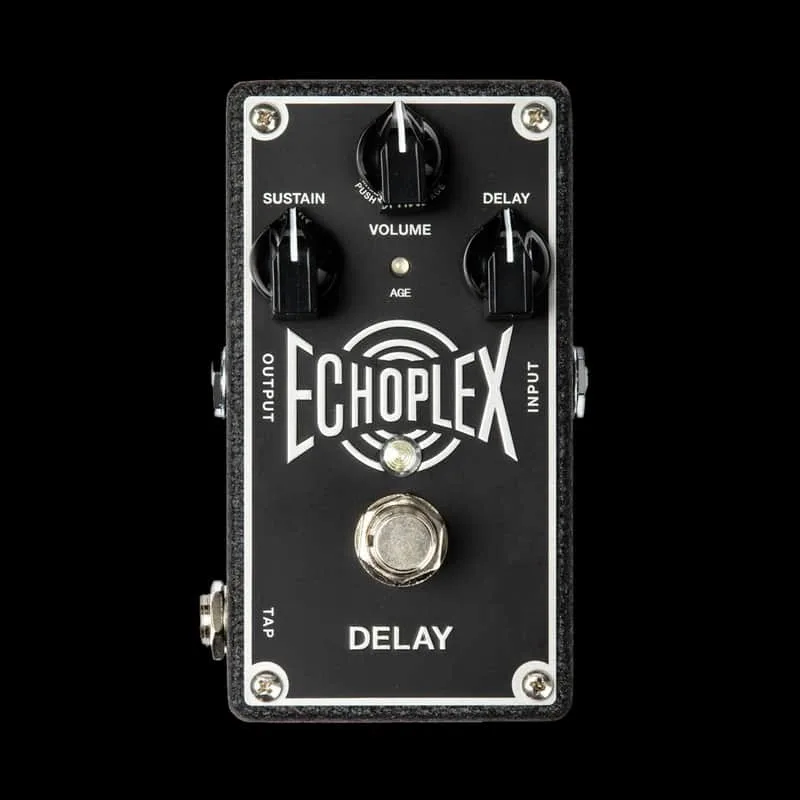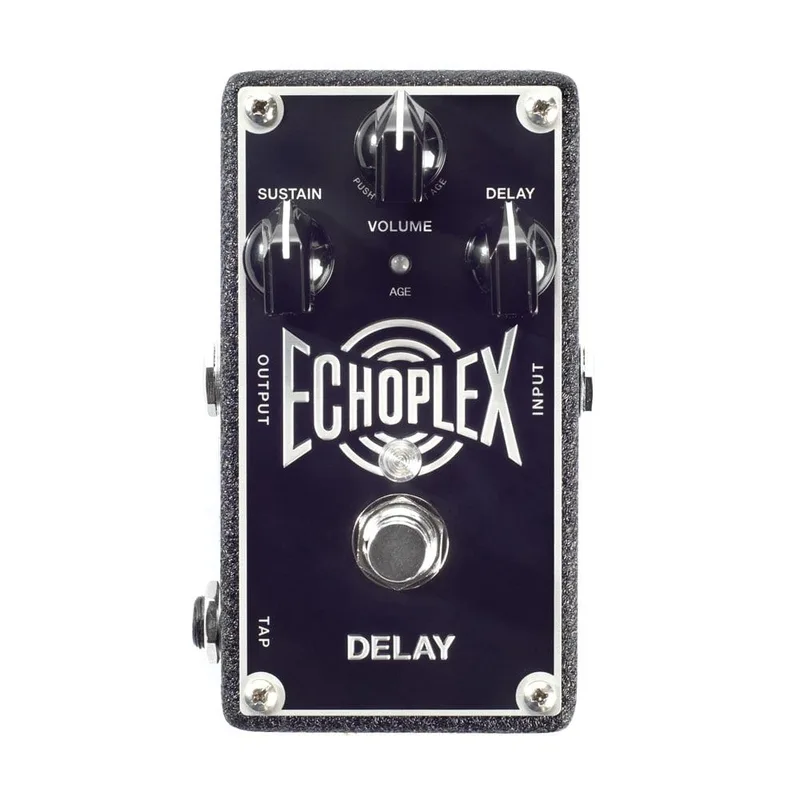


The Dunlop Echoplex Delay, sold as the EP103, is a compact delay pedal that recreates the echo effects and controls of the original Maestro Echoplex EP-3 tape echo unit in a housing the size of a Phase 901. Dunlop describes it as delivering "Vintage Echoplex EP-3 tape echo warmth and modulation"2, and it adds features the tape machine never had: an Age mode that simulates a worn machine, selectable stereo or mono operation, an optional tap tempo control, and true bypass or trails bypass modes1.
Where an original Echoplex needs tape, motors and maintenance, MusicRadar's reviewer found that "Dunlop's offering gives you a delay experience that's similar to an original without any of the maintenance issues - plus it will fit on your pedalboard"3.
The controls and the Age setting
The EP103 keeps the control layout of the tape original: three knobs, echoing the EP-1's separate echo volume, instrument volume and repeats controls plus its movable head67. Here is what each one does:
| Control | What it does |
|---|---|
| Delay | Sets the delay time, 65 to 750 ms per the manual (Guitar World's review quotes 40 to 750 milliseconds)21 |
| Sustain | Sets the number of repeats4 |
| Volume | Sets output level; hold it for 2 seconds to enter Age mode4 |
The Age parameter is the pedal's signature feature. Brought in and out by a press on the Volume knob, it is designed to emulate sonic artifacts reflecting the idiosyncrasies of tape echoes3. In use, it dials in darker, warmer tones and increased "wow and flutter" modulation that replicates the sound of worn-out tape, and your final setting can be locked in and recalled by pressing the Volume control1. Premier Guitar's reviewer found that activating Age mode "darkens the repeats, adds cool coloration, and at times even seems to lend randomness to the modulation"5.
By contrast, the standard mode does what MusicRadar called "a pretty good impression of a tape echo in good working order with new tape," while the degrees of Age replicate a machine that may have issues and tape that's well-worn3. Delicious Audio put it simply: "The tiny 'Age' control makes the repeats increasingly degraded"7.
The pedal also has a Wet mode, selectable via a startup mode procedure, that sends only the wet signal to your amplifier2, and it can store advanced mode settings using a knob setting and pressing procedure1. An internal STEREO/MONO switch toggles stereo or mono input functionality2.
Getting four seconds of delay
On its own, the Delay knob covers 65 to 750 ms2. Pedal of the Day described the same extension via "the Tap Tempo jack and M199 switch"4. Guitar World's tape echo buying guide also notes the tap tempo option lets you sync your delay without any fuss8.
Analog, digital, and the preamp question
The EP103 is a digital pedal. Stompbox Book describes it as "a digital one, but reviews praised it for how close its sound hews to the classic EP-3"9, and Guitar World's buying guide lists its type as analog/digital8 because the dry path is analog: the EP103 features an all-analog, hi-fi dry signal path for a clean bypassed signal4. The delay circuit itself samples at 96 kHz2, with a noise floor of -107 dBV2, 1 MΩ input impedance and 100 Ω output impedance2.
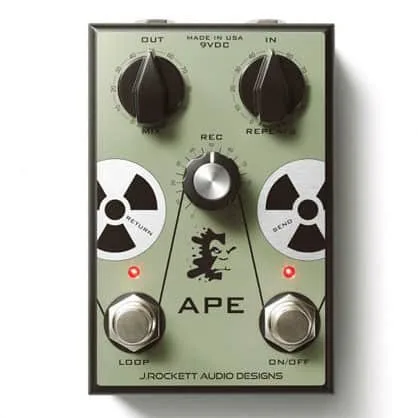
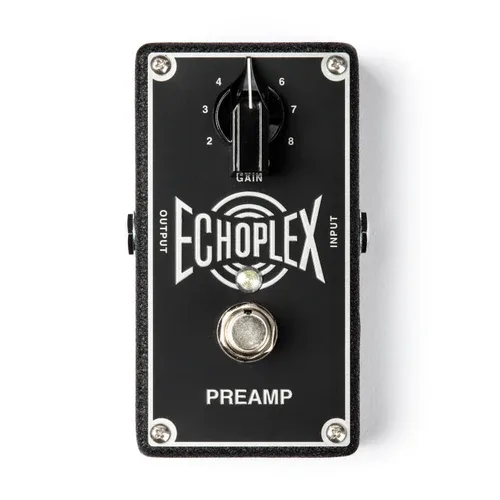
The pedal does not include the EP-3's famous preamp as a separate feature. Dunlop sells that circuit on its own as the EP101 Echoplex Preamp, which recreates the EP-3's front end with a Field-effect Transistor (FET) just like the original, following the exact same signal path, with a Gain control for up to +11 dB of boost10. Guitar World's review of the EP103 notes that most guitarists preferred the EP-3 for its preamp, quiet performance, and a delay signal that was cleaner and brighter than the tube echo units1. Players who want that front-end character in front of a digital delay can also look at the J. Rockett Audio Designs A.P.E. Echoplex EP3 Preamp, which puts the EP3 preamp in a pedal with a loop for your delay11.
History: from the tape Echoplex to the EP103
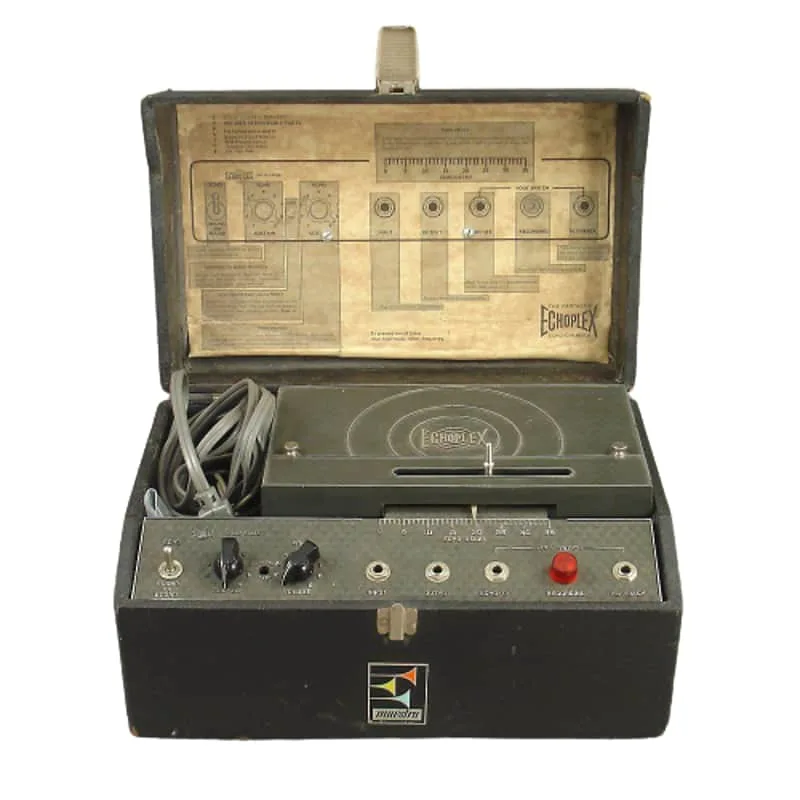
The original Echoplex was a tape delay effect designed in 1959, the brainchild of Mike Battle, who honed his engineering skills building crystal sets and repairing radios as a kid and later worked in the military as a tech for remote-controlled target planes9. The patent went in Battle's name12, and the early cases and metal parts were built by Battle's brother John, a die maker, in his basement13. The machine used about 180 parts, with motors bought 5,000 at a time to get a good price12.
The Echoplex is essentially a tape machine with two playback heads, one that repeats milliseconds after the first9, and it was the first stand-alone delay effect for guitar9. Versions included the EP-1, EP-2 and EP-3, with the two earliest housed in what looks like an old tool box9. The solid-state Maestro EP-3 that emerged in 1970 became the definitive delay for many players, showcased by Eddie Van Halen, Joe Walsh, Brian May, Jimmy Page, Andy Summers and David Gilmour14. Users ran from Jimmy Page, Brian May, Duane Allman and Eddie Van Halen15 to Miles Davis, who used it on his trumpet as part of the technology infusion on "Bitches Brew"9. Many guitarists, including Eddie Van Halen and Jimmy Page, used the Echoplex for its tone-enhancing abilities as much as for its echo effects16. Vintage Guitar wrote that the Echoplex "has become the standard by which everything else is measured"13. Assembly lines halted with the last solid-state version, and Echoplex is now a Dunlop trademark, with the company offering preamp and echo stompboxes1317.
On That Pedal Show, Dan and Mick opened up an original unit to show how it works: "I take this lid off you will see a lovely tape spool going around we've got the Record Head we've got the erase head and the playback head and it sets up an echo using actual magnetic tape real tape"18.
Guitar World's buying guide notes the EP103 "is brought to you by Dunlop/MXR and is just about as simple as tape echo is ever going to get"8.
What reviewers said
Reviews across the press were positive about how close the EP103 gets to the tape original:
- Guitar World: "Most digital emulations of this effect sound comparatively flat, but the EP103 absolutely nails the EP-3's unique character"1. The review also found the Age mode "replicates the warm sound and chorus-like wow and flutter of aged tape to provide truly accurate analog tape tones"1.
- MusicRadar: "The Echoplex's authentic vibes are hugely addictive, and once you've played with it, you may struggle to play without..."3. The review lists "Classic tone without the maintenance issues" as a reason to buy and "Not for you if you're after esoteric delays" as a reason to avoid3.
- Delicious Audio: "Loved by many, this is one of the best-sounding delay pedals on the market," while noting it has trouble with some third-party power supplies7.
- Pedal of the Day: "The wow-and-flutter of the Age mode really makes this thing sing, and captures those special and hard-to-achieve tones very easily"4, and the pedal "can even run the Inputs and Outputs in STEREO, for a really versatile, option-filled effect"4.
Pedal of the Day also noted the pedal comes with Constant Headroom Technology, providing a full 20 volts of headroom4, and that it covers ground from "dark, brooding repeats" to "bright, clear delay tones, and a mix of everything in between"4.
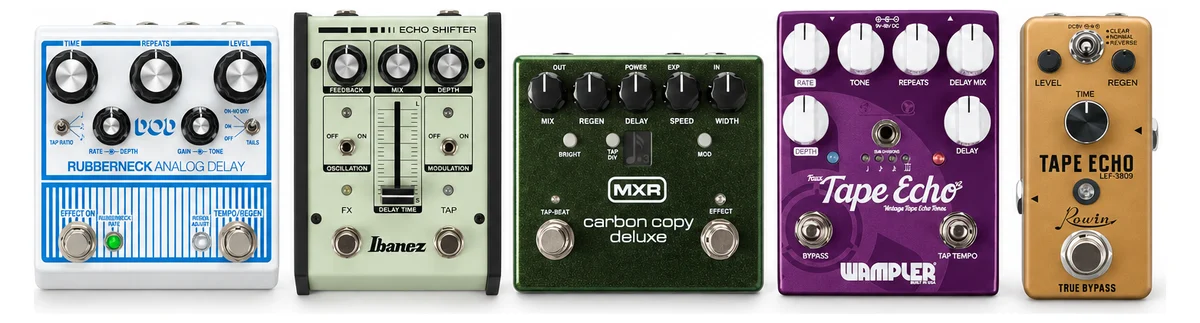
For players comparing delay pedals, the EP103 sits among several Echoplex-derived options, from Dunlop's own EP101 preamp to J. Rockett's APE, all chasing the same 1970 tape machine10719.
Videos
ProGuitarShopDemos
Guitar World
Sweetwater
News
Questions
What is the delay time of the Dunlop Echoplex Delay?
The Delay knob gives you 65 to 750 ms of delay time on its own, which Dunlop's manual states as the pedal's range. Guitar World's review of the pedal quoted a slightly wider range of 40 to 750 milliseconds. With Dunlop's optional tap tempo footswitch plugged into the Tap jack, the maximum delay time extends to four seconds.
How do you get four seconds of delay from the EP103?
You plug Dunlop's optional tap tempo switch, the MXR M199, into the pedal's Tap jack. With the stock Delay knob the range tops out at 750 ms, but the tap tempo switch extends the maximum delay time to four seconds. The switch is sold separately and does not ship with the pedal.
Who invented the original Echoplex?
The Echoplex was designed in 1959 and is the brainchild of Mike Battle, who developed his engineering skills building crystal sets and repairing radios as a kid, and later as a military tech for remote-controlled target planes. Don Dixon worked with Battle for about three years to get the design right, and the patent was put in Battle's name.
Does the Echoplex Delay pedal include the Echoplex preamp?
The EP103 is a delay pedal, not a preamp pedal. Dunlop sells the EP-3's preamp circuit separately as the EP101 Echoplex Preamp, a FET-based pedal that follows the same signal path as the EP-3's front end and offers up to +11 dB of gain. Guitar World's review notes the EP103 offers the same echo effects and controls as the original EP-3.
Is the Dunlop EP103 analog or digital?
The EP103 is a digital delay. Stompbox Book describes it as a digital pedal whose sound hews close to the classic EP-3, and Guitar World's tape echo buying guide lists its type as analog/digital because the dry signal path is all analog. The wet, echoed signal is digital, running at a 96 kHz sampling rate.
Is the Dunlop EP103 Echoplex analog or digital?
It is digital, with an all-analog dry signal path that keeps your bypassed signal clean. The delay circuit samples at 96 kHz, and reviewers praised it for how closely its digital repeats match the character of the original tape machine. Dunlop's separate EP101 Echoplex Preamp is a fully analog FET circuit.
Sources (19)
- Review: Dunlop EP103 Echoplex Delay Pedal, Guitar World, 2016-09-07
- EP103.pdf, Dunlop Manufacturing, Inc., 2019
- Dunlop Echoplex Delay review, MusicRadar, 2016-10-13
- Dunlop Electronics EP103 Echoplex® Delay, Pedal of the Day, 2018-01-19
- MXR EP103 Echoplex Delay Review, Premier Guitar, 2017-01-16
- Echoplex, Vintage Guitar magazine, 2004-12-07
- The 3 Best Delay Pedals Per Type, In 2023, Delicious Audio (delicious-audio.com), 2023-08-25
- Best tape echo pedals: Nail the warm sound of tape delay, Guitar World, 2023-02-07
- Echoplex, Stompbox Book (stompboxbook.com), 2019-03-03
- ECHOPLEX® PREAMP, Dunlop (jimdunlop.com)
- J. Rockett Audio Designs A.P.E. Echoplex EP3 Preamp, Delicious Audio, 2020-07-14
- Echoplex, Part I: Pre-Echoplex Days, Vintage Guitar magazine, 2004-07-08
- Echoplex EP-2, Vintage Guitar magazine, 2015-02-17
- Universal Audio UAFX Orion Tape Echo Delay pedal review, MusicRadar, 2023-10-28
- Gibson revives legendary Maestro pedals brand with five new stompboxes, including the Fuzz-Tone FZ-M, MusicRadar, 2022-01-18
- Why Tape Delay Goes in Front of Your Amp, Guitar World, 2018-08-15
- J. Rockett Audio wants to give your delay a vintage makeover with the APE delay preamp, Guitar World, 2019-11-26
- That Pedal Show, That Pedal Show (YouTube), 2016-02-05
- Axion JFET Preamp / Echoplex EP-3 Preamp, Aion FX, 2025-03-28