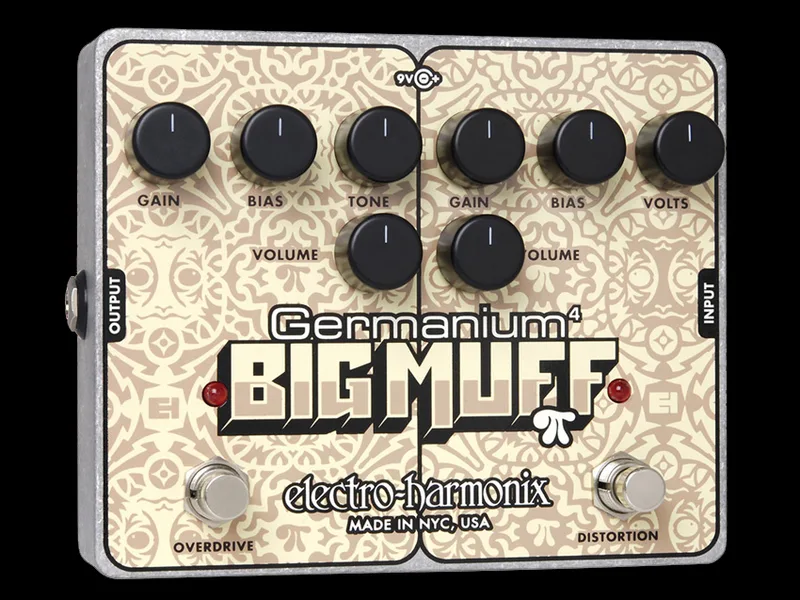


The Germanium 4 Big Muff Pi is a distortion and overdrive pedal from Electro-Harmonix, released in 2010 and discontinued in 20241. It is effectively two pedals in one enclosure: an Overdrive side and a Distortion side, each built on its own pair of N.O.S. NKT275 germanium transistors, each with its own true-bypass footswitch and controls231. The two sides can be used independently or stacked in series, and when both are engaged all four germanium transistors come into play4.
Electro-Harmonix announced it as a return to "the warm sound unique to the germanium transistors of the 1960s" with "modern control and power"5. It was unveiled at Summer NAMM 2010 in Nashville5.
The Germanium 4 Big Muff Pi was discontinued in 20241. It is no longer in the Electro-Harmonix lineup, so it is found on the used market.
Two germanium circuits: overdrive and distortion
The pedal splits into two halves. The left side houses the overdrive footswitch and its four knobs; the right side is dedicated to the distortion4. Each channel has an on/off true-bypass stompswitch with an LED indicator3.
The two sides can run independently or simultaneously, with the overdrive following the distortion in the signal chain when both are engaged6. Vintage Guitar describes the practical payoff: because the Distortion side cascades to Overdrive, you can use the Overdrive side to boost output volume and the Distortion side for soloing or to add gain for a super-saturated sound3. Premier Guitar notes that stacking the two in series gives you two individual control sets that work in combination for a hybrid tonality that can be mixed and balanced2.
What each side does to the sound, according to reviewers:
| Side | What reviewers found |
|---|---|
| Overdrive | "Crunchy, just breaking up and overdriven amp sounds" through a clean amp, with enough output to push an already-overdriven amp further4 |
| Distortion | Capable of much more dirt than the overdrive side, with plenty of sustain4 |
| Both stacked | The two together "pile it on further, creating plenty of sustain"4 |
Kit Rae's history of the Big Muff family characterizes the Distortion side as "a very tweakable Germanium fuzz type pedal" that does similar fuzz tones to a Fuzz Face, though with its own unique voice, while the Overdrive side dials in a light to moderate drive tone and can also work as a booster or blend pedal after a traditional Big Muff7. With the Overdrive switched on in series, he found you can get anything from a warm boost to the fuzz to "screaming overdriven fuzz territory" depending on settings7.
Controls
Each side has four knobs, for eight pots and two footswitches in total8. Both effects share a gain knob for preamp gain and a volume knob for output level4. The remaining two knobs differ per side.
| Control | Side | What it does |
|---|---|---|
| Gain | Both | Adjusts the amount of gain1 |
| Volume | Both | Sets the output level14 |
| Bias | Overdrive | Acts like a tone control "with more attitude": mellow with less gain fully counter-clockwise, transparent straight up, bright and snappy with more gain fully clockwise3 |
| Tone | Overdrive | A simple single-knob tone control14 |
| Bias | Distortion | Dials in sounds from smooth and lush to bright and aggressive3 |
| Volts | Distortion | Adjusts the voltage supplied to the transistors, simulating a low or dying battery43 |
The Volts knob is the control reviewers singled out. MusicRadar's Trevor Curwen found that rolling it back moves the sound "towards buzzy fuzztone territory before crapping out completely into sputtering dead battery-style sonic mayhem"4. Kit Rae calls it the most important knob on the pedal, letting you get from a traditional gated fuzz into sputtery, broken fuzz9. At full voltage, Premier Guitar's reviewer found the distortion side "produces the expected rich Big Muff-style tones"6.
Power and connections
The pedal runs on the included 9V battery, or on an optional 9.6VDC-200mA power adapter, which is not included1. The launch press releases specified an optional 9DC-100 power supply52. Current draw is 12mA1. Connections are simple: an input jack for your instrument and an output jack to your amplifier1.
Is the Germanium 4 a Big Muff circuit?
Despite the name, no. MusicRadar's review puts it plainly: "A Big Muff Pi in name then, but the completely new circuit design makes it quite a different beast"4. Kit Rae's classification states that "this is not a traditional silicon based four transistor Big Muff circuit, but as the name implies this is a new BM class - the GERMANIUM Big Muff"7. The DIY community at Guitar FX Layouts goes further, noting the circuit "has absolutely nothing in common with all the other 14 different versions of Big Muff Pi" and calling the design "pretty non-standard"8.
The tonal consequence is that it does not do the classic Big Muff thing. Kit Rae found no deep scooped mids or huge Big Muff tones7, and Derek See's history for Stompbox Book describes it as "more like a '60s fuzz" with versatile tone shaping and two channels, though "that coveted Muff sustain is nowhere to be found"10. In the NKT275 clipping positions on the distortion side, the transistors are used for clipping only, and germanium diodes can be substituted there8.
Price
At launch in 2010 the USA list price was $1935, with most retailers selling it for just under $100 that year9. Vintage Guitar listed it at $133 list and $99.75 street in February 20113, and Premier Guitar's 2021 review gave a $99 street price6.
What reviewers made of it
MusicRadar's verdict listed "Two pedals in one" and the Volts knob's tonal variety among the reasons to buy4. Kit Rae found it "did a pretty good job replicating some of my favorite vintage fuzz tones, but got into a other interesting clean drive and sludge-fuzz territories too"9, though he found the overdrive side "a bit thin and bright for most things" even while noting that most overdrive pedals costing much more do not sound as nice9. A commenter at Guitar FX Layouts who owned one called it "a fairly decent pedal, quite fun to tweak"8.
Vintage Guitar tested it between a '50s reissue Fender Telecaster and a mid-'60s Fender Bandmaster head through a vintage Fender 2x12" cabinet3, and found the lack of a Tone control on the distortion side did not hinder the variety of distorted tones available3. The enclosure itself marked a departure: Premier Guitar noted the typical big silver Big Muff chassis was ditched for the standard rectangular box common to EHX's recent releases, with a khaki psychedelic graphic6.
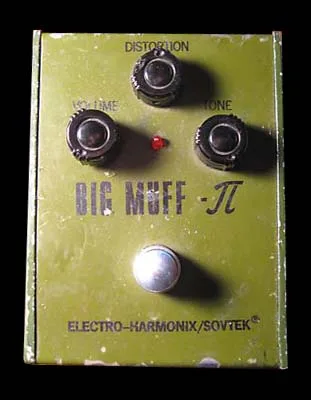
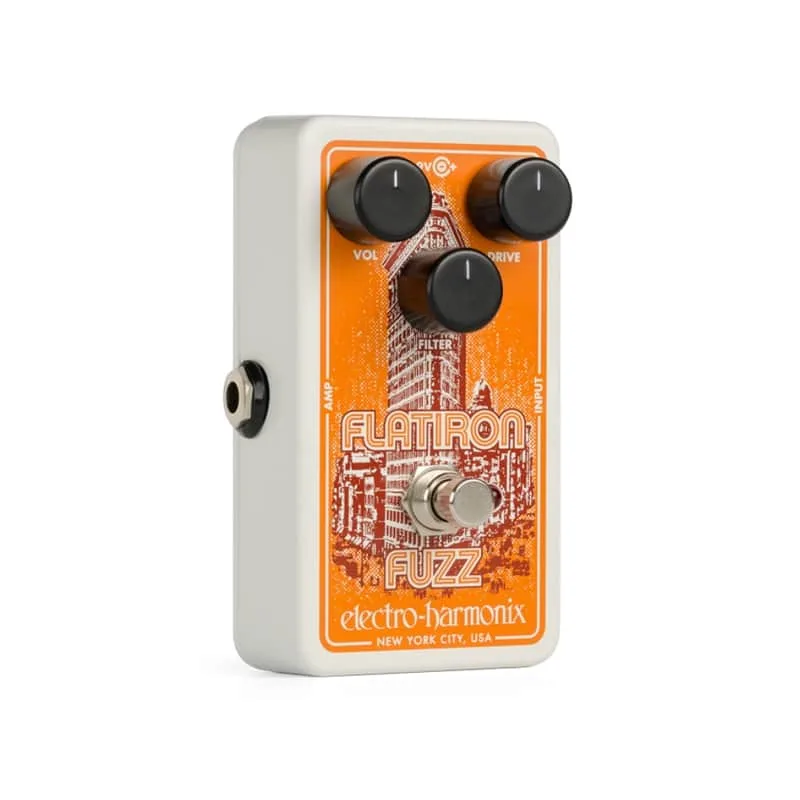
The pedal was designed by Bob Myer and Daniel Shin9, and by 2011 it was one of more than ten Big Muff versions in the Electro-Harmonix lineup3. Players comparing it today will find it alongside other EHX dirt boxes like the Nano Big Muff Pi, the Green Russian Big Muff and the Flatiron Fuzz, though only the Germanium 4 pairs germanium transistors with a two-channel overdrive and fuzz layout.
Videos
ProGuitarShopDemos
gearmanndude
mikemattdemo
Questions
What is the Germanium 4 Big Muff Pi?
It is a two-in-one overdrive and distortion pedal released by Electro-Harmonix in 2010 and discontinued in 2024. Each side runs on its own pair of NKT275 germanium transistors with its own footswitch and controls, and the two sides can be used independently or stacked in series, bringing all four transistors into play. Despite the name, it is a new circuit rather than a classic Big Muff Pi design.
Is the Germanium 4 a Big Muff circuit?
No. Reviewers and historians describe it as a completely new circuit design with nothing in common with the classic four-transistor silicon Big Muff Pi. Kit Rae classifies it as a new Big Muff class built on germanium transistors, and the DIY community notes it shares nothing with the other Big Muff versions. It behaves more like a germanium fuzz and overdrive than a scooped-mid Big Muff.
Sources (10)
- Germanium 4 Big Muff Pi, Electro-Harmonix (ehx.com)
- New Electro-Harmonix 44 Magnum Amp & Germanium Pedal, Premier Guitar, 2010-06-08
- The Electro-Harmonix Germanium 4 Big Muff Pi, Vintage Guitar magazine, 2014-10-06
- Electro-Harmonix Germanium 4 Big Muff Pi review, MusicRadar, 2010-10-20
- Electro-Harmonix to launch Germanium 4 Big Muff Pi at Summer NAMM 2010, MusicRadar, 2010-06-03
- Electro-Harmonix Germanium 4 Big Muff Pi Pedal Review, Premier Guitar, 2010-10-28
- Big Muff Versions_Quick Identifier, Kit Rae (kitrae.net), 2026
- Guitar FX Layouts: EHX Germanium4 Big Muff Pi, Guitar FX Layouts (tagboardeffects.blogspot.com), 2014-02-25
- The Big Muff History of All Versions 3, kitrae.net, 2017-03
- Big Muff Pi, Stompbox Book, 2020-03-21