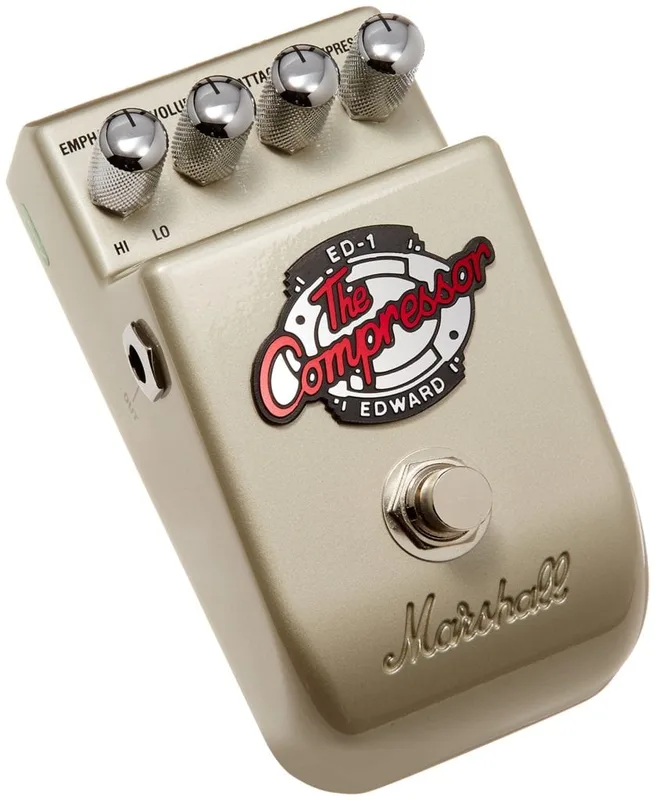


The Marshall ED-1 Edward Compressor is a compressor pedal made by Marshall Amplification, part of the company's line of effects pedals alongside its amplifiers. It is a retro-styled stompbox with four knobs: Emphasis, Volume, Attack and Compression1. At its 2007 launch it carried a $119.99 MSRP and sold for approximately $70, which reviewers placed squarely in the middle range of compressor pedals1; by 2020, JHS Pedals' buying guide listed it at $452.
A compressor evens out the volume between your loudest and quietest notes, raising sustain and tightening the overall sound. The ED-1 gives you control over how much compression is applied, how the initial strike of each note comes through, and which part of the tonal spectrum the effect works on hardest.
What it does and how it is controlled
The ED-1 is housed in a heavy-duty metal chassis with chrome metal knobs, a metal button-style footswitch, and an LED that shows whether the pedal is on or off1. The four knobs divide the compression job between them:
| Control | What it does |
|---|---|
| Emphasis | A Hi/Lo adjustment with everything in between; selects which end of the tonal spectrum you wish to emphasize1 |
| Volume | Controls the level of sound1 |
| Attack | Controls the level of the initial strike of the note or string1 |
| Compression | Adjusts the amount of compression desired1 |
The Emphasis knob is the one that sets this pedal apart from a basic two-knob compressor. Instead of compressing the whole signal equally, you can aim the effect at the high end, the low end, or anywhere between1. That matters in practice: single-coil pickups and humbuckers respond differently to compression, and a reviewer found the ED-1's results depended on the guitar1.
Power and documentation
The battery compartment sits on the bottom of the unit and requires a coin or screwdriver to open1. If you would rather not use batteries, the same chassis includes a jack for an optional AC adapter1, so the pedal can sit on a powered pedalboard.
The battery door needs a coin or screwdriver to open, so it is not a quick-swap design. Plan on the AC adapter jack if you change batteries often1.
Marshall also provided good documentation regarding connections and sample settings to get the user acquainted with the unit1, which is useful if you are new to compression and want starting points rather than starting from scratch.
What reviewers said
The MusicPlayers.com review from February 2007 found the pedal's quality depended on the guitar in use:
"Depending on the guitar you play, the ED-1 is a very good sounding compressor."
With a Strat and single-coil, low-output pickups, the reviewer reported it worked beautifully, giving a very smooth and warm sustain when run in series with an overdrive pedal, and a very clean, compressed sound on its own1. That pairing with an overdrive pedal is a common way players use compression: the compressor feeds a level signal into the drive pedal, and the drive pedal sustains it further.
Thirteen years later, the ED-1 still had a champion. In JHS Pedals' 2020 buying guide of pedals that do not suck, Josh Scott recommended it as a budget compressor at $452, which tells you the design held up long after its introduction and that it could be found cheap on the used and discounted market.
Where it sits among compressors
At approximately $70 street in 2007, the ED-1 fell squarely within the middle range of compressor pedals1, a market the same review described as crowded with options described as Red, Blue, Orange, Over-easy, curvaceous, warm, and hard1. Its four-knob layout, especially the Emphasis control, gave it more tonal shaping than the simplest compressors of its price class, while its metal chassis and LED status light matched the build standards of the era's mid-priced pedals1.
Videos
Guitargasdotcom
Pedal Sessions
MrSonG St
Questions
Does the Marshall ED-1 Edward take a battery?
Yes. The ED-1 has a standard nine volt battery compartment on the bottom of the unit, which requires a coin or screwdriver to open. The same chassis also carries a jack for an optional AC adapter, so you can run it either way.
How much does the Marshall ED-1 Edward cost?
At its 2007 launch the ED-1 carried a $119.99 MSRP and sold for approximately $70, which reviewers placed in the middle range of compressor pedals. By 2020, JHS Pedals' buying guide listed it at $45.
What does the Emphasis knob do on the ED-1?
Emphasis is a Hi/Lo adjustment with everything in between, and it lets you select which end of the tonal spectrum the compressor emphasizes. Set it toward Hi to compress the brighter content more, or toward Lo to focus the effect on the low end.
Does the Marshall ED-1 come with sample settings?
Yes. Marshall provided good documentation regarding connections and sample settings to get the user acquainted with the unit, according to the MusicPlayers.com review, so a first-time compressor user has starting points to work from.
Can the ED-1 Edward run on an AC adapter?
Yes. The pedal includes a jack for an optional AC adapter alongside its standard nine volt battery compartment, so it can be powered from the wall or a pedalboard power supply instead of a battery.
Sources (2)
- Marshall ED-1 Edward Compressor, MusicPlayers.com, 2007-02-07
- $70 PEDALS THAT DON'T SUCK, JHS Pedals, 2020