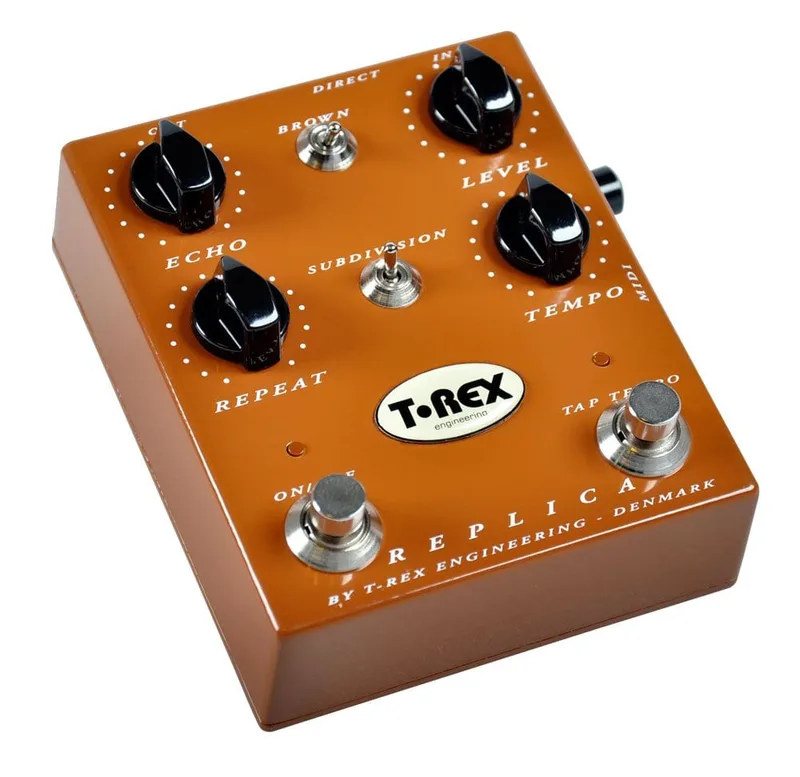


The T-Rex Replica is a delay pedal made by T-Rex Engineering, a Danish effects company. T-Rex describes it as its legendary delay returning "with an even larger and more powerful engine", while keeping what the company calls the same iconic sound and simplicity1. The pedal is built in Denmark with European components2.
What makes the Replica unusual among digital delays is its signal path. The delay core is digital, but the direct signal and the feedback circuit are pure analog2. In Sweetwater's demo, Don Carr called this split "one of the reasons that this delay sounds so good"3. The current version is a true stereo tap delay1, with a Vintage/Modern mode switch, three subdivisions, and MIDI.
What the Replica does
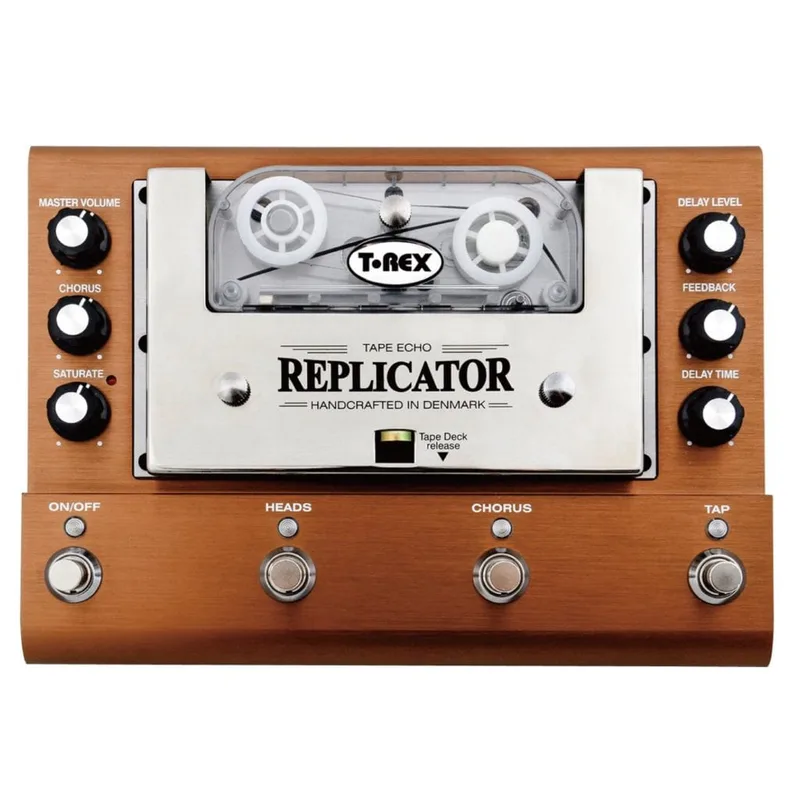
The Replica generates its repeats with a digital engine, but your dry signal never goes through the conversion: it stays in the analog domain, as does the feedback path that feeds repeats back into the delay2. This hybrid layout is the pedal's defining design choice, and it separates the Replica from T-Rex's own Replicator family, which are genuine tape echo units with a motor, magnetic heads and a tape cartridge, running a 100% analog signal path5.
The current Replica adds a Hi-Cut knob to darken the repeats, and an Input Gain control to compensate for signal loss1. On the 2010 version, a Hi-cut button cut high frequencies on the repeats, which T-Rex said perfectly simulated the tone of a 60s era tape echo41.
Controls
| Control | What it does |
|---|---|
| Echo | Delay level3 |
| Repeat | Number of repeats3 |
| Tempo | Delay time3 |
| Volume | Overall output level3 |
| Input gain | Level feeding the delay signal3 |
| Hi-Cut | Darkens the repeats1 |
| Vintage/Modern switch | Selects the repeat character3 |
| Note divider switch | Quarter notes, triplets, dotted eighths2 |
| On/Off | Bypass footswitch2 |
| Tap tempo | Sets delay time to the song's tempo4 |
In his demo, Don Carr highlighted the number of level controls as a practical strength:
"i really like the flexibility of the fact that you've got so many level controls you've got an input level that drives the delay you've also got the delay level versus the dry level and then you've got an overall output makes it really easy to match to any rig"
Vintage and Modern modes
The mode switch is the biggest difference between the current Replica and the original3. Vintage mode recalls the first generation: repeats pass through a compressor/expander circuit, which T-Rex says makes the sound smooth and dynamic, and that circuit was carried over from the first generation of the Replica2. Modern mode delivers a more pristine delay with clear repeats and a more open sound1.
The two modes also behave differently at the extremes. In Sweetwater's demo, the repeats go into self-oscillation in Vintage mode and trail off cleanly in Modern mode3. Delicious Audio described Vintage mode as sounding like the original unit, but in stereo1.
Power and connections
The current Replica runs on a standard 9V DC supply through a 2.1mm barrel plug, drawing 145 mA2. Its connectors are input jacks L and R, output jacks L and R, a 9V DC jack, and MIDI on a 5 pole female DIN plug2.
The 2010 version was a different animal on the power front: it ran on 12V DC or 12V AC from the T-Rex FuelTank, with a minimum supply voltage of 10,8V DC and a maximum of 12,5V DC, drawing 120 mA at 12V4. Its connectors were a single input, output and direct jack, plus a 12V AC/DC jack and MIDI4.
Power differs by generation. The current stereo Replica takes 9V DC; the 2010 version required 12V DC or 12V AC, with supply voltage between 10,8V and 12,5V DC24. A 9V supply from a modern pedalboard power brick will not run the older pedal.
MIDI
The Replica offers versatile MIDI options: bypass, tap tempo and MIDI clock2. In practice, that means the pedal receives MIDI clock information, and you can trigger bypass and tap tempo over MIDI3, which lets you sync the delay to a tempo source rather than tapping it in by foot.
Bypass
The current Replica's bypass mode uses an FET circuit to keep the impedance consistent throughout the rest of the rig3. This is a buffered bypass rather than a hard true bypass. The earlier version was described differently: Analog Man listed the Replica as a "True-Bypass Digital delay with easy to use Tap Tempo and warm sound"6. Players comparing a used original against the current stereo version should expect a different bypass behavior.
Where it came from and what reviewers said
The Replica first appeared as a mono pedal, documented on T-Rex's 2010 product page with its own control set including a "brown" control and input level1. In 2015, Delicious Audio placed the Replica at a $380 price point, against roughly $250 mid-range delay pedals of the time7. The stereo version arrived in 2022, announced through Sweetwater, which Delicious Audio called "an endorsement strong enough to put the company back on the map"1.
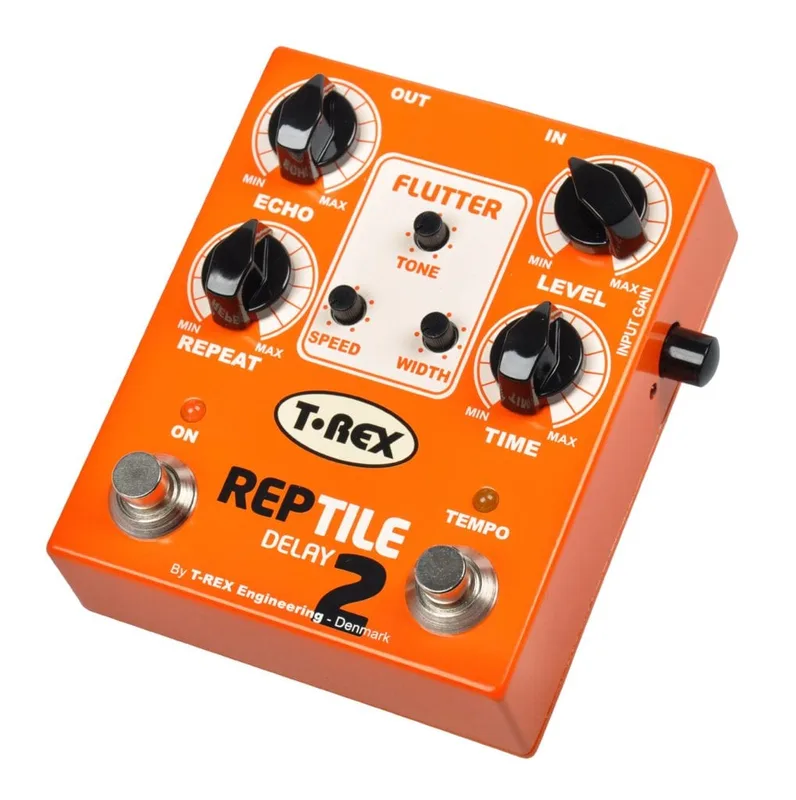
MusicRadar's reviewers have rated the Replica's pedigree highly, calling it "among the best digital delay pedals available" when describing its tap tempo circuit borrowed for the Reptile 28.
Sweetwater's 2022 demo walks through the whole pedal: the mode switch, the level controls, the subdivisions, and a playing demo through a Fender Strat and a Mesa Boogie California Tweed3.
How it differs from other T-Rex delays
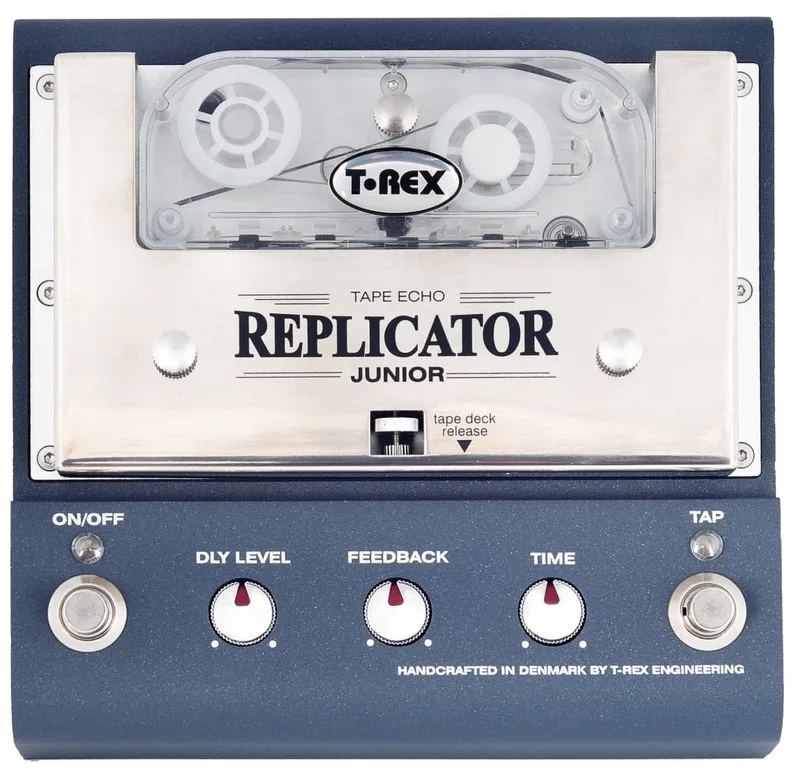
The Replica sits apart from T-Rex's tape echo line. The Replicator is a real tape echo with a motor and tape cartridge, 100% analog, running on 24V DC5. The Replicator Junior is a stripped down, single head version on 12V DC9, and the Replicator D'Luxe adds two heads and relay true bypass10. The Replica, by contrast, is the company's digital engine with an analog dry path: no tape to replace, no motor to service, and standard 9V power on the current version2.
Videos
ProGuitarShopDemos
T-Rex Effects
Questions
Is the T-Rex Replica stereo?
The current Replica is a true stereo tap delay, with left and right input jacks and left and right output jacks. The earlier 2010 version was a mono pedal with a single input, output and direct jack, so stereo operation depends on which version you are looking at.
Is the T-Rex Replica analog or digital?
It is a hybrid. The delay core is digital, using DSP to generate the repeats, but the direct signal and the feedback circuit are pure analog. T-Rex says the repeats in Vintage mode also pass through a compressor/expander circuit carried over from the first generation of the pedal.
Does the T-Rex Replica have tap tempo?
Yes. Both the current stereo version and the 2010 original have a tap tempo switch for setting the delay time to the tempo of the song. On the current version, tap tempo can also be sent over MIDI, along with bypass and MIDI clock.
Is the T-Rex Replica true bypass?
The current stereo version uses an FET circuit in bypass mode, which keeps the impedance consistent through the rest of the rig rather than fully disconnecting the circuit. The earlier version was described by Analog Man as true bypass, so the bypass type differs between generations.
What subdivisions does the T-Rex Replica offer?
The Replica offers three subdivisions: quarter notes, triplets and dotted eighths, selected with a three position note divider switch. The 2010 version's subdivision switch moved between 1/4 and 1/8 triplets.
Sources (10)
- Pedal Update: T-Rex Replica Stereo Delay, Delicious Audio, 2022-10-18
- → T-REX EFFECTS ← Pedals for guitar and bass players!, T-Rex Effects
- T-Rex Replica Stereo Delay Pedal Demo, Sweetwater, 2022-06-20
- → T-REX EFFECTS ← Pedals for guitar and bass players!, T-Rex Effects
- → T-REX EFFECTS ← Pedals for guitar and bass players!, T-Rex Effects
- T-Rex Guitar Effects pedals, Analog Man (analogman.com), 2015
- New Pedals: T-Rex Replay Box, Delicious Audio, 2015-03-06
- T-Rex Reptile 2 review, MusicRadar, 2011-03-30
- → T-REX EFFECTS ← Pedals for guitar and bass players!, T-Rex Effects
- → T-REX EFFECTS ← Pedals for guitar and bass players!, T-Rex Effects