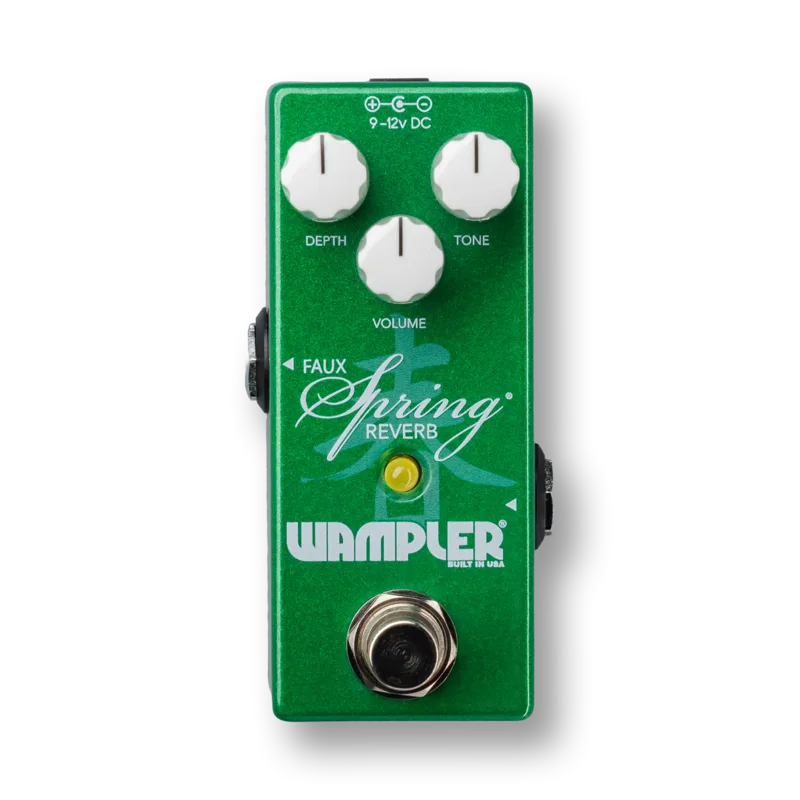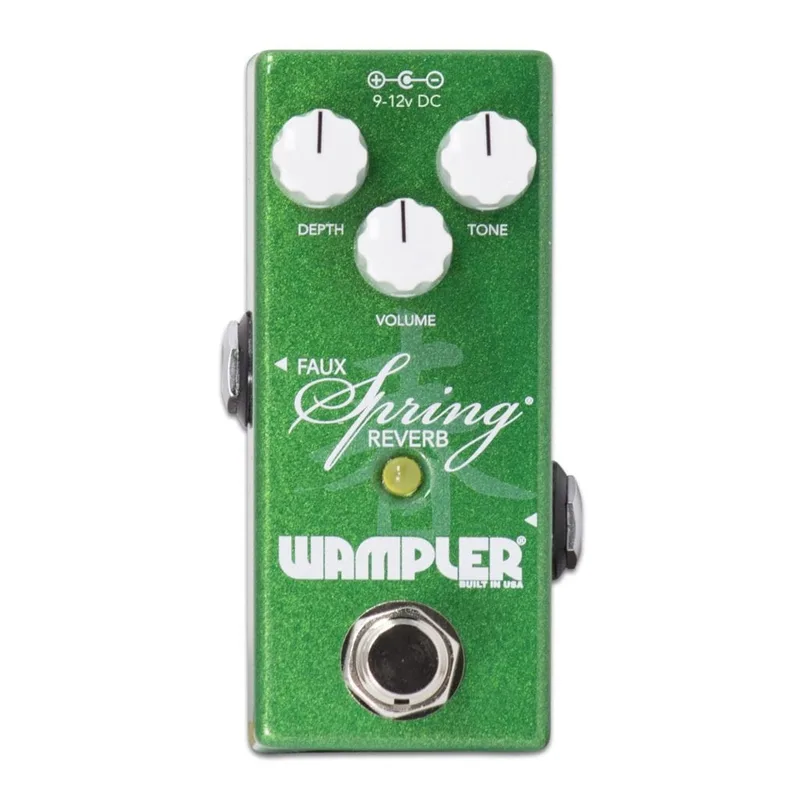


The Wampler Mini Faux Spring Reverb is a compact spring reverb pedal from Wampler, built to deliver the drippy, bouncy character of a spring reverb tank without the size and weight of a real one. Wampler describes it as serving up "authentic tones that drip with boing just like a great spring tank," with an extended decay time over the original Faux Spring Reverb it condenses into a mini enclosure1.
It was released at Sweetwater's GearFest on June 22, 2018, where Brian Wampler presented it as a new mini pedal released that day2. Delicious Audio called it a reduced version of the discontinued full-size Faux Spring Reverb, writing that "from its convenient size to its top-tier components, the Mini Faux Spring Reverb pedal is every bit a Wampler"3.
Where it came from
The Mini Faux Spring Reverb is the successor to the full-size Wampler Faux Spring Reverb, which was discontinued a few years before the Mini was made. After it was dropped, Brian Wampler received numerous requests from players to bring it back, and he responded by taking all of that player feedback and giving the design an upgrade: more decay, more drippiness, and more of the bouncy spring tone players love in bigger reverb tanks, condensed into a mini enclosure that fits at the end of any pedalboard chain1.
The full-size Faux Spring Reverb had been discontinued a few years before the Mini was made, and Brian Wampler received numerous requests to bring it back in the meantime1. The Mini is the answer to those requests, packing the spring reverb effect into a smaller enclosure.
The controls: Volume, Depth and Tone
The Mini Faux Spring Reverb keeps the same three controls as the full-size Faux Spring Reverb: Volume, Depth, and Tone, which Wampler says give you full control of your reverb trail15.
| Control | What it does |
|---|---|
| Volume | Sets the level of the reverb effect |
| Depth | Sets the amount and length of the reverb trail |
| Tone | Shapes the character of the reverb tail |
Wampler says the Mini's decay time is extended compared with the original, and at GearFest 2018 Brian Wampler said the pedal has "a reverb tail all the way to about four seconds"2.
The maker also describes how the circuit handles your core sound: the signal is split, the core tone is unchanged through the pedal, and the effect is laid on top of your tone1. For a player, that means the dry guitar signal is not colored by the reverb circuit, only supplemented by it.
How it compares with a real spring tank
The Mini Faux Spring Reverb is a digital stompbox, not a mechanical spring tank. MusicRadar's reviewer, writing about the Faux Spring line, found it "may be as close as you'll come to spring reverb in a practical format, albeit lacking some of the randomness of a real spring"4. That randomness, the unpredictable boing and clatter of physical springs being driven hard, is what a digital emulation trades away in exchange for a box that fits on a pedalboard and costs far less than a vintage outboard spring unit.
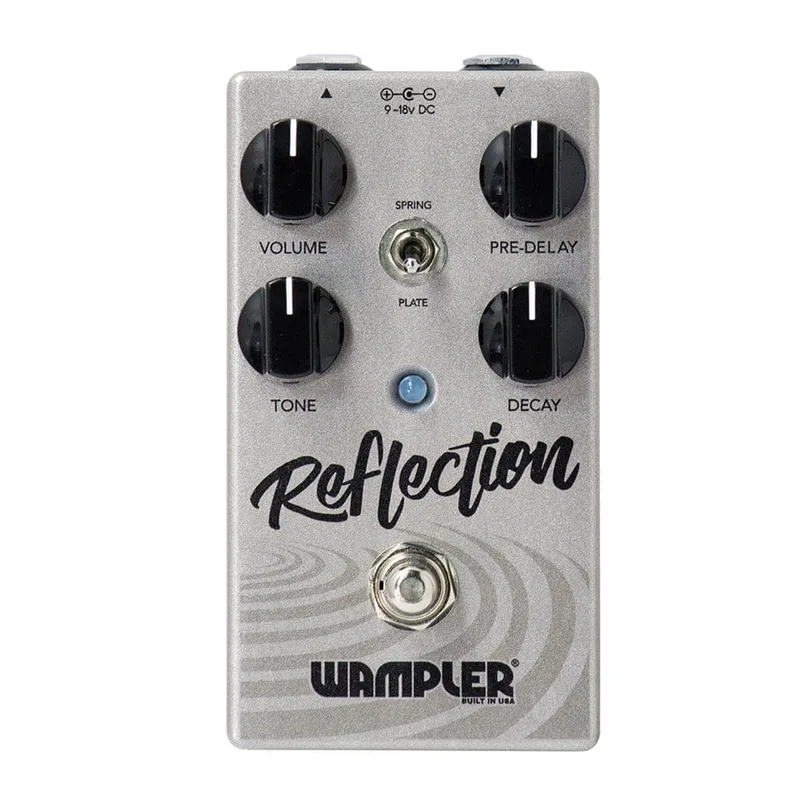
For players weighing other Wampler options, the company also offers the Wampler Reflection reverb pedal, a more feature-rich reverb than the single-purpose Mini Faux Spring.
"From its convenient size to its top-tier components, the Mini Faux Spring Reverb pedal is every bit a Wampler."
Power and placement
The pedal runs on a 9V power jack with no battery connector inside, so a battery is not an option1. Its current draw of 64.3mA at 9V is modest by digital pedal standards, but it is enough that a small daisy chain shared with several other digital pedals is worth planning around. The enclosure measures 1.50" x 3.50" x 1.5", a footprint Wampler calls small and ideal for pedalboard placement, and the pedal carries Wampler's limited 5-year warranty1.
Videos
Wampler Pedals
JayLeonardJ
Tom Quayle
Questions
Does the Wampler Mini Faux Spring Reverb take a battery?
No. The pedal has a 9V power jack with no battery connector inside, so it runs only on an external power supply. It draws 64.3mA at 9V, which is more than a typical battery-driven analog pedal would want to supply anyway.
Is the Mini Faux Spring Reverb true bypass?
Yes. Wampler lists the pedal as 3PDT true bypass, meaning your dry signal passes through untouched when the effect is switched off. The maker also says the signal is split inside, so the core tone is unchanged even when the effect is on.
Is the Mini Faux Spring Reverb a real spring?
No. It is a digital stompbox that emulates spring reverb rather than containing an actual spring tank. Wampler describes it as serving up tones that drip with boing like a great spring tank, and MusicRadar's reviewer found it may be as close as you'll come to spring reverb in a practical format, though it lacks some of a real spring's randomness.
How long is the reverb tail on the Mini Faux Spring?
Brian Wampler said at GearFest 2018 that the Mini Faux Spring Reverb has a reverb tail all the way to about four seconds. That is longer than the original Faux Spring Reverb, whose version two decay ran up to about ten seconds.
Sources (5)
- Mini Faux Spring Reverb, Wampler Pedals, 2026-10-06
- Wampler Mini Faux Spring Reverb Pedal Overview with Brian Wampler, Sweetwater, 2018-06-22
- Wampler Mini Faux Spring Reverb, Delicious Audio, 2018-07-10
- Wampler Faux Spring Reverb review, MusicRadar, 2015-06-02
- New Wampler Pedals at Winter NAMM 2018, Sweetwater, 2018-01-27