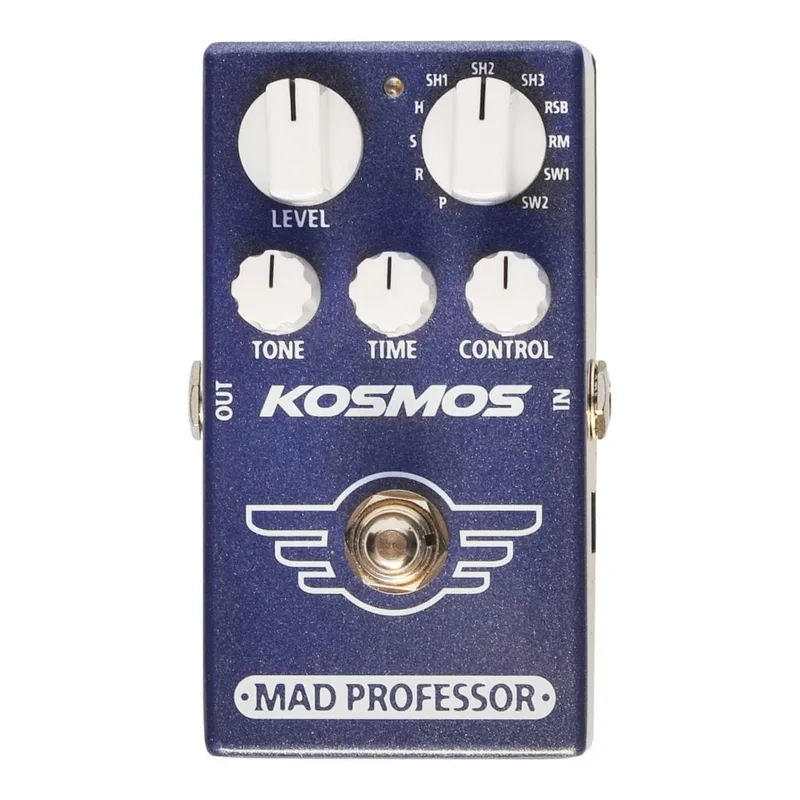


The Mad Professor Kosmos is a compact reverb pedal from Finnish maker Mad Professor, released in 2018. It is billed as an ambient reverb, and it packs 11 reverb types into a small, TARDIS blue-colored enclosure, including plate, room, hall, shimmer and spring patches, duck and swell modes, and combined reverb and delay patches12. What sets it apart from a basic reverb box is that everything expressive, from swells to an infinite freeze, is handled by a single footswitch3.
What it does: ambient reverb with duck, swell and freeze
The Kosmos offers 11 reverb types and comes with footswitch-enabled swell and freeze functions3. The reverb patches cover the familiar ground: plate, room, hall, shimmer and spring, plus duck modes, swell modes and combined reverb and delay patches1.
The controls are straightforward. Besides the standard controls for tone, level and time, each patch has a variable parameter governed by the control knob, and that parameter changes with the patch you have loaded1:
| Patch type | What the control knob does |
|---|---|
| Duck modes | Varies the duck depth, meaning how low the reverb mix is pushed while you are playing1 |
| Swell patches | Controls swell rate1 |
| Combined reverb and delay patches | Covers delay intensity1 |
The single footswitch does more than bypass. Held down, it triggers the freeze functionality, resulting in infinite reverb, or creates a swell, depending on the reverb type selected13. For a player building ambient textures, that means one switch handles the effect's most expressive moves without extra controls or an expression pedal.
The Kosmos is a true-bypass effect with an analog dry signal path, so the dry signal is not converted digitally on its way through, and the pedal will not alter your guitar's tone when engaged2.
Power comes from a 9V power supply or battery operation4. A standard 9V battery gives around 2 to 3 hours of effect time, so battery use is possible but short-lived2.
What reviewers said
MusicRadar's reviewer Alex Lynham found the Kosmos shines on textural work, tremolo picking and glacial arpeggios, and called the spring reverb patch convincing too. On the core sounds, the reviewer's view was that "the plate, room, hall and shimmer sound just too good to not be the main attraction"1.
The review's plus points covered the pedal's signature features:
The one minus point was the price: "Just the price!"1. The overall verdict summed it up as:
"A compact, versatile reverb that has enough unique features to make it well worth considering over mainstream contenders"
Videos
Premier Guitar
Mad Professor Amplification
Mad Professor Amplification
Questions
Does the Mad Professor Kosmos run on a 9V battery?
Yes. The Kosmos runs on a 9V power supply or battery operation, and a standard 9V battery gives around 2 to 3 hours of effect time. That makes it usable on a small board without a power supply, though the battery life is short enough that most players will prefer a supply.
Is the Mad Professor Kosmos true bypass?
Yes. The Kosmos is a true-bypass effect with an analogue dry signal path, so the dry signal does not pass through digital conversion when the pedal is off, and it leaves the guitar's core tone alone.
How does freeze work on the Mad Professor Kosmos?
The Kosmos has a single footswitch. Besides bypassing the unit, holding it down triggers the freeze function, which sustains the reverb tail indefinitely for an infinite reverb effect. On swell reverb types, holding the footswitch instead creates a swell.
How many reverb types does the Kosmos have?
The Kosmos includes a total of 11 reverb types. These cover plate, room, hall, shimmer and spring patches, duck and swell modes, and combined reverb and delay patches.
Sources (4)
- Mad Professor Kosmos review, MusicRadar, 2019-02-12
- The Mad Professor floats off into space, gearnews.com, 2018-03-10
- Mad Professor's new pedal lets you choose from 11 reverb types, Guitar.com, 2018-03-13
- Mad Professor's Kosmos reverb pedal “will open a universe of ambient tones”, MusicRadar, 2018-03-09