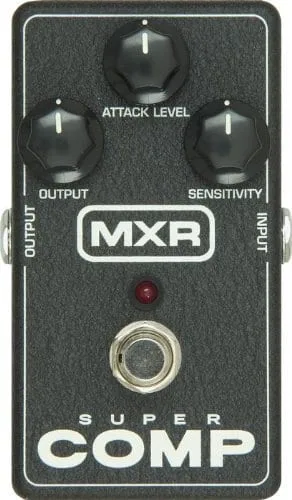


The MXR Super Comp (model M132) is an analog compressor pedal from MXR, built as an updated version of the company's classic Dyna Comp. MXR describes it plainly: "The Super Comp Compressor updates the Dyna Comp Compressor with an Attack Level control to preserve initial volume" while keeping the sustain1. In practice that means it does the Dyna Comp's job of evening out the volume between notes and stretching sustain, but with a third knob that decides how much of the pick attack at the front of each note survives the compression.
A compressor is one of the less obvious pedals on a board: instead of adding something to your sound, it controls it, pulling loud notes down and quiet notes up so parts sit evenly in a mix. The Super Comp's three knobs, Output, Sensitivity and Attack Level, cover that job with a minimum of fuss, and the manual describes its character as "Classic Dyna Comp style compression"2.
The controls
The Super Comp has three knobs and one footswitch. Two of them are inherited directly from the Dyna Comp, which MXR's own history says was originally built with controls "labeled Output and Sensitivity, to govern the volume and compression levels, respectively"5.
| Control | What it does |
|---|---|
| Output | Controls overall effect volume2 |
| Sensitivity | Sets the amount of compression; MXR says Output and Sensitivity together "let you dial in the perfect setting to keep your parts where they belong in the mix"1 |
| Attack Level | Sets the attack attenuation level2; MXR says it "lets you keep your initial bite and chunk as you pour on the sustain"236 |
| Footswitch | Toggles the effect on and bypass, with a red LED indicating on2 |
The Attack Level knob is the whole reason the Super Comp exists. Dunlop's history article explains that it "gives players control over how the initial crack of the note is treated" by the compressed signal6. On a two-knob compressor like the Dyna Comp, heavy compression tends to flatten the transient at the front of each note, which is exactly the "bite" that makes a picked note cut through. The Attack Level knob lets you dial back how much of that initial hit gets pulled down, so a note can still crack open sharply and then settle into long sustain.
A 2003 Guitar Player review noted that this control is not a simple single-parameter adjustment: "the Attack knob seems to modify several parameters simultaneously"7. That is worth knowing before you buy: it is a shaping control, not a labeled attack-time dial.
The manual also includes four sample settings to use as starting points, labeled Light Comp, Heavy Squish, Dimed and Tweed2.
Power and connections
The Super Comp runs on 9V DC with a center-negative plug and draws only 3.5mA3, which is light enough that it is easy on any isolated or daisy-chained power supply. Jim Dunlop lists three ways to power it: a 9-volt battery, the Dunlop ECB003 9-volt adapter, or the DC Brick, Iso-Brick and Mini Iso-Brick power supplies, none of which are included with the pedal1. The battery installs by removing the bottom plate2.
Signal connections are the standard pair: a cable from your guitar into the input jack, and a cable from the output jack to your amplifier2.
The Super Comp's bypass is listed in the MXR manual as True Hardwire, not true bypass2. Players who notice tone loss with the pedal switched out on long cable runs often place a buffer elsewhere in the chain.
Specifications
These figures come from the MXR M132 manual1, with power details from RockBoard's product listing1.
| Specification | Value |
|---|---|
| Effect type | Compressor pedal3 |
| Circuit | Analog3 |
| Maximum compression | 36 dB2 |
| Attack time | 5 ms2 |
| Release time | 1s2 |
| Input impedance | 1 MΩ2 |
| Output impedance | 10 kΩ2 |
| Nominal input level | -5 dBV2 |
| Nominal output level | -12 dBV2 |
| Noise floor | -95 dBV (A-weighted)2 |
| T.H.D. | 0.2% Typ. at -20 dBV, 1 kHz2 |
| Power | 9V DC, center negative, 3.5mA3 |
The attack and release times are fixed, not user-adjustable. The Attack Level knob shapes how much of the note's front end is attenuated, but the underlying timing stays at 5 ms attack and 1 second release2.
A Dyna Comp with an Attack Level knob
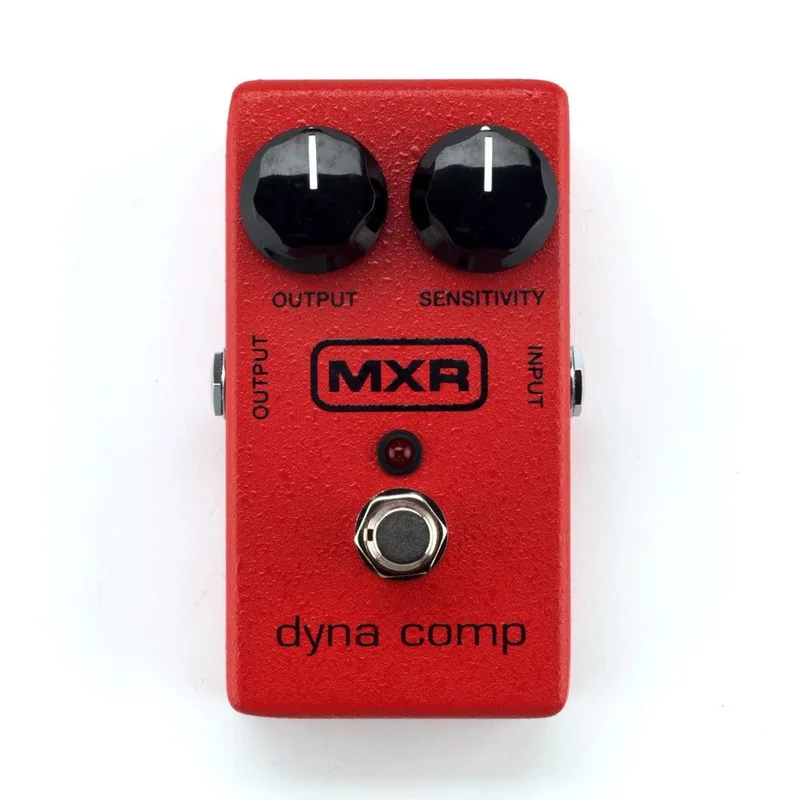
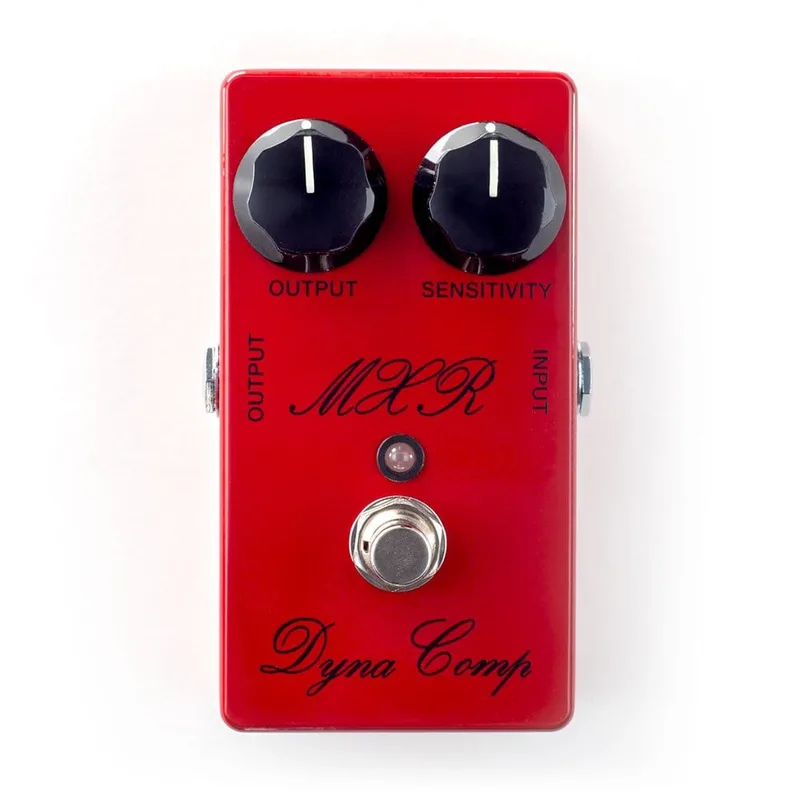
The Super Comp's story starts with the Dyna Comp, first released in 19728. The original had just the two knobs, Output and Sensitivity, and its sound became a reference point for pedal compression. The Super Comp keeps that circuit and adds the third control; Guitar Player's 2003 review described it as "Following in the footsteps of the classic Dyna Comp"7.
If you are comparing the two, the practical difference is that single knob:
- Dyna Comp: Output and Sensitivity, fixed attack treatment, the same 5 ms attack and 1s release times listed in its manual9.
- Super Comp: the same two knobs plus Attack Level, letting you preserve the note's initial volume without giving up sustain2.
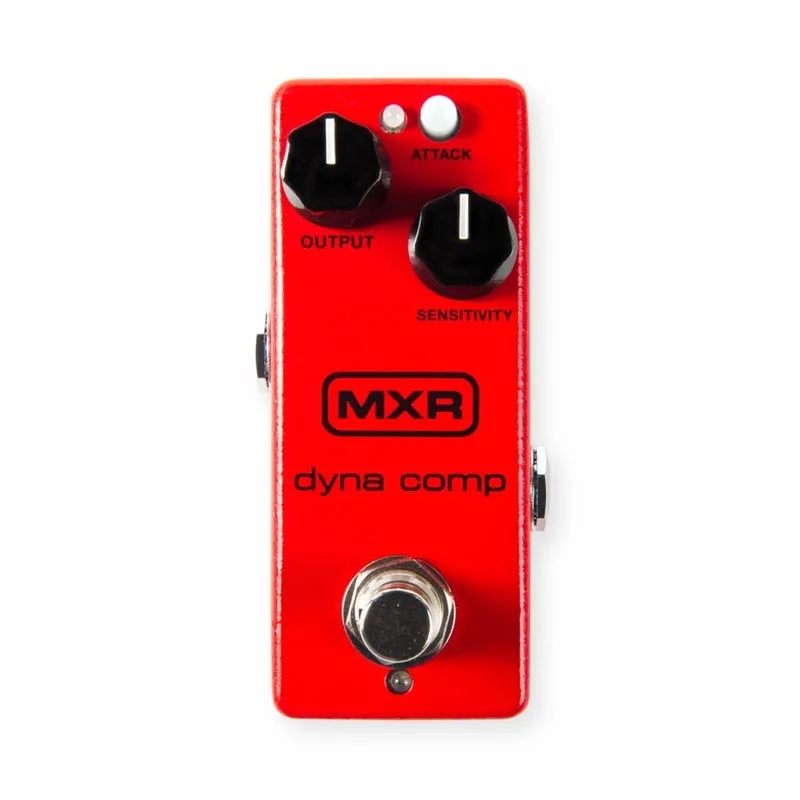
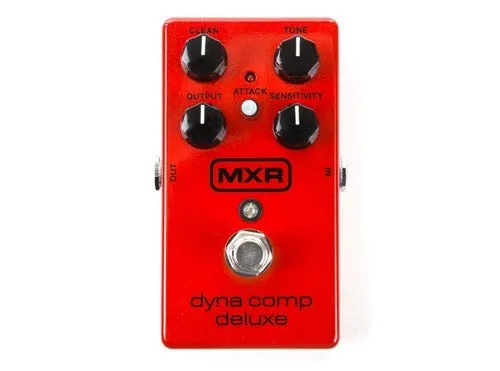
MXR has since carried the same idea further in other models. The Dyna Comp Mini uses an Attack switch rather than a knob, which Dunlop's history says "allows you to go from the classic slower attack or a faster, tighter response"6. The Dyna Comp Deluxe goes further still, with tone and clean blend knobs and an attack button that toggles between slow and fast modes. So the Super Comp sits in the middle of the family: more control than the original two-knob pedal, less than the Deluxe.
When Guitar Player reviewed it in June 2003, the Super Comp sold for $70 retail and $65 street7; the current Jim Dunlop list price is $125.994.
Videos
tunnelvisionmusic
Paul Miles Whitehead
ChrisPedalDemos
Questions
Is the MXR Super Comp true bypass?
No. The MXR manual lists the Super Comp's bypass as True Hardwire, which is MXR's hardwire switching rather than true bypass. The original Dyna Comp carries the same True Hardwire bypass listing. If you run long cables or many pedals, a buffer elsewhere in the chain can offset any bypassed signal loss.
Does the MXR Super Comp take a battery?
Yes. The Super Comp runs on one 9-volt battery, installed by removing the bottom plate, or on a Dunlop ECB003 9-volt adapter. It draws only 3.5mA, so a battery lasts a long time, and it is also compatible with Dunlop's DC Brick, Iso-Brick and Mini Iso-Brink power supplies.
What is the difference between the MXR Super Comp and the Dyna Comp?
The Super Comp is an updated version of the Dyna Comp circuit with one extra control. Both pedals have Output and Sensitivity knobs, but the Super Comp adds an Attack Level knob that sets how much the compressor attenuates the initial crack of each note, letting you keep the bite at the front of the note while sustaining.
What are the attack and release times of the MXR Super Comp?
According to the MXR manual, the Super Comp has an attack time of 5 ms and a release time of 1 second. Those are fixed times, not adjustable; the Attack Level knob shapes how much of the note's initial transient is affected rather than changing the timing itself.
Sources (9)
- MXR® SUPER COMP, Jim Dunlop (jimdunlop.com)
- M132.pdf, Jim Dunlop, 2019
- M132 Super Comp by MXR, RockBoard (rockboard.de), 2026
- MXR® STUDIO COMPRESSOR, Jim Dunlop (jimdunlop.com)
- Ambulator.pdf, madbeanpedals.com, 2024-04-25
- A Dyna Comp-rehensive History, Dunlop (lifestyle.jimdunlop.com), 2018-10-25
- COMP-1 | Guitar Player (June 2003) | Demeter Amplification, Guitar Player, 2003-06
- Aurora Compressor / Sustainer, Aion FX, 2018-06-30
- M102.pdf, Jim Dunlop, 2019