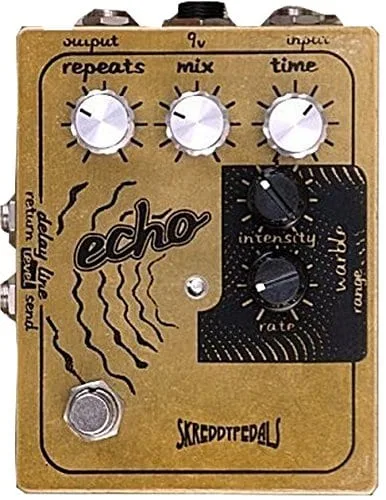


The Skreddy Echo is a delay pedal from Skreddy Pedals, a big-box unit aimed at players who want a lush, tape-like delay without giving up an untouched dry signal. Under the hood it is a hybrid: an ultra-high sample-rate Delta-Sigma digital delay with analog filtering and limiting produces the repeats, while your dry signal passes through a transparent analog path that the maker describes as having "tons of headroom"1. The result, in Skreddy's words, is a "lush, tape-like delay"2.
The pedal is still available in its big-box format with a delay-line effects loop, true bypass, and a mix control that goes to 100% wet1. It is built to order, with a lead time of about 2 weeks, and is listed at $338, discounted to $304.20 as of October 202612.
What it does to your sound
The Echo is designed to reproduce the character of a classic tape delay in a pedalboard-friendly box. The repeats come from a digital delay line, but they are shaped by analog filtering and a limiter circuit before they reach the output, which is where much of the tape-like character comes from. Your original signal never enters the digital conversion at all: it stays on the analog dry path, so the tone you hear when the pedal is engaged is the same tone you hear when it is off, with the repeats layered on top1.
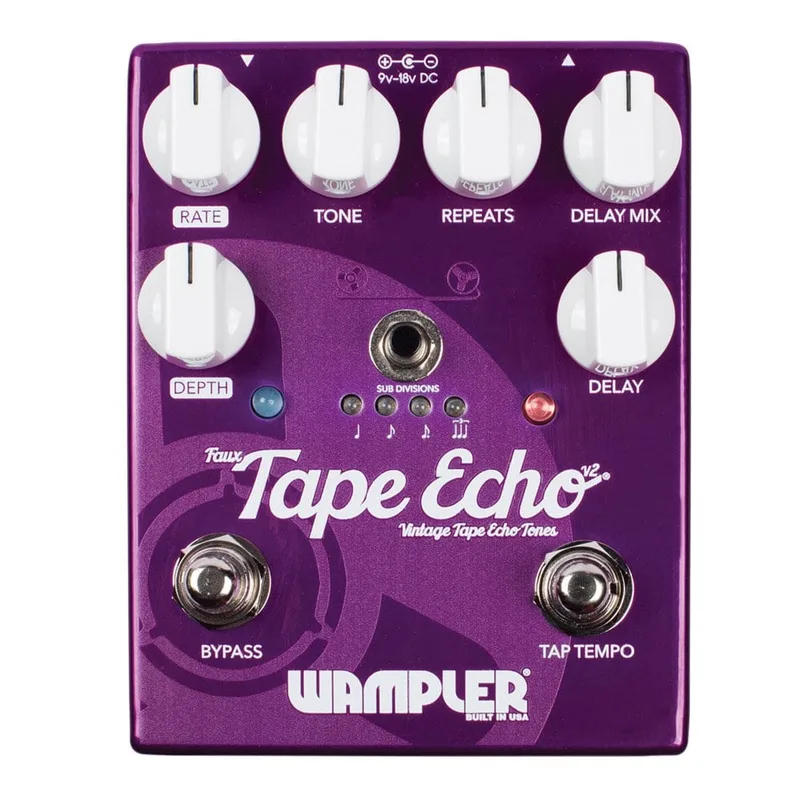
This hybrid approach is not unique to Skreddy. The Wampler Faux Tape Echo V2 uses the same idea, a completely pure analog dry path with the digital delay layered on top, and only the delay line is digital5. The difference between pedals in this family is mostly in the filtering, the modulation, and the feature set, not in the basic architecture.
The mix control is a standout feature for studio-minded players: it goes to 100% wet, killing the dry signal at full up, which opens up interesting studio effects such as parallel processing or wet-only re-amping1.
The controls and the delay-line effects loop
The Echo keeps its control set simple, in keeping with the vintage tape units it emulates. The maker's published description highlights the mix control and the delay-line effects loop as the big-box version's distinguishing features1.
| Control or feature | What it does |
|---|---|
| Mix | Sets the balance of dry and wet; goes to 100% wet, killing the dry signal at full up, for studio effects1 |
| Delay-line effects loop | Lets you insert other effects into the delay path, so only the repeats hear them1 |
| True bypass | Removes the pedal from the signal chain entirely when off; no trails1 |
The delay-line effects loop deserves a note for players who have not used one before. Because it sits in the repeat path rather than the main signal path, anything you plug into it colors the echoes but not your dry tone. Running a fuzz or overdrive into the loop, for example, gives you degraded, distorted repeats while your clean signal stays untouched, a trick borrowed from the tape echo units that let you insert processing between the playback heads.
Jack placement is practical for tight boards: the input, output, and DC jacks are all on the back side, with the loop jacks on the left side1.
Power
The Echo runs on DC power only, and the maker states that an AC power supply is not to be used with it1.
The Skreddy Echo runs on a DC adapter only, not included, and cannot run on a battery1. Do not use an AC power supply.
Voltage is flexible: 9V gives the stock, soft, "vintage" tone, while higher voltage, up to 18V, produces a clearer, harder, more "bell-like" tone1. The connector is the industry standard 5.5mm barrel x 2.1mm center coax with negative center polarity, so it works with typical pedalboard power supplies1. Actual current draw is only about 26mA, though Skreddy recommends supplying a minimum of 100mA1.
The Echo family: Mini, Vintage, and Infinity
Skreddy sells the Echo circuit in several forms, and knowing the differences helps you pick the right one.
| Version | What it is | Bypass | Delay range |
|---|---|---|---|
| Echo | Big-box with delay-line effects loop and 100%-wet mix control | True bypass, no trails | about 50ms to about 550ms1 |
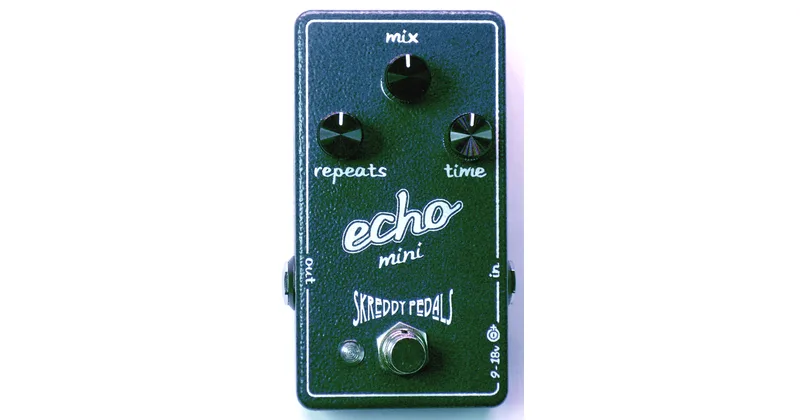
| Echo Mini | Echo circuit compressed into a standard small enclosure, with the modulation section deleted | Buffered bypass, for trails | about 32ms to about 550ms6 |
| Echo Vintage | The Echo made as close to the original edition as possible | ||
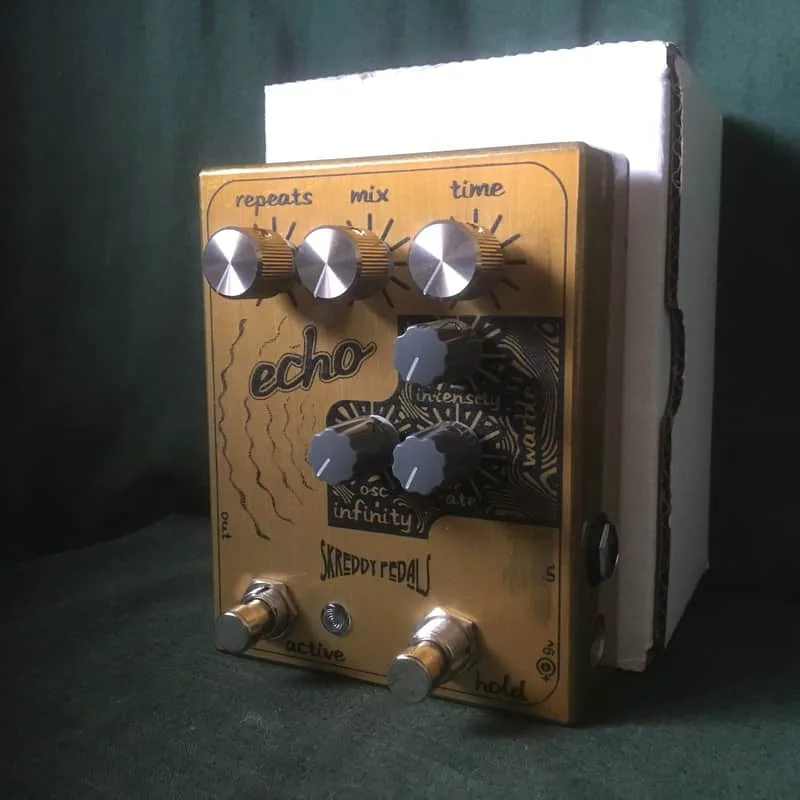
| Echo Infinity | Echo with adjustable modulation and an infinite-repeats footswitch | Active bypass, not true bypass | about 50ms to about 550ms4 |
The Echo Mini takes the same circuit and compresses the parts layout, deleting the modulation section, to fit a standard small enclosure6. Its buffered bypass is a deliberate choice: it facilitates trails, meaning the delays naturally decay after you switch it off, and Skreddy notes that the buffer is the Echo's dry circuit and a better quality signal than true bypass switching6. The Mini draws about 26mA and accepts 9V, or up to 18V for more headroom6.
The Echo Infinity adds a warble section with Intensity, Oscillation, and Rate controls, plus Active and Hold footswitches for the modulation, alongside the main Repeats, Mix, and Time controls7. Its infinite-repeats footswitch pushes the delay into self-oscillation for sound-making beyond conventional echo. Like the big-box Echo, it draws about 26mA actual with a 100mA supply recommended4.
The Echo Vintage is simply the Skreddy Echo made as close to the original edition as possible, built to order with a wait of approximately 2 weeks to 1 month2.
Who designed it
The Echo was designed by Marc at Skreddy Pedals, with helpful advice from Björn Juhl on the limiter circuit1. The limiter is part of what shapes the repeats' tape-like behavior, taming the peaks as the echoes stack up.
How to get one
The Echo is built to order rather than stocked. The maker's stated lead time is about 2 weeks, with the current wait time running approximately 2 weeks to 1 month1. The Echo Vintage carries the same 2 weeks to 1 month wait2.
Videos
Chicago Music Exchange
Dennis Kayzer
musictoyznetwork rasch
Questions
Does the Skreddy Echo have trails when bypassed?
No. The Skreddy Echo uses true bypass, which the maker states plainly means no trails: the repeats cut off as soon as you switch the pedal off. If you want repeats that decay naturally after bypassing, the smaller Echo Mini uses buffered bypass specifically to allow trails.
Can the Skreddy Echo run on a battery?
No. The Skreddy Echo runs on a DC adapter only, and the adapter is not included. It uses a standard 5.5mm barrel x 2.1mm center coax plug with negative center polarity, the same connector as most modern pedals, so a typical 9V pedalboard supply will power it.
Is the Skreddy Echo analog or digital?
It is a hybrid. The delay line is an ultra-high sample-rate Delta-Sigma digital delay with analog filtering and limiting, but your dry signal stays in a transparent analog path with what the maker calls tons of headroom. Only the repeats are digital.
What is the maximum delay time on the Skreddy Echo?
The delay time runs from about 50ms to about 550ms. That covers slapback through longer, tape-style repeats. The Echo Mini reaches the same 550ms ceiling but starts lower, at about 32ms, for tighter doubling effects.
How long does it take to get a Skreddy Echo?
The pedal is built to order. The maker's stated lead time is about 2 weeks, with the current wait time running approximately 2 weeks to 1 month. The Echo Vintage version carries the same 2 weeks to 1 month wait.
Sources (7)
- Delay | Skreddy Echo | Skreddy Pedals, Skreddy Pedals
- Delay | Echo Vintage | Skreddy Pedals, Skreddy Pedals
- Delay | Skreddy Pedals, Skreddy Pedals
- Delay | Echo Infinity | Skreddy Pedals, Skreddy Pedals
- Faux Tape Echo v2, Wampler Pedals, 2026-08-18
- Delay | Echo Mini | Skreddy Pedals, Skreddy Pedals
- Guitar Pedal X, Guitar Pedal X, 2024-12-20
 Billy Corgan