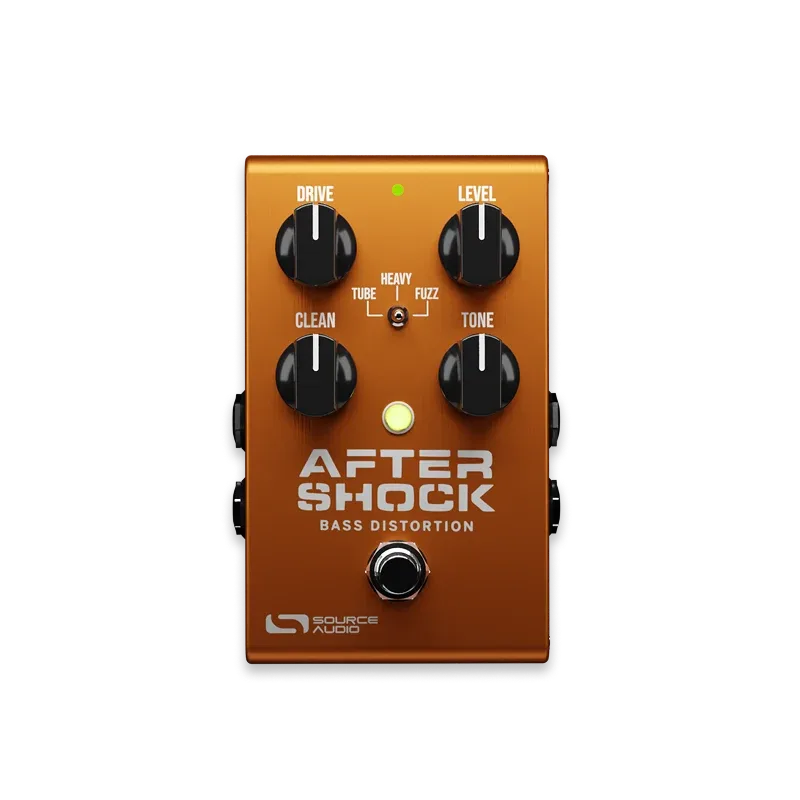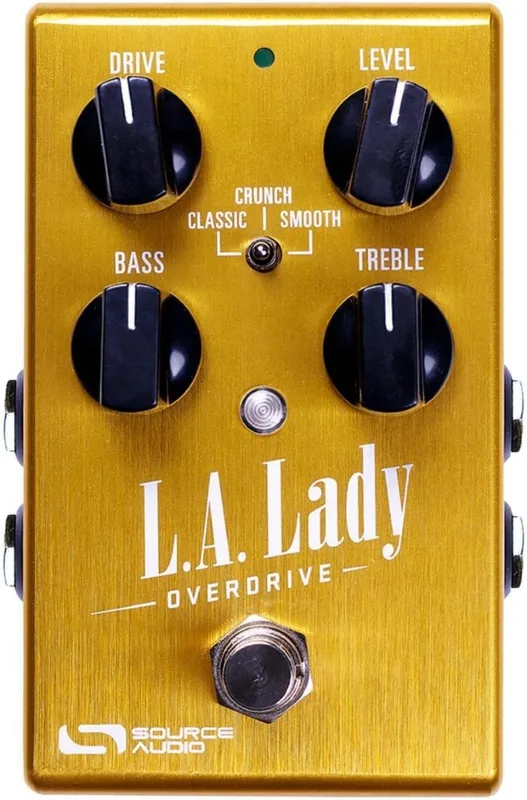


The Source Audio L.A. Lady is a digital overdrive pedal released on May 12, 2016, alongside the Kingmaker Fuzz and AfterShock Bass Distortion1. It is part of Source Audio's One Series, a range of pedals that the company's Neuro app unifies into one editing system2. Where a conventional analog overdrive gives you one fixed clipping circuit, the L.A. Lady runs on a 56-bit Sigma DSP and ships with three different drive engines on a toggle switch, with many more available through the app32.
Out of the box, the L.A. Lady delivers three overdrive tones: Classic, Smooth and Crunch3. It also has stereo ins and outs, a rarity among drive pedals, and each output can carry a separate drive engine, so you can split your signal and run two different drives at once3.
Three overdrive engines in one pedal
The three factory-equipped overdrive engines cover popular territory. You choose between them with a three-way toggle switch hosted in the center of the case34:
| Engine | What it does |
|---|---|
| Classic | Emulates the popular "Marshall in a box" sound3 |
| Smooth | A more understated thump and mid-range bump, appropriate for genres like Texas blues3 |
| Crunch | Source Audio's own version of an overdriven tube amp, offering warm and chunky low gain tones with additional drive levels3 |
In Sweetwater's demo video, Don Carr described the three voices as a cranked British amp sound, a screamer-type overdrive, and a smooth tube amp-style overdrive2.
The pedal's knobs are the familiar drive-pedal set: Drive, Level, Bass and Treble2. Beyond the knobs, the Neuro app adds a low and high frequency control for the overall output2.
The stereo outputs are where the L.A. Lady separates itself from most overdrive pedals. Because the pedal is digital, guitarists can split the signal and send a separate drive engine to each output3. In his demo, Carr showed a dual-engine sound, a Tube Drive sound cascaded into an engine called Clone2.
Editing in the Neuro app
The L.A. Lady's internal tweakability runs through the Neuro Mobile App, a free download for iOS and Android3. You can also connect via computer2. Premier Guitar describes the Neuro app as Source Audio's free app for iOS and Android for editing pedal sounds, downloading and sharing presets, selecting bypass mode and routing, and entering tap-tempo rates5.
The app is what turns the L.A. Lady from a three-voice overdrive into something much broader. Neuro also gives you access to more overdrive engines, including distortions and fuzz2. That puts distortion and fuzz territory inside the same enclosure as your overdrive, all editable from a phone.
Stereo and connections
The dual inputs and outputs can be used in stereo, as a connection for the Neuro app, or both simultaneously2. Stereo ins and outs are a rarity in distortions, as Delicious Audio noted when covering the pedal3.
What reviewers said
In Sweetwater's demo, Don Carr, playing a PRS 513 through an Orange Rocker 32 with a Source Audio TR spring reverb, found there is much more to the pedal than the demo shows, saying it "really sounds great"2.
"If you've ever heard it played, then you know that it's super dynamic"
JHS Pedals named the L.A. Lady among underrated overdrives, highlighting how dynamic it sounds in use6.
In the Sweetwater demo, Don Carr walks through the three factory voices, the Drive, Level, Bass and Treble controls, the stereo connections, and a dual-engine patch cascading a Tube Drive sound into an engine called Clone, demoed on a PRS 513 through an Orange Rocker 322.
Videos
sourceaudioeffects
EytschPi42
Questions
Is the Source Audio L.A. Lady analog or digital?
It is a digital pedal, built around Source Audio's 56-bit Sigma DSP. That is what lets one enclosure hold several different drive engines and gain access to many more through the Neuro app, something an analog circuit with fixed clipping diodes cannot do.
Can the L.A. Lady do distortion and fuzz?
Yes. Out of the box it delivers three overdrive tones, Classic, Smooth and Crunch, but the Neuro app gives access to more overdrive engines, including distortions and fuzz. The pedal can also split its signal and send a separate drive engine to each output.
Does the L.A. Lady work in stereo?
Yes. It has dual inputs and outputs, which you can use in stereo, as a connection for the Neuro app, or both simultaneously. Each stereo output can carry its own separate drive engine, a rarity among drive pedals.
What does the Classic mode on the L.A. Lady sound like?
Classic emulates the popular "Marshall in a box" sound, a cranked British amp style. The other two factory engines are Smooth, a more understated thump and mid-range bump suited to genres like Texas blues, and Crunch, Source Audio's take on an overdriven tube amp with warm, chunky low-gain tones.
When did the Source Audio L.A. Lady come out?
Source Audio released the L.A. Lady Overdrive on May 12, 2016, alongside the Kingmaker Fuzz and AfterShock Bass Distortion. It is part of the Source Audio One Series, the range of pedals that the Neuro app unifies into one editing system.
Sources (6)
- Source Audio's New Guitar and Bass Effects Pedals, Premier Guitar, 2016-05-12
- Source Audio L.A. Lady Overdrive Pedal Demo, Sweetwater, 2018-12-06
- Source Audio LA LADY Overdrive, Delicious Audio, 2018-12-06
- New Pedals: Source Audio L.A. Lady Overdrive And Kingmaker Fuzz, Delicious Audio, 2016-06-06
- Source Audio Vertigo Tremolo Review, Premier Guitar, 2015-08-14
- UNDERRATED OVERDRIVES, JHS Pedals