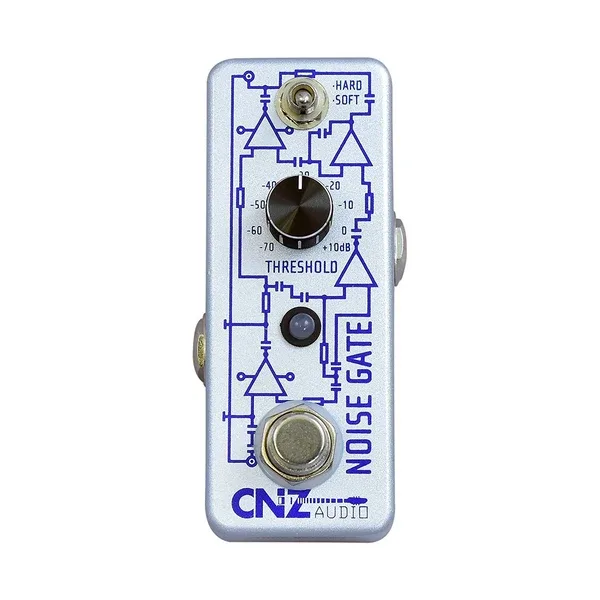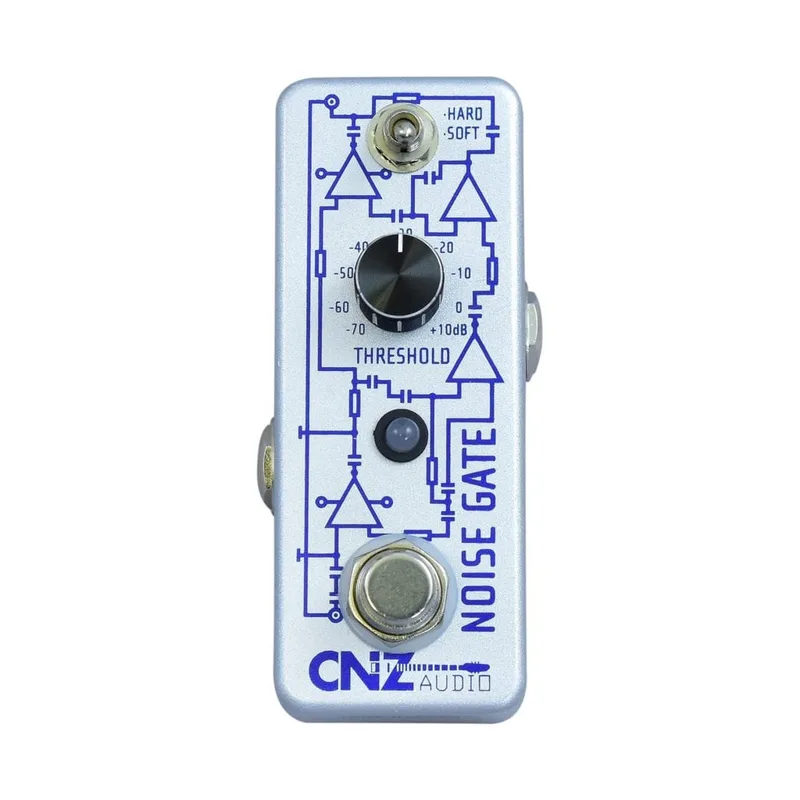

The CNZ Audio Noise Gate is a noise gate pedal made by CNZ. A noise gate does one job: it passes your guitar signal only while it is above a set level, and mutes everything below it. Boss describes the difference plainly: "a noise gate clamps down and eliminates any signal below a certain threshold. This makes the noise gate a more harsh, less responsive option than a noise suppressor"1. That hard cutoff is exactly what makes a gate useful on a high-gain pedalboard, where hiss and hum from distortion and fuzz pedals sit well below the level of your playing.
The payoff is silence between phrases. When you stop playing, the gate closes and the noise floor disappears; when you pick a note, the gate opens and the signal passes through. Boss notes that the fast clamping of a sensitive noise gate has become a quintessential part of the complex rhythmic note stabs of djent music1, where tight, percussive chugs depend on the noise vanishing instantly.
How a noise gate works
A gate is a level-controlled switch. The core idea, as AMT Electronics puts it in its Pangaea manual, is that "the Noise Gate allows the signal to pass through only when it is above the threshold"2. Everything hinges on that threshold and on how quickly the gate opens and closes around it.
Guitar World's buyer's guide breaks down the controls you will find on a gate pedal3:
| Control | What it does |
|---|---|
| Threshold | Sets the level at which the gate will "open" and let signal through |
| Attack | The time it takes the gate to move from closed to fully open, like a fade-in control |
| Release | The time taken to go from open to closed; a fast release stops the sound dead, a slower one fades out gradually |
| Hold | How long the gate stays open after the signal falls below the threshold |
| Range | How much the signal is reduced when the gate is closed; on guitar pedals this is often hard-set to full attenuation |
Not every pedal has all five. Hold is more commonly seen on studio or broadcast kit3, and simpler versions may make the attack time automatic4. The classic Boss NF-1, one of the earliest gate pedals, simply cuts off the signal once the level falls below the threshold set5.
A poor quality noise gate, or one set too high, can cause the sound to have a pronounced on-and-off rather than a smooth fade off or on6. If your notes chop in and out unnaturally, back the threshold off until the gate only catches the noise between phrases.
Where a noise gate goes in the signal chain
Placement is the biggest practical question with any gate, and makers give different answers depending on what the pedal is designed to clean up.
- After your gain and EQ pedals. Boss advises that if you are running several gain or EQ pedals, it is best to position the noise gate after all of them, so it reduces the noise of any pedals in front of it1.
- In the drive section of the board. Boss also calls the drive-section spot the logical place for a noise gate like the NS-2, to control that unruly section of the pedalboard7.
- After the compressor. Anasounds suggests adding a noise gate after the compressor if you like heavy distortions on the gain stage that add too much noise8.
- First in the chain. Lectric-FX says of its STFU! gate that "for best results the STFU! should be placed first in your signal chain"9. GUP Tech gives similar advice for its MWAC gate: wire it early in the signal chain after the tuner, and return to the gate as late as possible, in the FX loop or just before the amp10.
The reason for the different answers is what triggers the gate. Placed early, the gate reacts to your clean guitar signal, so it tracks your playing directly. Placed after your drives, it catches the noise those pedals generate. Some gates with send and return jacks can do both at once using the four-cable method: as Guitar World explains, "you put drive pedals and the guitar preamp in the loop and run the effects send of the amp into the pedal return", so the gate is triggered by the clean input of the guitar and downstream noise can never open the gate3.
Noise gate or noise suppressor?
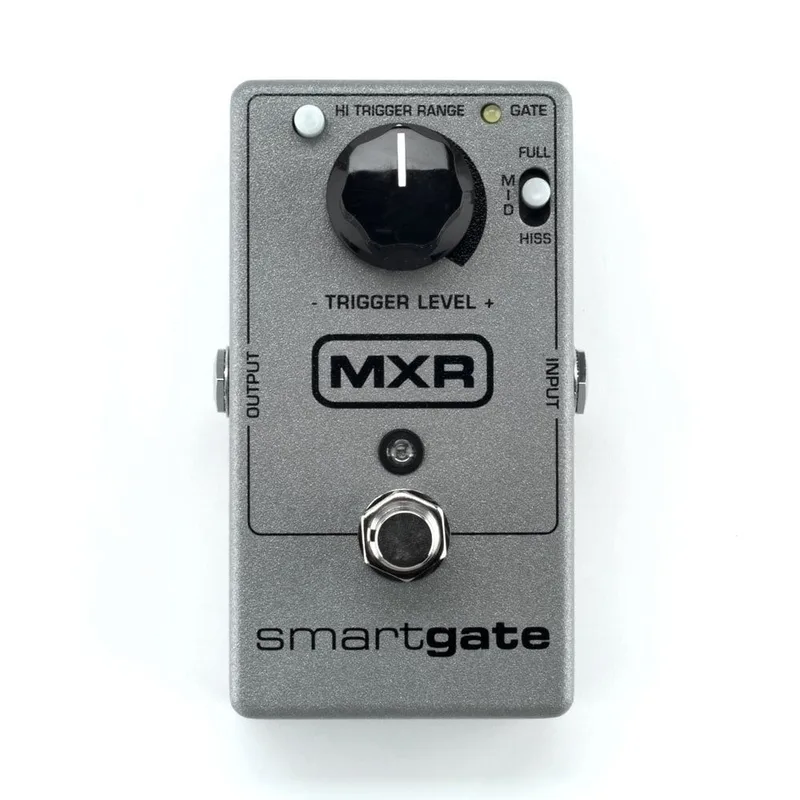
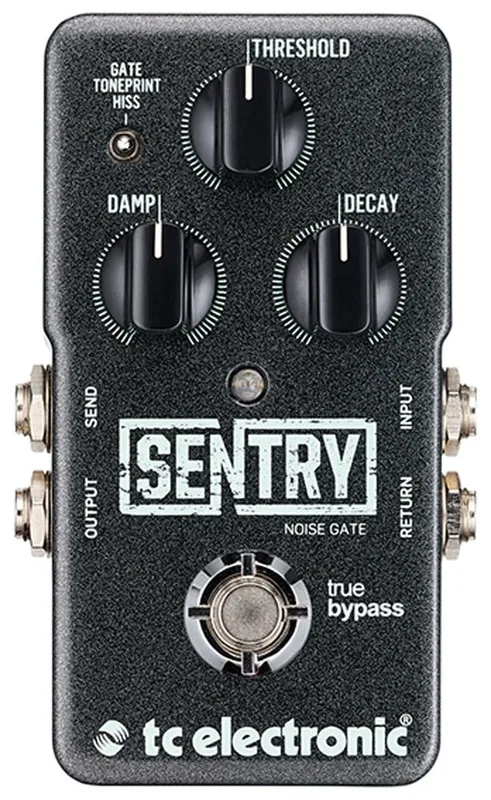
A gate and a suppressor solve the same problem in different ways. The gate's hard on/off behavior makes it, in Boss's words, a more harsh, less responsive option than a noise suppressor, which attenuates the signal more gradually1. For players who want the noise gone completely and instantly, especially in high-gain metal styles, that harshness is the point. Kit Rae's technical analysis of David Gilmour's Big Muff-era tone notes that "there are good ones on the market like the MXR Smart Gate, Boss NS-2, or ISP Decimator"6, and reviewers have found modern gates versatile: MusicRadar wrote of the TC Electronic Sentry that "if a noise gate is a necessity in your signal chain, this one offers real versatility"11.
Videos
Aaron J Livecchi
Questions
Where should a noise gate go in the signal chain?
It depends on what you want it to clean up. If you run several gain or EQ pedals, Boss advises placing the gate after all of them so it reduces the noise of every pedal in front of it. Some makers, like Lectric-FX and GUP Tech, recommend putting the gate first in the chain, right after the tuner, so it is triggered by the clean guitar signal. In the drive section of the board is another common spot.
Can a noise gate cut off reverb tails?
Yes. A gate mutes the signal once it falls below the threshold, so a slow decay like a reverb tail can be chopped off early. Sound On Sound notes the release time needs to be adjustable so slowly decaying sounds such as reverb tails are not cut off early. A slower release setting lets the tail fade out gradually instead of stopping dead.
Sources (11)
- The Complete Guide to Noise Gate and Suppressor Pedals, BOSS (articles.boss.info), 2023-11-30
- AMT Electronics Pangaea CP-100FX User's Guide (Rev A), AMT Electronics
- Best noise gate pedals 2026: clean up your signal, Guitar World, 2021-03-19
- Multi-effects Explained: Part 2, Sound On Sound, 1997-08
- TONEHOME, TONEHOME
- David Gilmour Tone Building, Kit Rae (Kit's Secret Guitar, Gear, and Music Page), 2019-12
- The Ultimate Guide to Guitar Effects Pedal Order and Signal Chain, BOSS (articles.boss.info), 2023-03-01
- Learn how to chain your effects pedals, Anasounds, 2020-09-18
- STFU! Noise Gate V.1.1, Lectric-FX
- MWAC Noise Gate Pedal Douche Edition, GUP Tech (guptech.ca)
- TC Electronic Sentry Noise Gate review, MusicRadar, 2015-11-30