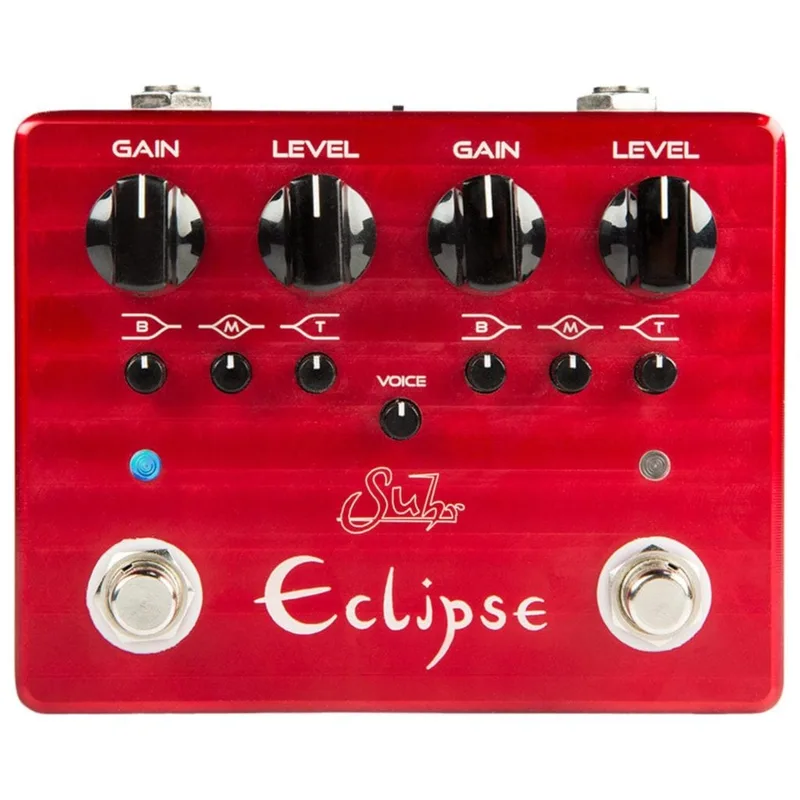


The Suhr Eclipse is a dual channel overdrive/distortion pedal built by Suhr (JS Technologies, Inc.). Suhr describes it as "a versatile, no compromise, dual channel overdrive/distortion that delivers a wealth of warm, organic" tone1. The idea behind it is simple: instead of stacking two pedals for a rhythm sound and a solo sound, the Eclipse puts two complete, independently voiced channels in one box, selected from two footswitches the way you would switch channels on an amplifier.
What it does and how it sounds
The Eclipse has two channels, blue and red, each with its own settings selected by the switch below it1. Each channel carries its own Gain, Level and 3-band passive EQ, which Suhr likens to a channel switching amplifier1. The two channels share the same basic voice: Suhr's manual states that "the blue and red channel in the Eclipse sound identical, and the beauty of this lies in the individual passive EQ circuits"1. Because each channel has its own EQ, the practical setup Suhr suggests is one channel dialed in for a tight, scooped rhythm sound and the other for a more saturated, midrange-focused tone for solos1.
The Gain control on each channel sets how much drive is added, moving from what Suhr calls tube-like classic crunch and overdriven tones into high gain distortion territory1.
| Control | What it does |
|---|---|
| Gain (per channel) | Sets the amount of gain added, from classic crunch to high gain distortion1 |
| Level (per channel) | Sets the channel's output level1 |
| 3-band passive EQ (per channel) | Shapes bass, midrange and treble independently for each channel1 |
| Left footswitch | Turns Channel 1 on or off1 |
| Right footswitch | Turns Channel 2 on or off1 |
Switching between channels is exclusive: stepping on one channel's switch automatically turns the other channel off1. That is what makes the pedal behave like a two-channel amp rather than two stacked drives.
Connections, switching and power
The panel carries a standard set of connections plus one less common jack1:
- Input: for guitar or the previous effect's output1
- Output: to an amp or another effect's input1
- FX LINK: a 1/8" stereo TRS jack for external control functions1
- DC input: for a power supply1
When no channel is selected, the Eclipse is in true bypass: the input jack is connected directly to the output jack via a relay, so the circuit drops out of the signal path entirely1.
Power comes from either a supply or a battery. The Eclipse accepts supplies in the range of 9 to 18 Vdc, center negative, through a 2.1mm x 5.5mm connector, with a nominal voltage of 9V and a maximum of 20Vdc1. A 9V battery is also supported: it connects when a cable is plugged into the input jack and no cable is in the DC input1.
The battery only connects when a cable is in the input jack and nothing is in the DC input1. Unplug the input when the pedal is stored on battery power, or the battery will drain.
Current consumption is low, at 12mA minimum and 15.5mA maximum1, so the pedal is easy on a multi-output pedalboard supply.
History and versions
The current Eclipse sits in a compact form factor, and Suhr states it uses "identical circuit and tone of the Original Eclipse Circuit"4. In other words, the pedal on sale today is a repackaging of the original Eclipse circuit in a smaller box rather than a redesigned circuit.
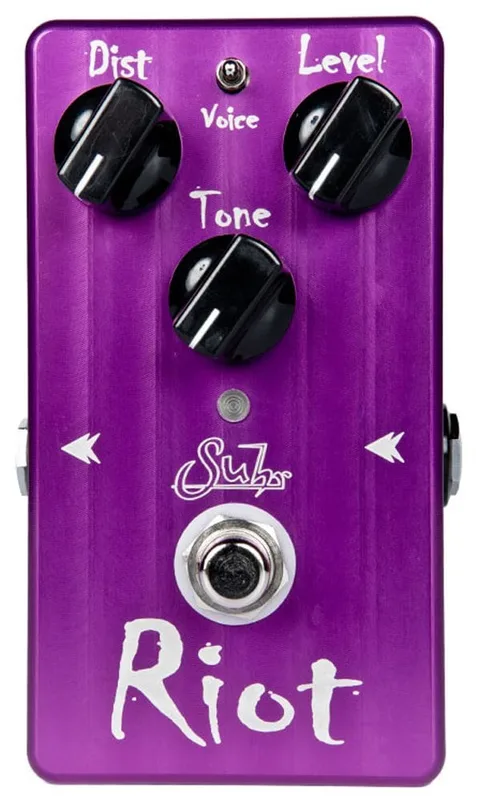
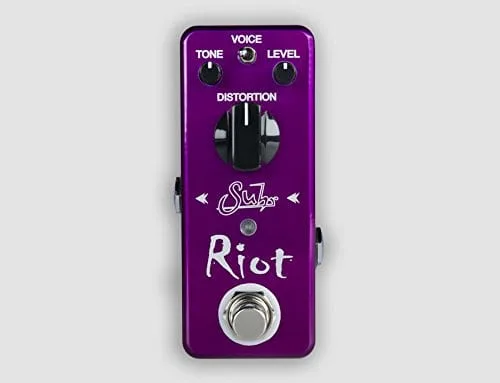
Suhr's distortion lineage gives the Eclipse its context. The company shipped its first Riot distortion pedal in 2009, followed it with Reloaded versions of the Riot and Shiba Drive in 2013, and introduced a mini Riot at NAMM 2018. The Eclipse extends the same maker's drive range with a two-channel format, where the Suhr Riot and its variants are single-channel distortions. Players comparing single-box distortions can read more on the distortion pedals page, and lighter gain options on the overdrive pedals page.
The pedal's user guide, revision 07.2024, is available from Suhr as a PDF4.
Warranty
JS Technologies, Inc. warrants the Eclipse for life from the date of purchase by the initial retail purchaser against defects in workmanship, with electronic components covered for 5 years1.
Suhr's warranty policy applies only to customers in the USA1.
Videos
Pete Thorn
Suhr Custom
Suhr Custom
Questions
Is the Suhr Eclipse true bypass?
Yes, with a qualification. When no channel is selected, the Eclipse is in true bypass: the input jack is connected directly to the output jack through a relay, so the pedal's circuit is fully out of the signal path. With a channel engaged, of course, the circuit is active.
What is the FX Link jack on the Suhr Eclipse for?
The Eclipse carries a 1/8 inch stereo TRS jack labeled FX LINK on its panel, alongside the guitar input, output and DC input. Suhr's user guide lists it among the pedal's connections for external control of the pedal's functions.
Can both channels of the Suhr Eclipse be on at once?
No. The Eclipse has two channels, blue and red, each selected by the switch below it. Switching one channel on automatically turns the other off, so the pedal works like a two-channel amplifier: one sound at a time, with independent settings stored per channel.
What warranty does the Suhr Eclipse have?
JS Technologies, Inc. warrants the pedal for life from the date of purchase by the initial retail purchaser against defects in workmanship, with electronic components covered for 5 years. The warranty policy applies only to customers in the USA.
Sources (4)
- Eclipse-User-Guide-rev.07.2024.pdf, Suhr (JS Technologies, Inc.), 2024-07
- Eclipse | Suhr.com, Suhr
- Koko Boost Legacy Edition, Suhr (www.suhr.com)
- Eclipse | Suhr.com, Suhr.com