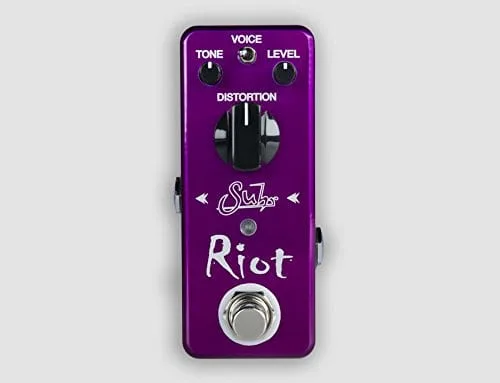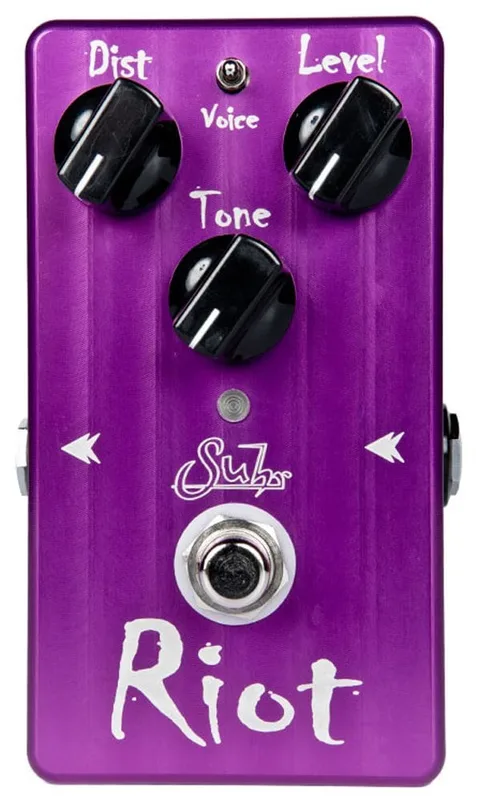


The Suhr Riot is a high-gain distortion pedal made by Suhr, first shipped in 20091. Suhr describes it as "a versatile high-gain distortion pedal with the sonic characteristics and touch sensitivity of a high quality 100 watt tube amplifier"23, and says it became an early success by letting players "transform a clean amp into a versatile Classic Rock tone machine"1. The current version carries the identical circuit and tone of the original Riot circuit2, at a $249 street price as of late 20262.
The Riot family has grown over the years. The Suhr Riot Reloaded added 30% more gain than the original Riot and a three position voicing switch with Classic, Modern, and Scooped settings45, the Suhr Riot Mini put the circuit in a smaller enclosure416, and the Suhr Riot Reloaded Legacy Edition reissued the Reloaded circuit at $1991. This page covers the full-size Riot itself.
The controls
The Riot keeps its control set simple: three knobs and a three-position voicing switch. Suhr describes the voicing switch as offering "a few different voicing options"8, and each position selects a different diode configuration in the clipping circuit, which is where the three distinct characters come from.
| Control | What it does |
|---|---|
| DIST | Adjusts the amount of gain added to your tone, from classic crunch to high gain23 |
| LEVEL | Adjusts the output of the pedal; Suhr says it provides enough level to push the front end of any tube amp into natural overdrive23 |
| TONE | Shapes the overall tonal response, from smooth and warm to cutting lead tones23 |
| Voicing switch | Three-position toggle selecting different clipping voicings8 |
The three voicing positions are where the Riot's range lives:
| Voicing position | Character |
|---|---|
| Left | A natural, organic tone that responds dynamically to your guitar's volume control23 |
| Middle | High gain territory with a solid midrange and a tight bottom end23 |
| Right | A vintage high gain response with excellent definition23 |
The left position is the one that rewards rolling back your guitar's volume: Suhr's description of it as dynamic and organic means the pedal cleans up as you turn the instrument down, the way a cranked tube amp would. The middle position is the modern rhythm setting, and the right position leans into a vintage high gain character.
For starting points, Suhr's manual gives three sample settings9:
| Setting | Drive | Voicing | Level | Tone |
|---|---|---|---|---|
| Classic Crunch | 2 | Left | 5 | 7 |
| Modern Rock Rhythm | 5 | Middle | 5 | 7 |
| Vintage High Gain | 8.5 | Right | 5 | 7 |
Note that Level and Tone stay at 5 and 7 across all three, so the Drive knob and voicing switch do most of the work.
Power and connections
The Riot runs on a 9Vdc center negative supply with a 2.1mm x 5.5mm barrel connector, or on an optional internal 9V battery23. The operating range is wide, 4V to 18V with 9V nominal, and the maximum is 20Vdc2. Current draw is a modest 8mA2, so it is easy on a pedalboard power supply. Reverse battery protection and over voltage protection are both built in2.
Plug your guitar into the input jack and your amp into the output jack; connecting a cable to the input jack powers the pedal up3. Tap the footswitch to engage the effect, and the LED lights to show the status9. If you run it on battery, unplug the input cable when you finish playing to conserve it, since the pedal draws power whenever a cable is connected3.
The estimated battery life is 75 to 100 hours of continuous use9. Because the input jack acts as the power switch, a cable left plugged in overnight drains the battery even if you are not playing.
The FX Link jack
The FX Link is a 1/8 inch mono jack that lets the pedal's switching be controlled from an external switch, pedalboard, loop switcher, or any other custom interface23. Shorting the shield to the tip activates the pedal, and opening the connection turns it off3. Maximum voltage on the FX Link is 3.3Vdc29.
A small slide switch sets the power-up behavior39:
- Left (toward the FX Link jack): the pedal powers up in the OFF state3
- Center: the pedal is switched remotely via the FX Link jack, and powers up OFF if the jack is not used3
- Right (toward the Power jack): the pedal powers up in the ON state3
If you want external control, the switch must be set to the center position9.
Bypass
The Riot is true bypass via a relay23. Suhr says the relay allows the remote switching and battery monitor features, and that it produces less popping when switching the pedal on and off than a mechanical bypass would29.
Where it came from
Suhr shipped its first Riot distortion pedal in 20091. The company describes the original as an overnight success that let players turn a clean amp into a classic rock tone machine1. Gearnews called it "a great mid- to high-gain '80s-inspired distortion pedal"10, and their writer, who owned a full-size Riot for years, said:
"it really nails that amp like Plexi tone that I would associate with '80s era Van Halen and bands of that era."
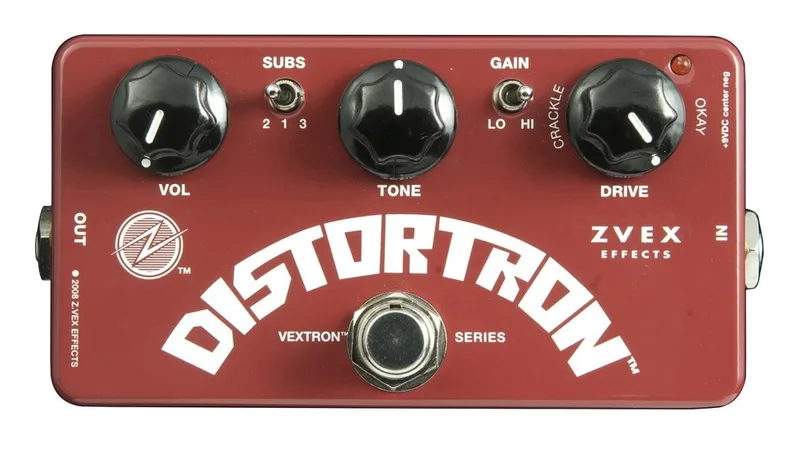
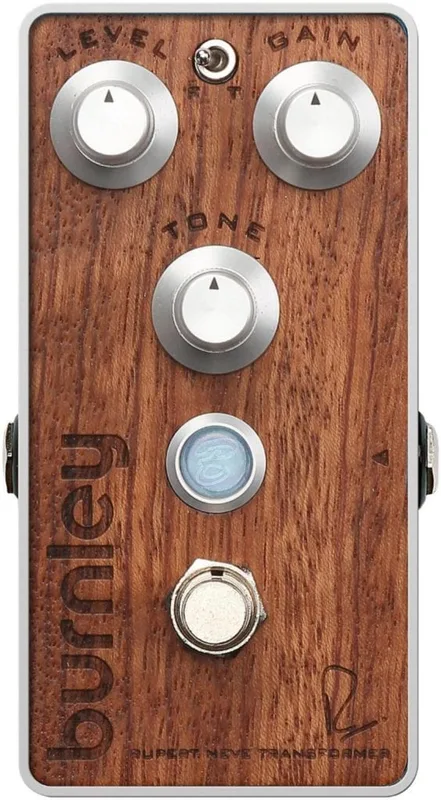
The Riot was one of eight distortion pedals compared in a That Pedal Show episode in February 2018, alongside the Boss DS-1, ZVEX Distortron, Bogner Burnley, Thorpy FX Warthog, MI Audio Super Crunchbox and Keeley DS-9.
The line expanded from there. In 2013 Suhr announced the Riot Reloaded, built by tweaking the original distortion circuit for 30% more gain, aimed at hi-gain rock, metal and drop tuning, in a spiral-faced enclosure anodized in deep saturated purple, at a $200 MSRP45. In 2018 the Riot Mini arrived at NAMM, keeping Level, Tone and Distortion controls plus a two-position voice switch that selects the two most popular diode selections from the original Riot1213. Pete Thorn, who demoed both, noted that apart from the switch, the Mini and the full-size pedal are "basically identical"8.
In his demo, Thorn ran the pedal through a Suhr Bella 1x12 combo at moderate volume to show a real-world scenario rather than a loud amp, and demonstrated the full-size Riot's three-position voicing switch against the Mini's two-position version6.
How the versions compare
| Version | Voicing switch | Gain | Notes |
|---|---|---|---|
| Riot | Three positions8 | Original circuit2 | $249 street price (October 2026)2 |
| Riot Reloaded | Three positions4 | 30% more than the original4 | Tone control modified to emphasize upper mids4 |
| Riot Mini | Two positions12 | Two most popular diode selections from the original13 | Compact die-cast enclosure12 |
| Riot Reloaded Legacy Edition | Three positions: Classic, Modern, Scooped1 | 30% more than the original4 | $1991 |
The Reloaded's tone control was modified to emphasize upper mid frequencies for what Suhr calls a sweeter, more cutting tone without sounding harsh or fatiguing1. Suhr also notes that the Voice switch on the Reloaded may have less effect at lower gain and tone settings4.
Warranty
JS Technologies, the company behind Suhr, warrants the pedal's workmanship for the lifetime of the initial retail purchaser, with electronic components such as capacitors, resistors, filters, transformers, jacks and pots covered for 5 years; the warranty applies to customers in the USA3.
Videos
Pete Thorn
Suhr Custom
Suhr Custom
News
Questions
Is the Suhr Riot analog?
Yes. The Riot is an analog distortion pedal, and Suhr describes it as a versatile high-gain pedal with the sonic characteristics and touch sensitivity of a high quality 100 watt tube amplifier. The current version uses the identical circuit and tone of the original Riot circuit.
How long does a battery last in the Suhr Riot?
Suhr estimates 75 to 100 hours of continuous use from a 9V battery. The battery is optional, and the pedal can run from a 9Vdc center negative power supply instead. Unplug the input cable when you finish playing, since connecting a cable to the input jack powers the pedal up.
What does the FX Link jack on the Riot do?
The FX Link is a 1/8 inch jack that lets the pedal's on/off switching be controlled from an external switch, pedalboard, loop switcher, or other custom interface. Shorting the shield to the tip activates the pedal. A slide switch sets whether the pedal powers up on, off, or under remote control.
Is the Suhr Riot true bypass?
Yes. The Riot is true bypass via a relay, which Suhr says allows remote switching and the battery monitor feature, and produces less popping when switching the pedal on and off than a plain mechanical bypass.
What are good starting settings for the Suhr Riot?
Suhr's manual lists three sample settings: Classic Crunch at Drive 2, Voicing Left, Level 5, Tone 7; Modern Rock Rhythm at Drive 5, Voicing Middle, Level 5, Tone 7; and Vintage High Gain at Drive 8.5, Voicing Right, Level 5, Tone 7.
Is the Suhr Riot Reloaded Legacy Edition true bypass?
Yes. Suhr says the Riot Reloaded Legacy Edition is true bypass via a relay, which allows remote switching and the battery monitor feature, and that the relay produces less popping when switching the pedal on and off.
Sources (13)
- Riot Reloaded Legacy Edition, Suhr
- Riot | Suhr.com, Suhr (www.suhr.com)
- Suhr Riot Distortion User Guide v1 07-09-2024, Suhr (media.suhr.com), 2024-07-09
- Riot Reloaded User Guide, Suhr (media.suhr.com), 2022
- Suhr Announce 'Reloaded' Editions of Riot and Shiba Drive Pedals, Guitar Interactive Magazine, 2013-08-19
- Riot Mini, Suhr
- Riot by Suhr, RockBoard PedalPedia, 2026
- SUHR RIOT MINI DISTORTION, demo by Pete Thorn, Pete Thorn (YouTube), 2018-03-09
- Riot-pedal-FINAL-1.pdf, Suhr (JS Technologies, Inc.), 2022
- Suhr Dual Boost, gearnews.com, 2016-02-09
- NAMM 2018: Suhr Mini Riot distortion pedal announced, gearnews.com, 2018-01-26
- Suhr Riot Mini Distortion, Delicious Audio, 2018-02-27
- RiotMiniManual-1.pdf, Suhr (JS Technologies, Inc.), 2022