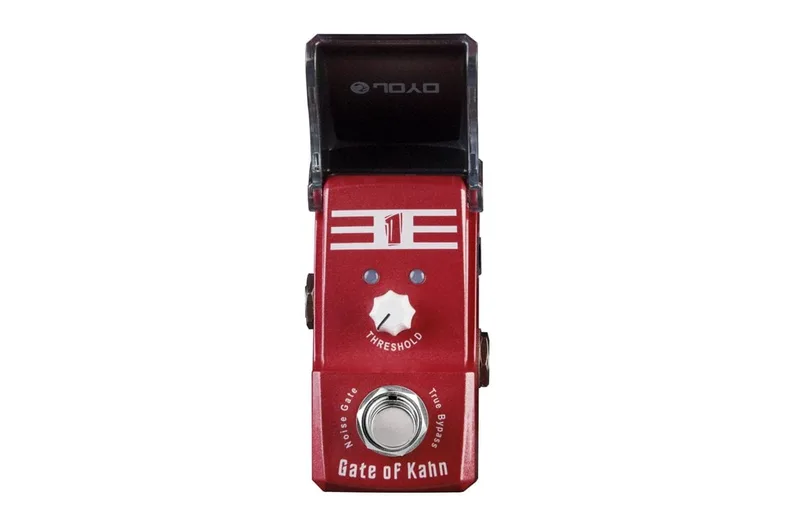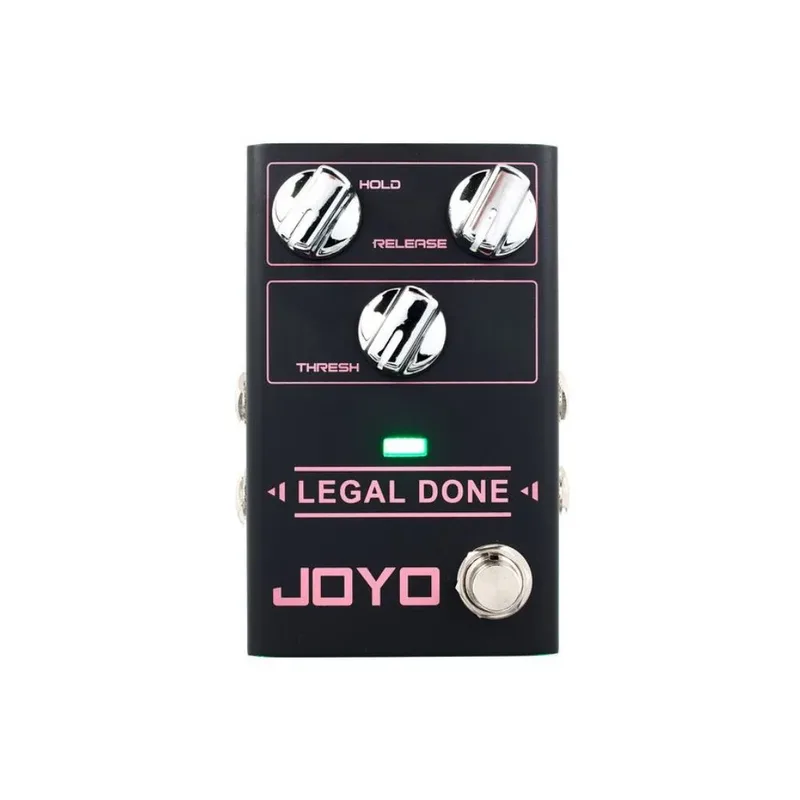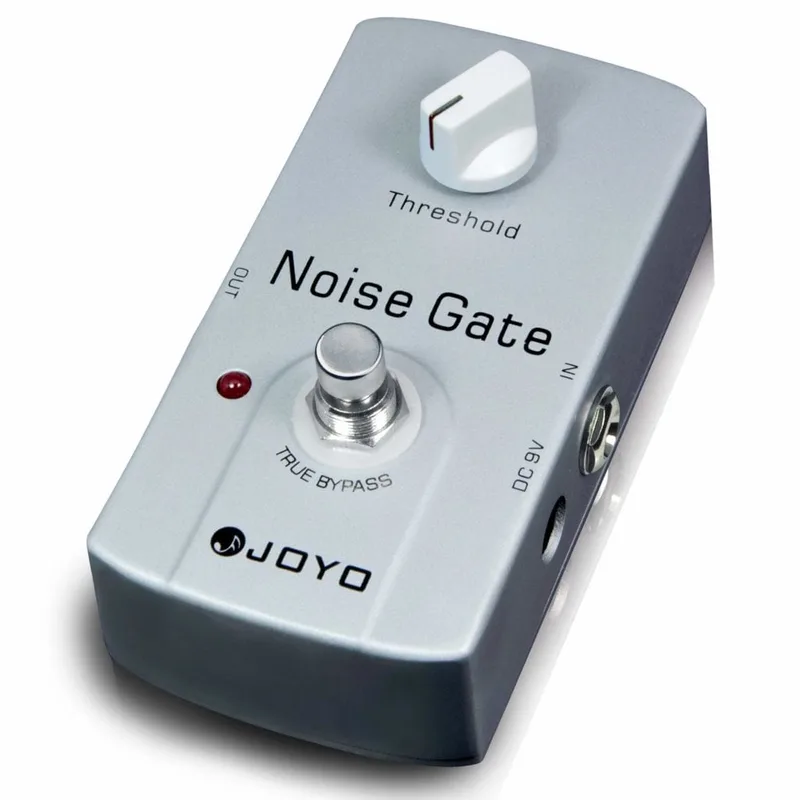


The JOYO JF-31 Noise Gate is a compact noise gate pedal from Joyo, part of the maker's 10/30 series of budget pedals. JOYO describes its job simply: it "reduces the extra noise from your signal"1. In practice that means the hum, hiss and buzz that high-gain distortion and fuzz pedals add to a chain get silenced whenever you stop playing, and come back the instant you pick a note.
It is about as simple as a gate gets. There is one control, a Threshold knob, which JOYO says makes the pedal "easily operated"1. Set the threshold to the level where you want the gate to open and let your playing through, and everything quieter than that, which is usually noise rather than guitar, gets cut off.
What a noise gate does
A noise gate works by clamping down on, and eliminating, any signal that falls below a certain threshold. BOSS's effects guide describes the noise gate as "a more harsh, less responsive option" than a noise suppressor, because it cuts the signal off rather than gently attenuating it2. For a player with a loud, high-gain rig, that hard cut is exactly the point: the noise stops dead, and the gate opens fast when you play.
The Threshold control is the core of any gate. Guitar World's buyer's guide explains that it "sets the level at which the gate will 'open' and let signal through"3. More fully featured gates add further controls:
| Control | What it does |
|---|---|
| Threshold | Sets the level at which the gate opens and lets signal through3 |
| Attack | The time the gate takes to go from closed to fully open, like a fade in3 |
| Release | The time taken to go from open to closed; fast stops dead, slow fades out3 |
| Hold | How long the gate stays open after the signal drops below threshold3 |
| Range | How much the signal is attenuated when the gate is closed3 |
The JF-31 has only the Threshold control. That keeps it simple, but it means the opening and closing behavior is fixed by the circuit rather than dialed in. Sound On Sound's technical analysis notes that on simpler gates the attack time may be automatic, and that release time needs to be adjustable so slowly decaying sounds such as reverb tails are not cut off early4. With a single-knob gate, if the threshold is set too high, the trade-off is audible: Kit Rae's technical page warns that "a poor quality noise gate, or one set too high, can cause the sound to have a pronounced on-and-off rather than a smooth fade off or on as the gate opens and closes"5.
One thing a fast, sensitive gate is known for in modern playing: BOSS's guide notes that fast clamping "has become a quintessential part of the complex rhythmic note stabs of djent music"2.
Where to put it in your chain
Placement is where a simple gate either works well or disappoints. The general rule from BOSS's guide: "If you're running several gain or EQ pedals, it's best to position the noise gate after all of them"2. That way the JF-31 sees and reduces the noise added by every pedal in front of it. BOSS's signal chain guide makes the same point from another angle, calling the drive section spot "the logical place for a noise gate like the NS-2 to control the unruly pedalboard section"61.
For the JF-31, that means:
- Put your overdrives, distortions and fuzz first.
- Place the JF-31 after the last gain pedal.
- Set the Threshold knob until noise disappears when you are not playing but notes still come through cleanly when you are.
Because the JF-31 gates everything upstream of it, putting it before your dirt pedals would leave their noise untouched.
How it differs from loop-based gates
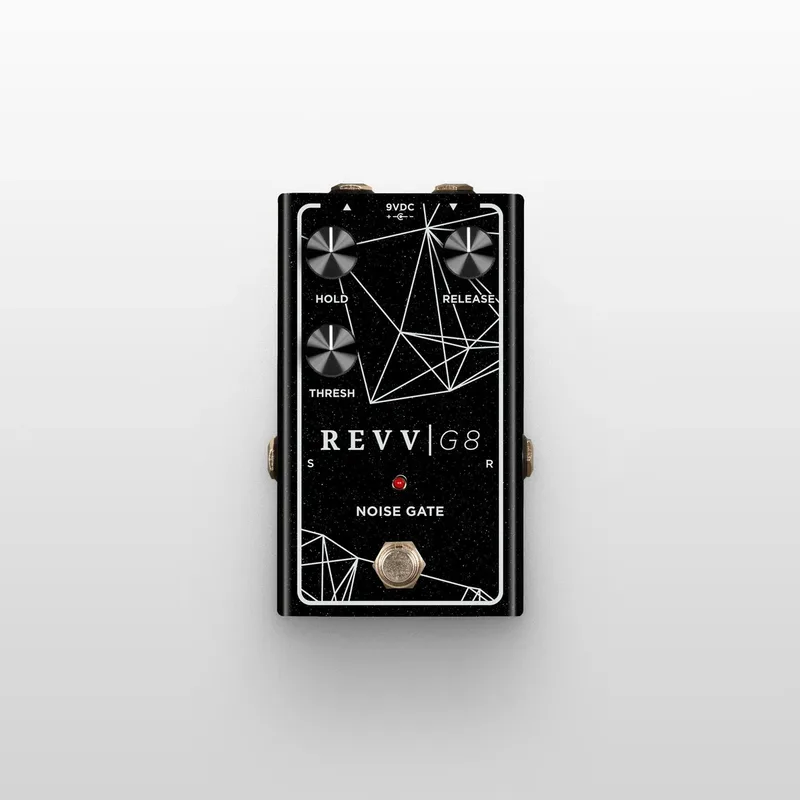
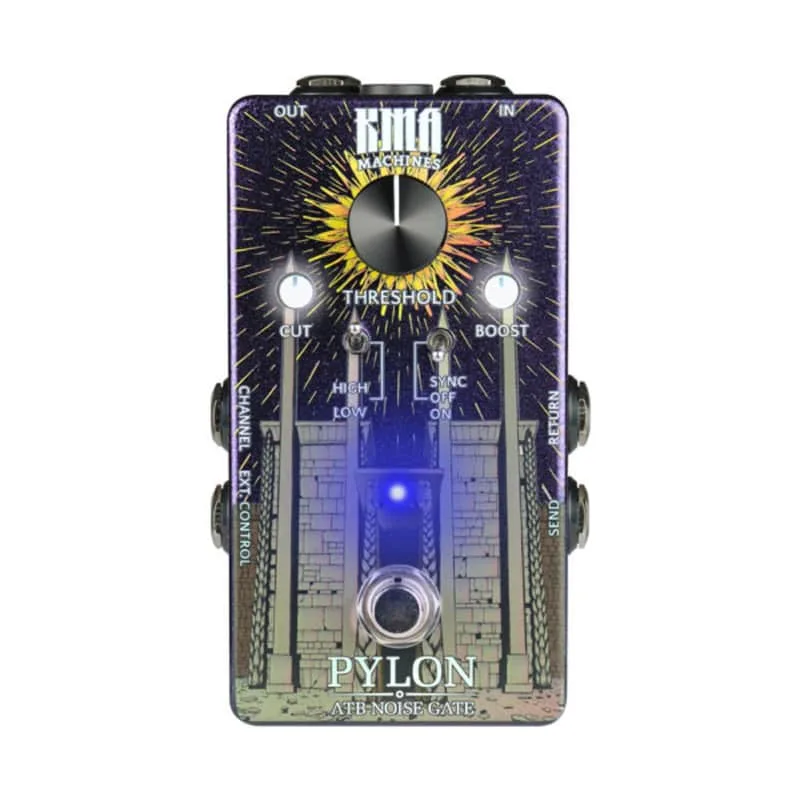
The JF-31 is an in-line gate: guitar goes in, gated signal comes out. It has no send and return loop, and that is the main thing separating it from more advanced gates. Pedals like the Revv G8 offer a 4-cable send and return loop for side-chain routing71, and the KMA Machines PYLON has in/out and send/return jacks to facilitate various setups, including the four cable method8.
The four cable method, as Guitar World describes it, is where "you put drive pedals and the guitar preamp in the loop and run the effects send of the amp into the pedal return"3. The gate is then triggered by the clean input of the guitar, so downstream noise can never open the gate. The JF-31 cannot do this; with only input and output jacks, it gates whatever passes through it, threshold and nothing else.
The JF-31 has no effects loop or key input, so it cannot be used with the four cable method. If your noise comes from a loud amp's preamp rather than from pedals, a loop-equipped gate is the tool for that job.
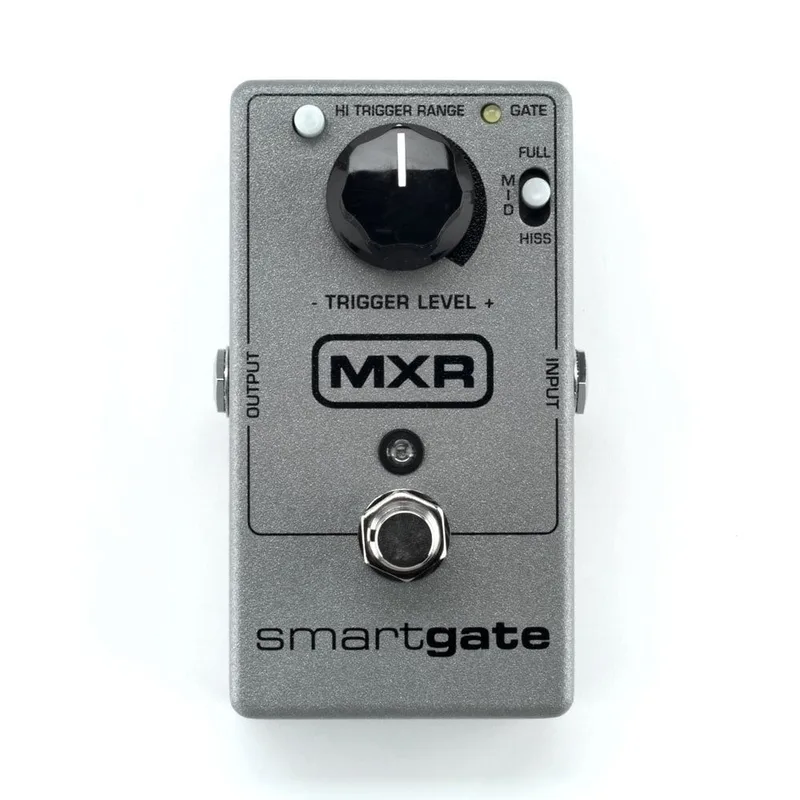
On the used market for well-regarded gates, Kit Rae's page names "the MXR Smart Gate, Boss NS-2, or ISP Decimator" as good examples5, all of which offer more control than the single-knob JOYO. The JF-31's appeal is the opposite: one knob, true bypass1, a 6mA draw1 and a light 200g weight1.
Power and practical details
The JF-31 runs on a 6F22 9V battery or a DC 9V adapter1. At 6mA it is a light load1, so it can share a daisy-chain supply with other 9V pedals without straining it, and a battery is a realistic option for a minimal board. Input impedance is 500KΩ and output impedance is 1KΩ1, standard figures that preserve the guitar's high-impedance signal on the way in.
The true bypass design1 means the pedal drops out of the signal path entirely when switched off, which suits players who want their clean tone untouched when the gate is not needed.
JOYO's product page carries a downloadable JF-31 Manual PDF under its Control and connection mode section1, covering the connection details and specifications.
Videos
EytschPi42
Danang B'Joe
Rich Bischoff
Questions
Where should the JOYO JF-31 go in a pedal chain?
JOYO's own guidance for noise gates applies here: if you are running several gain or EQ pedals, put the gate after all of them so it reduces the noise of everything in front of it. BOSS's signal chain guide also places gates in the drive section of the board to control that unruly section. With only a Threshold knob, placement after your dirt pedals is the practical spot.
Can the JOYO Noise Gate be used with the four cable method?
No. The four cable method needs a pedal with a send and return loop, so the gate can be triggered by the clean guitar signal while gating the noisy part of the chain. The JF-31 has only input and output jacks and no loop, so it works as a simple in-line gate. Loop-equipped gates like the Revv G8 or KMA Pylon are built for that job.
Is the JOYO JF-31 true bypass?
Yes. JOYO lists the JF-31 as a true bypass design, so when the pedal is switched off the signal passes through without the circuit coloring it. That matters on a pedalboard with several pedals, since a buffered bypass gate would still load the signal when bypassed.
Can the JOYO JF-31 run on a battery?
Yes. JOYO specifies power from a 6F22 9V battery or a DC 9V adapter, and the pedal draws only 6mA, so a battery lasts a long time at occasional use. For a fixed pedalboard, a 9V DC supply is the usual choice.
How big is the JOYO JF-31?
The enclosure measures 118 mm long by 68 mm wide by 50 mm high, and it weighs 200g. That is a standard compact mini-style footprint, comparable to other single-knob budget gates, so it fits easily on a small board.
Where can I find the JF-31 manual?
JOYO's product page for the JF-31 carries a downloadable JF-31 Manual PDF, linked from the Control and connection mode section of the page at joyoaudio.com. The page also lists the full specifications, including input and output impedance, power requirements and dimensions.
Sources (8)
- JF-31 Noise Gate_JOYO, JOYO, 2019-12-17
- The Complete Guide to Noise Gate and Suppressor Pedals, BOSS (articles.boss.info), 2023-11-30
- Best noise gate pedals 2026: clean up your signal, Guitar World, 2021-03-19
- Multi-effects Explained: Part 2, Sound On Sound, 1997-08
- David Gilmour Tone Building, Kit Rae (Kit's Secret Guitar, Gear, and Music Page), 2019-12
- The Ultimate Guide to Guitar Effects Pedal Order and Signal Chain, BOSS (articles.boss.info), 2023-03-01
- Revv Amps G8: Noise Gate, Revv Amplification
- KMA Audio Machines unveils the Pylon ATB Noise Gate, promising “silence and control” from the boost-equipped stompbox, MusicRadar, 2022-02-25