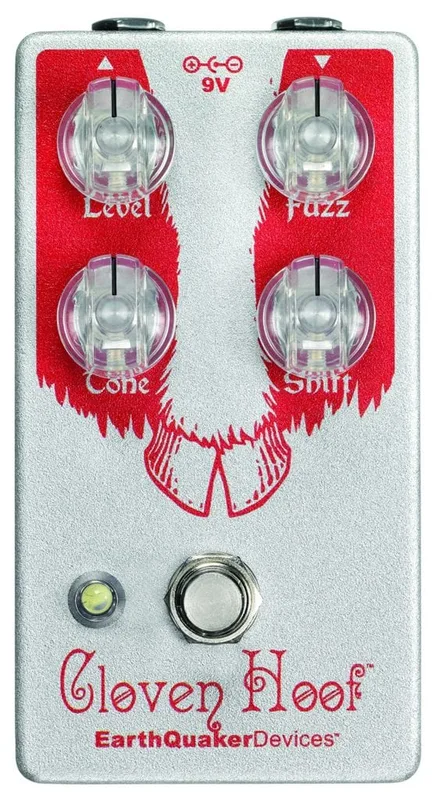


The EarthQuaker Devices Cloven Hoof is a four-knob fuzz pedal that EarthQuaker Devices built as a reworking of its Hoof circuit. Where the Hoof is a hybrid fuzz that uses germanium transistors, the Cloven Hoof swaps those out for silicon, which EarthQuaker says brings cleaner cleans, higher gain and improved temperature stability1. The company's own shorthand for the relationship is blunt: "The Cloven Hoof is the Hoof's evil twin"1.
The pedal is no longer in production. EarthQuaker Devices marks it as discontinued on its product page, so a player who wants one is looking at the used market1.
The controls: Fuzz, Tone, Shift and Level
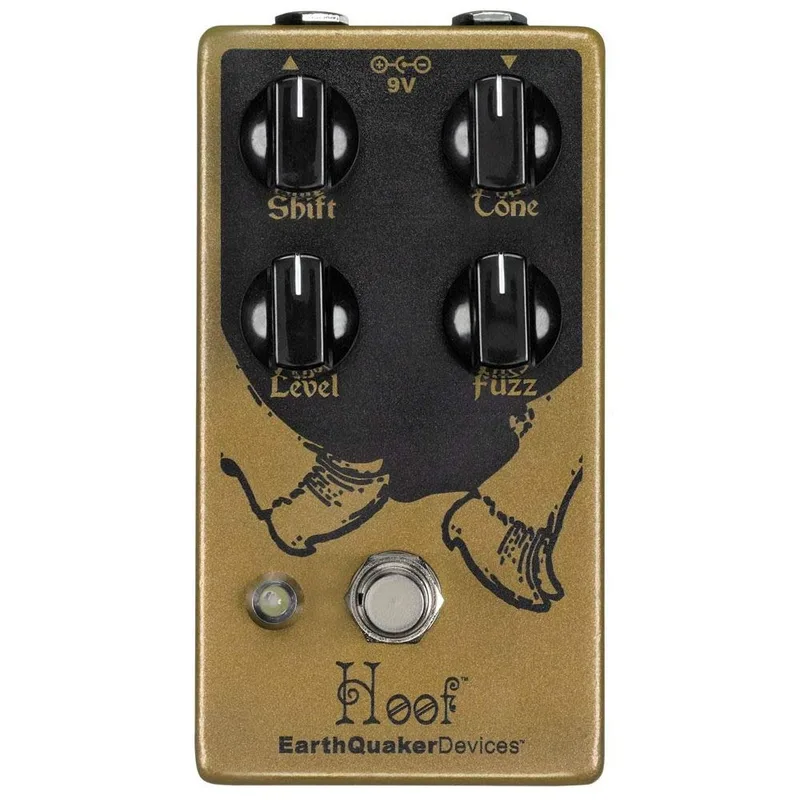
The Cloven Hoof carries four controls: Level, Fuzz, Tone, and Shift. The Level control makes the Cloven Hoof louder or quieter, the Fuzz control runs clockwise for heavy and counterclockwise for light, the Tone control runs bass to the left and treble to the right, and the Shift control adjusts the mid content, clockwise for scooped mids and counterclockwise for boosted. Each one is simple enough to dial in without a manual2.
| Control | What it does |
|---|---|
| Fuzz | Clockwise for heavy, counterclockwise for light2 |
| Tone | Bass to the left, treble to the right2 |
| Shift | Adjusts the mid content. Clockwise for scooped mids, counterclockwise for boosted1 |
| Level | Makes the Cloven Hoof louder or quieter2 |
The Shift knob is the one that sets the Hoof family apart from a plain two-knob fuzz. On the Hoof, the same control changes the frequency response of the tone control, mostly on the treble side, while also trimming muddiness on the bass side3. On the Cloven Hoof it works as a midrange control in its own right: turn it clockwise for a scooped-mid sound, counterclockwise to push the mids forward1. Between Tone and Shift, a player can move from a dark, mid-heavy grind to a bright, scooped wall without touching the amp.
Power and bypass
Powering the Cloven Hoof is straightforward. It runs on a standard 9-volt DC supply with a 2.1mm negative center barrel, the common pedalboard standard, or on a 9v battery1. At 14 mA it draws little current, so it is easy on a power supply's budget1.
One thing matters more than the voltage: the switching. The pedal is true bypass, but it uses an electronic relay to do the switching, and EarthQuaker states that audio will not pass without power1.
If the battery or power supply dies while the Cloven Hoof is on your board and engaged, your signal stops. Players who leave pedals connected but unpowered on a board should keep this one fed.
From the Hoof's germanium to four silicon transistors
The Cloven Hoof exists because of one design decision: taking the Hoof circuit and replacing its germanium transistors with silicon. EarthQuaker's product page puts it in a single line, "NOS Germanium transistors? Nope!", and explains that the company installed a set of four specially selected silicon transistors for cleaner cleans, higher gain and improved temperature behavior1. Germanium fuzzes are known for drifting with temperature; silicon does not have that reputation, and that stability is part of the point here.
The independent circuit analysts at Guitar FX Layouts, who traced and laid out the V1 circuit, described the redesign in similar terms: "EarthQuaker kept the clarity of the Hoof along with the wide range of dirt tones and redesigned everything around it"2. Their layout specifies 2N5089 transistors for the build2.
For gain, EarthQuaker says the Cloven Hoof delivers over four times the gain of the original Hoof, while keeping the tightness, clarity and wide range of fuzz sounds players liked about the Hoof1. In practice that means the Cloven Hoof leans harder into fuzz territory where the Hoof can sit closer to a warm overdrive at low settings.
How it differs from the Hoof
The Hoof is a hybrid fuzz, in EarthQuaker's own classification4, built around germanium transistors. The Cloven Hoof keeps the control layout and the tonal range but goes silicon and goes louder. EarthQuaker's framing is that the company "kept the tightness and clarity you loved about the Hoof, along with the wide range of fuzz sounds, and threw the rest" at the gain stage1.
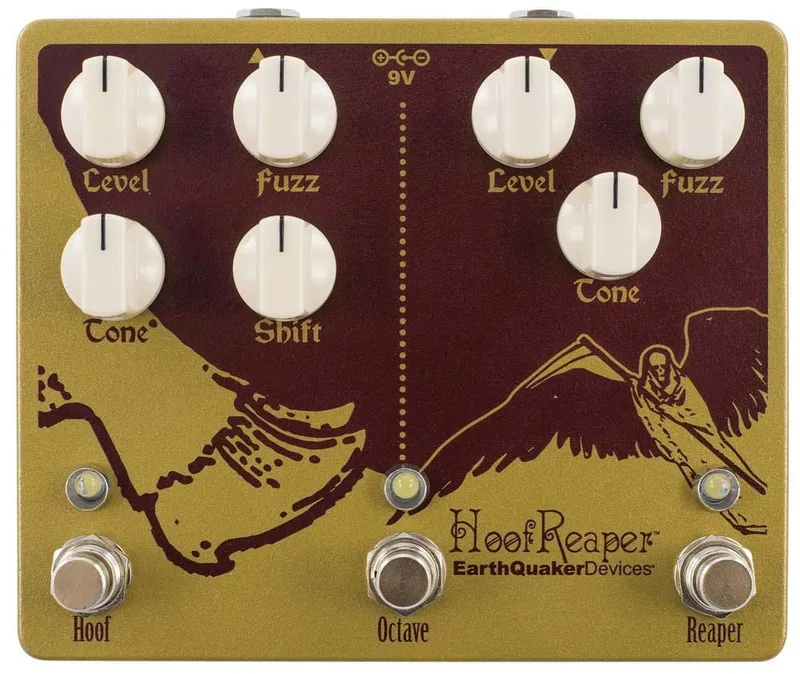
A third pedal in the family, the Hoof Reaper, combined Hoof-family fuzz with a Tone Reaper-style octave circuit; it too is no longer in production5.
A player's view
Guitarist Marissa Paternoster, interviewed by Stompbox Book in 2020, owned a Cloven Hoof but was undecided about its place in her rig6:
"I'm not sure if I'll ever use it in my live set up"
Videos
ProGuitarShopDemos
EarthQuakerDevices
Mike Hermans
Questions
Is the Cloven Hoof still made?
No. EarthQuaker Devices lists the Cloven Hoof as no longer in production. The pedal was made by hand in Akron, Ohio, but new units are not being built, so finding one means the secondhand market or remaining retailer stock.
Can the Cloven Hoof run on a battery?
Yes. EarthQuaker Devices says the Cloven Hoof can be powered by a 9v battery or a standard 9-volt DC power supply with a 2.1mm negative center barrel. Current draw is 14 mA, so a battery lasts a reasonable while at that level.
Does the Cloven Hoof pass signal without power?
No. The pedal is true bypass but uses electronic relay-based switching, and EarthQuaker Devices states plainly that audio will not pass without power. If your battery or supply dies mid-set, the pedal cuts your signal.
How is the Cloven Hoof different from the Hoof?
The Hoof is a hybrid fuzz using germanium transistors, while the Cloven Hoof replaces them with four specially selected silicon transistors. EarthQuaker describes the Cloven Hoof as the Hoof's evil twin, with over four times the gain, tighter and clearer than the original.
Sources (6)
- Cloven Hoof Fuzz Grinder, EarthQuaker Devices
- Guitar FX Layouts: Earthquaker Devices Cloven Hoof V1, Guitar FX Layouts (tagboardeffects.blogspot.com), 2020-07-10
- Guitar FX Layouts: EarthQuaker Devices Hoof Fuzz, tagboardeffects.blogspot.com (Guitar FX Layouts), 2014-03-31
- Hoof Hybrid Fuzz, EarthQuaker Devices
- Hoof Reaper Double Fuzz with Octave Up, EarthQuaker Devices
- Visiting Marissa Paternoster, Stompbox Book (stompboxbook.com), 2020-02-08